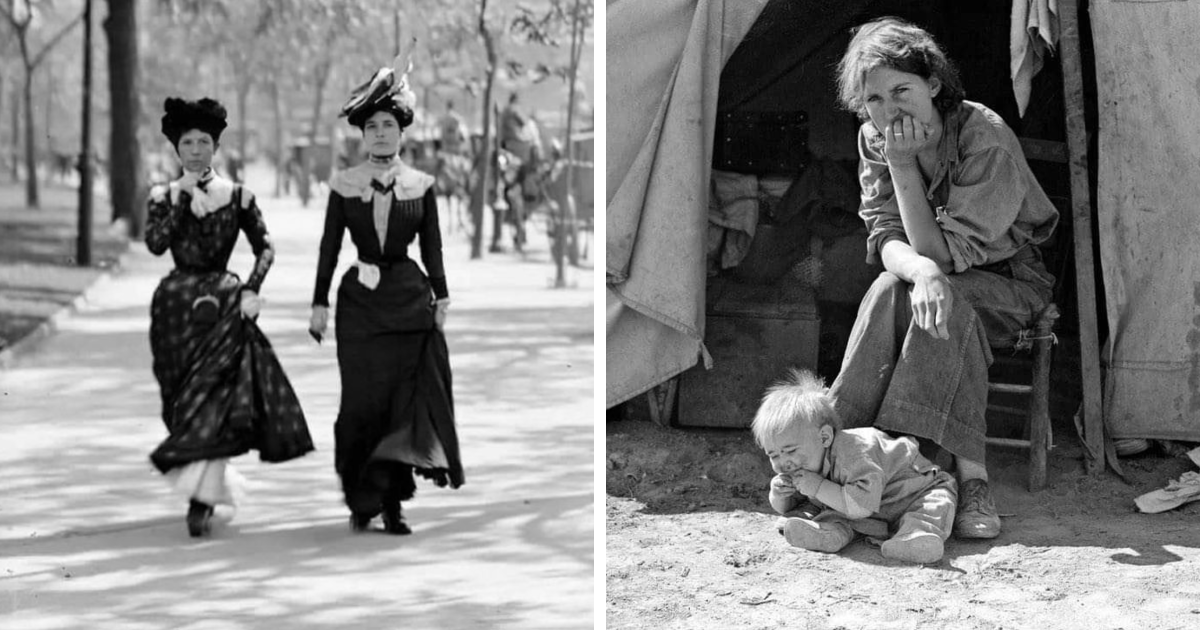
Some photographs do more than show the past. They crack it open. One old image can make you wonder how a city smelled before air-conditioning, what dinner tasted like during rationing, or why everyone in the frame looks like they had already lived three lifetimes before age thirty. That is the strange magic of historic photos: they do not just preserve faces, outfits, and buildings. They preserve tension, habits, class differences, hopes, exhaustion, and the tiny background details that history books sometimes leave behind.
That is why collections of vintage images remain irresistible. A famous photograph may begin with a headline moment, but curiosity usually kicks in around the edges. Look past the main subject and suddenly there is a lunch pail, a patched sleeve, a hand-painted sign, a crowded stoop, a wartime haircut, a new television, or a child staring straight into the lens as if to say, “Yes, I know you are from the future. Please explain the internet.” Historic photos give us the official story and the human story at the same time.
Why Historic Photos Still Fascinate Us
People love historic photos because they make the past feel less like a chapter title and more like a lived-in place. Archival images reveal how ordinary people worked, dressed, commuted, celebrated, protested, cooked, flirted, queued, worried, and adapted. That matters because real history is not built only from presidents, generals, inventors, and celebrities. It is also built from factory shifts, schoolrooms, train platforms, porches, diners, street corners, dance halls, and kitchen tables.
Great historical photography also rewards slow looking. At first glance, you may see a breadline, a march, or a moon mission. A second look reveals shoes worn thin, handwriting on cardboard signs, children imitating adults, and the quiet inventions of daily life. In other words, historic photos spark deep curiosity because they answer one question while creating ten more. That is exactly what makes them unforgettable.
50 Historic Photos That Make The Past Feel Startlingly Close
Work, streets, and survival in the early 20th century
- A child labor portrait outside a mill. One look at the worker’s face tells you childhood used to end early for many families. The image forces modern viewers to rethink labor, poverty, and what “normal” once meant.
- Newsboys sleeping near their papers. These photos are rarely polished, and that is the point. They show hustle before dawn, urban grit, and a version of childhood with a payroll attached.
- Immigrants waiting at Ellis Island. You can almost feel the mix of fear and stubborn hope. Suitcases, hats, posture, and expressions turn migration into something deeply personal instead of abstract.
- A crowded tenement stairwell. Historic photos of dense city housing reveal how privacy was once a luxury. The walls are narrow, the air looks heavy, and every inch of life seems shared.
- A street full of horse carts and early automobiles. This kind of photo captures a culture caught mid-transition. The future is rolling in, but the past has not packed up yet.
- Women marching for suffrage. The signs are bold, the clothing is formal, and the message is revolutionary. These images remind us that political change often arrives dressed very neatly.
- A one-room schoolhouse scene. Historic classroom photos reveal discipline, scarcity, and community in a single frame. The room may be small, but the ambitions inside it are not.
- Factory workers lined beside giant machines. These images make industry look both heroic and exhausting. You notice scale immediately: tiny humans, enormous equipment, and a workday that could swallow a person whole.
- A family posed on a farmhouse porch. Porch portraits look simple, but they reveal class, region, kinship, and pride. The shoes, the chairs, and even the distance between relatives tell a story.
- A busy amusement park boardwalk. Historic leisure photos are deliciously revealing. They show that fun has always been serious business, even when everyone is wearing too much wool for summer.
Depression-era America and the power of documentary photography
- “Migrant Mother” and other Dust Bowl portraits. These photos endure because they turn economic collapse into a human face. They do not need dramatic effects; the worry is already doing the heavy lifting.
- A breadline curling down a city block. This kind of image strips away the myth that hardship is always private. In bad times, need becomes visible, organized, and impossible to ignore.
- Dust storms swallowing a farmhouse. The frame can look almost apocalyptic, yet it is real history. You begin to understand how weather can become a social crisis, not just a forecast.
- Children at a migrant camp. Historic camp photos reveal play and hardship sharing the same ground. Even in lean years, kids still invent games, moods, and mischief.
- A roadside gas station in the 1930s. Images like this show commerce on a human scale. The pumps are simple, the signage is bold, and the whole country seems to be waiting for motion.
- Sharecroppers seated in front of weathered homes. These portraits expose inequality without shouting. The dignity is unmistakable, which makes the injustice harder to dismiss.
- A city stoop full of neighbors. Urban photos from the Depression often show poverty, but also social resilience. People leaned on one another long before “community support” became a polished phrase.
- Harlem nightlife in a jazz club. Historic photos of music scenes remind us that culture does not disappear during hardship. Sometimes it gets sharper, louder, and better dressed.
- A Civilian Conservation Corps camp. Uniforms, shovels, barracks, and young faces reveal how work relief shaped both land and lives. It is government policy made visible in boots.
- A main street with half-empty storefronts. These images quietly reveal economic fragility. You can see the missing customers even when the street itself is technically full.
War years, sacrifice, and the home front
- Rosie the Riveter-style women in factories. Historic wartime photos of women at work show social roles shifting under pressure. The images are practical, patriotic, and quietly radical.
- A farewell at a train station. Few photos hit harder than departures during wartime. Gloves, uniforms, hats, and strained smiles reveal how emotion used to travel with strict posture.
- Families tending victory gardens. These photos make patriotism look domestic. The war effort reaches right into the backyard, beside the tomatoes and stubborn rows of beans.
- Ration lines and coupon books. Historic photos of shopping during wartime remind us that conflict changes kitchens as much as battlefields. Scarcity becomes a household routine.
- Blackout drills in a neighborhood. Images of ordinary streets preparing for danger show how war rearranges daily life. Even sleep, lighting, and silence become national concerns.
- Women welding airplane parts. The photos radiate competence. They also reveal how quickly necessity can crack open old assumptions about who belongs in which job.
- Service members eating, waiting, writing letters. Not every wartime image shows combat. Some of the most revealing ones capture boredom, ritual, and the fragile machinery of morale.
- A family with identification tags during forced relocation. These images are haunting because they show injustice wearing bureaucratic clothing. Labels, luggage, and posture do the emotional work.
- A wartime cafeteria or factory lunch break. Meals in old photos are incredibly revealing. You see nutrition, social order, class, and fatigue in one tray and one table.
- Children collecting scrap for the war effort. Historic photos like these show how national crises recruit the imagination of the young. Even chores become part of a grand story.
Postwar comfort, Cold War tension, and a changing American dream
- A suburban family around a new television. These photos reveal more than gadgets. They show the living room becoming a stage where entertainment, advertising, and identity all meet.
- A supermarket aisle from the 1950s. The abundance looks dazzling, almost theatrical. After years of scarcity, consumer choice itself becomes part of the national mood.
- A backyard barbecue in a new subdivision. Historic postwar photos often look cheerful, but they also raise questions about conformity, race, class, and who got invited into that prosperity.
- Schoolchildren in a civil defense drill. Nothing says “history is weird” quite like kids practicing for nuclear danger under their desks. The image is calm, and that makes it stranger.
- A chrome diner full of teenagers. Here, style becomes social language. Hair, jukeboxes, milkshakes, and body language announce a growing youth culture with no intention of being quiet.
- An early interstate road trip. Cars, motels, roadside signs, and open highways reveal how mobility changed family life. The journey itself starts to matter almost as much as the destination.
- A science classroom during the Space Age. Historic school photos from this period radiate ambition. You can feel a national obsession with rockets, progress, and the future arriving on schedule.
- A segregated lunch counter protest. These images are composed of stillness and courage. The ordinary setting makes the moral stakes look even larger.
- The March on Washington. Crowd photos from this day reveal democracy as something physically assembled: signs, bodies, heat, patience, and determination sharing public space.
- A moon mission control room or lunar surface image. Space photos fascinate because they combine astonishing technology with very human expressions. Even history-making looks tired under fluorescent lights.
Late-century culture, protest, technology, and everyday reinvention
- A feminist march from the 1970s. Historic protest photos reveal how social change broadens beyond one issue. Clothing, signs, and facial expressions show confidence replacing apology.
- A disco floor or roller rink. These photos are pure atmosphere. They remind us that every decade has a way of moving that future generations will both admire and gently roast.
- A family using an early home computer. Historic tech photos look charming now, but they capture a huge cultural shift. The machine is bulky; the new world inside it is not.
- A neighborhood video store on a Friday night. This scene instantly reveals how entertainment used to require shoes, parking, and negotiation. Convenience was not yet king.
- Children in an arcade. Old arcade photos show the beginnings of digital obsession before it migrated into everyone’s pocket. The glow was already there; it just came from a cabinet.
- An immigrant-owned corner shop. These images reveal continuity across generations. Work, risk, family labor, and neighborhood trust all live inside one storefront.
- A Pride march from decades ago. Historic photos of early LGBTQ+ activism carry enormous emotional force. Joy and danger often stand side by side in the same frame.
- Teenagers on skateboards in a parking lot. Ordinary youth photos matter because subculture often appears before society realizes it is looking at a cultural shift.
- An office full of cubicles and ashtrays. Historic workplace images can be unintentionally hilarious and deeply informative. They capture changing attitudes toward gender, health, hierarchy, and what counted as professional.
- A candid family snapshot from the 1980s or 1990s. Sometimes the most revealing historic photo is not famous at all. It is a birthday, a couch, a wallpaper pattern, and an era quietly telling on itself.
What These Historic Photos Really Reveal
Taken together, these images show that the past was never a single mood. It was glamorous and cramped, hopeful and unequal, inventive and harsh, stylish and deeply inconvenient. Historic photos draw deep curiosity because they reveal contradiction. People posed with pride during hardship. They found humor in tight spaces. They marched in their best clothes. They adapted to technology, war, migration, protest, and change while still needing dinner, rent money, friendship, and a decent pair of shoes. That blend of the epic and the ordinary is what keeps archival photography alive for modern readers.
Experiences That Make Historic Photos Hit Even Harder
There is also an experience to looking at historic photos that goes beyond “interesting old image, nice hat.” A truly powerful photograph creates a weird little time-travel glitch in the brain. You know the people in the image lived decades ago, but some part of you still starts reading them like neighbors. You study the room, the clothes, the dishes, the sidewalks, the posture, the wallpaper, the lunch counter stools, the church shoes, the school desks, and the hand-me-down coats. Suddenly the past stops behaving like a museum label and starts acting like a real place where people were late for work, annoyed at relatives, proud of their children, and probably tired of the weather.
One of the most memorable experiences with historic photography is the moment a background detail steals the show. Maybe it is a woman balancing groceries while a parade passes. Maybe it is a kid smirking during a serious public event. Maybe it is a handwritten sign taped crookedly to a shop window. Those details are gold. They make history feel unedited. Big events still matter, of course, but the edges of the frame often tell us how people actually lived through them. That is where curiosity gets deep: not just what happened, but how did ordinary people move through it hour by hour?
Historic photos also create a strange emotional blend of distance and recognition. On one hand, the hairstyles are different, the tools are unfamiliar, and half the furniture looks sturdy enough to survive a small earthquake. On the other hand, the emotions are completely legible. A worried parent in a Depression-era portrait still looks like a worried parent. Teenagers in a 1950s diner still look like they are inventing identity in real time. A protester at a march decades ago still looks like someone who got dressed that morning with purpose. That emotional continuity is part of what makes old photographs so addictive. They remind us that people in the past were not “simpler.” They were just living without Wi-Fi.
For many readers, the deepest experience comes from comparing public history with private memory. You may look at a famous archival image and then think of your own family albums: grandparents in work clothes, a parent as a child on a bicycle, an uncle standing beside a first car with absurd confidence, a kitchen that now exists only in stories. Historic photos from museums and archives open the door, but family snapshots often walk you through it. Together, they create a richer understanding of life and times from decades ago. One shows the era; the other shows how the era landed in real households.
And that may be the biggest reason collections like these keep drawing readers in. Historic photos do not just satisfy curiosity. They train it. They teach us to look closely, question assumptions, notice class and design and labor and body language, and understand that every era feels ordinary while it is happening. The people in those images were not trying to become “historic.” They were trying to earn a living, raise children, survive upheaval, enjoy a weekend, or stand up for something bigger than themselves. That is exactly why the photos still work. They show history before it knew it would be framed.
Conclusion
The best historic photos are not frozen relics. They are active invitations to wonder. They ask us to notice the textures of real life across decades: the crowded city blocks, the uncertain migrations, the wartime routines, the postwar ambitions, the protest lines, the pop culture explosions, and the quiet domestic scenes that never made headlines but shaped everyday experience. Whether the image captures a famous event or an unknown family on a porch, it can reveal a world.
That is what makes these 50 historic photos so compelling. They do not merely document life and times from decades ago. They pull us into them. They make us curious about what happened one minute before the shutter clicked and one minute after. And in that curiosity, history stops being distant. It becomes human, messy, funny, brave, stylish, exhausted, and very much alive.