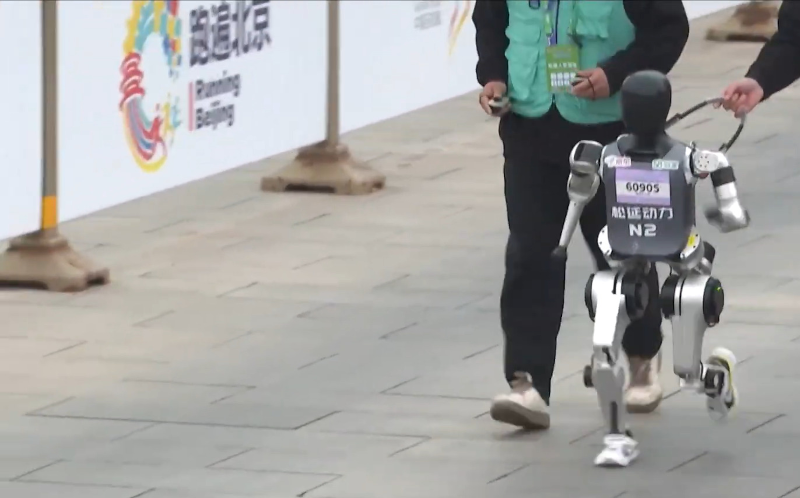
For decades, marathon runners have worried about sore knees, blistered feet, dehydration, and the mysterious decision to pay money for 13.1 miles of voluntary suffering. Now they can add a new concern: being overtaken by a humanoid robot that does not breathe, complain, or ask where the nearest portable toilet is.
China’s latest robot marathon turned the streets of Beijing into a public laboratory for artificial intelligence, mechanical endurance, autonomous navigation, and advanced robotics. The event was entertaining enough to produce viral clips of machines sprinting, wobbling, crashing, and occasionally behaving like someone who had skipped every training session. Beneath the spectacle, however, was a serious demonstration of how quickly China’s humanoid robot industry is progressing.
The second Beijing E-Town Humanoid Robot Half-Marathon, held on April 19, 2026, showed a striking improvement over the inaugural 2025 competition. A robot developed by Chinese smartphone maker Honor completed the 21-kilometer course in just 50 minutes and 26 seconds. The result was not merely faster than the other machinesit was faster than every human runner participating that day and faster than the recognized human benchmark for the distance.
What Happened at China’s Robot Marathon?
The Beijing event combined a conventional half-marathon for approximately 12,000 human athletes with a parallel competition for humanoid robots. Humans and machines traveled along separate courses to reduce the chance of collisions, which was sensible because several robots still treated barriers as optional suggestions.
More than 300 humanoid robots representing over 100 teams entered the 2026 competition, a major increase from the roughly 20 teams that participated one year earlier. The course included paved roads, slopes, turns, and sections of parkland intended to test the machines under more challenging conditions than a flat indoor laboratory floor.
Lightning Wins the Race
The star of the event was an autonomous red humanoid commonly identified as Lightning, developed by Honor. It crossed the finish line in 50 minutes and 26 seconds. Two additional autonomous Honor robots took the next podium positions, finishing in approximately 51 and 53 minutes.
A remotely controlled Honor robot reportedly completed the course even faster, in 48 minutes and 19 seconds. However, the autonomous machine received the championship under scoring rules that rewarded robots capable of navigating without continuous human control. That distinction matters. A remotely operated robot can be directed by a skilled technician, while an autonomous robot must process sensor data, maintain balance, choose a path, regulate its speed, and react to the course largely by itself.
According to reporting from the event, roughly 40 percent of the participating robots used autonomous navigation. The remaining machines were remotely controlled. In the 2025 competition, by comparison, all the robots depended heavily on remote operation or human guidance. That shift from assisted movement toward independent decision-making may be more important than the dramatic finishing time.
Did a Robot Really Break the Human Record?
Major reports described Lightning as beating the human half-marathon world record. World Athletics lists Jacob Kiplimo’s 56-minute, 42-second performance in Barcelona in February 2025 among the fastest officially recorded human times. Lightning’s 50:26 finish was therefore more than six minutes faster, although comparing a purpose-built machine with a biological athlete is not the same as comparing two runners under identical sporting rules.
A motorcycle is also faster than a marathon champion, but nobody awards it a gold medal and asks which energy gel it prefers. What makes Lightning more fascinating is its humanlike shape. It ran upright on two legs, balanced dynamically, and used a gait inspired by elite athletes. The visual similarity makes the result feel less like transportation technology and more like a preview of science fiction wandering into a road race.
From Mechanical Comedy to Record-Breaking Speed
The scale of improvement becomes clearer when the 2026 marathon is compared with China’s first humanoid half-marathon in April 2025.
That inaugural competition featured 21 humanoid robots. Only a small number completed the full distance, and many entrants fell, overheated, lost components, veered into barriers, or required extensive intervention from engineers. One machine’s head became detached. Others were cooled with sprays or repaired using tape. Several human operators appeared to receive a more demanding workout than the robots they were supposed to supervise.
The 2025 winner, Tiangong Ultra, completed the half-marathon in 2 hours, 40 minutes, and 42 seconds. It required several battery changes and human assistance but still represented an impressive endurance achievement for a bipedal machine. Only six robots reportedly reached the finish line, and most were far slower than the human competitors.
One year later, the winning time had improved by approximately 110 minutes. The field expanded from a few dozen machines to hundreds, autonomous entries became common, and several robots finished ahead of experienced human runners. In robotics development, where teams may spend months making a machine climb stairs without introducing its face to the floor, that is a remarkable jump.
The improvement did not mean every robot suddenly became an Olympic-quality athlete. Some still fell at the starting line, wandered off course, hit barriers, or needed technical help. The difference was that these mishaps no longer defined the entire event. In 2025, successful completion was the achievement. In 2026, speed, independent navigation, and competitive strategy became the central questions.
How Humanoid Robots Survived 21 Kilometers
Running a half-marathon is difficult for a robot because walking on two legs is already an engineering challenge. Every step requires the machine to shift its center of gravity, place a foot accurately, absorb impact, maintain traction, and prepare for the next movementall within fractions of a second.
Longer Legs and a Runner-Inspired Design
Honor engineers reportedly gave Lightning legs measuring roughly 90 to 95 centimeters, proportions modeled after high-level human runners. Longer legs can create a larger stride, allowing the robot to cover more ground with each movement. The design must still balance stride length against stability because an aggressive step can quickly become an expensive somersault.
The robot’s joints, frame, actuators, and control system were optimized for repetitive high-speed motion. Removing unnecessary weight can also reduce power consumption and stress on motors. A marathon robot does not necessarily need expressive fingers, a realistic face, or the ability to wink at spectators. It needs legs that keep working after thousands of impacts.
Liquid Cooling Prevented Overheating
Electric motors, processors, batteries, and joint actuators generate heat. During a long race, excessive temperature can reduce performance, damage components, or force the robot to stop. Honor adapted liquid-cooling knowledge associated with consumer electronics to manage the heat produced by Lightning’s hardware.
Thermal management may sound less exciting than artificial intelligence, but it is essential. Brilliant navigation software is not useful when the robot’s knee motor has decided to become a toaster. Engineers must keep temperatures within safe limits while minimizing the weight of pumps, tubes, radiators, and coolant.
Balance Required Constant Corrections
A humanoid runner is never perfectly balanced. Its control system continuously estimates body position and makes tiny corrections. Sensors may include cameras, inertial measurement units, joint encoders, depth sensors, and force sensors in the feet. Together, they help the machine understand whether it is upright, leaning, slipping, turning, or about to perform an unplanned pavement inspection.
The robot’s software then adjusts joint angles, foot placement, stride timing, and speed. These calculations must happen rapidly. A delayed correction of even a fraction of a second can turn a graceful sprint into a pile of carbon fiber and confused engineers.
Autonomous Navigation Raised the Difficulty
Remote-controlled robots depend on humans to select direction and speed. Autonomous machines must interpret the road, remain inside course boundaries, navigate slopes and curves, and respond to obstacles without constant commands.
This requires more than following a painted line. Outdoor lighting changes, shadows confuse cameras, surfaces vary, and nearby runners or robots can appear unexpectedly. Successful autonomous navigation combines perception, route planning, motion control, and real-time decision-making. The 2026 event showed meaningful progress, but a controlled racecourse remains much simpler than a crowded factory, hospital, disaster area, or home.
Why China Is Turning Robotics Into a Spectator Sport
The robot marathon was not simply an unusual sporting event. It was also a highly visible demonstration of China’s ambitions in humanoid robotics and embodied artificial intelligence.
China has supported the sector through research programs, development zones, subsidies, infrastructure, manufacturing partnerships, and incentives for technology companies. Humanoid robots are viewed as potential tools for factories, logistics centers, hazardous environments, health care, elder assistance, and other labor-intensive industries.
A public race offers advantages that a private laboratory test cannot provide. It creates pressure. Components must survive for hours rather than minutes. Software must handle real outdoor conditions. Engineers must make repairs quickly. Companies can compare designs under similar circumstances, while government officials, investors, potential customers, and the general public can see the results.
The marathon also transforms abstract engineering into an understandable story. Most people do not become excited by a chart showing actuator torque, thermal efficiency, or control-loop frequency. Show them a red robot sprinting past trained runners, however, and suddenly everyone has an opinion about the future of civilization.
Sports competitions have long been used to accelerate technology. Auto racing improved engines, brakes, aerodynamics, and safety systems. Drone contests pushed navigation and control. Robotics competitions encourage teams to test machines beyond comfortable laboratory routines. Even failure generates useful data about weak joints, unstable gaits, battery limitations, sensor errors, and cooling problems.
What the Robot Marathon Provesand What It Does Not
The event demonstrated that a specialized humanoid robot can maintain an extremely fast bipedal gait for more than 13 miles under controlled conditions. It also showed rapid progress in mechanical reliability, cooling, autonomous navigation, battery performance, and the integration of hardware with AI-based control systems.
That is significant, but it does not mean humanoid robots are ready to replace people across the economy. Running quickly along a marked route is a narrow task. Industrial and domestic work requires machines to recognize unfamiliar objects, manipulate tools, open containers, respond safely to unpredictable humans, understand verbal instructions, and recover from situations that were not included in training.
A robot that can run 21 kilometers may still struggle to pick up a dropped coin, fold a towel, connect a cable, or identify why a factory worker has placed a box in the wrong location. Human hands, vision, judgment, and adaptability remain extremely difficult to reproduce.
Commercial value is another challenge. A humanoid must do useful work reliably enough to justify its purchase, maintenance, energy, software, supervision, and repair costs. A spectacular prototype can attract headlines without being economical. Reuters noted that practical applications remain largely in trial stages and that dexterity, perception, and real-world efficiency continue to limit widespread deployment.
The marathon should therefore be understood as a demanding benchmark rather than proof of general robotic intelligence. Lightning was built to run, and it ran brilliantly. Asking it to organize a warehouse, assist an older adult, or prepare breakfast would be a different competition entirelyand possibly a dangerous morning for the orange juice.
Could Robot Racing Become a Real Sport?
Robot competitions may eventually develop into a sporting category of their own. Instead of comparing machines directly with humans, organizers could create divisions based on height, weight, autonomy, battery capacity, control method, and permitted materials.
An autonomous class would reward perception and decision-making. A speed class could prioritize pure performance. Endurance races might limit battery replacements. Obstacle events could test stairs, uneven terrain, doors, ramps, and object manipulation. Strict rules would be necessary to prevent the competition from becoming a collection of wheeled machines wearing decorative arms and insisting they are humanoid.
Robot sports could also make engineering more accessible. Young viewers may become interested in programming, electronics, mechanical design, AI, or materials science after watching a machine recover from a fall and finish a race. Universities and startups could use competitions to recruit talent and demonstrate technology.
However, robot racing is unlikely to replace human athletics. People watch sports because human performers experience fatigue, fear, pressure, pain, disappointment, and joy. A robot does not spend years waking before sunrise, sacrificing weekends, or questioning its life choices at mile 11. Machines can provide technical drama, but human sports remain emotionally powerful because the participants have something personal at stake.
Experiencing China’s Robot Marathon
Watching a robot marathonwhether from the roadside or through online footageis a different experience from attending a normal running event. At first, the machines attract attention simply because they look unusual. Some are tall and athletic, while others move with short, careful steps. Their exposed joints, cooling systems, protective padding, and mechanical feet reveal that every competitor represents a different engineering philosophy.
The Spectator Experience
For spectators, the race alternates between genuine suspense and accidental comedy. A robot may run smoothly for several kilometers, looking almost effortless, then suddenly wobble after encountering a minor change in the pavement. The crowd waits to see whether it will recover automatically, receive assistance, or collapse like an office chair that has lost an argument with gravity.
The sound also changes the atmosphere. Human races feature breathing, shoe strikes, cheering, and conversation. Robot runners add electric motor whines, mechanical impacts, cooling fans, warning signals, and shouted instructions from engineers. Instead of volunteers handing out sports drinks, technical crews stand ready with tools, batteries, laptops, replacement parts, and the universal symbol of engineering confidence: a suspiciously large roll of tape.
The most memorable moments are not always the fastest ones. Spectators tend to cheer when a struggling robot regains its balance or reaches the finish after repeated failures. People naturally assign personality to machines. A robot with an awkward gait appears determined. One that repeatedly turns in the wrong direction seems confused. A machine standing motionless while engineers restart its software somehow looks embarrassed, despite lacking both emotions and an urgent desire to pretend nothing happened.
The Engineering Team’s Experience
For engineers, the marathon is less like a sports festival and more like a final examination conducted in public. Months of design work can be undone by a loose connector, overheated actuator, software error, damaged foot, weak battery, or unexpected surface condition.
Teams must balance speed against survival. A faster gait increases the risk of falling and puts more stress on joints. Stronger components add weight. Larger batteries extend running time but require more energy to carry. Aggressive cooling improves reliability but can make the robot heavier and more complicated. Every advantage creates another problem waiting politely around the next corner.
The race also provides data that cannot be collected easily through short laboratory trials. Engineers can study energy consumption over thousands of steps, identify components that wear unexpectedly, examine how navigation systems respond to changing light, and discover whether small control errors become larger as the machine heats up or tires mechanically.
The Human Runner’s Experience
For human athletes, running near robots creates a strange mixture of competition and curiosity. The machines occupied separate tracks, but runners could still see them moving nearby. Some participants paused to take photographs, accepting that a personal-best time was less important than obtaining evidence that they had shared a race with the future.
Being overtaken by a humanoid robot may bruise an athlete’s pride, but the comparison is mostly symbolic. Robots do not follow biological limits, and humans do not receive fresh batteries or software updates at aid stations. The real achievement is not deciding whether machines or people are “better.” It is observing how different forms of intelligence and engineering solve the same physical challenge.
The Lasting Impression
The lasting experience of China’s robot marathon is the sensation of watching technology change in real time. In 2025, the event was remembered for slow machines, falls, overheating, detached parts, and frantic repairs. By 2026, several robots were faster than elite human runners and capable of navigating autonomously.
That progress does not guarantee that useful humanoid workers will soon fill every factory and home. It does show that once engineering teams receive funding, manufacturing support, a measurable goal, and permission to fail spectacularly in public, improvement can arrive very quickly.
China’s robot marathon was therefore more than a race. It was a stress test, a technology exhibition, a recruiting event, a policy statement, and an extremely elaborate method of proving that even robots occasionally need someone beside the road holding spare parts.
Conclusion
China’s robot marathon offered one of the clearest demonstrations yet of the accelerating progress in humanoid robotics. The 2026 winner completed a half-marathon in 50 minutes and 26 seconds, while autonomous machines occupied the podium and hundreds of robots tested their balance, cooling, endurance, and navigation on a challenging outdoor course.
The spectacle also exposed the distance between specialized athletic performance and useful general-purpose robotics. Running fast is impressive. Working safely in a chaotic factory, hospital, disaster zone, or family home is considerably harder. The next major breakthrough will not be a robot that simply crosses a finish line first, but one that can adapt reliably when the finish line keeps moving.
Note: Event details and technical comparisons reflect publicly available reporting reviewed through July 14, 2026. Participation totals vary slightly among reports because some sources counted individual robots while others counted teams or institutions. This article synthesizes reporting from the Associated Press, Reuters, TechCrunch, WIRED, The Verge, CBS News, PBS NewsHour, Smithsonian Magazine, Fortune, Forbes, The Wall Street Journal, and World Athletics.