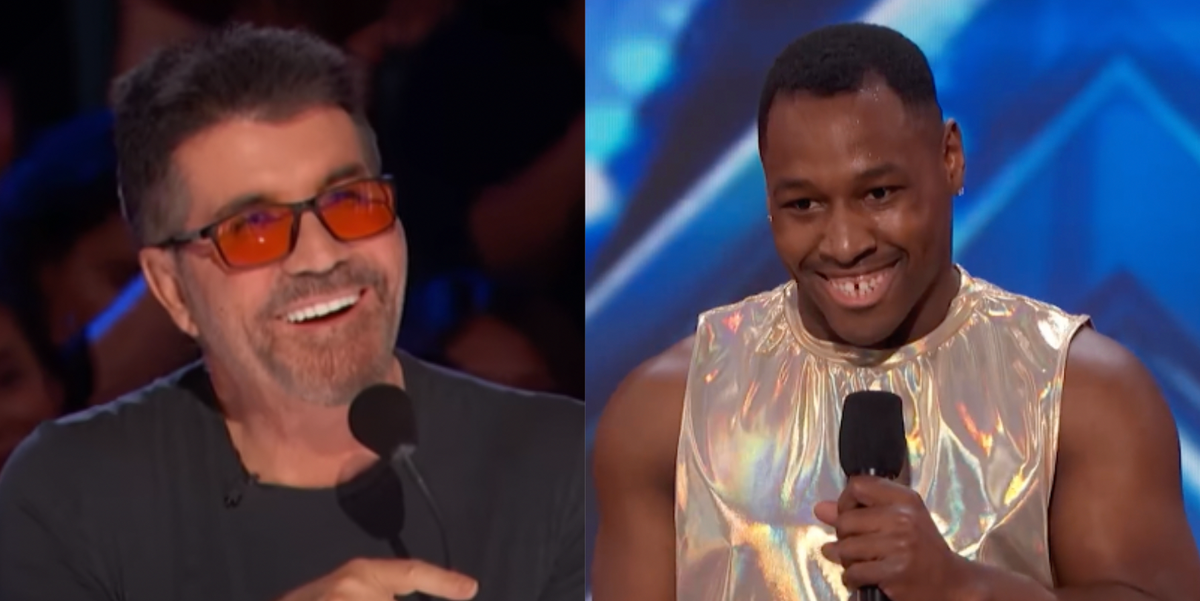
Every season of America’s Got Talent delivers at least one audition that makes viewers pause mid-snack, sit forward, and wonder, “Wait, how is that even a thing people can do?” In Season 19, that moment arrived with Phillip Lewis, a self-taught baton twirler from Statesboro, Georgia, whose audition turned an often-underestimated skill into a full-blown arena spectacle.
When Simon Cowell hears the words “baton twirling,” he probably does not imagine the room is about to explode. Frankly, most people picture halftime routines, marching bands, and maybe a polite round of applause from someone’s aunt. Then Phillip Lewis stepped onto the AGT stage, brought the speed, precision, personality, and athletic control of a seasoned showman, and completely changed the temperature in the room.
By the end of the performance, Cowell had declared it the best baton act he had ever seen. That is not a casual compliment from a judge who has watched singers, magicians, acrobats, comedians, dancers, danger acts, dog acts, drone acts, and acts that make you wonder whether liability insurance was invented specifically for reality TV. So why did this audition hit so hard? Let’s break down the performance, the reaction, and the bigger reason Phillip Lewis became one of the most memorable America’s Got Talent auditions of 2024.
Who Is Phillip Lewis?
Phillip Lewis entered America’s Got Talent Season 19 as a 27-year-old self-taught baton twirler from Statesboro, Georgia. That detail matters because “self-taught” is doing a lot of heavy lifting here. Baton twirling is not just waving a shiny stick around and hoping physics is in a generous mood. It requires hand-eye coordination, rhythm, balance, timing, flexibility, stamina, and the confidence to throw an object into the air while believing your face will not become part of the act.
Lewis also had something AGT loves: a memorable personality before the performance even started. He charmed the judges by explaining that he practiced with doughnuts. Yes, doughnuts. In a world where performers talk about discipline, sacrifice, and early-morning rehearsals, Phillip gave America the spiritual gift of imagining baton training with pastries. Somewhere, a fitness coach fainted softly into a protein shake.
But once the music started, the joke ended. Lewis moved with total command. His routine was fast, sharp, and theatrical, blending technical baton work with stage presence that felt far bigger than a simple novelty act. The audition worked because it did not ask the audience to politely appreciate a niche talent. It grabbed the audience by the collar and said, “Actually, you are going to care deeply about baton twirling for the next two minutes.”
Why Simon Cowell Was So Impressed
Simon Cowell’s reputation has always been built on blunt honesty. He can be funny, warm, and surprisingly emotional, but he is not known for handing out praise like free samples at a grocery store. That is why his reaction to Phillip Lewis stood out. Cowell admitted that when someone says “baton twirling,” his first instinct is not exactly wild enthusiasm. Then he made it clear that Phillip had performed on a completely different level.
The key phrase was Cowell calling the act the best he had ever seen in that category. He also praised the showmanship, which is important because AGT is not only about technical skill. The show rewards performers who know how to fill a stage, tell a story, and turn a short audition into a moment viewers remember after the commercial break.
Phillip did exactly that. He did not merely demonstrate baton tricks; he built a performance. There was pacing, personality, momentum, and a sense that every catch mattered. The routine had the thrill of a danger act without needing flames, blades, or someone yelling, “Do not try this at home,” although honestly, do not try this at home unless your living room has excellent insurance.
The Audition That Made Baton Twirling Feel Like a Headliner Act
Baton twirling is often treated as a supporting performance art. It appears in parades, school events, and marching routines, but it rarely gets framed as a prime-time headline act. Phillip Lewis challenged that assumption. His America’s Got Talent audition showed how powerful a familiar skill can become when it is pushed to its limits.
What made the act special was the combination of speed and clarity. In a strong variety performance, the audience should understand the difficulty even if they do not know the technical vocabulary. Viewers did not need a baton-twirling manual to realize that Phillip was operating at a high level. The tosses were clean. The catches were tight. The movement was musical. The whole thing had the visual rhythm of a dance routine and the suspense of a juggling act.
That is why the performance translated so well on television. Some acts are impressive in person but flatten on screen. Phillip’s act had the opposite effect: the camera captured the speed, the facial expressions, the motion, and the crowd reaction in a way that made the routine feel electric. It was the kind of audition that could make someone at home say, “I had no idea baton twirling could look like that.” That sentence is basically AGT’s love language.
How the Judges and Audience Reacted
The judges’ reaction was immediate and enthusiastic. Simon Cowell, Sofía Vergara, Heidi Klum, and Howie Mandel were visibly engaged, and the audience responded with the kind of energy that tells you the act has broken through. On America’s Got Talent, audience reaction matters because it often signals whether a performance is merely good or genuinely memorable.
Phillip Lewis received the go-ahead to continue in the competition, and the response online quickly echoed the excitement in the room. Fans praised his self-taught background, the difficulty of his routine, and the way he made an old-school talent feel fresh. Many viewers also latched onto the doughnut-practice detail because, naturally, the internet loves a performer who can combine elite coordination with dessert-based training lore.
In a season filled with singers, comedians, dance groups, magicians, and large-scale visual acts, Phillip stood out because he delivered something specific and unexpected. AGT has always been strongest when it reminds audiences that talent is not limited to one lane. A person can walk out with a baton and, two minutes later, have one of the most famous judges on television rethinking the entire category.
Why This Moment Fit Perfectly Into AGT Season 19
Season 19 of America’s Got Talent premiered in 2024 with Simon Cowell, Heidi Klum, Howie Mandel, and Sofía Vergara returning as judges, while Terry Crews continued as host. The season also came with a major twist: more Golden Buzzers. Each judge had two Golden Buzzers, while Terry Crews had one, creating more chances for standout acts to jump straight to the live shows.
Even though Phillip Lewis’ audition was not remembered primarily as a Golden Buzzer moment, it happened during a season that was clearly designed to feel bigger, louder, and more surprising. That made his performance especially valuable. In a year when AGT leaned into spectacle, Phillip proved that spectacle does not always require massive staging. Sometimes it just requires one performer, one baton, and enough confidence to make an entire theater lean forward.
That same June 4 episode also became notable for Golden Buzzer drama involving Simon Cowell and other acts, including moments that stirred conversation among fans. But Phillip’s audition carved out its own lane. It did not rely on a rule change or a twist. It relied on execution. Clean, charming, athletic execution.
What Makes a Great America’s Got Talent Audition?
The best America’s Got Talent auditions usually share a few ingredients. First, they create surprise. The audience thinks it understands what is about to happen, and then the act goes somewhere better. Second, they have a clear identity. A memorable performer does not feel interchangeable. Third, they offer emotional or visual payoff quickly, because AGT auditions do not have the luxury of slow-burn storytelling.
Phillip Lewis checked all three boxes. The surprise came from taking a misunderstood talent and making it thrilling. The identity came from his personality, Georgia background, self-taught journey, and playful doughnut anecdote. The payoff came from a routine that wasted no time proving it belonged on national television.
Great AGT auditions also make judges revise their expectations in real time. That is exactly what happened with Cowell. He began from a place of skepticism about baton twirling as an act and ended by giving one of the strongest category-specific compliments possible. That transformation is the engine of reality competition television: doubt enters, talent answers, applause follows.
The Power of Showmanship
Simon Cowell’s praise for Phillip Lewis’ showmanship deserves special attention. Technical talent can impress, but showmanship connects. A performer might execute difficult moves flawlessly and still leave the audience cold if the act feels mechanical. Phillip avoided that trap by performing with personality.
He smiled, moved with confidence, and made the stage feel like his natural habitat. The baton was not just a prop; it became an extension of the performance. Every spin, toss, and catch had a little bit of swagger. Not arrogant swagger, either. More like “I practiced this until my furniture feared me” swagger.
That matters because AGT is a variety show, not a technical exam. The judges are not sitting there with clipboards measuring rotational velocity. They are looking for acts that can entertain a broad audience. Phillip’s audition succeeded because it made the technical side visible without making the audience feel like they needed a degree in baton physics.
Why Viewers Love Underdog Skills
One reason Phillip Lewis’ audition resonated is that viewers love seeing an overlooked skill get its main-character moment. Baton twirling is familiar enough that people think they understand it, but specialized enough that most people have never seen it performed at an elite level. That gap creates the perfect surprise.
It is similar to when a ventriloquist, quick-change artist, dog trainer, or shadow-dance group takes the AGT stage and makes audiences reconsider what counts as a winning act. The show has always been a home for talents that might not fit neatly into radio, Broadway, sports, or comedy clubs. Phillip’s baton routine belonged to that tradition.
His audition also showed how much value there is in dedication. A self-taught performer must become their own coach, critic, motivator, and repair department. When viewers see the final routine, they are also seeing countless unseen hours of repetition. Every clean catch represents the dozens of missed catches that came before it. The polished version is exciting because the struggle is hidden inside it.
What Happened After the Audition?
Phillip Lewis advanced beyond his audition and later returned for live-show competition. His quarterfinal performance raised the stakes, including more ambitious elements and a more dangerous presentation. Live television, however, is a different beast. In later coverage, his live routine included mistakes, including dropped batons, but he continued the act and earned respect for pushing through under pressure.
That part of the story actually makes his journey more interesting. A perfect audition can make a performer look almost superhuman, but live competition reminds viewers that real performance is unpredictable. The stage is bigger, the pressure is louder, and one tiny timing error can change the whole rhythm. Phillip’s willingness to keep going reinforced the same quality that made his audition work in the first place: commitment.
Not every memorable AGT performer wins the season, and not every viral audition becomes a finals run. But some auditions earn their place because they expand the audience’s imagination. Phillip Lewis did that. He gave baton twirling a prime-time glow-up and made Simon Cowell say what plenty of viewers were thinking: this was not what anyone expected, and that was the fun of it.
Experiences and Lessons Inspired by Phillip Lewis’ AGT Audition
There is something deeply relatable about watching a performer like Phillip Lewis succeed with a talent many people might underestimate. Most of us have a “baton” in our own lives: a hobby, skill, dream, or weird little interest that other people may not immediately understand. Maybe it is painting tiny models, restoring old furniture, learning card tricks, making short films, training a dog to dance, or baking bread so seriously that your kitchen starts to look like a friendly science lab.
The lesson from Phillip’s audition is not that everyone should run outside and start throwing metal sticks into the air. Again, please be kind to your ceiling fans. The lesson is that passion becomes powerful when it is developed with patience and presented with confidence. Phillip did not walk onto the AGT stage apologizing for baton twirling. He treated it like a headline-worthy art form, and that attitude helped the audience see it that way too.
That is a useful reminder for anyone building a skill. Sometimes the world does not recognize the value of what you do until you show it clearly. Presentation matters. Energy matters. The way you introduce your work can shape how people receive it. Phillip used humor, charm, and then undeniable performance quality. He gave the judges a reason to smile before giving them a reason to stand up.
There is also a lesson about being self-taught. In many creative fields, people worry that they need the perfect background, the perfect training, or the perfect permission slip from the universe before they begin. Phillip’s journey suggests otherwise. Being self-taught can be messy, slow, and occasionally full of doughnuts, but it can also create originality. When you build a skill outside the usual system, you may develop habits, style, and creative choices that feel distinct.
Of course, raw passion is not enough on its own. The audition worked because Phillip clearly practiced. The “overnight success” feeling was supported by years of effort. That is the part audiences do not always see. Behind every thrilling AGT moment is a long private history of repetition, frustration, adjustment, and stubborn belief. Talent opens the door, but preparation walks through it without tripping over the rug.
For viewers, the audition is also a reminder to stay open-minded. It is easy to dismiss something before seeing what it can become in the hands of the right person. A baton can look ordinary. A song can seem overdone. A magic trick can feel familiar. Then someone arrives with a fresh angle, and suddenly the familiar becomes exciting again. That is the magic of variety entertainment: it rewards curiosity.
Phillip Lewis’ audition stands out because it was joyful. It did not need a dramatic sob story or manufactured tension to work. It had enough personality and skill to carry itself. In a media world full of loud moments competing for attention, that kind of joyful excellence feels refreshing. It says, “Here is something I love. I worked hard at it. Watch what it can do.” Honestly, that is a pretty good philosophy for life, art, and possibly doughnut shopping.
Conclusion
Phillip Lewis’ America’s Got Talent audition became one of Season 19’s standout moments because it turned a familiar performance style into something unexpected, polished, and genuinely exciting. Simon Cowell’s “best I’ve ever seen” reaction captured the heart of the moment: this was not just a baton routine; it was a reminder that talent can surprise us when it is performed with imagination and confidence.
In the end, the audition worked because it combined technical skill, charm, showmanship, and the rare ability to change expectations in real time. Phillip Lewis did not simply advance in a competition. He gave a niche talent a national spotlight and proved that sometimes the most unforgettable AGT moments come from the acts people underestimate first.