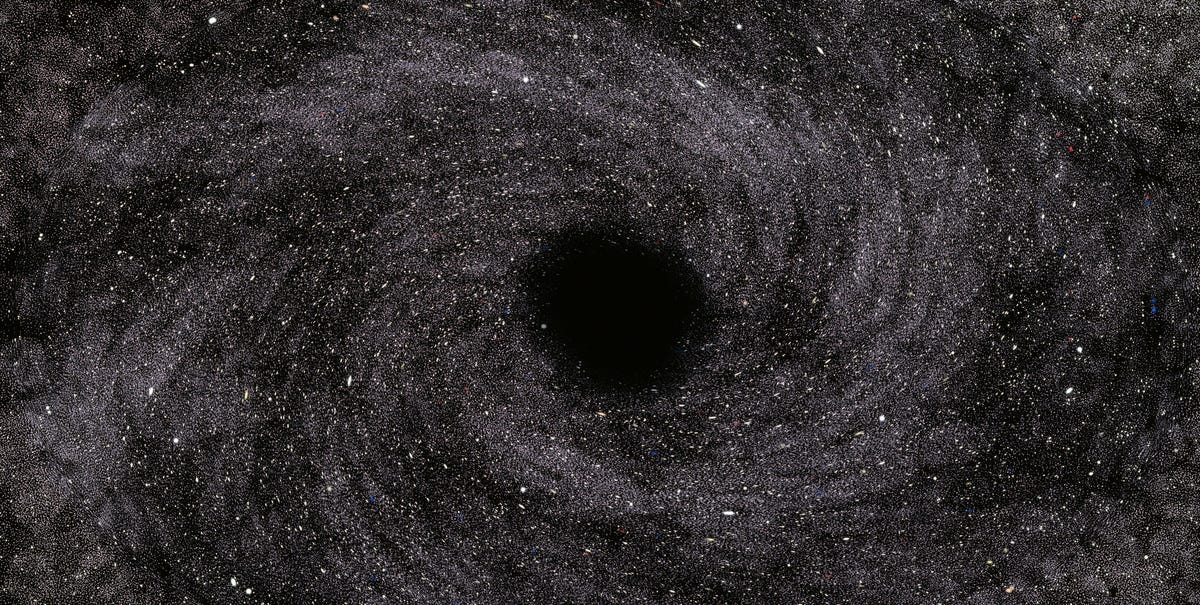
Somewhere in the Milky Way, an invisible object with the mass of a mountain, moon, or planet may be cruising through space. It would emit no ordinary light, possess no glowing surface, and might have an event horizon smaller than a coinor even smaller than an atomic nucleus. Astronomers call this hypothetical cosmic fugitive a primordial black hole.
Unlike familiar black holes created by collapsing stars, primordial black holes, or PBHs, may have formed from unusually dense pockets of matter during the universe’s first fractions of a second. Depending on when those pockets collapsed, the resulting objects could have masses ranging from almost microscopic scales to many thousands of Suns. The smallest surviving examples would be tiny in physical size but spectacularly heavy. NASA notes that the proposed mass range extends from far below the mass of a paperclip to vastly more massive than the Sun.
Finding one would be a scientific jackpot. It could reveal new information about the Big Bang, test the physics of black hole evaporation, and perhaps solve the mystery of dark matter. Unfortunately, hunting something that is tiny, dark, fast, and potentially located thousands of light-years away is roughly the astronomical equivalent of searching for a silent flea in a stadiumwith the lights off.
What Is a Primordial Black Hole?
Ordinary stellar black holes form when sufficiently massive stars exhaust their fuel and collapse. That process imposes a practical lower limit on their masses because stars cannot produce black holes arbitrarily lighter than the Sun.
Primordial black holes would have a completely different birth story. During the infant universe, matter and radiation were extremely hot and dense. If a region contained a large enough density fluctuation, its own gravity could have overwhelmed the surrounding expansion and compressed it into a black hole.
The mass of the newborn black hole would have been related to the amount of material inside the cosmic horizon at that moment. Earlier formation could produce lighter PBHs, while formation slightly later could create heavier ones. Possible triggers include amplified density fluctuations, cosmic phase transitions, collapsing cosmic strings, or other exotic early-universe processes.
“Tiny” Refers to Size, Not Necessarily Mass
Black holes pack enormous mass into remarkably small regions. An asteroid-mass black hole could have a horizon comparable to or smaller than an atomic nucleus. A black hole with Earth’s mass would have a Schwarzschild radius of only about nine millimeters. In other words, Earth’s entire mass could theoretically be squeezed into an object roughly the size of a marble, although approaching that marble would be a profoundly bad vacation choice.
This extreme compactness separates PBHs from planets, rogue asteroids, brown dwarfs, and diffuse dark matter clumps. It also gives astronomers several indirect ways to identify them.
Why Astronomers Care About These Invisible Objects
The strongest motivation is dark matter. Galaxies rotate and galaxy clusters move as though they contain far more mass than telescopes can see. Dark matter appears to account for most of the universe’s matter, yet decades of searches have not established what it is made of.
Primordial black holes are attractive candidates because they require no undiscovered particle. They behave gravitationally like cold dark matter and could have formed before ordinary atoms, stars, and planets existed. However, observations have already ruled out PBHs as all of the dark matter across many mass ranges. The remaining question is whether they could dominate within a narrower window or contribute a smaller percentage of the total.
Even a minor PBH population would be revolutionary. Its mass distribution would preserve information about density fluctuations at scales far smaller than those directly measured in the cosmic microwave background. A discovery could therefore provide a fossil record from an era that conventional telescopes cannot see.
Method 1: Watching Stars Brighten Through Microlensing
The leading technique for finding planetary- and asteroid-mass primordial black holes is gravitational microlensing. According to general relativity, mass bends spacetime. When a compact object passes almost directly between Earth and a distant star, its gravity bends and magnifies the star’s light.
The foreground object remains invisible, but the background star temporarily brightens. A simple, isolated gravitational lens should produce a smooth, approximately symmetrical light curve. The brightening should also be nearly achromatic, meaning that it occurs similarly across different colors of light.
Event Duration Reveals the Lens Mass
The duration of a microlensing event depends on the lens mass, distance, and speed. A star acting as the lens may brighten a background source for weeks or months. An Earth-mass object may create an event lasting hours. Still lighter PBHs could produce flashes measured in minutes.
That means astronomers cannot casually photograph a crowded star field once per evening and call it a day. They must repeatedly image millions of stars at intervals short enough to catch fleeting events. They also need excellent weather, stable instruments, enormous computing resources, and the emotional resilience to discover that an exciting “black hole” was actually a variable star having a dramatic afternoon.
Subaru’s Andromeda Campaign
A landmark search used the Hyper Suprime-Cam on Japan’s Subaru Telescope to monitor tens of millions of stars in the Andromeda Galaxy. The original campaign collected images approximately every two minutes over seven hours. Only one candidate emerged, allowing researchers to place strong limits on PBHs across part of the asteroid-to-planet mass range.
Later observations and analyses demonstrated why candidate verification is so difficult. A 2026 analysis reported several short-duration candidates in expanded Subaru data, but an independent reanalysis argued that the objects were variable stars, including RR Lyrae stars and an eclipsing system. The dispute illustrates an essential rule of primordial black hole hunting: one unusual brightening is interesting, but repeated variability can send the supposed black hole back to the ordinary-star department.
OGLE and the Magellanic Clouds
The Optical Gravitational Lensing Experiment, or OGLE, has conducted another powerful test. From October 2022 through May 2024, researchers monitored almost 35 million stars in the Large and Small Magellanic Clouds. They detected no short-timescale microlensing events despite being sensitive to them.
The results showed that compact objects between roughly half the Moon’s mass and the planet–brown dwarf boundary could account for no more than about 1% of dark matter under the adopted halo model. The findings also favored free-floating or wide-orbit planets, rather than PBHs, as the explanation for certain ultrashort events previously seen toward the Galactic bulge.
Method 2: Measuring Tiny Shifts in Stellar Positions
Microlensing can affect more than brightness. A foreground object also shifts the apparent position of the background star’s image. This effect is called astrometric microlensing.
The positional movement can last longer than the most obvious brightening, offering another way to estimate the lens’s mass. When photometric and astrometric measurements are combined, astronomers may be able to distinguish a black hole from an ordinary dim star, brown dwarf, or rogue planet.
NASA’s Nancy Grace Roman Space Telescope is expected to transform this work. Its wide field of view, infrared sensitivity, and repeated observations of dense star fields will make it capable of detecting enormous numbers of microlensing events. NASA has specifically identified ancient Earth-mass black holes as potential Roman targets.
Roman will not automatically label an event “primordial.” Researchers will still need to examine its mass, velocity, location, frequency, and possible electromagnetic counterparts. Nevertheless, a population of dark lenses with unexpected masses and a halo-like distribution would be difficult to ignore.
Method 3: Listening for Subsolar-Mass Mergers
Primordial black holes may occasionally form binaries and spiral together. As they orbit, they emit gravitational wavesripples in spacetime that observatories such as LIGO, Virgo, and KAGRA can detect.
The clearest signature would be a black hole merger involving an object significantly lighter than the Sun. Known stellar evolution does not provide a conventional way to create a black hole with, for example, one-tenth of a solar mass. Detecting such a merger would therefore point toward a primordial or another exotic origin.
Planetary-Mass Binaries Produce Long Signals
Planetary-mass binaries sweep slowly through the frequency range of ground-based detectors. Their signals could remain observable for hours or days rather than ending with the rapid chirp associated with heavier black holes.
LIGO scientists have developed specialized searches for these long-duration tracks. The challenge is computational: comparing months of detector data against an enormous library of possible signals can become brutally expensive. Researchers therefore analyze time-frequency patterns and other compressed representations instead of relying only on traditional matched-filter searches.
Searches using the first part of the fourth LIGO–Virgo–KAGRA observing run also targeted subsolar-mass compact binaries. No accepted detection has yet established a PBH population, but improving sensitivity continues to expand the volume of space in which these mergers could be found.
Method 4: Looking for Hawking Radiation
Quantum theory predicts that black holes are not perfectly black. They should emit particles through Hawking radiation, gradually losing mass. Large black holes are extraordinarily cold and evaporate at a negligible rate. Small black holes are hotter, brighter, and lose mass faster.
A PBH light enough to be completing its evaporation today could release gamma rays, electrons, positrons, neutrinos, and other energetic particles. Astronomers therefore search gamma-ray catalogs for unidentified bursts or point sources with the expected spectral behavior. They also compare measured cosmic-ray and neutrino backgrounds with predicted PBH emission.
The final stage would be especially violent. As the black hole loses mass, its temperature rises, accelerating the evaporation in a runaway process. A 2025 MIT study explored whether an exceptionally energetic neutrino might have originated from the final burst of a primordial black hole. The proposal remains unconfirmed, but it demonstrates how neutrino observatories can participate in what was once considered primarily an optical and gamma-ray search.
PBHs below a critical initial mass should already have evaporated over the age of the universe. Their absenceor the absence of their radiation productsplaces strong constraints on the lightest mass ranges. Even a nondetection becomes useful because it limits how many tiny black holes could be hiding nearby.
Method 5: Turning Pulsars Into Galactic Clocks
Pulsars are rapidly rotating neutron stars that emit radio pulses with extraordinary regularity. By tracking a network of millisecond pulsars, astronomers create a galaxy-scale timing instrument known as a pulsar timing array.
A passing compact object could tug gravitationally on Earth or on a pulsar, producing a subtle change in pulse arrival times. Its gravity could also create a Shapiro time delay as radio signals pass nearby. The effects would be tiny, but years of precision timing across many pulsars may reveal either individual encounters or the statistical influence of a PBH population.
Forecasts suggest that future pulsar timing data could probe compact dark matter across a broad range, potentially extending from asteroid-like masses to objects heavier than the Sun. The method is valuable because it does not depend on the black hole emitting light, accreting gas, or passing directly in front of a visible star.
Method 6: Searching the Cosmic Backgrounds
Heavier primordial black holes could pull in surrounding gas. Accreting material would heat up and emit radiation, particularly in radio and X-ray wavelengths. If a large population existed in the early universe, its energy output could have altered the ionization history recorded in the cosmic microwave background.
Astronomers compare theoretical accretion models with measurements of the microwave background, radio sky, X-ray sources, and the 21-centimeter signal from neutral hydrogen. These constraints can be powerful, although they depend on uncertain details such as gas density, PBH velocity, magnetic fields, and accretion efficiency.
This is why PBH exclusion plots often resemble colorful plates of cosmic spaghetti. Each shaded region comes from different observations and assumptions. A constraint that appears decisive under one accretion model may weaken when the astrophysical environment is modeled differently.
Why Nondetections Still Matter
No primordial black hole has been conclusively identified. That does not mean the searches have failed. Every well-designed survey removes possible hiding places from the PBH mass spectrum.
Microlensing limits restrict many planetary and stellar mass ranges. Hawking-radiation observations constrain the lightest surviving PBHs. Gravitational-wave searches test subsolar binaries. Cosmic background measurements challenge heavier populations that would accrete gas. Together, these observations make it increasingly difficult for PBHs of a single mass to constitute all dark matter.
Important possibilities remain. PBHs might account for only a small fraction of dark matter. Their masses may follow a broad distribution rather than being identical. They could be spatially clustered, changing expected encounter rates. Some observational constraints also carry substantial modeling uncertainties.
The scientifically responsible answer is therefore neither “PBHs are the dark matter” nor “PBHs are dead.” It is that the available territory has narrowed, while specific windows and subdominant populations remain worthy of investigation.
What the Hunt Is Really Like: Experience From the Data Trenches
A realistic primordial black hole search begins less like a science-fiction adventure and more like an argument with a spreadsheet containing several million rows. Researchers first choose a target field crowded with background stars, such as the Galactic bulge, Andromeda, or the Magellanic Clouds. More stars create more opportunities for lensing, but they also create blended images, variable stars, detector artifacts, and enough false positives to make a computer consider changing careers.
During an observing run, the telescope repeatedly photographs the same field. The team calibrates every exposure, removes instrumental signatures, aligns images, and performs difference imaging. This technique subtracts a high-quality reference image from each new exposure. Constant sources disappear, while objects that brighten or fade leave residual signals.
The first candidate list can be enormous. Automated filters remove cosmic-ray strikes, hot pixels, satellite trails, moving asteroids, poor seeing, and fluctuations near saturated stars. Machine-learning classifiers may help rank events, but they must be trained carefully. A classifier that has seen thousands of ordinary variables but almost no real PBH events can become confidently wronga talent not limited to machines.
Surviving light curves are fitted with microlensing models. Researchers ask whether the event is symmetrical, whether its color remains stable, and whether it returns permanently to its original brightness. They examine images by eye, compare multiple photometric pipelines, and search archival observations. A star that flares again several months later is probably not being lensed by two remarkably punctual black holes; it is more likely an intrinsic variable.
The most informative part of the experience is often the injection-and-recovery test. Scientists place thousands or millions of simulated microlensing events into real data and run the full detection pipeline. The fraction recovered reveals the survey’s efficiency as a function of event duration, brightness, crowding, and observing conditions.
This step prevents an apparently simple nondetection from becoming misleading. Detecting zero ten-minute events means little if clouds, cadence gaps, or software filters would have erased nearly all ten-minute events anyway. Conversely, if the pipeline should have recovered hundreds of events under an all-PBH dark matter model but finds none, the resulting limit can be powerful.
The work is collaborative and intensely cross-disciplinary. Observers understand telescope behavior. Statisticians estimate rates and uncertainties. Theorists predict mass functions. Software engineers process petabytes of images. Gravitational-wave physicists, gamma-ray astronomers, and pulsar specialists contribute completely different detection channels.
The emotional rhythm is equally distinctive: excitement over a strange signal, suspicion when one data point looks too perfect, disappointment when archival images expose an ordinary variable star, and satisfaction when even that rejection produces a stronger constraint. In this field, disproving your favorite candidate is not wasted effort. It is part of turning a cosmic rumor into reliable science.
The Next Phase of the Primordial Black Hole Search
The future hunt will rely on scale and coordination. Roman will deliver precise space-based microlensing observations. The Vera C. Rubin Observatory will repeatedly survey huge areas of the southern sky, creating long time-series records that can expose recurring variables and rare transients. Continued OGLE-style monitoring will improve sensitivity to brief events, while LIGO, Virgo, and KAGRA will keep searching for subsolar mergers.
Gamma-ray telescopes, neutrino detectors, cosmic-ray instruments, and pulsar timing arrays will provide independent tests. The most convincing discovery would likely involve more than one channelfor example, a statistically unusual population of dark microlenses supported by a compatible gravitational-wave or high-energy signal.
Astronomers may ultimately discover that primordial black holes are a modest dark matter ingredient rather than the entire recipe. They may instead rule them out across every plausible range. Either result would teach us something profound about the early universe.
Conclusion
Tiny primordial black holes are difficult to find precisely because they behave like ideal cosmic criminals: they are dark, compact, potentially fast-moving, and rarely interact with ordinary matter. Astronomers therefore hunt for their fingerprints rather than their light.
A brief stellar brightening, an unexplained positional shift, a subsolar gravitational-wave chirp, a burst of gamma rays, or a tiny disturbance in pulsar timing could reveal their presence. So far, these methods have produced strong limits rather than a universally accepted discovery. But each new survey makes the search more sensitive and the remaining hiding places smaller.
One day, a few minutes of unusual starlight or a faint ripple in spacetime could expose a black hole born before the first atom existed. Until then, astronomers will continue watching millions of stars, listening to the universe’s quietest clocks, and checking whether every suspicious flash is a primordial relicor just another star being weird.
Note: This article reflects observational results and active research available through July 2026. Primordial black hole candidates remain unconfirmed, and interpretations may change as surveys collect additional data.