Gymnastics at home can be exciting, confidence-building, and surprisingly funnyespecially when a “perfect landing” turns into a dramatic pose next to the laundry basket. But for kids, home gymnastics should be about safe beginner movement, not risky tricks. The goal is to build balance, flexibility, coordination, strength, and body awareness in a space that is calm, clear, padded, and supervised by an adult.
This guide focuses on safe gymnastics moves for kids at home: basic shapes, balance drills, gentle floor skills, beginner handstand preparation, cartwheel foundations, and strength games. It does not teach flips, handsprings, aerials, headstands, back walkovers, or advanced stunts. Those belong in a real gym with a qualified coach, proper mats, and spotting. At home, we keep it smart, fun, and “no one has to explain a couch-shaped bruise to Grandma.”
Before You Start: The Home Gymnastics Safety Rules
Before learning any gymnastic moves at home, kids need a few non-negotiable rules. Think of them as the “sparkly helmet” of gymnastics practice: not always glamorous, but extremely important.
Set up a safe practice zone
Choose an open area with enough room to stretch arms and legs without hitting furniture, walls, pets, siblings, lamps, or mysterious objects hiding under the rug. A firm exercise mat, gymnastics mat, or carpeted space is better than tile, wood, or concrete. Beds and sofas are not safe practice surfaces because they are unstable and can cause awkward landings.
Practice with adult supervision
A parent, guardian, coach, or trusted adult should be nearby. Kids may feel ready to try “one tiny advanced move,” but gymnastics skills can go wrong quickly without proper coaching. A good rule is simple: if it requires flipping, flying, twisting, or landing upside down, it is not a home skill.
Warm up every time
Cold muscles are grumpy muscles. Start with five to ten minutes of light activity: marching, jogging in place, arm circles, shoulder rolls, ankle circles, high knees, and gentle jumping jacks. Then add easy dynamic stretches. Save deep stretching for later, when the body is warm.
Stop if something hurts
Gymnastics should feel challenging, not painful. If a wrist, ankle, knee, neck, shoulder, or back hurts, stop right away. Pain is not a badge of honor; it is the body’s way of waving a tiny red flag.
1. Start With Gymnastics Body Shapes
Every great gymnast begins with shapes. Body shapes teach control, posture, balance, and awareness. They may look simple, but they are the alphabet of gymnastics. Before kids try rolls or cartwheel drills, they should know how to make strong shapes with their bodies.
Tuck, pike, straddle, and straight shape
Start sitting on the mat. For a tuck shape, knees bend toward the chest while the arms hug the shins. For a pike shape, legs stay straight together in front while the body reaches toward the toes. For a straddle, legs open wide in a “V” while the back stays tall. For a straight shape, the body stretches long like a pencilhopefully not the wobbly pencil at the bottom of a backpack.
Kids can practice switching between these shapes slowly. Try calling out “tuck,” “pike,” “straddle,” and “straight” like a game. The challenge is to move with control instead of flopping from one shape to the next like a pancake with dreams.
Hollow body and arch body
The hollow body shape is a core-strength superstar. Kids lie on their backs, gently press the lower back toward the mat, lift the arms and legs slightly, and hold a curved “banana” shape. For arch body, they lie on the stomach and lift the chest and legs slightly. These shapes help build strength for future gymnastics basics, but they should be held briefly and comfortably.
Why this matters
Body shapes help kids understand how to stay tight, balanced, and controlled. A child who can hold a strong shape is more prepared for safe movement. Plus, shape practice is easy to do in a small space, making it one of the best gymnastics activities for kids at home.
2. Build Balance With Beginner Gymnastics Moves
Balance is one of the safest and most useful gymnastics skills to practice at home. It improves coordination, focus, posture, and confidence. Even better, it can be done without turning the living room into a circus tent.
Flamingo balance
Stand tall with arms out to the sides. Lift one foot slightly off the floor and balance on the other leg for five to ten seconds. Switch sides. For a fun challenge, pretend to be a flamingo who just remembered it has homework. Keep the standing knee soft, not locked.
Airplane balance
Stand on one foot, stretch the arms out like airplane wings, and gently tip the chest forward while the back leg reaches behind. Kids do not need to go low. The goal is control, not drama. Return to standing and switch sides.
Heel-to-toe walk
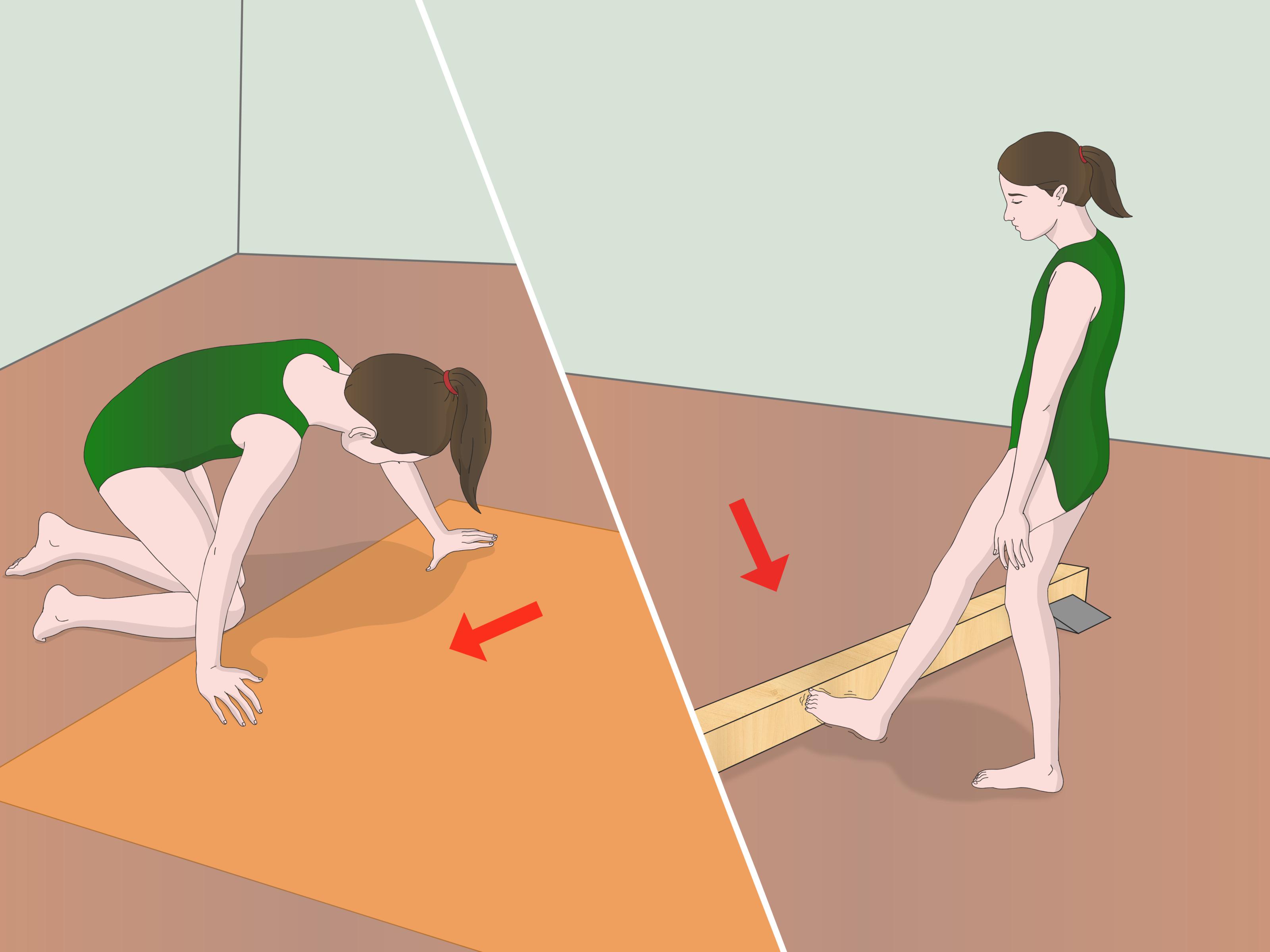
Place a strip of painter’s tape on the floor as a pretend balance beam. Kids walk heel-to-toe along the line with arms out. Try forward walking first, then sideways steps. Avoid using real furniture, narrow boards, or high surfaces as beams. A floor line is safer and still builds real balance skills.
Balance pose freeze game
Play music while kids move around the mat. When the music stops, call out a pose: star, flamingo, airplane, lunge, or tall stretch. Kids freeze in that shape for three seconds. This turns gymnastics practice into a game and helps younger kids stay engaged.
3. Practice Safe Floor Rolls and Tumbling Foundations
Floor gymnastics is fun, but it must be kept beginner-friendly at home. The safest starting point is not a dramatic flip; it is learning how to move close to the floor with control.
Log rolls
A log roll is simple and safe for many kids. Lie straight on the mat with arms reaching overhead, then roll sideways like a pencil. The body should stay long and controlled. This teaches body tension, direction, and spatial awareness without putting pressure on the neck.
Egg rolls
Sit in a tuck shape, gently roll backward onto the upper back, and return to sitting. Keep the movement small. The goal is to feel the rounded shape, not to launch across the room. If a child cannot keep the movement controlled, return to tuck holds and rocking practice.
Forward roll caution
Forward rolls can be part of beginner gymnastics, but they should only be practiced if a child has already learned proper technique from a coach or qualified instructor. The neck must be protected, and the child should roll smoothly over the upper back on a proper mat. At home, parents should not try to teach a forward roll from scratch using random internet confidence. Confidence is great; neck safety is better.
Animal walks
Bear walks, crab walks, frog jumps, and inchworm walks are excellent tumbling foundations. They build shoulder strength, coordination, core control, and flexibility. They also make kids giggle, which is not officially a gymnastics requirement, but it should be.
4. Try Handstand Prep Without Doing a Full Handstand
Handstands are classic gymnastics moves, but full handstands can be risky at home without spotting. Instead, kids can practice safe handstand preparation drills that build strength and body awareness.
Strong plank hold
Start in a push-up plank with hands under shoulders and the body straight from head to heels. Hold for five to fifteen seconds. Keep the belly gently pulled in and the neck neutral. This builds the shoulder and core strength needed for future skills.
Downward dog shoulder push
From hands and feet, lift the hips into an upside-down “V” shape. Gently press the chest toward the thighs while keeping hands firmly on the mat. This helps kids feel weight through the arms without going fully upside down.
Donkey kicks
Place hands on the mat, keep arms strong, and do tiny hops with the feet. The hips should lift only a little. Kids should not kick hard, fling the legs, or try to reach a full handstand. The drill is about learning arm support, not trying to become a human rocket.
Wall plank
For a safer wall drill, kids can place their feet low on a wall while hands stay on the floor in a plank position. Keep the feet close to the ground at first. This is not a wall handstand. It is a strength drill. Stop if the wrists, shoulders, or back feel uncomfortable.
5. Learn Cartwheel Foundations the Safe Way
A cartwheel is one of the most popular gymnastics moves for kids, but a full cartwheel requires coordination, flexibility, arm strength, and safe landing space. At home, practice the building blocks first.
Star to lunge
Start in a star shape with arms and legs wide. Step one foot forward into a lunge with arms reaching up. Return to star. This teaches the starting and finishing positions used in a cartwheel.
Hand-hand-foot-foot pattern
Place four paper spots or soft markers on the floor in a curved line. Kids practice touching the spots in order: hand, hand, foot, foot. Keep the movement slow. This helps the brain learn the cartwheel pathway without needing speed.
Bunny hops over a line
Place a tape line on the floor. Put both hands down on one side of the line and hop both feet lightly to the other side. Keep the hops small. This builds weight transfer through the hands and helps kids understand side-to-side movement.
When to wait
If a child cannot support weight on the hands, keep arms straight, or land with control, wait before trying a full cartwheel. There is no prize for rushing. Gymnastics skills grow best when kids master the pieces before assembling the whole puzzle.
6. Finish With Flexibility, Strength, and Cool-Down Games
Gymnastics is not only about tricks. Flexibility and strength are the quiet heroes behind every safe skill. A good cool-down helps the body recover and makes practice feel complete.
Gentle flexibility
After practice, try easy stretches: butterfly stretch, seated pike reach, straddle reach, shoulder stretch, and calf stretch. Stretches should feel mild, not painful. Kids should never bounce hard or force a split. Flexibility improves slowly, and forcing it is a fast way to make muscles complain.
Kid-friendly strength
Try short sets of hollow holds, superman lifts, wall sits, calf raises, and plank shoulder taps. Keep the numbers small and the form clean. For example, five careful reps are better than twenty wild ones performed with the grace of a shopping cart with one broken wheel.
Cool-down breathing
End with calm breathing. Sit tall, breathe in through the nose, and slowly breathe out. This helps kids shift from “gymnastics energy” back to normal life, where they may still cartwheel emotionally but not physically through the hallway.
Sample 20-Minute Home Gymnastics Routine for Kids
Here is a simple routine that keeps gymnastics practice safe, organized, and fun:
- Minutes 1–5: Warm up with marching, arm circles, high knees, ankle circles, and light jumps.
- Minutes 6–8: Practice tuck, pike, straddle, straight shape, hollow body, and arch body.
- Minutes 9–11: Do balance drills: flamingo, airplane, and heel-to-toe walking on a tape line.
- Minutes 12–14: Try log rolls, egg rocks, bear walks, and crab walks.
- Minutes 15–17: Practice plank holds, downward dog, and small donkey kicks.
- Minutes 18–20: Cool down with butterfly stretch, pike stretch, shoulder stretch, and calm breathing.
This routine can be adjusted by age and ability. Younger kids may enjoy shorter sessions with more games. Older kids may want more structure, but they should still avoid advanced skills without coaching.
Common Mistakes Kids Make When Practicing Gymnastics at Home
Skipping the warm-up
Kids often want to jump straight into the “cool part.” Unfortunately, bodies are not microwaves; they need time to warm up. A quick warm-up improves movement quality and reduces unnecessary strain.
Trying advanced moves too soon
Backbends, walkovers, handsprings, aerials, flips, and headstands should not be practiced at home without proper instruction and supervision. Even flexible kids need strength, technique, and safe spotting.
Using unsafe surfaces
Beds, couches, trampolines, stairs, and slippery floors are not gymnastics equipment. A safe, flat, padded surface is much better.
Practicing when tired
Fatigue makes balance, coordination, and judgment worse. If a child looks sloppy, frustrated, or unusually tired, it is time to stop. Rest is part of training, not a punishment.
Parent Tips: How to Keep Home Gymnastics Positive
Parents do not need to become Olympic judges. In fact, please do not hold up a scorecard at breakfast. The best role for parents is to make the space safe, encourage effort, and keep practice age-appropriate.
Praise control, not difficulty
Instead of saying, “Can you do something harder?” try saying, “That balance looked really controlled,” or “I like how you landed softly.” This teaches kids that good gymnastics is not about rushing into bigger skills. It is about doing simple skills well.
Keep sessions short
For many kids, fifteen to twenty minutes is enough. Long sessions can lead to fatigue, boredom, and sloppy movement. A short, happy practice is better than a long practice that ends with tears, arguments, or someone blaming the mat.
Make it playful
Use music, obstacle courses, shape games, and balance challenges. Kids learn best when they are engaged. A “gymnastics safari” with bear walks, crab walks, frog jumps, and flamingo balances can build real skills while feeling like play.
Experience Notes: What Practicing Gymnastics at Home Really Feels Like
Home gymnastics sounds simple: roll out a mat, point the toes, become graceful. Real life is usually more entertaining. The dog sits in the middle of the practice space like a furry judge. A younger sibling wants to participate by lying down exactly where the cartwheel line should be. Someone announces, “Watch this!” and then forgets what “this” was supposed to be. That is normal. Home practice is not a perfect gym environment, so the experience should be flexible, patient, and safety-first.
One useful experience many families discover is that kids often enjoy the routine more when it has a theme. Instead of saying, “Do ten balance drills,” try creating a “jungle gymnastics course.” The child bear-walks across the mat, flamingo-balances on one foot, log-rolls through the “river,” and finishes with a star pose. The movements are the same, but the energy changes completely. Suddenly, practice feels less like a workout and more like an adventure. This is especially helpful for younger kids who may not care about technique yet but absolutely care about pretending the carpet is lava.
Another real-world lesson: small wins matter. A child may not learn a full cartwheel at home, and that is perfectly fine. Maybe today’s win is keeping arms straight in a plank for eight seconds. Maybe it is walking heel-to-toe along a tape line without stepping off. Maybe it is remembering to warm up without being reminded six times. These tiny improvements build the foundation for bigger skills later. Gymnastics rewards patience, even though patience is not always a child’s favorite event.
Parents also learn that confidence and caution can live in the same room. A child can feel proud, brave, and athletic while still following rules. In fact, rules help kids feel safer because they know what is allowed and what is not. For example, a family might have a simple home rule: “Only floor skills, no flips, no furniture, no upside-down skills without a coach.” Clear rules reduce arguments and keep practice from turning into a stunt show.
Finally, home gymnastics works best when the mood stays light. Some days, kids will be focused. Other days, they will invent a new move called “The Flopping Starfish.” That is okay. Movement should feel positive. When kids associate gymnastics with fun, encouragement, and safe challenges, they are more likely to keep moving, stay active, and build healthy habits. The best at-home gymnastics experience is not about becoming perfect in one afternoon. It is about learning control, enjoying movement, and finishing practice with a smile instead of an ice pack.
Conclusion: Safe Gymnastics at Home Starts With the Basics
Kids can absolutely enjoy gymnastics at home, as long as the focus stays on beginner-friendly skills. Body shapes, balance drills, safe rolling foundations, handstand preparation, cartwheel basics, flexibility, and strength games all help children build coordination and confidence. These activities support fitness without pushing kids into risky stunts.
The most important lesson is simple: safe gymnastics is good gymnastics. Use a clear space, warm up, practice with adult supervision, avoid advanced moves, and stop when the body says stop. A child does not need to flip through the air to feel like a gymnast. Sometimes, a strong plank, a steady balance, and a proud star pose are more than enough.
Note: This article is educational and designed for safe beginner movement. Advanced gymnastics skills should be taught only by qualified instructors in a properly equipped gymnastics facility.