Before Jim Carrey became a pet detective, a green-faced human cartoon, or the proud owner of the most annoying sound in the world, he spent several years performing in a television comedy laboratory. That laboratory was In Living Color, the fearless Fox sketch series that gave Carrey a national audience, a collection of unforgettable characters, and permission to turn every muscle in his body into a punchline.
Carrey’s explosive movie breakthrough in 1994 can look like an overnight success when viewed from a distance. Three major comediesAce Ventura: Pet Detective, The Mask, and Dumb and Dumberarrived in the same calendar year and transformed him into one of Hollywood’s biggest stars. Yet the machinery behind those performances had been assembled, tested, and occasionally set on fire every week on In Living Color.
Jim Carrey Was Working Long Before He Was Famous
Carrey’s career did not begin with a studio executive spotting him across a crowded restaurant and shouting, “That man’s eyebrows will make millions!” He had already spent years developing an impression-heavy stand-up act in Canada and the United States.
As a teenager, he performed in Toronto comedy clubs. After his family’s financial difficulties, he worked ordinary jobs while continuing to chase stage time. He eventually opened for established comedians, moved to Los Angeles, and became known for remarkably accurate celebrity impressions.
Hollywood noticed his technical ability, but noticing someone and building a career around that person are very different things. Carrey appeared in movies such as Peggy Sue Got Married, Earth Girls Are Easy, and The Dead Pool. He also landed a leading role in the 1984 NBC sitcom The Duck Factory, playing a young cartoonist at a struggling animation studio.
The sitcom was canceled after a short run. Carrey also auditioned for Saturday Night Live without becoming a cast member. By the end of the 1980s, he had experience, talent, and enough rejection letters to wallpaper a moderately sized breakfast nook. What he lacked was a platform that understood how unusual his talent really was.
Why In Living Color Was Different
Created by Keenen Ivory Wayans, In Living Color premiered on Fox on April 15, 1990. At the time, Fox was still establishing itself as a fourth broadcast network, which meant it had both a problem and an advantage: it needed attention, and it had less tradition to protect.
Wayans built a sketch show that moved faster, looked younger, and addressed subjects that mainstream television comedy often avoided. The cast was predominantly Black, the music reflected contemporary hip-hop culture, and the sketches attacked celebrity, race, class, politics, advertising, and television itself with cheerful disrespect.
The ensemble included Keenen, Damon, Kim, Shawn, and Marlon Wayans, along with David Alan Grier, Tommy Davidson, T’Keyah Crystal Keymáh, Kelly Coffield Park, Jamie Foxx, and others. The Fly Girls dance troupe also became a defining part of the program, with future stars such as Jennifer Lopez appearing among its members.
Carrey was entering an environment where polished imitation was less valuable than fearless invention. The show did not need another performer who could simply sound like a celebrity. It needed someone willing to become a human special effect before computer-generated imagery could do the job for him.
A Show Willing to Let Performers Be Dangerous
In Living Color was famous for challenging network standards and forcing its creative team to negotiate with censors. Some sketches have aged better than others, and several relied on stereotypes that deserve criticism today. Nevertheless, the show’s willingness to risk failure was essential to its impact.
That atmosphere suited Carrey. Instead of asking him to reduce his performance until it fit inside a conventional sitcom, the show encouraged him to stretch an idea until it nearly snapped. His face could collapse, his limbs could behave like loose garden hoses, and his voice could jump from a whisper to an emergency siren.
Keenen Ivory Wayans Recognized the Right Kind of Weird
Carrey’s casting was not simply a matter of adding a white performer to a diverse ensemble. Wayans recognized that Carrey possessed a combination of technical discipline and unpredictable imagination. Beneath the apparent chaos was an actor who understood rhythm, camera placement, character construction, and the exact moment when a strange expression became funnier than a spoken line.
That distinction mattered. Plenty of comedians can behave loudly. Far fewer can make exaggeration feel precise. Carrey knew how long to hold a stare, when to freeze his body, and when to accelerate into total physical disaster.
Wayans also created an ensemble culture rather than treating the series as a collection of competing solo acts. Carrey performed alongside comedians with sharply different styles and perspectives. He had to listen, react, surrender scenes, and support other performers. Those skills would later help him work effectively with Jeff Daniels, Cameron Diaz, Courteney Cox, and the many straight-faced actors assigned to stand near him while he behaved like an escaped parade balloon.
Fire Marshal Bill Became the Blueprint
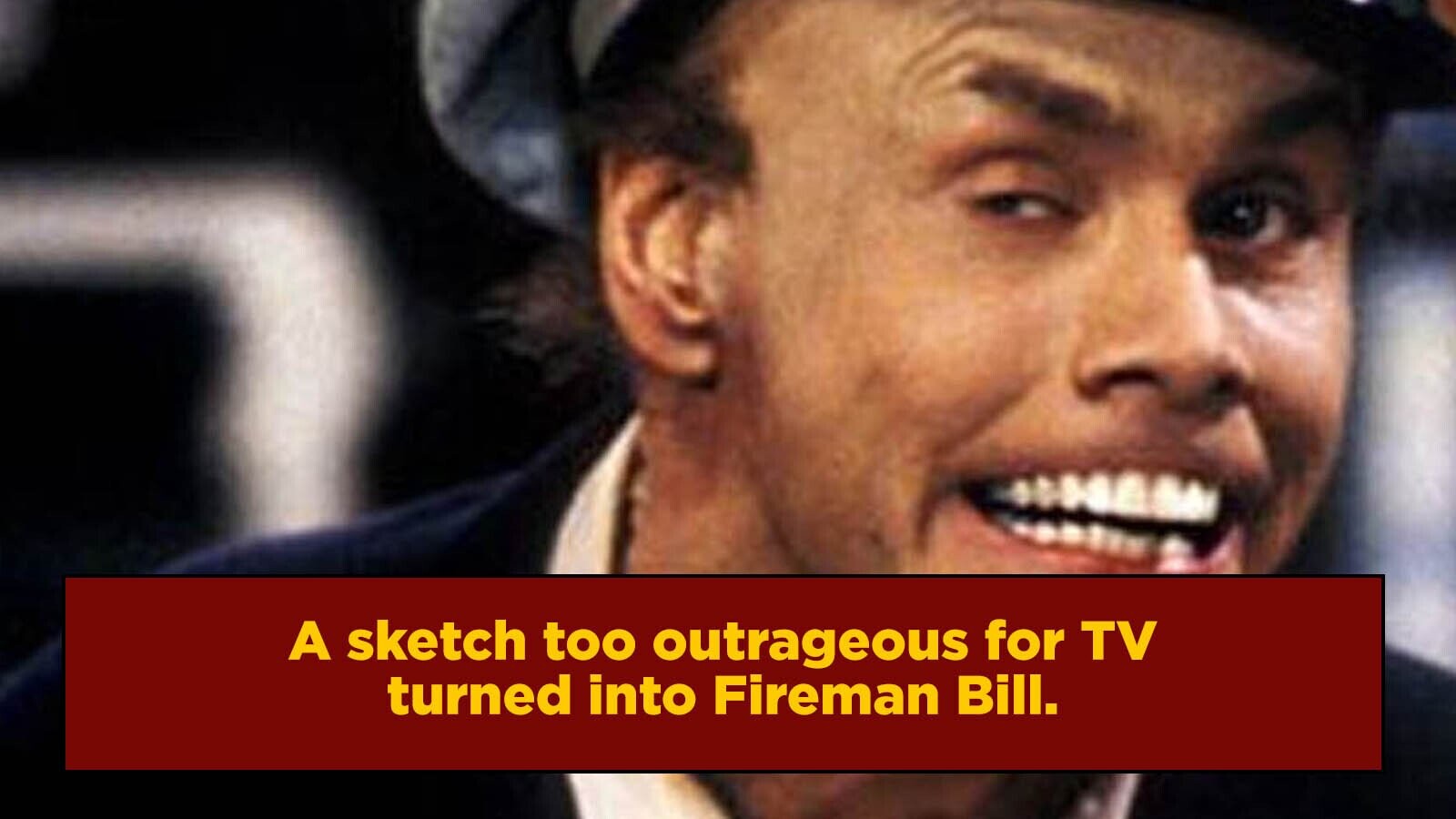
No discussion of Jim Carrey on In Living Color can avoid Fire Marshal Bill, although sensible people would certainly avoid inviting the character into an actual building.
Bill was a safety expert whose demonstrations created significantly more danger than they prevented. His scarred appearance, exposed gums, mangled speech, and complete confidence turned every lesson into a countdown to catastrophe. He would introduce a demonstration with “Lemme show ya something!” and then prove that fire codes exist for excellent reasons.
The character displayed nearly every quality that would define Carrey’s early movie career:
- Extreme facial transformation
- Highly specific vocal patterns
- Commitment to ridiculous physical danger
- A character who considers himself normal while everyone else panics
- Escalation from a simple premise to magnificent chaos
Fire Marshal Bill was not Ace Ventura in a different costume, but the two characters shared comedic DNA. Both invaded ordinary environments with absolute confidence. Both treated social rules as optional suggestions. Both used Carrey’s entire body as a delivery system for jokes.
Most importantly, Bill taught audiences how to watch Jim Carrey. Viewers learned that his characters might violate personal space, reshape their faces, survive impossible injuries, and turn a harmless conversation into a public emergency. By the time Ace Ventura arrived, millions of television viewers were already fluent in Carrey’s comic language.
His Other Characters Expanded the Experiment
Fire Marshal Bill became the signature creation, but Carrey’s development on In Living Color was broader than one recurring sketch.
Vera de Milo
Vera de Milo was an aggressively muscular female bodybuilder portrayed through exaggerated makeup, costuming, posture, and vocal choices. The character reflects an era when sketch comedy frequently used gender nonconformity as a punchline, and modern viewers may find parts of the material dated.
From a performance standpoint, however, the sketches demonstrated Carrey’s ability to build a character from the outside inward. The walk, shoulders, mouth, breathing, and facial tension all worked together. He was not merely wearing a costume; he was redesigning his physical behavior.
The Background Guy
In the Background Guy sketches, Carrey turned supporting action into the main attraction. While another scene appeared to unfold normally, his character performed increasingly absurd business behind the speakers.
This concept sharpened his understanding of visual composition. He learned how to steal attention without dialogue, how to use the edge of a frame, and how to make viewers anticipate the next movement. Those abilities became enormously useful in movies, where a raised eyebrow in the background could compete with an entire page of dialogue.
Celebrity Impressions
Carrey also performed impressions of public figures and entertainers, drawing on the skills he had developed in clubs. Yet In Living Color encouraged him to push beyond vocal accuracy. His impressions became miniature characters, amplified through posture, facial control, and surreal behavior.
The shift was crucial. An impression says, “Look how accurately I can copy this person.” A fully developed comic character says, “Look at the strange universe this person carries around.” Carrey’s movie career would be built on the second approach.
The Weekly Schedule Built More Than Confidence
A sketch program is a demanding training ground. Performers must learn scripts quickly, create characters, rehearse physical business, adjust to rewritten material, accommodate costumes and prosthetics, and hit camera marks. Then the process starts again with a fresh batch of ideas.
For Carrey, this repetition transformed instinct into reliable technique. He learned which expressions survived a close-up and which movements became confusing on camera. He learned when a joke needed another level of escalation and when one perfectly timed pause could do more than six cartwheels.
The program also provided immediate feedback. When a recurring character returned, Carrey could refine what audiences loved rather than merely repeat it. Catchphrases became sharper. Physical routines became cleaner. The apparent recklessness became more controlled.
This is one reason his later movie performances feel both spontaneous and carefully engineered. He could appear to lose control because he had spent years learning exactly where control was located.
In Living Color Made Jim Carrey Familiar Before Hollywood Took the Risk
Movie studios are more comfortable taking chances on a performer when audiences already recognize that performer. During its strongest years, In Living Color was not a small cult program hiding in the back corner of cable television. It was a major Fox series with a devoted national audience.
The show won the Emmy for Outstanding Variety, Music or Comedy Series after its first season. In 1992, it staged a live Super Bowl halftime counterprogramming special that drew a massive audience away from the official halftime presentation. The stunt demonstrated that the series was not merely popular; it was capable of interfering with one of American television’s largest events.
Carrey benefited from that exposure. Casting him in a leading movie still involved risk, but he was no longer a complete mystery. Viewers knew his face, his characters, and his willingness to commit himself to a joke as though dignity had been legally abolished.
How the Show Led Directly Into Ace Ventura
Ace Ventura: Pet Detective was released in February 1994, while In Living Color was still on television. Carrey helped shape the movie’s screenplay and, more importantly, built a protagonist around his own performance strengths.
Ace was not designed as a generic detective who happened to be funny. His hair, walk, voice, clothing, posture, and attitude made him recognizable before he solved a single clue. That is sketch-comedy character construction applied to a feature film.
The movie’s humor also followed the escalation pattern Carrey had practiced on television. Ace enters a familiar situationa police station, an apartment, a partyand refuses to behave according to its rules. Other characters attempt to preserve reality while he bends it into a new shape.
Critics were divided, particularly over the movie’s crude humor and treatment of gender. Audiences, however, responded strongly enough to turn the modestly budgeted comedy into a major hit. Carrey was suddenly a movie star, although “suddenly” ignores the years spent perfecting the performance in front of Fox’s cameras.
1994 Proved the Formula Could Travel
If Ace Ventura had been the only success, Carrey might have been dismissed as a one-character phenomenon. Instead, The Mask arrived in July 1994 and Dumb and Dumber followed in December.
The Mask: The Cartoon Becomes Literal
In The Mask, visual effects stretched Carrey’s face and body beyond normal anatomy. The technology worked because it amplified behavior he was already capable of suggesting physically. The computer effects did not manufacture the energy; they chased after it.
The role also required contrast. As Stanley Ipkiss, Carrey played a shy, anxious bank employee. As the Mask, he exploded into a dancing, wisecracking force of nature. The transformation worked because his television experience had taught him how to create separate physical vocabularies for different personalities.
Dumb and Dumber: Sharing the Comic Space
Dumb and Dumber showed another lesson learned from ensemble sketch comedy: generosity. Carrey’s Lloyd Christmas was outrageous, but Jeff Daniels received room to be equally funny as Harry Dunne.
The movie depended on partnership rather than one performer continuously overpowering the other. Carrey knew when to dominate a scene and when to react. That balance helped turn a collection of idiotic decisions, unfortunate haircuts, and deeply questionable travel plans into an enduring comedy.
The Show Also Prepared Carrey for Serious Roles
The connection between In Living Color and movies such as The Truman Show, Man on the Moon, and Eternal Sunshine of the Spotless Mind may appear less obvious. Those performances are quieter and more emotionally complex than Fire Marshal Bill demonstrating household safety with the delicacy of a wrecking ball.
Yet physical comedy requires close observation of human behavior. Carrey had spent years studying how people hold tension in their mouths, shoulders, eyes, and hands. Dramatic acting uses the same information with the volume turned down.
In The Truman Show, his familiar grin could express friendliness, fear, suspicion, or emotional imprisonment. In Man on the Moon, his experience with impressions helped him recreate Andy Kaufman’s external behavior, while the role demanded a deeper exploration of performance and identity. In Eternal Sunshine of the Spotless Mind, Carrey created a withdrawn character partly by suppressing the explosive energy audiences expected from him.
The comedian who seemed capable of doing anything became dramatically compelling when he chose not to do everything.
Why In Living Color Remains Essential to the Jim Carrey Story
It would be inaccurate to say In Living Color created Jim Carrey from nothing. He arrived with years of stand-up experience, exceptional mimicry, and the persistence required to survive repeated disappointment.
What the series provided was alignment. It connected his abilities with the right creative environment, collaborators, audience, and historical moment. It gave him weekly opportunities to convert strange impulses into repeatable characters. It demonstrated to Hollywood that his physical comedy could attract a mainstream audience.
The show also helped launch or elevate an extraordinary collection of talent, including Jamie Foxx, Jennifer Lopez, David Alan Grier, Tommy Davidson, and several members of the Wayans family. Carrey’s success is therefore part of a larger story about what happens when television expands the range of performers, voices, and comedic perspectives allowed on screen.
In Living Color did not hand Carrey a completed movie career. It gave him the workshop, tools, and test audience. He supplied the rubber face.
The Experience of Watching Carrey’s Career Blueprint Take Shape
Watching Jim Carrey’s In Living Color sketches today can feel like discovering rehearsal footage for an entire decade of blockbuster comedy. The costumes and references belong unmistakably to the early 1990s, but the central performance style is instantly recognizable. A viewer can practically see Ace Ventura, Stanley Ipkiss, and Lloyd Christmas waiting just outside the frame for their turn.
The most revealing experience comes from watching several sketches consecutively instead of viewing a single Fire Marshal Bill clip. One performance showcases facial distortion. Another depends almost entirely on movement. A celebrity parody demonstrates vocal precision, while an ensemble scene reveals how carefully Carrey reacts to his castmates. The variety makes it clear that his success was not based on one funny expression or one loud character.
It is also fascinating to notice the discipline underneath the apparent madness. Carrey often begins with recognizable human behavior. A safety expert speaks with professional confidence. A bodybuilder displays pride. A background performer tries to attract attention. He establishes that basic behavior before stretching it toward absurdity.
That structure helps explain why imitation alone rarely captures what made early Jim Carrey performances effective. Anyone can widen their eyes and shout. Carrey built an internal logic for each character. Fire Marshal Bill genuinely believes he is helping. Ace Ventura genuinely believes every room improves when he enters it. Lloyd Christmas genuinely believes optimism can repair a plan constructed almost entirely from errors.
Revisiting the show also produces a more complicated response than simple nostalgia. Some sketches remain fast, inventive, and surprisingly daring. Others contain stereotypes or attitudes that feel uncomfortable now. Recognizing those weaknesses does not require erasing the program’s achievements. It allows viewers to understand comedy as a product of its timecapable of breaking important barriers while carrying other limitations forward.
For aspiring actors, comedians, and writers, the most useful lesson is that career-defining work often begins in a format that appears temporary. A weekly sketch can look disposable when it airs, yet it may teach a performer how to create characters, manage a camera, collaborate with writers, and survive creative failure. Carrey’s movie career was built partly from lessons hidden inside short television segments surrounded by commercial breaks.
There is also something encouraging about the timeline. Before his breakthrough, Carrey had already experienced a canceled sitcom, minor film roles, unsuccessful auditions, and years of uncertain progress. In Living Color did not rescue an inexperienced beginner. It revealed what a persistent performer had been building while the larger industry was looking elsewhere.
Seen from that perspective, the show offers more than a collection of early Jim Carrey performances. It captures the moment preparation finally met opportunity. The result was not merely a successful cast member leaving television for movies. It was the construction of a comic identity strong enough to dominate theaters, survive dramatic reinvention, and remain recognizable decades later.
Conclusion
In Living Color set up Jim Carrey’s career by giving him what conventional Hollywood roles had not: room to be unmistakably himself. The show transformed his impressions, elastic face, fearless physicality, and unusual character ideas into a complete comedic language.
When Ace Ventura, The Mask, and Dumb and Dumber made him a superstar in 1994, audiences were witnessing the movie-sized version of an experiment that had been running on television for years. The films supplied bigger screens and larger budgets, but the engine had already been built.
Fire Marshal Bill may have been terrible at preventing disasters. As career preparation, however, he was remarkably effective.