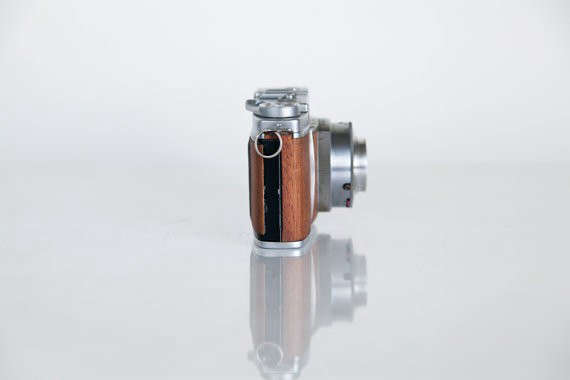
The Graflex Kowa Century 35mm Rangefinder is the kind of camera that quietly waits on a shelf until a curious film shooter picks it up and says, “Hold on, why does this Graflex look Japanese?” That question is exactly where the fun begins. The Century 35 is not the big, flashbulb-popping press camera most people imagine when they hear the name Graflex. Instead, it is a compact 35mm rangefinder made by Kowa Optical Works in Japan and sold under the respected Graflex name in the United States during the late 1950s and early 1960s.
In other words, it is a small camera with a surprisingly large identity crisisand collectors love that sort of thing. It combines American branding, Japanese optical manufacturing, mechanical simplicity, and mid-century rangefinder charm. It is not as famous as a Leica, Canonet, Nikon S, or Yashica Electro 35, but that is partly what makes it interesting. The Graflex Kowa Century 35mm Rangefinder is a camera for people who enjoy taking the scenic route through photographic history.
What Is the Graflex Kowa Century 35mm Rangefinder?
The Graflex Century 35 is a fixed-lens 35mm film camera with a coupled rangefinder. It was produced by Kowa Optical Works, a Japanese company better known today for lenses, spotting scopes, binoculars, and medical optics. The camera was sold by Graflex, the legendary Rochester, New York camera company famous for press cameras such as the Speed Graphic.
At its core, the Century 35 belongs to the same family as the Kowa Kallo 35. In practical terms, many examples are rebadged or closely related versions of Kowa’s domestic-market rangefinders. Depending on the exact variant, you may see Prominar lenses such as a 45mm f/3.5 or 48mm f/2.8, usually paired with a Seikosha-MX leaf shutter. Some related Century 35 models and later “NE” versions used different lenses, shutters, or metering systems, so the golden rule is simple: read the front lens ring before bragging at a camera club meeting.
A Brief History: Graflex Meets Kowa
Graflex was one of America’s most recognizable camera names in the first half of the twentieth century. Its large-format press cameras helped define news photography for decades. But by the 1950s, the market was shifting. Smaller 35mm cameras were becoming more popular, and Japanese manufacturers were building cameras with impressive speed, quality, and price competitiveness.
Kowa, meanwhile, was building its own optical reputation. The company released the Kalloflex twin-lens reflex in the mid-1950s and soon moved into 35mm cameras. The Kallo 35 line showed Kowa’s interest in compact, practical rangefinder design. Graflex, looking to offer a 35mm camera without building every component from scratch, partnered with Japanese production. The result was the Graflex Century 35: a camera that wears an American badge but speaks fluent 1950s Japanese engineering.
Why This Camera Is Often Overlooked
The Century 35 arrived in a crowded era. The 1950s and 1960s were packed with capable fixed-lens rangefinders from Canon, Minolta, Yashica, Ricoh, Konica, Petri, and many others. Some had faster lenses. Some had built-in meters. Some had celebrity-level collector appeal. The Graflex Kowa Century 35mm Rangefinder, by contrast, was more of a quiet professional: solid, capable, and slightly mysterious at parties.
That lower profile is good news for today’s film photographers. While better-known rangefinders can command premium prices, the Century 35 often remains approachable, especially if the buyer is patient and willing to inspect condition carefully.
Design and Build Quality
The Graflex Kowa Century 35mm Rangefinder has the classic look of a late-1950s fixed-lens rangefinder: a metal body, bright chrome accents, black leatherette, manual controls, and a purposeful rectangular shape. It does not try to be cute. It looks like it has a job, a lunch break, and perhaps opinions about jazz records.
Most versions feel dense and solid in the hand. The camera is not featherlight, but that weight gives it steadiness. Controls are mechanical and direct. There is no battery dependency on the basic non-metered versions, which is a major advantage for modern film shooters. No battery means no battery corrosion, no obsolete mercury cell drama, and no late-night internet search titled “why does my vintage meter lie to me?”
The Rangefinder Experience
A coupled rangefinder means that focusing is done by aligning two images in the viewfinder. Turn the focus ring or focusing control, bring the double image together, and the lens is focused at that distance. It is quicker and more precise than scale focusing, especially for portraits, street photography, and everyday scenes.
The Century 35’s viewfinder experience is best described as practical rather than luxurious. It does the job. The focusing patch can be pleasant when clean and aligned, but age matters. Haze, dust, mirror deterioration, or rangefinder misalignment can make the camera harder to use. When shopping for one, always check whether the rangefinder patch is visible and whether it agrees with actual focus.
Lens and Shutter: The Heart of the Camera
The most discussed part of the Graflex Kowa Century 35mm Rangefinder is its Kowa Prominar lens. Prominar is a respected Kowa optical name, and even modest Prominar lenses can produce attractive results. Many Century 35 cameras are seen with a Prominar F.C. 45mm f/3.5 lens, while other variants may carry a 48mm f/2.8 lens. Either way, the focal length sits in the normal-lens zone, making the camera suitable for travel, family photography, street scenes, architecture details, and casual portraits.
The typical Seikosha-MX leaf shutter offers speeds up to 1/500 second on many rangefinder examples, plus bulb mode. A leaf shutter is quiet and compact, and it can synchronize with flash at useful speeds. For modern shooters, the quiet shutter is one of the camera’s biggest pleasures. It does not announce itself like a tiny metal door slamming in a library.
Image Character
Expect a vintage rendering rather than modern clinical sharpness. Stopped down to f/5.6 or f/8, a clean Prominar lens can deliver crisp, satisfying negatives. Wide open, contrast may be gentler, corners may soften, and flare control may depend heavily on lens condition and light angle. That is not a flaw; it is part of the charm. This camera was built for real photographs, not pixel-peeping debates at 400% magnification.
Black-and-white film suits the Century 35 beautifully. Ilford HP5 Plus, Kodak Tri-X, Kentmere 400, and Fomapan 100 are all friendly choices. Color negative film also works well, especially Kodak Gold 200, Kodak Ultramax 400, and Fujifilm 400. For sunny walks, ISO 100 or 200 film gives plenty of flexibility. For cloudy days or indoor window light, ISO 400 is more forgiving.
How to Use the Graflex Kowa Century 35mm Rangefinder
Using the Century 35 is refreshingly straightforward once you understand its control layout. Load 35mm film, advance to the first frame, set your film reminder if the camera has one, choose your shutter speed and aperture, focus through the rangefinder, compose, and press the shutter. That is the whole dance. No menus. No firmware. No screen asking whether you accept cookies.
Exposure Settings
Many Century 35 cameras are fully manual. If your version has no working meter, use a handheld light meter, a smartphone meter app, or the Sunny 16 rule. In bright sun, start around f/16 at a shutter speed close to your film speed. With ISO 400 film, that means roughly 1/500 at f/16 or 1/250 at f/16 depending on available shutter speeds. Open up as the light drops.
Some Century 35-related models use an EV-style exposure system where shutter speed and aperture can be linked. This allows the photographer to maintain the same exposure while shifting the balance between motion control and depth of field. It sounds fancy, but it is basically the camera saying, “Would you like more blur in the background or less blur in the subject?” Very polite for a machine made of metal.
Focusing Tips
For best results, focus carefully at wide apertures and close distances. Rangefinders can be extremely accurate, but only when properly aligned. If your photos are consistently sharp behind or in front of the subject, the camera may need rangefinder adjustment. At smaller apertures such as f/8 or f/11, depth of field becomes more forgiving, making the camera excellent for street shooting and travel snapshots.
Common Problems and Buying Advice
Because every Graflex Kowa Century 35mm Rangefinder is now several decades old, condition matters more than cosmetics alone. A shiny camera with a frozen shutter is merely a handsome paperweight. A worn-looking camera with clean glass and accurate focus may be the better purchase.
What to Check Before Buying
- Shutter speeds: Slow speeds often stick on old leaf shutters. Test every speed if possible.
- Lens condition: Look for fungus, haze, scratches, coating damage, and internal dust.
- Rangefinder patch: Make sure it is visible and aligns at infinity.
- Film advance: The lever should move smoothly and stop correctly.
- Light seals: Expect to replace them if they are gummy, dusty, or missing.
- Aperture blades: They should move cleanly and should not be oily.
- Viewfinder clarity: A cloudy finder makes photography feel like driving in soup.
Do not be afraid of minor cosmetic wear. Small scratches, brassing, and leatherette aging are normal. Be more cautious about cameras sold as “untested.” In vintage camera language, “untested” sometimes means “I did not test it,” and sometimes means “I tested it, and now we are both pretending I did not.”
Is the Graflex Kowa Century 35 Good for Beginners?
Yes, with one condition: the beginner must want to learn manual exposure. The Century 35 does not behave like a point-and-shoot. It expects the photographer to understand shutter speed, aperture, focus, and film speed. That makes it less convenient but more educational.
For a new film shooter, this camera can be a wonderful teacher. It slows the process just enough to make each frame feel intentional. You learn to observe light, estimate distance, choose depth of field, and wait for the right moment. A digital camera lets you take 400 photos of lunch. The Century 35 politely suggests that perhaps twelve will be enough.
Collector Appeal and Market Position
The Graflex Kowa Century 35mm Rangefinder appeals to several groups. Graflex collectors like it because it represents the company’s move into compact 35mm cameras. Kowa collectors like it because it connects to the Kallo rangefinder family. Film shooters like it because it is usable, mechanical, and different from the usual recommendations. It is not the most famous rangefinder, but it is exactly the kind of oddball that gives a collection personality.
Its rarity varies by version. The Century 35 name appears on multiple related cameras, including basic rangefinder models, simpler viewfinder versions, and later metered variants. The less common versions may interest collectors more, while ordinary shooting examples are often valued primarily by condition.
Best Uses for the Graflex Kowa Century 35mm Rangefinder
This camera is best for deliberate everyday photography. It works well for walks around town, quiet street scenes, vintage car shows, family gatherings, flea markets, old storefronts, and travel when you want a camera that feels like part of the adventure. Its normal lens encourages natural framing. You move your feet instead of zooming, which is healthier than it sounds.
It is less ideal for sports, fast wildlife, low-light concerts, or situations where quick automatic exposure is essential. But for slow photography, documentary details, and black-and-white storytelling, it has a charming rhythm.
Real-World Shooting Experience: Living With a Graflex Kowa Century 35mm Rangefinder
Using the Graflex Kowa Century 35mm Rangefinder feels different from using a modern camera because the camera asks you to participate. It does not simply obey; it negotiates. First, you check the light. Then you choose a film speed. Then you decide whether the scene needs depth of field or subject separation. Then you focus. Then you wait half a second longer than usual because, with film, impatience costs real money.
The first thing many shooters notice is the weight. It is compact, but not flimsy. The body has that satisfying mid-century density that makes you believe it could survive a bus ride, a family picnic, and possibly a minor argument with gravity. The advance lever gives a mechanical reward after every frame. The shutter has a soft leaf-shutter click rather than a loud slap. On the street, that quiet sound is useful. People are less likely to notice the exposure, and the photographer feels less like a one-person press conference.
The rangefinder focusing process is enjoyable when the viewfinder is clean. Aligning the images encourages you to slow down and think. It is especially satisfying for portraits at moderate distances. With ISO 400 film and the lens around f/5.6 or f/8, the camera becomes very forgiving. You can set a practical shutter speed, focus quickly, and trust the lens to do honest work. The results often have a vintage look without becoming mushy or overly romantic. It is not a magic machine, but it has a voice.
One pleasant surprise is how naturally the camera fits everyday subjects. A coffee cup near a window, a parked truck with chrome trim, an old sign on a brick wall, a friend laughing across a tablethese are exactly the scenes where the Century 35 feels at home. The Prominar lens tends to reward good light. Give it side light, soft afternoon sun, or a cloudy sky, and it produces negatives with texture and character. Point it straight into harsh sun without a hood, and it may remind you that lens coatings have improved since Eisenhower was president.
The camera also teaches humility. If a roll comes back with missed focus, the camera may not be entirely to blame. Rangefinder shooting requires discipline. If the shutter speeds are slow, old lubricant may be the culprit. If the frame spacing looks strange, the advance mechanism needs attention. If the light leaks look like abstract art, the seals probably need replacing. Vintage film photography is half photography and half friendly detective work.
For travel, the Century 35 is enjoyable because it starts conversations. People recognize it as “old,” but not in the obvious Leica way. It invites curiosity rather than envy. That can be a benefit. A rare but affordable camera lets you enjoy photography without feeling as though you are carrying a museum donation in your backpack. Still, it deserves care. A simple strap, a lens cap, and a small padded pouch go a long way.
The best experience comes when you stop comparing it to more famous cameras. The Graflex Kowa Century 35mm Rangefinder is not trying to beat a Leica M3, a Canon P, or a Nikon S2. It is a modest, mechanical, fixed-lens rangefinder with a fascinating backstory and enough optical quality to make beautiful photographs. Its pleasure is not perfection. Its pleasure is personality. And in a world full of cameras that all look like black rectangles, personality is worth loading a roll for.
Conclusion
The Graflex Kowa Century 35mm Rangefinder is a rewarding vintage film camera for collectors and shooters who appreciate mechanical design, unusual branding history, and classic rangefinder photography. Made by Kowa and sold under the Graflex name, it bridges two photographic worlds: American camera heritage and Japanese postwar optical manufacturing. Its Prominar lens, Seikosha-style leaf shutter, coupled rangefinder, and manual controls make it a capable tool when properly serviced.
It is not the easiest camera to find in perfect working order, and buyers should inspect shutter accuracy, lens clarity, rangefinder alignment, and film transport before committing. But when everything works, the Century 35 delivers a satisfying shooting experience with a quiet shutter, solid feel, and images full of vintage character. For anyone tired of the same predictable film camera recommendations, this little Graflex-by-Kowa deserves a closer look. It may not shout from the display case, but give it a roll of film and it has plenty to say.
SEO Tags
Note: Specifications can vary between Century 35 versions and related Kowa-made models, so always verify the exact lens, shutter, rangefinder condition, and markings on the individual camera before buying or publishing a listing.