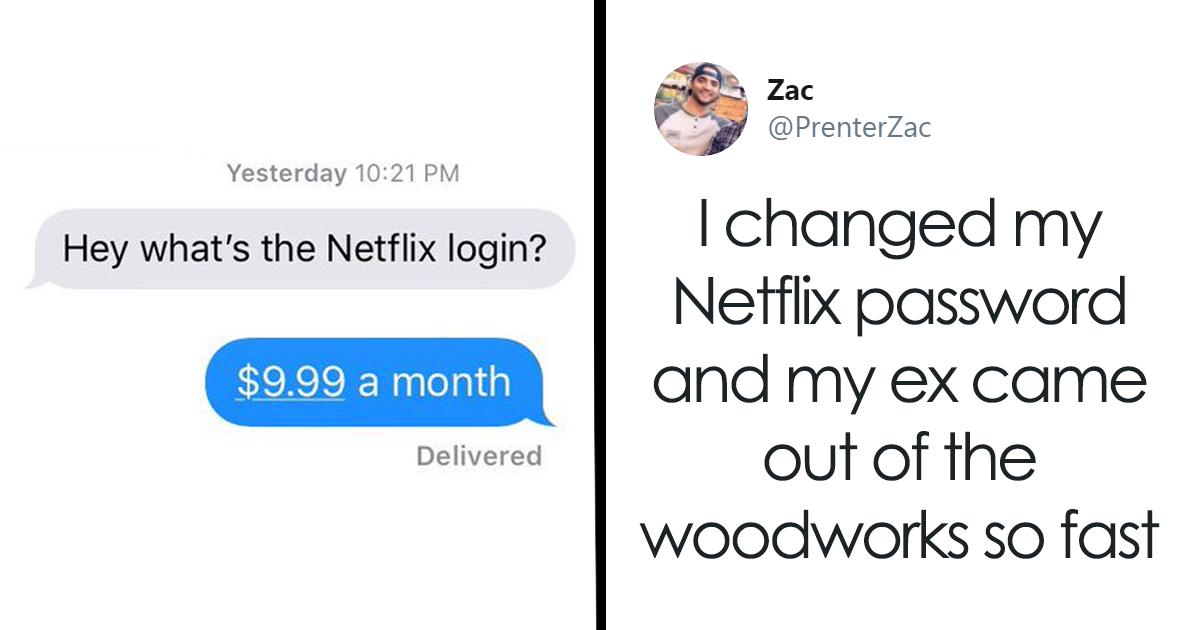
There are two kinds of people in the streaming world: those who pay for Netflix, and those who treat someone else’s password like a family heirloom they are morally entitled to inherit. The second group is often surprisingly confident. They do not simply ask, “Hey, can I use your Netflix?” They negotiate like tiny entertainment lawyers, act offended when told no, and occasionally suggest that the person paying the bill is being “selfish” for not funding their fifth rewatch of a crime documentary at 1:37 a.m.
That is the wonderfully chaotic energy behind the internet’s fascination with “smart” people who believe paying for Netflix is dumb but begging, guilt-tripping, or quietly leeching from someone else is somehow a masterclass in financial strategy. The original viral idea made people laugh because the screenshots were painfully familiar: friends, exes, cousins, roommates, dates, and total freeloading philosophers trying to turn one subscription into a public utility.
But behind the comedy is a very real shift in how streaming works. Netflix password sharing used to exist in a gray, wink-wink zone. Plenty of people shared accounts with siblings, parents, partners, college roommates, and that one friend who still has your login from 2018 and refuses to develop shame. Today, Netflix has made its position much clearer: an account is meant for one household, and people outside that household need their own account or a paid extra-member option where available.
So let’s laugh at the leeches, analyze why people feel weirdly entitled to streaming passwords, and explore what this says about modern subscriptions, digital boundaries, and the fragile social contract known as “I changed the password because Brad from work kept watching anime on my profile.”
Why Netflix Password Sharing Became Everyone’s Favorite Tiny Scam
Netflix became popular because it felt simple. You paid a monthly fee, watched what you wanted, and avoided the ancient cable ritual of paying for 800 channels just to watch three of them. It was clean, cheap, and flexible. Then streaming multiplied. Suddenly, one show was on Netflix, another was on Hulu, the movie you wanted was on Max, the cartoon your kid loved was on Disney+, and your bank account began making the same noise as a printer jam.
That is where password sharing found its golden age. One household had Netflix. Another had Disney+. Someone else had Prime Video. A friend’s cousin’s roommate had HBO. People formed informal streaming alliances like medieval kingdoms, except instead of trading grain, they traded logins.
At first, it felt harmless. If a plan allowed multiple profiles and multiple screens, many users assumed sharing was part of the deal. But the reality was always more complicated. Multiple profiles were designed to keep household viewing separate, not to create a small village of unpaid subscribers scattered across four ZIP codes.
The funniest “smart” Netflix leeches rarely see it that way. In their minds, the account already exists, so using it costs the owner nothing. This is the classic freeloader argument: “You’re paying anyway.” It sounds logical for about three seconds, until you remember that people also pay rent anyway, and that does not mean your coworker gets to sleep on your couch indefinitely while eating your cereal.
The 29 Types of “Smart” Netflix Leeches We All Recognize
You do not need the exact screenshots to recognize the behavior. The internet has seen enough password-sharing drama to build a complete field guide. Here are the most common characters in the Netflix freeloading ecosystem.
1. The “It’s Just Netflix” Person
This person acts like Netflix is not a real expense because it is smaller than rent, groceries, or a car payment. They say things like, “Come on, it’s only Netflix,” while mysteriously refusing to pay for “only Netflix” themselves. Their argument collapses under the weight of its own cheapness.
2. The Ex Who Forgot They Are an Ex
Few things are more emotionally confusing than an ex who no longer wants commitment but still wants access to your streaming services. They may not text back, but they can absolutely finish a limited series on your account before you notice.
3. The Profile Invader
This freeloader does not just use your account. They create a profile with a name like “Mike” or “Do Not Delete.” Bold. Terrifying. Almost impressive. If audacity were a subscription tier, they would be Premium.
4. The Algorithm Destroyer
You once had elegant recommendations: dramas, documentaries, thoughtful films. Then your cousin borrowed your password and watched twelve seasons of reality dating shows. Now Netflix thinks your personality is “emotionally unstable yacht party.”
5. The Midnight Streamer
This person watches at strange hours and triggers suspicion. You check your account activity and see a device streaming from a location you do not recognize. Are you hacked? Is it your friend? Is your account living a richer life than you are?
6. The Guilt-Tripper
When denied, they respond as if you refused to donate a kidney. “Wow, I thought we were friends.” Yes, and friends usually do not demand recurring monthly entertainment tribute.
7. The “I’ll Pay You Back” Legend
This person promises to split the bill and then vanishes every month like a magician with poor budgeting skills. The payment is always coming “Friday.” Which Friday? Great question. Scholars are still investigating.
8. The Stranger With Confidence
Some people ask acquaintances, coworkers, or online contacts for passwords as casually as asking for a restaurant recommendation. This is not networking. This is digital panhandling with subtitles.
9. The Parent Who Shares With Everyone
Sometimes the account owner is not the victim but the accidental distributor. A parent gives the password to one child, who gives it to a roommate, who gives it to a partner, who gives it to someone named Kyle. Eventually the account has more branches than a genealogy website.
10. The Password Historian
This person still uses a password you gave them years ago. You have changed jobs, moved apartments, and possibly become a different person. They, however, are still on your Netflix, watching like time has no meaning.
Why People Feel Entitled To Someone Else’s Subscription
Netflix leeching is funny because it exposes a weird modern etiquette gap. Most people understand that borrowing a physical object requires permission. You would not take someone’s car because “they already paid for it.” You would not move into a neighbor’s guest room because “it was empty anyway.” But digital services feel invisible, and invisible things are easier to rationalize.
Another reason is subscription fatigue. Americans now juggle subscriptions for entertainment, software, cloud storage, delivery, fitness apps, news, and sometimes toothbrush heads because apparently even plaque needed a business model. When every service charges monthly, people start hunting for shortcuts.
There is also social pressure. Asking for a password sounds small, so refusing can feel awkward. Nobody wants to seem cheap. Ironically, the person refusing is usually the only one paying.
The “smart” leech uses that awkwardness as leverage. They rely on the account owner not wanting confrontation. That is how one innocent login becomes a long-term arrangement nobody agreed to. The account owner says yes once, then spends three years wondering why their homepage keeps recommending shows in languages they do not speak.
Netflix Changed The Game With Household Rules
For years, Netflix account sharing existed in a messy cultural zone. People joked about it. Brands joked about it. Users assumed the company tolerated it because growth was strong and streaming still felt like a bargain. But as competition increased and production costs rose, Netflix began turning password sharing into a business issue rather than a punchline.
The company now defines a Netflix Household as the collection of devices connected to the internet at the main place where the account is watched. People outside that household are expected to create their own account or be added as extra members when that option is available. This is not subtle. It is basically Netflix saying, “We saw Kyle on your account, and Kyle needs a wallet.”
Netflix also gives subscribers tools to manage access and devices. That matters because password sharing is not just about money. It is also about account security. If someone you barely know has your password, you may not know where else that password has been saved, shared, reused, or exposed. A casual favor can become a security headache, especially if the same password is used on other services.
The Security Problem Nobody Thinks About
The most obvious problem with Netflix leeching is freeloading. The less obvious problem is password hygiene, which sounds boring until someone logs into your account from three states away and changes the profile names to “I Live Here Now.”
Sharing passwords trains people to treat login credentials as casual objects. But passwords are not house keys you can easily take back. Once shared, they can be saved in browsers, written in messages, screenshotted, forwarded, or remembered by people who should not have them. If you reused that password elsewhere, the risk becomes bigger than one streaming account.
That is why account owners should periodically review signed-in devices, remove unfamiliar access, and update passwords when needed. It is not dramatic. It is basic digital housekeeping. Think of it as cleaning the fridge, except the mystery leftovers are old roommates still watching documentaries on your dime.
Is Refusing To Share A Netflix Password Rude?
No. Refusing to share your Netflix password is not rude. Asking repeatedly after being told no is rude. Acting insulted because someone will not subsidize your entertainment is rude. Creating a secret profile on someone else’s account is rude with a small garnish of chaos.
A helpful rule: if you would feel awkward doing it with a physical subscription or bill, it is probably awkward digitally too. Would you ask a coworker to add you to their gym membership for free? Would you expect your friend to pay your phone bill because “the family plan already exists”? Probably not. Streaming is just another service, even if it arrives wrapped in comedy specials and cliffhangers.
There are fair exceptions. Parents may pay for children. Couples may share within the same household. Roommates may split bills. Families may use official extra-member options. The issue is not generosity. The issue is entitlement.
What The Netflix Leeches Teach Us About Boundaries
The funniest screenshots of Netflix freeloaders work because they reveal how bad some people are at hearing “no.” They turn a small boundary into a moral debate. Suddenly, the account owner is greedy, dramatic, or “changed.” No, they just noticed that twelve people were using an account built for one household.
Digital boundaries are still boundaries. You are allowed to change your password. You are allowed to sign out devices. You are allowed to say, “I’m keeping my account private.” You do not need a courtroom defense or a 14-slide PowerPoint called “Why My Cousin Cannot Watch Bridgerton For Free.”
In fact, the best response is often short: “Sorry, I’m not sharing my account.” That sentence is complete. It does not need a coupon code, apology basket, or emotional footnote.
The Bigger Streaming Lesson: Cheap Is Not The Same As Free
Netflix is not the only streaming platform tightening account rules. The broader industry has learned that password sharing is not a harmless side effect when millions of people do it. Streaming is now a mature business, not a startup-era buffet. Services want viewers to pay, advertisers want measurable audiences, and studios want revenue to fund the next wave of shows and movies.
Consumers, meanwhile, are tired of rising prices. That frustration is real. Many households are cutting back, rotating subscriptions, choosing ad-supported plans, or waiting until a full season drops before paying for one month. Those are smart strategies. Leeching off someone else while mocking them for paying is not smart. It is just freeloading in a tiny graduation cap.
The best modern streaming strategy is simple: subscribe intentionally. Keep the services you actually use. Cancel the ones collecting dust. Rotate platforms. Use legal bundles where they save money. Choose ad-supported tiers if the tradeoff works for you. Split costs only with people allowed under the service terms and with clear expectations. Above all, do not become the person whose entertainment budget depends on emotional blackmail.
500 More Words From Real-Life Streaming Experience: The Password Drama Is Never About Just Netflix
Anyone who has ever shared a streaming password knows the experience starts innocently. Someone asks during a casual conversation. Maybe they want to watch one movie. Maybe they are between jobs. Maybe they are visiting for the weekend and need to finish a series. You think, “Sure, what’s the harm?” Then, months later, your account looks like a bus station.
The first sign is usually the recommendations. You open Netflix expecting your normal homepage and find a parade of content that has nothing to do with you. Suddenly the algorithm believes you are passionate about monster trucks, teen vampires, cooking competitions, and extremely dramatic reality reunions. You did not change. Your password did.
The second sign is the profile situation. A responsible guest uses your profile once and logs out. A professional-grade leech creates their own profile. The boldest ones customize the avatar. At that point, they are not borrowing anymore; they are decorating the apartment.
The third sign is inconvenience. You try to watch something, but too many screens are active. Now you, the person paying, are locked out while someone else finishes an episode. This is where generosity begins to feel less like kindness and more like accidentally adopting a raccoon.
The awkward part is not changing the password. The awkward part is the reaction afterward. People who have been quietly using your account may suddenly message you with suspicious urgency: “Hey, is Netflix down?” Translation: “My free entertainment pipeline has been disrupted, and I would like customer support from the person I was freeloading from.”
That moment teaches a valuable lesson about digital favors. A small favor can become an expectation if no one defines the limit. If you lend a login, say exactly what it is for. “You can use it tonight” is different from “Welcome to my account forever.” If you do not want to share at all, say so early. The earlier boundary is less awkward than the later eviction.
There is also a surprisingly emotional side to shared accounts. Streaming profiles can hold memories: watchlists, kids’ shows, comfort movies, half-finished series, and recommendations built over years. Letting random people use the account can feel like letting them rummage through a very silly diary. No, it is not your bank account. But it is still personal.
The practical fix is boring but effective. Review your devices. Sign out anything unfamiliar. Change your password. Use a unique password that is not shared with email, banking, shopping, or social accounts. Tell people clearly that you are no longer sharing. Most reasonable people will understand. The unreasonable ones will provide free comedy material, which is almost as good as a subscription.
In the end, the “smart” Netflix leech is not really smart. A smart person manages their subscriptions, rotates services, uses trials legally, chooses cheaper tiers, or simply waits until they can afford the platform. The leech chooses drama. And while drama can be entertaining, it should not be billed to someone else’s credit card.
Conclusion: The Password Party Is Over, And Honestly, It Was Getting Weird
The saga of people trying to leech Netflix for free is funny because it is familiar, but it also captures a bigger truth about modern digital life. Subscriptions may be invisible, but they are still paid for by someone. Passwords may be easy to send, but they are still private credentials. And generosity may be kind, but it should never become an unpaid family plan for every friend, ex, cousin, and mysterious Smart TV in another city.
Netflix password sharing used to feel like a harmless internet habit. Now it is a boundary issue, a security issue, and a budget issue. The good news is that users have more tools and more awareness than before. The even better news is that saying “no” remains completely free.