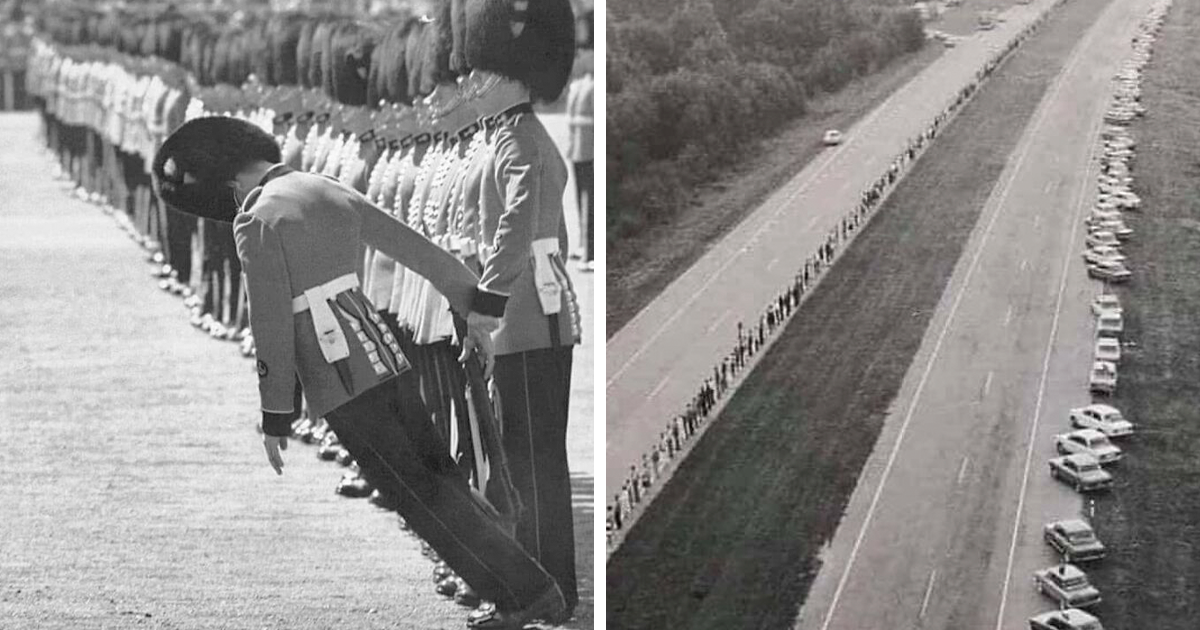
Some people learn history from textbooks. Some learn it from documentaries. And some of us get smacked in the face by a single old photograph and suddenly realize, “Oh. These were real people with real shoes, real jobs, real fear, and probably real back pain.” That is the magic of historical photography, and it is exactly why pages like Historyfeels hit such a nerve. A strong image does not just tell you what happened. It reminds you that the past was once the present for someone else.
A gallery of 50 historical photos can do something surprisingly powerful: it can turn history from a timeline into a lived experience. One frame might show a child standing in a factory doorway. Another might capture immigrants arriving with all their worldly belongings. Another might freeze a war, a protest, a celebration, or the ordinary act of commuting to work in clothes that now look like a costume department had too much fun. When you look at enough of these photos together, a bigger truth starts to emerge. History is not just made of presidents, treaties, and wars. It is also made of hairstyles, lunch breaks, train platforms, family portraits, tired faces, proud faces, and the occasional expression that says, “I did not agree to be photographed, sir.”
Why Historical Photos Hit Harder Than You Expect
The best historical photos collapse distance. A hundred years disappears in a second when you see a mother comforting her child, workers clowning around during a break, or a crowd gathering in hope or panic. Suddenly, the past stops feeling dusty and starts feeling uncomfortably familiar. That is the reason collections of archival images remain so compelling. They do not merely illustrate history; they humanize it.
That human element matters. Facts can tell you that the Great Depression devastated families, that migration reshaped cities, or that war altered daily life. A photograph shows you the look in someone’s eyes when those forces landed in the middle of their ordinary Tuesday. It gives texture to the abstract. It also gives scale. The giant forces of history become easier to understand when they are reflected in one face, one street, one classroom, one train car, or one kitchen table.
That is why a collection like this feels richer than a random batch of vintage pictures. It is not just old stuff for the sake of old stuff. It is visual evidence. It is a record of how people dressed, worked, traveled, protested, played, mourned, built, and endured. In other words, it is history behaving like real life.
What 50 Photos Can Teach You About the Past
1. Everyday Life Is Never Boring to Future Generations
One of the biggest lessons historical photography teaches is that ordinary life becomes extraordinary with time. A streetcar stop, a school lunch, a storefront, or a family posed on the porch may have seemed completely unremarkable when the shutter clicked. Decades later, those same details become gold for anyone trying to understand a vanished world.
That is why images of neighborhoods, workers, and families matter so much. They preserve the rhythms of life that official records often ignore. Governments preserve laws and reports. Cameras preserve socks, lunch pails, expressions, furniture, and the thousand little signs of how people actually lived.
2. Progress Is Real, but It Is Never Neat
Scroll through enough historical photos and one thing becomes obvious: progress is not a straight line. Technology improves, cities expand, transportation speeds up, and tools change. But the human story remains messy. Photos of industrial labor, crowded immigrant processing centers, wartime production, and early urban growth reveal ambition and hardship sitting side by side. Civilization does not move forward like a smooth elevator. It lurches, rattles, and occasionally forgets what floor it was aiming for.
That is part of what makes old images so educational. They show achievement without hiding the cost. A gleaming factory can also hint at dangerous working conditions. A modern city block can also reveal inequality. A heroic national moment can still contain exhausted people doing the unglamorous work that made it possible.
3. The Camera Preserves Both Triumph and Trouble
Historical photography has captured some of the most hopeful and painful chapters of modern history. Images from battlefields, internment sites, protests, migrations, and humanitarian crises do more than document events. They force viewers to confront what those events looked like on the ground.
That is especially important because memory tends to simplify. Over time, people flatten history into slogans. Photos resist that flattening. They insist on detail. They show that war is not only strategy, but mud, bodies, distance, smoke, and stunned faces. They show that civil rights were not won by a paragraph in a textbook, but by real people standing in real streets under very real pressure. They show that displacement is not only a policy issue, but luggage, waiting rooms, family separation, and uncertainty.
4. Fashion, Design, and Architecture Are Secret History Teachers
Let us give proper respect to hats, signage, wallpaper, and suspiciously serious mustaches. These details are not decorative fluff. They are clues. Historical photos teach us how beauty standards shifted, how wealth was displayed, how public spaces were organized, and how technology entered the home. A single image can reveal class, region, occupation, and even political climate if you know what to look for.
A crowded city scene, for example, tells you about transportation, consumer culture, advertising, and social mixing. A portrait studio image tells you about dignity, aspiration, and how people wanted to be seen. A photo of a schoolroom quietly reveals everything from discipline to literacy to public investment. In historical photography, the background is never just background.
The Most Powerful Lessons Hidden Inside a Historyfeels-Style Gallery
If you take 50 strong historical images from across different eras, several themes rise to the top again and again.
History Is Built by Ordinary People
Famous leaders appear in archives, of course. But so do farmers, machinists, nurses, students, migrants, children, photographers, and people whose names never made it into the big history books. That matters because the past was not shaped only by the famous. It was shaped by millions of people who got up, went to work, raised families, joined movements, survived disasters, or simply kept going.
Photos are especially good at restoring that balance. They remind us that anonymous people were never actually anonymous to themselves. Every unknown subject in an archive was the center of somebody’s world.
Public Memory Is Selective
Collections like this often feel surprising because they show what formal education leaves out. Textbooks have limits. They cannot linger on every local story, every overlooked community, or every transitional moment that did not make the greatest-hits album of national history. Historical photo collections fill in those gaps.
That is why lesser-known images can be more illuminating than the famous ones. A well-known photograph might symbolize an era, but a less familiar one can reveal how that era actually felt. The combination of both is where the real learning happens.
Context Matters More Than Vibes
Old photos are powerful, but they are not self-explanatory. A dramatic image can mislead if the caption is wrong, incomplete, or oversimplified. That is why good historical interpretation asks basic but essential questions: Who took the picture? When? Where? Why? What was outside the frame? Was this candid, staged, official, personal, or propagandistic?
This is where viewers become better historians. The goal is not just to admire old images and whisper, “Wow, neat suspenders.” The goal is to read them critically. Every photograph is both evidence and argument. It shows something real, but it also reflects a choice: what to include, what to exclude, and what story to emphasize.
Real Historical Photography Proves the Point
Some of the strongest archival traditions in the United States make this lesson crystal clear. Civil War battlefield photography changed how Americans saw conflict because it brought the aftermath into public view with shocking immediacy. Depression-era documentary images made poverty and labor visible in ways statistics alone never could. Immigration photographs preserved the anxious hope of arrival. Images from Japanese American incarceration sites revealed the human reality behind wartime policy. Photographs tied to the civil rights era turned moral struggle into something impossible to ignore. And space-age archives remind us that even the grandest technological achievements were built by people in labs, offices, hangars, and control rooms doing painstaking, very earthly work.
Put those traditions next to a modern social media curation project like Historyfeels, and the appeal makes perfect sense. The platform is not popular because people suddenly discovered that sepia tones are fashionable again. It works because viewers are hungry for connection. They want history that feels inhabited. They want reminders that the past was crowded with people just as complicated as we are.
How to Look at Old Photos Like a Better Reader of History
If a gallery like this pulls you in, do not stop at the surface. Slow down. Study the edges of the image. Look at clothing, posture, signage, tools, buildings, and who is present or absent. Ask what the photographer wanted you to notice. Ask what the subject might have wanted hidden. Ask whether the image captures power, vulnerability, pride, fear, or performance.
Then do one more thing: compare images across time. That is where the real fun begins. Put a wartime factory next to a modern workplace. Put a street in 1910 next to the same street today. Put a classroom, hospital, protest, or family portrait beside its modern equivalent. The similarities can be just as revealing as the differences. Technology changes. Human behavior, less so. People still posture in group photos. Kids still look bored sometimes. Adults still try to appear more composed than they feel. In that sense, history is not distant at all. It is just earlier.
Why This Kind of Gallery Still Matters Now
We live in an age of too many images and too little attention. Ironically, that makes historical photography even more important. A good archival photo interrupts the scroll. It asks for patience. It rewards curiosity. It reminds us that every era thinks it is normal while living through events future generations will label dramatic, defining, or disastrous.
That perspective is healthy. It makes us more humble about the present and more compassionate toward the past. It also makes us harder to fool. Once you learn to read images carefully, you become better at reading all media carefully, including the polished, edited, emotionally manipulative stuff flooding modern feeds every hour.
So yes, 50 photos from Historyfeels might teach you more about our past. Not because they replace books, museums, or scholarship, but because they invite you into them. They are gateways. They spark questions. They make history feel less like a lecture and more like a room you can walk into. And once you step inside, it is very hard to go back to treating the past like a list of dates that politely happened to other people.
Experiences That Make Historical Photos Stick With You
There is also something deeply personal about spending time with historical photographs, even when the people in them are complete strangers. Many viewers have the same experience: they start by casually browsing, then suddenly stop on one image and stay there much longer than expected. Maybe it is a child leaning against a parent, a worker staring straight into the lens, or a crowd frozen in the middle of a huge public moment. Whatever it is, the photo stops being “content” and starts feeling like contact.
That experience can be oddly emotional. You are not just seeing old clothing or antique cars. You are recognizing body language, fatigue, pride, grief, excitement, or awkwardness in people who lived decades ago. The surprise comes from realizing how recognizable they still are. A grandmother smiling in a 1930s porch photo can remind you of someone in your own family. A student in a formal class portrait can look exactly like the kid who sits near the window in any modern school. A tired parent photographed during a hard season of life still looks like a tired parent. History suddenly stops feeling foreign.
Many people also experience a strange kind of humility when they study archives. It becomes obvious that the present is not as original as we like to think. We tend to imagine ourselves as more advanced, more informed, and somehow less dramatic than previous generations. Then a historical photo shows a political rally, a labor strike, a fashion craze, a public health response, or a transportation headache, and you realize humanity has been remixing the same anxieties for a very long time. The tools change. The feelings do not.
Another memorable part of the experience is noticing tiny details that historians and photographers love but casual viewers often overlook at first. The shoes. The lunch tin. The cigarette sign. The hand on a shoulder. The worn-out collar. The way one person faces the camera while another refuses it. These details make a photo feel inhabited. They transform the image from a historical example into a lived scene. It is a bit like hearing a famous song stripped down acoustically; suddenly, all the texture becomes clearer.
For some viewers, historical photos spark curiosity about family history. After seeing enough archival images online, people start asking older relatives about the pictures stored in drawers, albums, or boxes in the closet. Who is that person? Where was this taken? Why was everyone dressed up on a random Tuesday? In that way, broad public history often leads back to private memory. Big history and family history start shaking hands.
And maybe that is the most valuable experience of all. A collection like Historyfeels does not just teach facts. It trains attention. It encourages people to pause, observe, question, and care. It shows that the past was full of people who did not know they were living inside history. That realization changes the way you look at today. It makes ordinary life feel more significant, not less. Someday, someone may study our own photos for clues about who we were, what we feared, what we celebrated, and how we carried ourselves through uncertain times. That thought is both funny and a little sobering. Apparently, even your most casual picture might one day become historical evidence. So choose your facial expression wisely.
Conclusion
In the end, the real power of a 50-photo historical gallery is not that it gives you a complete account of the past. No gallery can do that. Its power is that it opens doors. It turns strangers into witnesses, forgotten moments into evidence, and distant events into something you can almost feel. That is why historical photography remains one of the best teachers around. It makes the past visible, human, and just close enough to unsettle us in the best possible way.