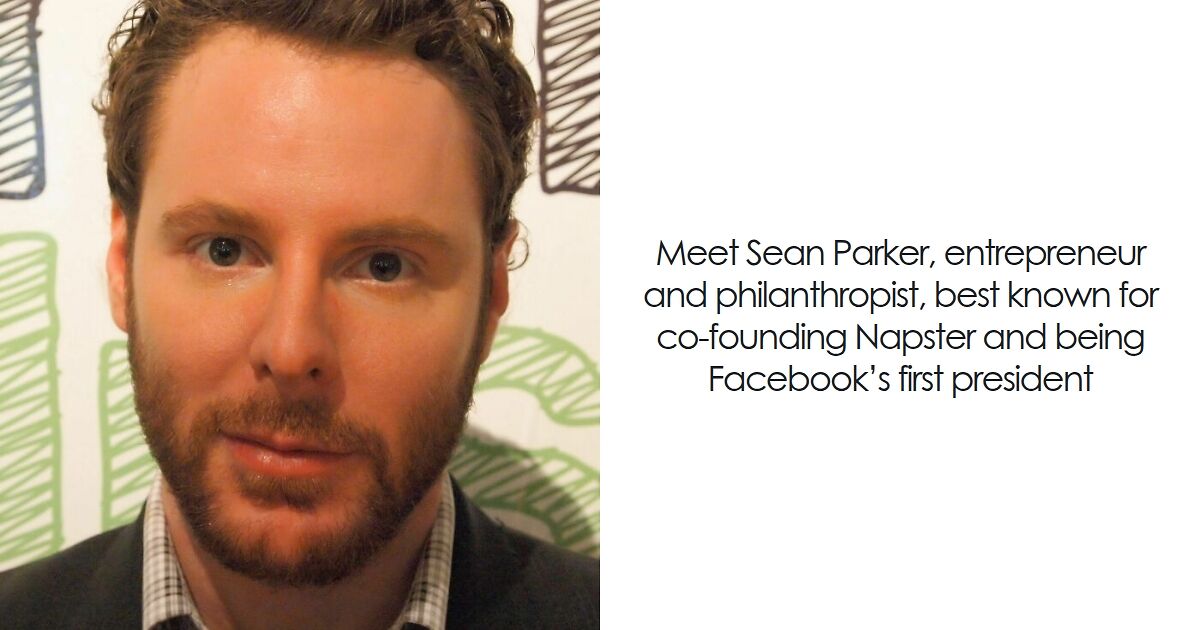
Sean Parker is one of those Silicon Valley figures who seems to have walked into the internet while it was still under construction, moved a few load-bearing walls, annoyed several lawyers, made several founders very rich, and then casually wandered into philanthropy. Best known as the co-founder of Napster and the first president of Facebook, Parker built a career around seeing where digital behavior was heading before most people had even finished downloading a dial-up ringtone.
His story is not a neat corporate ladder climb. It is more like a high-speed browser with 47 tabs open: music sharing, social networking, venture capital, civic technology, cancer immunotherapy, public policy, artificial intelligence, and the occasional pop-culture cameo. Yet beneath the chaos is a consistent pattern. Parker has repeatedly attached himself to ideas that changed how people connect, communicate, consume media, and organize information.
This biography explores Sean Parker’s early life, major companies, career highlights, public influence, controversies, philanthropic work, and the lessons entrepreneurs can learn from his unusual path.
Early Life: A Programmer Before “Startup Founder” Was a Personality Type
Sean Parker was born on December 3, 1979, and grew up in Virginia. His father introduced him to computer programming when Parker was still a child, giving him a head start in a world that was about to become increasingly software-driven. By the time many kids were collecting baseball cards, Parker was learning how systems worked, how networks connected, and how code could turn an idea into something millions of people might use.
As a teenager, Parker became known for his programming ability and his curiosity about computer networks. He also had a brush with federal authorities after hacking activity as a minor, an episode often mentioned in profiles of his early life. The important takeaway is not that he was a “bad boy hacker,” although Hollywood certainly enjoyed that angle. It is that Parker developed an unusually deep understanding of digital systems before the commercial internet had matured.
He graduated from Oakton High School in Virginia in 1996. Rather than following the traditional college-to-corporate-job route, Parker moved quickly into internet entrepreneurship. That decision put him in the middle of the late-1990s web explosion, when a clever idea, a small team, and a slightly suspicious server room could become a cultural earthquake.
Napster: The Company That Made Music Panic and the Internet Pay Attention
Sean Parker’s first major career-defining moment came in 1999 with Napster, the peer-to-peer file-sharing service he co-founded with Shawn Fanning. Napster allowed users to search for and share MP3 music files across the internet. It was simple, fast, and wildly popular. It also gave the record industry the sort of headache normally associated with eating gas-station sushi.
Napster did not merely introduce a new product; it exposed a new consumer expectation. People wanted music instantly, digitally, and on demand. The company’s legal problems were enormous because copyrighted music was being shared without permission, and the service was eventually forced to shut down. But even in failure, Napster changed the direction of the music business.
Before Napster, music distribution was still tied heavily to physical albums and controlled retail channels. After Napster, the industry could no longer pretend the internet was a cute side project. The future would be digital, searchable, portable, and user-driven. Legal services such as iTunes, Spotify, and other streaming platforms later built business models around a reality Napster had made impossible to ignore.
For Parker, Napster was both a triumph and a warning. It proved he could spot massive behavioral shifts early. It also showed that disruption without legal structure can burn hot and fast. Napster made him famous in tech circles, but it also taught a lesson that would echo throughout his later career: the best internet products do not just need users; they need sustainable systems around them.
Plaxo: Social Networking Before Social Networking Became the Internet’s Living Room
After Napster, Parker co-founded Plaxo, an online address book and contact-management service. Today that may sound about as thrilling as alphabetizing a filing cabinet, but at the time it reflected another early insight: personal data, identity, and social connections were moving online.
Plaxo helped users keep contact information updated automatically. It was not Facebook, but it pointed toward the same larger shift: the internet was becoming personal. People were no longer just browsing websites; they were building digital identities, maintaining networks, and expecting software to remember relationships.
Parker’s experience at Plaxo was also personally important because it sharpened his thinking about founder control, company governance, and how investors influence startups. Later, when he joined Facebook, that experience helped him understand why protecting Mark Zuckerberg’s long-term control could matter. In other words, Plaxo may not be Parker’s most famous company, but it helped prepare him for the role that would make him a central figure in social media history.
Facebook: The First President Who Helped Turn a College Site Into a Company
Sean Parker joined Facebook in 2004, when the platform was still young and known as Thefacebook. At the time, it was a fast-growing social network for college students, not yet the global platform that would later reshape communication, advertising, politics, media, and the way relatives comment on vacation photos.
Parker became Facebook’s first president and brought startup experience, investor connections, and product instincts. He helped the company move from a promising campus project into a serious business. One of his most important contributions was helping Facebook connect with early funding, including the investment network around Peter Thiel. Parker also supported a cleaner product vision at a time when competitors like MySpace were cluttered, chaotic, and visually allergic to restraint.
His time at Facebook was brief, lasting roughly from 2004 to 2005, but his influence was significant. He pushed the company toward scale, helped professionalize its operations, and understood that authentic identity could become Facebook’s defining advantage. While other social platforms allowed users to hide behind decorative usernames and glittering profile chaos, Facebook emphasized real names, real schools, and real social graphs.
Parker eventually stepped down after an arrest in 2005, though no charges were filed. The episode became part of the Parker legend and was later dramatized in the film The Social Network, where Justin Timberlake portrayed him as a charismatic, sharp-tongued disruptor. As with most Hollywood business portrayals, viewers should treat the film as drama, not a notarized affidavit with a soundtrack.
Venture Capital and Spotify: A Return to the Music Question
After Facebook, Parker remained active in technology investing and joined Founders Fund, the venture capital firm associated with Peter Thiel and other prominent Silicon Valley investors. His investment career reflected the same pattern as his operating career: he was drawn to companies that could reshape user behavior at scale.
One of Parker’s most meaningful later bets was Spotify. In 2010, he invested in the Swedish music-streaming company and later served on its board. This move felt almost poetic. Napster had shown what people wanted from digital music, but it lacked the legal and commercial framework to survive. Spotify offered a licensed streaming model that gave users access to huge music libraries while working with labels and rights holders.
Parker’s involvement with Spotify connected the first messy chapter of online music to a more mature version of the same idea. The lesson was clear: disruption wins faster when it solves problems for users and negotiates reality with the industry it is disrupting. Not as fun as a digital rebellion? Maybe. More durable? Absolutely.
Causes, Brigade, and Civic Technology
Sean Parker also explored civic engagement through platforms such as Causes and Brigade. Causes began as a social advocacy application that allowed people to support campaigns, share issues, and organize around social causes. Brigade later aimed to increase political participation and help users engage with civic issues more directly.
These projects reflected Parker’s belief that networks could influence more than entertainment and friendship. If digital platforms could change how people found music and friends, perhaps they could also change how citizens discovered issues, contacted representatives, or participated in democracy.
Civic technology has always been harder than consumer social media. People will share memes instantly, but asking them to study local policy is like asking a cat to attend a budget meeting. Still, Parker’s work in this area showed his broader interest in applying internet mechanics to public life.
The Parker Foundation and Cancer Immunotherapy
In 2015, Parker launched the Parker Foundation with a major philanthropic commitment focused on life sciences, global public health, civic engagement, and the arts. The foundation became the center of his shift from startup disruption to large-scale problem solving.
One of its most important initiatives is the Parker Institute for Cancer Immunotherapy, established in 2016 through a $250 million grant. The institute was designed to accelerate collaboration among top cancer researchers and major medical centers. Its mission is centered on immunotherapy, a field that uses the body’s immune system to fight cancer.
The Parker Institute’s model emphasizes cooperation, data sharing, industry partnerships, and breaking down research silos. That approach sounds very Silicon Valley because, in many ways, it is: take a slow, fragmented system; connect the right people; fund the infrastructure; and try to speed up outcomes. Cancer research is obviously more complicated than launching an app, but Parker’s philanthropic strategy borrows from the startup playbook: align incentives, build networks, and focus on results.
Economic Innovation Group and Public Policy
Parker also helped found the Economic Innovation Group, a bipartisan public policy organization focused on economic opportunity and distressed communities. EIG became closely associated with the Opportunity Zones initiative, a policy tool designed to encourage long-term private investment in lower-income areas across the United States.
Opportunity Zones have attracted both praise and criticism. Supporters argue that they can direct capital into places that need investment. Critics argue that the benefits can flow too heavily toward wealthy investors and developers. Parker’s involvement demonstrates another recurring theme in his career: he is attracted to systems-level problems where technology, capital, incentives, and policy intersect.
Current Influence: Beyond the Classic Web 2.0 Era
Sean Parker’s public profile is still tied to Napster and Facebook, but his work has expanded well beyond early internet companies. Official biographical materials list roles connected to Cantina Labs, Stability AI, Weta FX, biotech companies, cancer research, arts organizations, and civic institutions.
This evolution matters because it shows how some early internet entrepreneurs have moved from building platforms to shaping infrastructure around science, artificial intelligence, healthcare, and public policy. Parker’s career is not just a nostalgia tour through Web 2.0. It is a case study in how technical instincts can migrate into new fields.
Sean Parker’s Career Highlights
Co-founding Napster
Napster made Parker a major figure in internet history. The service challenged the music industry, introduced millions of users to peer-to-peer sharing, and helped define the digital music era.
Co-founding Plaxo
Plaxo showed Parker’s interest in identity, networks, and personal data management before social platforms became mainstream.
Serving as Facebook’s First President
Parker helped Facebook move from a college social network to a real company. His role in early funding, product direction, and founder control remains one of the most discussed parts of his career.
Investing in Spotify
Spotify represented a more sustainable version of the digital music access model that Napster had previewed. Parker’s investment and board role connected him again to the future of music distribution.
Launching Major Philanthropic Initiatives
Through the Parker Foundation and the Parker Institute for Cancer Immunotherapy, Parker has directed substantial resources toward science, healthcare, and public impact.
Working in Civic and Economic Innovation
His involvement with Causes, Brigade, and the Economic Innovation Group reflects a long-running interest in using networks and policy to influence civic participation and economic opportunity.
Why Sean Parker Matters
Sean Parker matters because his career sits at the intersection of several major shifts: music going digital, identity moving online, social networks becoming infrastructure, venture capital shaping consumer technology, and philanthropy adopting startup-style urgency.
He is not simply a founder with one famous company. He is a connector, strategist, investor, and institution builder. His strongest talent appears to be pattern recognition. Parker has repeatedly recognized when user behavior was changing before the market, media, or regulators fully understood it.
That does not mean every Parker-backed idea became a runaway success. Airtime, for example, generated major attention but struggled to become the next great social platform. Yet even that failure is useful because it shows that timing, product design, and user behavior must align. A famous founder and celebrity launch party can attract headlines, but headlines do not automatically become habits.
Experiences and Lessons From Sean Parker’s Career
Sean Parker’s career offers several practical experiences for founders, marketers, writers, creators, investors, and anyone trying to understand how internet-era influence works. The first lesson is that big opportunities often appear first as user behavior that looks strange, messy, or even threatening. Napster was controversial, but it revealed a real demand: people wanted instant access to music. The legal model was broken, but the consumer insight was powerful. For entrepreneurs, this is gold. Watch what users do before the official market approves it.
The second lesson is that timing can be both a superpower and a trap. Napster was early enough to become legendary but too early to become legally stable. Spotify arrived later with licensing, subscriptions, mobile adoption, and industry partnerships better aligned. In business, being first is impressive, but being first with a working ecosystem is better. A rocket without a landing plan is still exciting, but investors usually prefer reusable rockets.
The third experience is the importance of networks. Parker’s career was built not only on ideas but also on relationships. His connection with Shawn Fanning led to Napster. His meeting with Mark Zuckerberg changed Facebook. His relationships in venture capital helped him influence companies beyond his own startups. This does not mean success is just about “knowing people.” It means that talent becomes more powerful when paired with trust, timing, and access to the right collaborators.
The fourth lesson is that product simplicity matters. Facebook’s early strength was not that it had every feature imaginable. It was clean, identity-based, and easy to understand. In a world full of noisy platforms, restraint can be a competitive advantage. Many founders try to win by adding more buttons, more dashboards, more pop-ups, and more “engagement features.” Users, meanwhile, are quietly begging for software that does not feel like a microwave manual written by aliens.
The fifth lesson is that controversy can follow disruption, especially when technology moves faster than law, culture, or business models. Parker’s major career chapters all touched sensitive systems: copyright, privacy, social identity, politics, healthcare, and economic policy. Builders who enter these spaces need more than clever code. They need judgment, accountability, and an understanding of second-order effects.
The sixth lesson is that reinvention is possible. Parker could have remained “the Napster guy” or “the Facebook guy,” but he moved into investing, philanthropy, immunotherapy, civic technology, and public policy. That kind of reinvention is difficult because public reputation tends to freeze people in their most famous moment. Parker’s later work shows that a career can become broader than its origin story.
Finally, Parker’s career highlights the difference between disruption and durable impact. Disruption gets attention. Durable impact changes systems. Napster disrupted. Facebook scaled. Spotify endured. The Parker Institute attempts to accelerate medical research. Each chapter shows a different version of influence. For readers building their own careers, the message is clear: spot change early, learn from failure, build strong networks, simplify the user experience, and think seriously about the consequences of what you create.
Conclusion
Sean Parker’s biography is a tour through the modern internet’s most important chapters. From Napster’s music revolution to Facebook’s social networking boom, from Spotify’s streaming model to cancer immunotherapy philanthropy, Parker has repeatedly appeared near ideas that reshaped industries.
His career has not been spotless, simple, or quiet. That is partly why it remains fascinating. Parker represents the restless, brilliant, occasionally chaotic energy of Silicon Valley at its most influential. He has been a founder, investor, strategist, philanthropist, civic-tech advocate, and public-policy participant. Few entrepreneurs have been so closely connected to so many major transitions in digital life.
For anyone studying entrepreneurship, Sean Parker’s career is a reminder that the future often arrives disguised as a problem. The people who recognize the pattern early may get criticized, copied, sued, celebrated, dramatized in a movie, and eventually invited to fund cancer research. In Parker’s case, that is not a metaphor. That is basically the résumé.