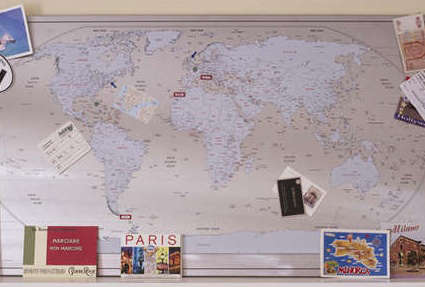
An enormous magnetic world map is what happens when geography, home décor, travel memories, and mild organizational obsession all decide to move in together. It is not just a big map on a wall. It is a conversation starter, a planning board, a classroom tool, a travel scrapbook, and occasionally a very polite reminder that Greenland is not actually the size of Africa.
Whether you want a huge magnetic world map for your living room, a classroom world map for students, a magnetic travel map for souvenirs, or a dramatic wall map for an office, the idea is simple: take the world, enlarge it, make it magnetic, and suddenly geography becomes something you can touch. Instead of stabbing a paper map with push pins like a tiny cartographic villain, you can move magnets around, mark dream destinations, track family trips, highlight business regions, or let kids learn continents without turning the wall into Swiss cheese.
In a world of GPS, satellite imagery, and “turn left in 300 feet,” a physical wall map might sound old-school. But that is exactly its charm. A giant magnetic world map slows geography down. It turns the planet into a visible daily object, not just a blue dot on a phone. And because it is magnetic, it invites interaction. Maps are not meant to sit quietly. They are meant to make people point, ask, argue, remember, and plan.
What Is an Enormous Magnetic World Map?
An enormous magnetic world map is a large-format world map designed to hold magnets. It may be printed on magnetic receptive material, mounted over steel, printed on a magnetic board, or made as metal wall art. Some versions look like traditional political maps with countries, borders, capitals, oceans, and latitude lines. Others are minimalist décor pieces with continent silhouettes, muted colors, or vintage styling.
The word “enormous” matters. A small desk map is useful, but a huge wall map changes the room. It can stretch across a hallway, fill a family room wall, anchor a homeschool space, or become the most interesting part of a conference room. Large maps also make labels easier to read and give magnets enough space to mark cities without causing a pileup over Europe, where every magnet seems determined to sit on top of Paris.
The “magnetic” part adds the magic. You can use souvenir magnets, colored magnetic dots, magnetic labels, dry-erase magnetic strips, or custom markers. A family may use red magnets for places visited, blue magnets for dream trips, and yellow magnets for “we will go once everyone agrees that six-hour layovers are not character-building.” Teachers may use magnets to show trade routes, migration paths, climate zones, or current events. Businesses may mark clients, suppliers, shipping lanes, and global offices.
Why People Love Huge Magnetic World Maps
They Turn Travel Memories Into Wall Art
Travel photos often disappear into phones, cloud folders, or that one external hard drive nobody dares unplug. A magnetic travel map gives memories a physical home. You can place a magnet on Rome after a honeymoon, Tokyo after a work trip, or Yellowstone after the family road trip where someone definitely claimed they were “not tired” five minutes before falling asleep.
Unlike a push pin map, a magnetic map is flexible. Plans change. Families move. Kids grow up. Someone may decide that the dream destination is no longer Iceland but New Zealand because they saw one landscape reel and now apparently needs mountains, sheep, and dramatic fog. With magnets, the map evolves without damage.
They Make Geography Easier to Learn
For students, geography becomes more memorable when it is visual, spatial, and hands-on. A large magnetic world map supports interactive learning. Children can place continent names, match flags to countries, trace ocean routes, compare time zones, or mark where historical events happened. It is especially useful for visual learners who need more than a paragraph in a textbook to understand how far Brazil is from Japan.
Teachers and parents can also use magnetic maps to create quick activities. Ask students to locate countries in the news, identify major mountain ranges, place magnets on the world’s largest deserts, or compare the locations of ancient civilizations. The board becomes part map, part game, part geography gym.
They Help Adults Think Globally
Adults benefit too. A giant magnetic world map can help with business planning, international shipping, nonprofit work, language learning, genealogy, and trip budgeting. It gives global relationships a physical shape. Seeing suppliers in Vietnam, clients in California, family in Canada, and future vacation dreams in Portugal makes the world feel both enormous and surprisingly connected.
For remote teams, a magnetic map can mark where colleagues live. For writers, it can track story settings. For history lovers, it can show empires, routes, battles, migrations, and cultural exchange. For food lovers, it can mark every country whose cuisine they want to cook, which is a noble mission and also an excellent excuse to buy more spices.
Choosing the Right Projection: The Map Behind the Map
When buying or designing an enormous magnetic world map, projection matters. A projection is the method used to turn the round Earth into a flat image. The problem is that the Earth is a sphere-like object and your wall is flat, so every world map has to compromise. Something must be stretched, squeezed, curved, or sacrificed to the geometry gods.
The Mercator projection is famous and widely recognized. It was historically useful for navigation because it represents lines of constant bearing as straight lines. However, it greatly enlarges areas near the poles, making Greenland, Canada, Russia, and northern Europe look much larger compared with countries near the equator. For general education or décor, this distortion can create misleading impressions of size.
Many modern world maps use compromise projections such as Robinson or Winkel Tripel. These try to balance shape, size, distance, and overall appearance. National Geographic adopted the Winkel Tripel projection for its signature world maps in the 1990s because it offers a visually balanced representation of the globe on flat paper. Equal-area projections, such as Equal Earth, focus on preserving relative land area, making them useful when accurate size comparison is important.
For a magnetic wall map, the best projection depends on purpose. If the map is mainly decorative, a beautiful compromise projection may be ideal. If it is for education, consider a projection that avoids extreme size distortion. If the map is for travel memories, readability may matter more than mathematical perfection. No flat map is flawless, but a good map should at least be honest about its compromises.
Materials: What Makes a Magnetic Map Actually Magnetic?
Not every map that says “magnetic” works the same way. Some are true magnetic boards with a printed map surface. Others are steel-backed panels that attract magnets. Some use magnetic receptive wallpaper or vinyl, while others are metal wall sculptures shaped like continents. Before buying, check whether the product attracts standard magnets, requires special magnets, or is itself magnetic but not magnetic receptive. Yes, this sounds like a small detail. It is not small when your souvenir magnet from Chicago slides sadly to the floor.
Common Material Options
Steel-backed printed maps are sturdy and excellent for regular use. They are popular in classrooms, offices, and family spaces because magnets hold well. Magnetic whiteboard maps are practical if you want to write notes, draw routes, or erase labels. Magnetic wallpaper or decals can create a seamless wall-sized effect, although installation requires care. Metal map wall art is stylish and often more decorative than detailed, making it better for visual impact than serious geography study.
Finish also matters. A matte finish reduces glare and works well in bright rooms. Lamination improves durability and may allow dry-erase use, depending on the surface. Framed maps look polished but may limit edge-to-edge magnet placement. Foam-mounted maps are lightweight but may not hold magnets unless they include a magnetic layer. Always read the specifications, because “large wall map” and “magnetic wall map” are cousins, not twins.
Best Places to Use an Enormous Magnetic World Map
Living Room
In a living room, a huge magnetic world map becomes personal art. It tells visitors where you have been and where you hope to go. It also gives guests something to discuss besides the weather, the price of groceries, or whether the houseplant in the corner is thriving or silently judging everyone.
Home Office
A home office map can support planning and motivation. Mark client locations, research regions, international markets, or writing projects. If your work involves global topics, the map becomes a visual dashboard. If your work does not involve global topics, it still makes you look thoughtful on video calls.
Classroom or Homeschool Room
For education, bigger is usually better. Students can gather around the map, move labels, place event markers, and compare regions. A magnetic classroom world map is also reusable. Teachers can change lessons quickly without printing new worksheets every time geography enters the chat.
Kids’ Playroom
In a playroom, a magnetic world map can turn learning into play. Use animal magnets to match species with habitats, food magnets to show where ingredients come from, or flag magnets to introduce countries. The map becomes a quiet teacher that does not assign homework, which makes it instantly more popular.
Office Lobby or Conference Room
Companies with international customers, suppliers, partners, or employees can use a large magnetic map to show global reach. It is more engaging than a bullet list on a slide and more memorable than a spreadsheet. A well-designed wall map says, “We work globally,” without making anyone sit through a 47-slide deck.
How to Style a Giant Magnetic Map Without Making the Wall Look Chaotic
The key to styling an enormous magnetic world map is restraint. Magnets are fun, but too many can make the map look like a refrigerator survived a tornado. Choose a system before you start. Use one color for visited places, another for future trips, and another for favorite destinations. If the map is for business, assign colors by region, project, or customer type.
Keep magnet size proportional. Tiny magnets disappear on a massive map, while oversized magnets can cover entire countries. This is especially tricky in areas with many small countries, such as Europe, the Caribbean, and parts of Southeast Asia. A good trick is to place magnets slightly outside crowded regions and use thin lines or labels to connect them to exact locations.
Lighting also matters. A large map deserves good light. Avoid placing glossy maps directly opposite windows, where glare can turn the Pacific Ocean into a mirror. Use warm wall lighting for a cozy look or track lighting for a gallery effect. If the map has muted colors, pair it with simple furniture. If it is colorful and detailed, let it be the star.
Installation Tips Before You Commit to a Wall-Sized Planet
Measure first. Then measure again. Then ask someone else to measure, because enormous wall décor has a way of becoming more enormous once it arrives. Check the width, height, wall clearance, furniture placement, and sightline. A map that looks dramatic online may overwhelm a narrow hallway or disappear on a giant blank wall if it is not scaled correctly.
For heavy magnetic boards or metal maps, use proper anchors and follow installation instructions. If possible, mount into studs. Large panels may require two people, a level, and a calm attitude toward tiny mistakes. Magnetic decals or wallpaper require a smooth wall and careful alignment. Bubbles, wrinkles, and crooked borders are the enemy. So is rushing.
Consider safety too. Small magnets can be hazardous for young children and pets, especially strong rare-earth magnets. Keep tiny magnets out of reach, and avoid placing powerful magnets near sensitive electronics, magnetic cards, or medical devices. For family spaces, choose larger, safer magnets that are easy to handle and hard to swallow.
Creative Ways to Use a Magnetic World Map
Track Past and Future Travel
Create a simple legend: green for places visited, gold for planned trips, and white for dream destinations. Add small date labels to remember when each journey happened. Over time, the map becomes a family travel archive.
Plan a Round-the-World Reading List
Place magnets on countries connected to books you read. One month could be Japan, the next Nigeria, then Mexico, India, and Norway. This turns a magnetic world map into a literary passport.
Teach Current Events
When a major news story happens, mark the location. This helps students and adults connect headlines to real places. News becomes less abstract when you can see where it is happening.
Build a Food Map
Mark the origins of dishes you cook at home: pho from Vietnam, tacos from Mexico, sushi from Japan, tagine from Morocco, pierogi from Poland. Warning: this activity may cause hunger and spontaneous grocery shopping.
Map Family History
Use magnets to show where grandparents, great-grandparents, or ancestors lived. Add notes, photos, or names. A world map can become a family story wall, connecting generations across oceans.
Common Mistakes to Avoid
The first mistake is buying a map that is large but not readable. A beautiful oversized map is less useful if country names blur from three feet away. Check sample images, font size, and label clarity. The second mistake is ignoring projection. If the map is for education, avoid designs that create serious misconceptions about landmass size.
The third mistake is choosing the wrong surface. If you want to use souvenir magnets, make sure the map is magnetic receptive. If you want dry-erase features, confirm that the surface supports it. The fourth mistake is buying too many tiny magnets. Tiny magnets look cute in a package but vanish visually on a huge map.
The fifth mistake is forgetting updates. Political borders, country names, and disputed territories may change over time. A decorative map does not need to be updated every week, but an educational or business map should be reasonably current.
Is an Enormous Magnetic World Map Worth It?
Yes, if you want a wall feature that is both beautiful and useful. A giant magnetic world map is more than decoration. It invites curiosity. It helps children learn. It gives travelers a place to collect memories. It helps businesses visualize global activity. It encourages people to think beyond their neighborhood, city, and country.
It is especially worthwhile for families who travel, teachers who want interactive geography tools, remote teams with international members, and anyone who loves maps. It is also a strong choice for people who want wall décor with meaning. A framed print can look nice, but a magnetic map keeps changing. It grows with your life.
Personal Experiences With an Enormous Magnetic World Map
The first thing you notice about an enormous magnetic world map is not the information. It is the presence. A regular map says, “Here is the world.” A giant magnetic map says, “Cancel your plans; we need to discuss Patagonia.” It changes the energy of a room immediately. People walk toward it without being asked. They point to places they have visited, places they mispronounce with confidence, and places they suddenly decide must be added to the bucket list.
One of the best experiences is watching children use it. Adults tend to approach maps with facts. Children approach them with wonder. They ask why countries have strange shapes, why oceans are so big, why islands look lonely, and whether Antarctica has restaurants. A magnetic world map gives those questions a place to land. Instead of saying, “Look it up later,” you can hand them a magnet and say, “Find it.” That small physical action makes learning feel like discovery.
For travel lovers, the map becomes emotional. A magnet on Italy may represent a first trip abroad. A magnet on Thailand may represent a summer that changed someone’s life. A magnet on New York may mark the place where a family reunion happened after years apart. The map quietly collects stories. It does not need captions, though captions help. Every marker becomes a memory button.
There is also a practical pleasure in rearranging it. Planning a trip on a phone is efficient, but planning on a wall map feels cinematic. You can step back, compare routes, notice nearby countries, and understand distance in a more intuitive way. Suddenly “we could also visit Prague” becomes visible. So does “maybe not five countries in six days unless we are training for the Travel Olympics.”
In an office, the experience is different but just as useful. A magnetic map can make global work feel concrete. Teams can mark customers, partners, shipping routes, or research regions. It encourages big-picture thinking. It also helps people realize that “international” is not an abstract word; it is made of real places, real time zones, real cultures, and real people trying to schedule meetings without accidentally choosing 3 a.m.
The map does have a few personality quirks. Magnets will migrate. Someone will place one slightly wrong and another person will correct it with the seriousness of a museum curator. Small countries will become crowded. Someone will ask why the map “looks different” from the one they grew up with, which opens the door to a useful conversation about projections and distortion. This is not a flaw. It is part of the charm.
Over time, an enormous magnetic world map becomes less like décor and more like a household object with a job. It reminds you where you have been, where you are connected, and how much remains unexplored. It makes the world feel large, but not unreachable. It adds curiosity to ordinary days. And in a room full of screens, that physical, touchable sense of the planet feels surprisingly refreshing.
Conclusion
An enormous magnetic world map is one of the rare wall pieces that can be decorative, educational, practical, and personal at the same time. It works for families, classrooms, offices, travelers, homeschoolers, and anyone who likes the idea of turning a blank wall into a living atlas. The best version is not simply the biggest one. It is the map with the right projection, readable labels, durable materials, reliable magnetic function, and a design that fits your space.
Choose carefully, install patiently, and use it often. Mark the places you have been. Mark the places you hope to go. Mark the places your children ask about. Mark the places that make the news, shape history, inspire recipes, or appear in books. The world is enormous. A magnetic map gives you a playful, practical way to keep it close.