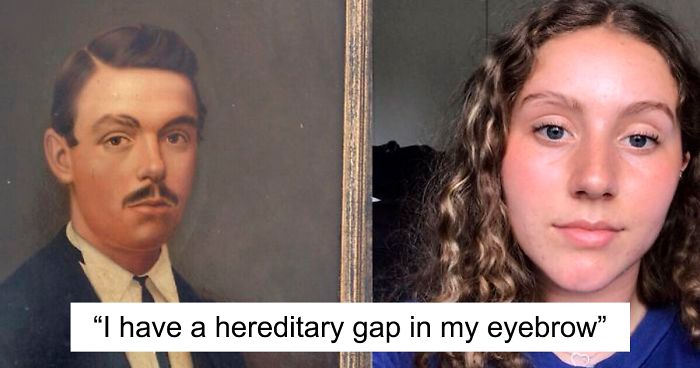
Some family photos whisper, “Yes, we are related.” Others walk into the room wearing matching cheekbones, identical smiles, the same suspiciously dramatic eyebrows, and announce, “The printer did not jam. It made another copy.” That is exactly the charm behind the viral trend where people share side-by-side photos of themselves, their parents, grandparents, siblings, cousins, and even great-grandparents looking so similar that genetics appears to have hit Ctrl+C, Ctrl+V, and then taken the afternoon off.
The title “People Are Sharing Pics Of How Their Genes Seemed To Just Hit Copy-Paste (40 Tweets)” captures a very internet-friendly idea: family resemblance can be funny, emotional, eerie, and oddly comforting all at once. A young woman beside her grandmother at the same age. A father and son with the same grin decades apart. A baby photo that looks like someone accidentally uploaded the parent’s childhood picture twice. Online, these comparisons become more than cute posts. They become tiny case studies in heredity, identity, memory, and the strange power of a face to make people say, “Wait, I’ve seen you before.”
Why “Copy-Paste Genes” Became Such a Shareable Trend
The internet loves a good visual punchline, and few punchlines are easier to understand than two relatives looking almost unbelievably alike. You do not need a biology degree to spot a matching nose bridge, the same eye shape, or a smile that seems to have traveled through three generations with a suitcase and a mission.
Part of the trend’s appeal is that it feels instantly personal. Everyone has heard someone say, “You look just like your mom,” or “That baby is your dad with less paperwork.” Family resemblance is one of those everyday experiences that connects science with dinner-table comedy. When people post these photos online, they are not just showing off similarities. They are turning private family history into a public moment of recognition.
And because social media rewards quick reactions, these posts are built for sharing. The viewer understands the joke in two seconds. Then comes the emotional aftertaste: a grandmother’s expression reappearing in a granddaughter, a parent’s childhood face showing up again in a toddler, or a great-grandfather’s posture reborn in someone who never met him.
The Science Behind Family Resemblance
Human beings inherit genetic information from both biological parents. Genes are basic units of heredity, and they carry instructions that help shape many physical and biological traits. Most people have two copies of many genes, one inherited from each parent, and small differences in those genes help create individual features such as hair texture, eye color tendencies, facial proportions, and other visible traits.
Still, genes do not work like a photocopier in the literal sense. The “copy-paste” effect is a fun metaphor, not an exact scientific description. Every child receives a shuffled mix of DNA, which means siblings can look like twins from different yearsor like they were assembled by completely separate committees. That genetic shuffle is why one child may inherit a grandfather’s nose, another may get a mother’s dimples, and a third may somehow resemble an aunt who lives three states away and always brings deviled eggs to Thanksgiving.
Facial Features Are Complicated, Not Single-Gene Magic
It is tempting to say, “She got her eyes from her mother” or “He got that chin from his father,” and sometimes that is a useful shortcut. But facial appearance is complex. Researchers studying facial genetics have found that many regions of the genome can influence the shape and structure of the human face. Features such as the nose, lips, chin, cheeks, forehead, jawline, and eye area are shaped by many genes working together, often with small effects that combine in noticeable ways.
That complexity is what makes copy-paste family photos so delightful. A person may not inherit an entire face like a downloaded file, but enough individual features can line up that the result feels uncanny. The same brow, the same half-smile, the same way of squinting at sunlightsuddenly a century-old photo starts looking less like history and more like a mirror with sepia settings.
Why Some Relatives Look Almost Identical
Strong resemblance can happen when a person inherits a combination of visible traits that closely matches a parent, grandparent, or other relative. This can include face shape, skin tone, hairline, ear shape, smile pattern, and even the way facial muscles move during expression. Sometimes the resemblance becomes especially obvious when two photos are taken at the same age, from the same angle, or with a similar hairstyle.
That last part matters. A dramatic side-by-side comparison is often helped by photography. If a daughter recreates her grandmother’s pose, parts her hair the same way, and wears a similar outfit, the resemblance can go from “cute” to “call a genetic detective.” But the fact that styling helps does not make the resemblance fake. It simply gives the viewer an easier path to notice what was already there.
The Role of Age, Expression, and Pose
Family resemblance often becomes clearer at certain ages. A baby may look like one parent, then grow into another relative’s features during childhood, then suddenly resemble a grandparent as an adult. The face changes over time, and different inherited traits may become more or less visible as bone structure develops, fat distribution changes, and expressions become more familiar.
Expression is also a big deal. A neutral face may not reveal much, but one laugh can expose the family blueprint. Maybe the left cheek lifts first. Maybe the eyes nearly disappear during a smile. Maybe everyone in the family makes the same “I am listening but suspicious” face. Genes help build the face, but family habits, shared gestures, and learned expressions can make the resemblance feel even stronger.
The Emotional Power of Looking Like Family
One reason these “copy-paste genes” posts hit so hard is that they are not only about appearance. They are about connection. A person may see their late grandparent’s face in their own reflection and feel a link that words cannot quite explain. For families separated by time, distance, adoption, migration, or loss, resemblance can feel like a small bridge across a very large gap.
This is why side-by-side family photos often generate comments like “I thought that was the same person” or “Your grandmother really said save as new file.” The jokes are funny, but underneath them is something tender. Faces carry memory. A familiar smile can make an old photo feel alive again.
For some people, resemblance also becomes part of identity. Being told you look like a parent or grandparent can feel like receiving an invisible inheritance: not money, not furniture, but a look, a presence, a place in the family story. Of course, not everyone wants to be compared to relatives, especially during awkward teenage years when being told you look like your dad’s school photo may feel less like a compliment and more like a personal attack by denim fashion. But over time, many people grow into those comparisons with affection.
What These Viral Tweets Teach Us About Heredity
The “copy-paste genes” trend is playful, but it also opens the door to real scientific curiosity. It reminds us that heredity is visible, but not always predictable. A family can have one child who looks like a clone of a grandparent and another who resembles no one until an old photo album reveals a great-aunt with the same exact face. Genetics is not a straight line; it is more like a shuffled playlist where a song from 1923 can suddenly come on in 2026.
It also shows that we tend to notice patterns. Humans are excellent at recognizing faces, and we naturally search for similarities among relatives. Sometimes we exaggerate resemblance because we expect to see it. Other times, the resemblance is so strong that even strangers online can spot it instantly. The viral magic happens when the comparison is both obvious and surprising.
Why Grandparents Often Steal the Show
Grandparent comparisons are especially popular because they create a satisfying time-travel effect. Parent-child resemblance is expected, but grandparent-grandchild resemblance feels more dramatic. The age gap makes the similarity look like a glitch in the timeline. A granddaughter standing beside a photo of her grandmother at 23 can feel like two versions of the same person separated by decades, fashion trends, and possibly the invention of Wi-Fi.
Scientifically, grandchildren inherit DNA through their parents, receiving segments that came from earlier generations. They do not inherit equal visible traits from every ancestor, but certain combinations can reappear in striking ways. That is why a grandchild may look more like a grandparent than either parent appears to at first glance.
The Internet’s Favorite Kinds of “Copy-Paste” Family Photos
Although every viral post has its own personality, the most popular examples usually fall into a few familiar categories. First, there is the “same face, different decade” comparison, where an old black-and-white or faded color photo is placed beside a modern selfie. These are the ones that make people zoom in and check whether the family owns a time machine.
Second, there is the parent-child baby photo comparison. These are especially funny because baby faces are already dramatic. Put two round-cheeked infants with the same startled expression next to each other and suddenly the family resemblance feels like an official document.
Third, there are sibling comparisons. Sometimes siblings look so alike that school teachers, neighbors, and confused relatives treat them like a rotating cast member. Other siblings look nothing alike, which leads to the classic family mystery: “Are we sure we read the assembly instructions correctly?” Both versions are entertaining because they show how unpredictable inheritance can be.
Finally, there are rare multi-generation comparisons: great-grandparent, grandparent, parent, and child all lined up with the same eyes or jawline. These photos feel almost cinematic. They show heredity not as an abstract concept, but as a visual rhythm repeating through time.
Why We Should Be Careful With Genetics Myths
As fun as the copy-paste idea is, it is important not to oversimplify genetics. A child does not inherit all “looks” from one parent, and there is no reliable rule that daughters look more like fathers or sons look more like mothers. Real inheritance is much more mixed and complex. Claims that one parent always determines beauty, intelligence, personality, or facial structure are usually too simplistic and often inaccurate.
It is also important to separate appearance from character. Looking like a relative does not mean someone will have the same personality, talents, health, or life path. A shared jawline is not destiny. You can inherit your grandfather’s eyebrows and still avoid his habit of arguing with the television during baseball games.
The best way to enjoy these viral photos is with curiosity and kindness. They are not proof that one side of the family “won.” They are snapshots of biological connection, mixed with memory, styling, photography, and a little internet comedy.
Experiences Related to “Copy-Paste Genes”
Anyone who has spent time with family albums knows the strange feeling of finding yourself in a person you never met. You flip through old photos expecting stiff poses and questionable wallpaper, and then suddenly there it is: your face, wearing your great-grandmother’s haircut or your uncle’s mischievous grin. It can feel funny at first, almost like catching an ancestor borrowing your reflection without asking.
One common experience is the family gathering comparison. Someone brings out an old photo after dinner, and within minutes the room turns into a committee of amateur geneticists. “That’s your nose.” “No, that’s your mother’s nose.” “Actually, that’s Grandma Rose’s whole face.” Nobody has a lab coat, but everyone has strong opinions. The youngest cousin is pulled into the debate, the photo is passed around, and suddenly a casual meal becomes a forensic investigation sponsored by mashed potatoes.
Another experience is the childhood photo shock. Many people have opened a parent’s baby album and realized they looked almost exactly the same as a parent at the same age. The resemblance can be sweet, but also mildly unsettling. Babies already look like tiny confused philosophers, so seeing two generations with the same expression can feel like the family reused the same baby template and only updated the background furniture.
Then there is the adoption or reunion experience, which can be far more emotional. For people who grow up without knowing one side of their biological family, seeing a shared facial feature for the first time can be powerful. A familiar smile or eye shape may answer a question they have carried for years. It does not replace relationship or history, but it can offer a sense of recognition: a visual clue that says, “You came from somewhere.”
Some people experience copy-paste genes through their own children. A new parent may spend months hearing that the baby looks like everyone except them. Then one day the child makes a facemaybe a skeptical eyebrow raise or a dramatic poutand the parent sees themselves completely. It is often not just the features but the expression that delivers the surprise. A face in motion can reveal family resemblance more clearly than a posed portrait.
These moments are why the trend keeps working. It is not just about who has the same chin. It is about how people use photos to understand belonging. In a world where families move, change, blend, and sometimes lose touch, a resemblance can feel like a tiny anchor. It can make the past feel less distant and the present feel more connected.
Final Thoughts: The Family Printer Is Still Running
The trend behind “People Are Sharing Pics Of How Their Genes Seemed To Just Hit Copy-Paste (40 Tweets)” is popular because it turns genetics into something everyone can see, laugh about, and feel. It takes the science of inheritance and gives it a human facesometimes the exact same face, apparently, with better lighting.
Genes are complex, and family resemblance is never as simple as copying and pasting a file. Still, when a grandchild looks exactly like a grandmother, or a father’s childhood photo could pass for his son’s current school picture, it is hard not to believe that DNA has a sense of humor. These photos remind us that families are living archives. Sometimes the archive is subtle. Sometimes it shows up with the same nose, the same smile, and the same expression that says, “Yes, this face has been here before.”
Note: This article is written as original commentary and analysis based on the broader viral “copy-paste genes” trend. It does not reproduce individual tweets, usernames, or copyrighted photos.