Electric motors are usually treated like the quiet kid in the electric vehicle classroom. Batteries get the headlines. Touchscreens get the glamour. Charging networks get the arguments. Meanwhile, the motor sits under the vehicle doing the very important job of turning expensive electrons into actual motion without asking for applause.
But every so often, a motor design shows up that deserves more than a polite nod. The twin-rotor motor, especially the dual-rotor radial-flux architecture being developed by DeepDrive, is one of those designs. It sounds like something an engineer would sketch on a napkin after drinking coffee strong enough to bend time: one stator, two rotors, more magnetic field used, less wasted material, and the possibility of better electric vehicle efficiency without simply cramming in a bigger battery.
This is not magic, although at first glance it does feel like the motor equivalent of discovering your suitcase had a hidden zipper all along. A twin-rotor motor rethinks how the magnetic forces inside an electric drive are arranged. Instead of asking one rotor to do all the work, the system uses an inner and outer rotor around a central stator. The result can be a compact, torque-dense electric motor designed for central drive units or even in-wheel applications.
Let’s take a deep drive deep dive into how this twin-rotor motor works, why automakers are paying attention, where the engineering gets tricky, and why this tiny-looking piece of hardware could matter a lot in the race to make EVs cheaper, lighter, and more efficient.
What Is a Twin-Rotor Motor?
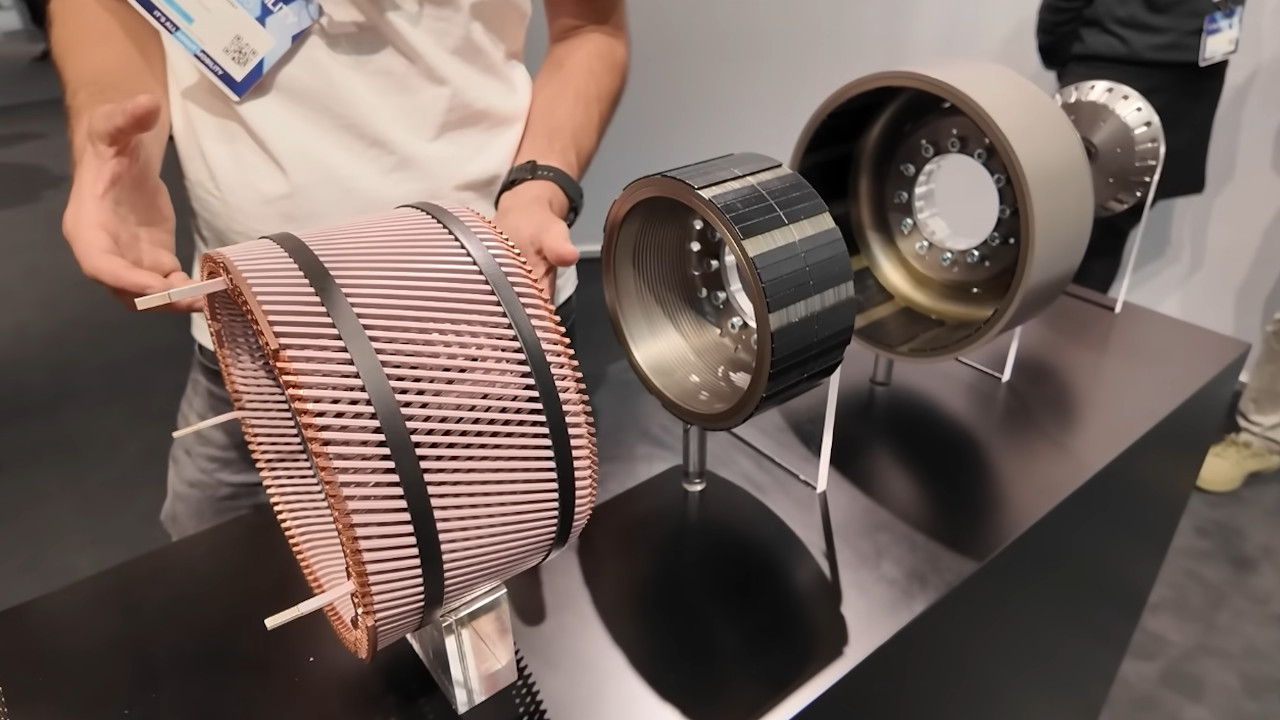
A twin-rotor motor is an electric motor design that uses two rotating elements instead of one. In DeepDrive’s case, the design is described as a dual-rotor radial-flux machine. That means the magnetic flux works mainly across the radius of the motor, while the stator sits between two rotors: one on the inside and one on the outside.
In a conventional electric vehicle motor, a stationary stator creates a rotating magnetic field that acts on a rotor. The rotor spins, torque goes through gears or shafts, and the car moves. Simple enough, at least until you remember that “simple” in motor engineering still involves electromagnetic fields, thermal limits, inverter control, copper losses, iron losses, magnets, laminations, bearings, cooling jackets, and enough acronyms to make a mechanic quietly walk into the woods.
The twin-rotor idea changes the geometry. Instead of using only the inner or outer side of the stator, both sides become active. The stator can drive an inner rotor and an outer rotor at the same time. This makes better use of the magnetic field and can increase torque density, which is engineer-speak for “more twist from less package.”
Why DeepDrive’s Dual-Rotor Design Is Getting Attention
DeepDrive’s motor has attracted interest because it addresses several of the biggest EV problems at once: efficiency, cost, packaging, weight, and material use. Automakers care about all of these because EV buyers tend to ask very human questions, such as: “How far can it go?” “Why does it cost that much?” and “Can I drive to my cousin’s house without studying a charging map like it’s a treasure hunt?”
DeepDrive claims its patented dual-rotor technology can improve vehicle range by up to about 20 percent, depending on the application and benchmark. The company’s architecture is also designed to reduce material needs, including iron and magnet content, while supporting compact integration. In simple terms, the design aims to squeeze more useful motion out of the same battery energy.
This matters because the battery is usually the most expensive component in an EV. If a more efficient motor can help a car travel farther from the same battery pack, automakers may either increase range or use a smaller battery to achieve the same range. Both options are attractive. One helps marketing departments write bigger range numbers. The other helps finance departments stop sweating into their spreadsheets.
How the Twin-Rotor Layout Works
To understand the twin-rotor motor, picture a normal electric motor as a magnetic handshake between the stator and rotor. The stator says, “Spin this way,” and the rotor says, “Fine, but I’m taking the shaft with me.” In a standard single-rotor radial-flux motor, that handshake happens across one air gap.
A dual-rotor motor creates two useful magnetic interfaces. The stator is sandwiched between two rotors, so the electromagnetic interaction happens on both sides. This can improve material utilization because more of the magnetic field contributes to torque production instead of merely hanging around like a bored intern.
Inner Rotor Plus Outer Rotor
The inner rotor spins inside the stator. The outer rotor spins outside it. Depending on the final mechanical design, these rotors can be connected so their torque combines into one output. The key idea is that both rotors are part of the same machine rather than two separate motors bolted together in a very expensive sandwich.
Radial Flux, Not Axial Flux
Many high-performance EV motor discussions focus on axial-flux motors, which are often shaped like pancakes and can deliver excellent power density. DeepDrive’s design is different. It is a radial-flux motor, closer in category to many conventional EV traction motors, but with a dual-rotor twist. That matters because radial-flux machines are well understood, widely manufacturable, and familiar to automotive engineers.
High Slot Fill and Bar Windings
DeepDrive also highlights its winding concept, including distributed bar windings and a high slot fill factor. Slot fill refers to how much copper can be packed into the stator slots. More copper in the right place can reduce electrical resistance and improve efficiency. Less wasted space means less heat, and less heat means fewer thermal tantrums.
The Big Benefits: Efficiency, Torque Density, and Packaging
The most obvious advantage of a twin-rotor electric motor is better use of space. EV packaging is a ruthless game. Every millimeter has a job interview, and the weak are sent home. A compact motor can free room for suspension parts, crash structures, battery modules, cargo space, or simply more flexible vehicle design.
Torque density is another major selling point. A motor with high torque density can produce strong acceleration without being physically huge. This is especially useful for in-wheel motors, where the drive unit must fit inside or near the wheel hub. It is also useful for central drive units, where smaller packaging can simplify platform design across multiple vehicle models.
Efficiency is the headline benefit. Every EV loses energy along the way: in the inverter, motor windings, magnetic materials, gears, tires, aerodynamics, and thermal systems. Improving motor efficiency does not eliminate those other losses, but it helps the entire vehicle. At highway speeds, even small efficiency gains can make a noticeable difference in range. Around town, improved torque production and regenerative braking behavior can also improve real-world energy use.
Why Less Material Matters
Electric motors often rely on copper, electrical steel, and permanent magnets. High-performance permanent magnets may use rare earth elements such as neodymium and dysprosium. These materials are valuable because they help create strong magnetic fields in compact packages. They are also politically, economically, and environmentally complicated.
Reducing magnet and iron use can lower cost, reduce supply-chain risk, and improve sustainability. That does not mean magnets are bad. It means automakers would rather not build the future of transportation on a materials supply chain that occasionally behaves like a drama series with tariffs, export controls, and surprise plot twists.
DeepDrive’s approach is interesting because it tries to get more performance from a smarter motor layout instead of simply throwing more material at the problem. If the magnetic field can be used more effectively, the motor may need less mass to achieve the same or better output. That is the kind of engineering optimization that makes accountants, sustainability teams, and vehicle dynamics engineers all briefly agree on something.
Central Drive or In-Wheel Motor?
One of the most intriguing parts of DeepDrive’s twin-rotor motor is its flexibility. The architecture can be used as a traditional central drive unit or as an in-wheel drive. These two applications have very different personalities.
Central Drive
A central drive unit is the familiar EV layout. The motor sits inboard and sends torque through shafts, gears, or a differential. This setup protects the motor from road abuse and makes cooling, sealing, and maintenance more straightforward. It also keeps unsprung mass lower, which helps ride comfort and handling.
For many production vehicles, central drive will remain the safer and more conservative path. Automakers like innovation, but they like warranty data even more.
In-Wheel Drive
In-wheel motors put the drive unit close to or inside each wheel. The appeal is huge: no driveshafts, more packaging freedom, potential torque vectoring, and very direct control at each corner of the vehicle. Imagine each wheel getting its own tiny electric brain and muscle group.
The challenge is that wheels live terrible lives. They hit potholes, swallow road salt, experience vibration, and get pressure-washed by people who believe “more nozzle” solves everything. In-wheel motors must survive heat, water, shock, braking loads, and long-term durability demands. They can also increase unsprung mass, which affects suspension response. That is why in-wheel motors are exciting but not automatically easy.
What About Braking and Regeneration?
A twin-rotor motor can work with regenerative braking like other EV traction motors. During deceleration, the motor acts as a generator, converting some vehicle motion back into electricity and sending it to the battery. Regenerative braking improves efficiency and can reduce friction brake wear.
In an in-wheel setup, the relationship between motor and brake becomes especially interesting. Continental and DeepDrive have explored integrated drive-brake concepts, where propulsion and braking hardware can be combined near the wheel. The dream is a compact module that handles acceleration, regeneration, and braking in a highly efficient package.
The engineering reality, of course, is more demanding. Brakes generate heat. Motors generate heat. Electronics dislike heat with the emotional intensity of a cat near bathwater. Any integrated system must manage temperatures, safety redundancy, serviceability, and cost.
The Engineering Challenges Nobody Should Ignore
A twin-rotor motor sounds elegant, but it is not a free lunch. It is more like a discounted lunch with a long terms-and-conditions page.
Mechanical Complexity
Two rotors mean more rotating structure to control. Bearings, alignment, rotor balance, air-gap precision, and mechanical stiffness become critical. The air gap between stator and rotor is tiny, and tiny gaps do not forgive sloppy manufacturing.
Cooling
High power density is wonderful until heat builds up. A compact motor must remove heat from copper windings, magnetic materials, and nearby electronics. Effective cooling is essential because overheating can reduce efficiency, limit performance, and shorten component life.
Windage and Drag Losses
More rotating surfaces can create additional air-friction losses inside the motor. Engineers must balance the gains from dual-rotor torque production against any extra losses caused by spinning parts. The goal is not just to make an impressive test-bench number, but to improve total efficiency across real driving conditions.
Manufacturing Scale
Building one brilliant prototype is hard. Building hundreds of thousands of reliable, affordable motors is a different sport. Automotive manufacturing requires repeatability, quality control, supplier readiness, and brutal cost discipline. A twin-rotor motor must not only work well; it must be manufacturable without turning every assembly line into a haunted house.
Why Automakers Care Now
The EV market has entered a more practical phase. Early adopters tolerated high prices and occasional inconvenience because they wanted the future parked in their driveway. Mass-market buyers are less romantic. They want range, reliability, normal pricing, fast charging, and no surprise engineering experiments disguised as lifestyle choices.
That creates pressure on automakers to improve efficiency everywhere. Better batteries help. Better aerodynamics help. Better tires help. Better software helps. But motor efficiency remains a major lever because it affects range, cost, weight, and performance at the same time.
A more efficient motor can support smaller batteries, lower vehicle cost, or longer driving range. It can also reduce demand for critical materials. For automakers trying to build profitable EVs at scale, that combination is extremely attractive.
Where Twin-Rotor Motors Could Fit Best
Twin-rotor motors may be especially useful in vehicles where packaging and efficiency are top priorities. Compact EVs could benefit from smaller drive units. Premium EVs could use the technology for range and performance. Commercial vehicles could benefit from efficiency gains because energy savings add up quickly over high mileage.
In-wheel versions could eventually support skateboard-like vehicle platforms with more interior space and advanced torque vectoring. A delivery van, for example, could use compact wheel motors to lower the floor or improve packaging. A performance car could use independent wheel torque control for sharper handling. A city car could use smaller batteries while still delivering practical range.
Still, the first broad adoption may come from central drive units, where the technology can prove itself without the full punishment of living inside the wheel. Once durability, cost, and service data are established, in-wheel applications may become easier to justify.
Experience Notes: What Working Around This Technology Feels Like
Spending time studying a twin-rotor motor changes how you look at EV engineering. At first, the idea seems almost too tidy: put the stator in the middle, let two rotors work together, and enjoy the benefits. But the deeper you go, the more you realize that the cleverness is not just in the concept. It is in making the concept survive production, heat, vibration, cost targets, and real drivers who will absolutely hit potholes while eating fries.
The first experience that stands out is how much motor design is about compromise. More power usually creates more heat. More magnets can improve performance but raise cost and supply-chain concerns. More compact packaging can make cooling harder. In-wheel motors can unlock brilliant vehicle layouts but introduce durability and unsprung-mass challenges. The twin-rotor motor is fascinating because it tries to move the compromise line instead of pretending compromise does not exist.
The second experience is how invisible good engineering becomes. A driver will not sit in a car and say, “Ah yes, I can feel the improved slot fill factor.” That would be weird, and passengers would slowly stop accepting rides. What the driver might notice is better range, smoother acceleration, stronger regeneration, quieter operation, or a vehicle that costs less than expected. The motor’s success would be measured by how little the owner has to think about it.
The third experience is that twin-rotor technology makes EV efficiency feel exciting again. For years, public EV conversations have been dominated by battery size and charging speed. Those matter, of course. But focusing only on batteries is like trying to win a cycling race by buying a bigger water bottle. The drivetrain matters. The motor matters. The inverter, cooling system, and software matter. A more efficient motor can make the entire vehicle better without asking the battery to do all the heavy lifting.
There is also a hands-on mental image that helps explain the appeal. Imagine using one side of a tool for years, then discovering the other side can work too. That is the emotional hook of a dual-rotor radial-flux machine. It feels like reclaiming wasted opportunity inside a familiar package. Not everything about the design is simple, but the basic intuition is satisfyingly clear: if a stator can interact effectively with two rotors, why settle for one?
From a product perspective, the most interesting experience is watching the gap between prototype excitement and production reality. The world has seen plenty of brilliant engineering ideas stall because they were too expensive, too fragile, too hard to manufacture, or too weird for conservative buyers. DeepDrive’s challenge is to prove that its motor is not just clever in a lab but dependable in vehicles, scalable in factories, and affordable enough for automakers fighting for every dollar.
That is why the twin-rotor motor story is worth following. It is not simply about one startup or one component. It represents a broader shift in EV thinking: better architecture can be just as powerful as bigger batteries. The next breakthrough in electric mobility may not arrive as a flashy dashboard feature. It may arrive as a compact motor quietly spinning with two rotors, turning smarter design into extra miles.
Conclusion: A Small Motor Idea With Big EV Consequences
The twin-rotor motor is not a silver bullet, because engineering does not hand those out. But it is one of the more compelling motor architectures in the current EV landscape. By placing a stator between inner and outer rotors, DeepDrive’s dual-rotor radial-flux concept aims to improve efficiency, torque density, packaging, and material use in one carefully engineered move.
If the technology scales successfully, it could help automakers build electric vehicles that go farther, cost less, and use fewer critical materials. It could support compact central drive units today and more ambitious in-wheel motor systems tomorrow. Most importantly, it reminds us that EV innovation is not only about batteries. Sometimes the smartest progress happens in the motor itself, where magnetic fields, copper, steel, and software quietly cooperate to make the wheels turn.
And honestly, that is the best kind of engineering story: less noise, more motion, and just enough cleverness to make every motor nerd lean forward in their chair.