Note: This article is based on synthesized information from reputable archaeology, heritage, science, and travel sources, including UNESCO, English Heritage, Historic Environment Scotland, Britannica, Smithsonian Magazine, National Geographic, Scientific American, Live Science, and official cultural heritage references.
Introduction: Stonehenge Is Famous, But It Is Not Lonely
Stonehenge gets the celebrity treatment. It has postcards, documentaries, solstice crowds, and enough mystery to keep historians, archaeologists, and overly confident internet commenters busy for another few thousand years. But here is the delightful twist: Stonehenge is not the only ancient stone superstar on the planet. Across Europe, Africa, and the Middle East, there are rock formations, standing stones, megalithic monuments, and prehistoric stone circles that could walk into the same room as Stonehenge and not feel underdressed.
Some are older. Some are larger. Some contain more stones. Some sit in landscapes so dramatic they look as if the Earth decided to decorate itself before humans invented interior design. These amazing rock formations are not simply “big rocks in a field.” They are carefully placed monuments that reveal how ancient people observed the sky, honored the dead, gathered communities, marked sacred space, and shaped landscapes long before written history came along with receipts.
In this guide, we explore seven ancient rock formations that could rival Stonehenge in scale, mystery, age, and sheer visual drama. Think of it as a world tour of prehistoric ambition, minus the jet lag and questionable airport sandwich.
1. Avebury, England: The Giant Stone Circle That Swallowed a Village
Why Avebury Rivals Stonehenge
If Stonehenge is the polished museum piece, Avebury is the sprawling epic. Located in Wiltshire, England, not far from Stonehenge itself, Avebury is one of the most impressive megalithic monuments in the world. It contains a massive henge, a huge circular bank and ditch, and the largest prehistoric stone circle known. Inside that outer circle were two smaller stone circles, creating a layered ritual landscape that makes Stonehenge look almost compact.
What makes Avebury especially fascinating is that a modern village sits partly inside the ancient monument. Imagine building your daily life inside a prehistoric ceremonial complex. One minute you are walking past a cottage; the next, you are standing beside a stone that may have been raised more than 4,500 years ago. That is not a neighborhood feature. That is time travel with sheep.
The Experience of the Site
Avebury feels less like a fenced-off attraction and more like a living landscape. Visitors can walk among many of the stones, study their shapes up close, and see how the earthworks curve through the countryside. Unlike Stonehenge, where distance often shapes the visitor experience, Avebury invites movement. Its scale is best understood on foot, because the monument is not just one circle; it is a prehistoric environment.
For SEO travelers searching for ancient stone circles, prehistoric sites in England, or megalithic monuments near Stonehenge, Avebury deserves a top spot. It rivals Stonehenge not by copying it, but by offering something bigger, more open, and wonderfully strange.
2. Ring of Brodgar and Stones of Stenness, Scotland: Orkney’s Ancient Power Couple
A Landscape Built for Wonder
In Scotland’s Orkney Islands, the Ring of Brodgar and the Stones of Stenness form part of the Heart of Neolithic Orkney, a UNESCO World Heritage landscape packed with ancient monuments. The Ring of Brodgar is a large stone circle surrounded by a rock-cut ditch, while the nearby Stones of Stenness are among the earliest stone circles in Britain.
What makes this area so powerful is not just the individual stones, but the way everything connects. Tombs, settlements, standing stones, and ceremonial spaces are arranged across a landscape of lochs, open sky, and low rolling land. Stonehenge may be iconic, but Orkney feels like an entire prehistoric operating system. The stones are only one part of a bigger cultural network.
Why It Feels Different From Stonehenge
The Ring of Brodgar has a broad, open drama. Its surviving stones stand in a wide circle, creating a sense of rhythm across the horizon. The Stones of Stenness, by contrast, are tall, blade-like slabs that feel older, sharper, and more intimate. Together, they create a contrast between scale and intensity.
Archaeologists have long studied the area because Orkney offers rare insight into Neolithic life. Nearby Skara Brae preserves stone-built houses, while Maeshowe shows remarkable chambered tomb construction and winter solar alignment. When you visit Orkney, you are not just looking at stones; you are stepping into a world where architecture, ritual, astronomy, and community were woven together.
3. Calanais Standing Stones, Scotland: The Cross-Shaped Mystery of the Isle of Lewis
Older Than Stonehenge’s Main Stone Circle
The Calanais Standing Stones, also known as Callanish, rise on the Isle of Lewis in Scotland’s Outer Hebrides. Erected roughly between 2900 and 2600 BC, they predate the main stone circle at Stonehenge. That alone earns them a confident seat at the “Stonehenge rivals” table.
Calanais is visually unforgettable because it is not simply a circle. The stones form a cross-shaped arrangement, with rows extending outward from a central stone circle. At the heart of the monument stands a tall central monolith, surrounded by other stones and associated with a chambered tomb. The design creates movement, direction, and mystery. It looks less like a simple enclosure and more like a stone diagram whose full message has gone politely silent.
Landscape, Light, and Legend
The Isle of Lewis gives Calanais a mood that few ancient sites can match. The weather changes quickly, the light moves across moorland and water, and the stones often appear dark against dramatic skies. The result is a site that feels both archaeological and atmospheric.
For visitors interested in ancient rock formations, sacred landscapes, or prehistoric Scotland, Calanais is a masterpiece. Its stones are made of local Lewisian gneiss, one of the oldest rock types in Europe, which adds geological depth to its cultural significance. These are not just stones placed in a pattern; they are ancient stones made from even more ancient stone. That is history wearing history like a very serious jacket.
4. Carnac Stones, France: The Army of Menhirs
Thousands of Stones in Formation
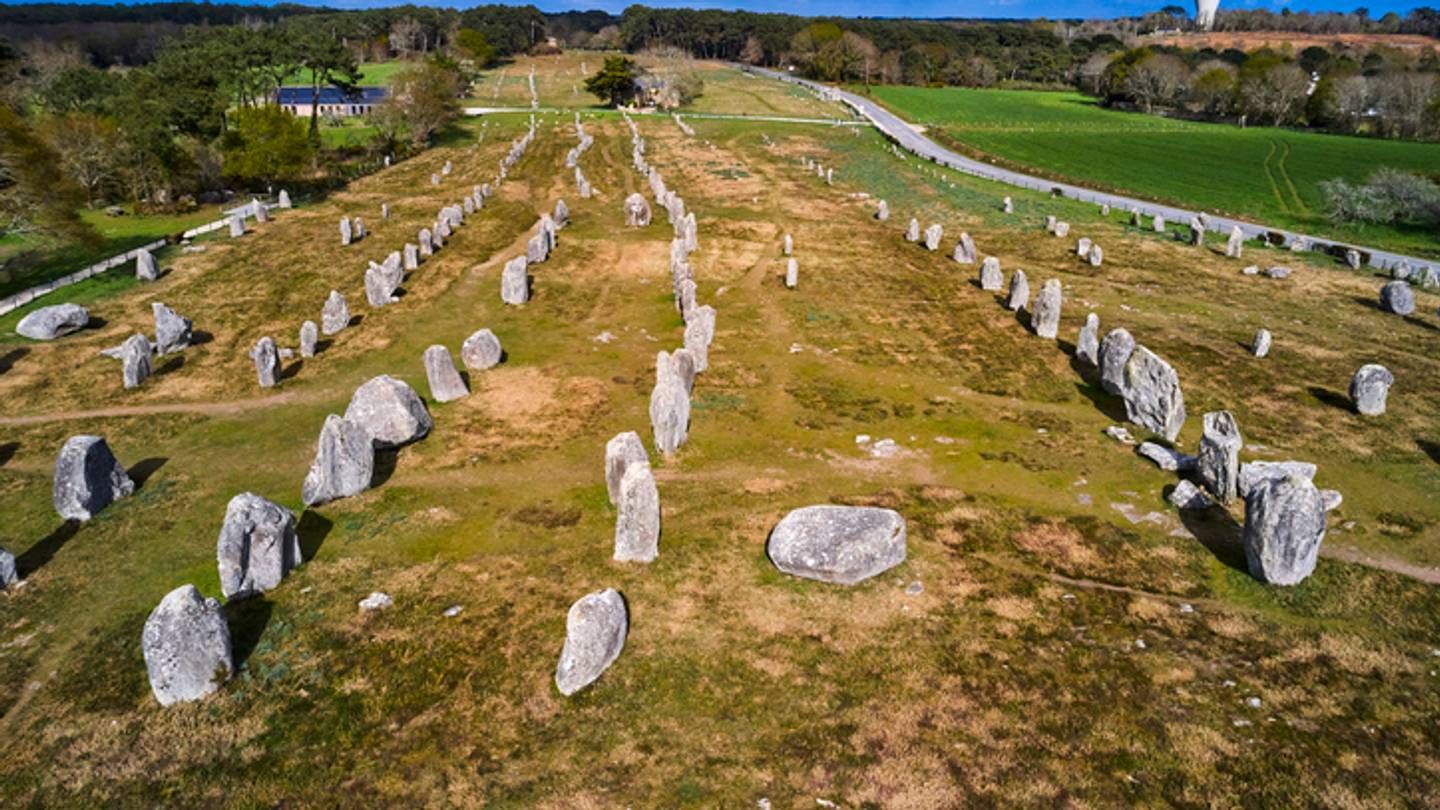
If Stonehenge impresses with architecture, Carnac overwhelms with numbers. Located in Brittany, France, the Carnac alignments include thousands of prehistoric standing stones, known as menhirs, arranged in long rows across the landscape. The Ménec, Kermario, and Kerlescan alignments stretch across fields in patterns that have fascinated researchers and travelers for generations.
The stones were erected during the Neolithic period, and their exact purpose remains debated. Theories include ritual processions, sacred boundaries, astronomical references, social gathering spaces, or symbolic landscapes connected to ancestors. The honest answer is that we do not know for certain. The fun answer is that prehistoric Brittany apparently believed one standing stone was good, but several thousand were better.
Why Carnac Could Outshine Stonehenge
Carnac rivals Stonehenge through scale and repetition. Instead of a single famous circle, it offers a vast stone landscape. The rows create a visual rhythm that changes as you move. From one angle, the menhirs look like an army. From another, they resemble a frozen procession. At sunrise or sunset, their shadows stretch across the fields and turn the site into a prehistoric light show.
For those searching for megalithic monuments in Europe, Carnac is essential. It reminds us that ancient builders were not limited to circles. They also used lines, avenues, enclosures, and alignments to organize space and meaning. Stonehenge may be the world’s famous stone puzzle, but Carnac is the jumbo puzzle box with half the pieces still laughing at us.
5. Göbekli Tepe, Turkey: The Monument That Rewrote the Timeline
Thousands of Years Older Than Stonehenge
Göbekli Tepe in southeastern Turkey is one of the most important archaeological sites ever discovered. Built during the Pre-Pottery Neolithic period, roughly between 9600 and 8200 BCE, it predates Stonehenge by thousands of years. Its monumental T-shaped limestone pillars were arranged in circular and oval enclosures, many decorated with carved animals and abstract symbols.
This site shook older assumptions about early human society. For a long time, scholars believed large ceremonial monuments appeared only after farming communities became settled and socially complex. Göbekli Tepe complicated that story. Its builders were hunter-gatherers or early communities in transition, yet they organized labor, carved massive pillars, and created monumental spaces long before cities, writing, or metal tools.
Not Just Big Stones, But Big Ideas
Göbekli Tepe rivals Stonehenge because of its age and intellectual impact. It is not merely an ancient rock formation; it is evidence that symbolic life, ritual architecture, and social cooperation developed earlier than many people once imagined. The carved foxes, snakes, birds, boars, and other creatures suggest a rich visual world whose meanings remain uncertain.
Standing at Göbekli Tepe, one confronts a humbling idea: people were reshaping stone into sacred architecture before agriculture fully transformed the region. Stonehenge may be mysterious, but Göbekli Tepe is the kind of mystery that taps archaeology on the shoulder and says, “Please rewrite Chapter One.”
6. Almendres Cromlech, Portugal: Iberia’s Ancient Stone Circle
A Prehistoric Treasure Near Évora
Almendres Cromlech, located near Évora in Portugal’s Alentejo region, is one of the most important megalithic monuments on the Iberian Peninsula. Set among cork oaks and open countryside, it includes dozens of standing stones arranged in an irregular oval or circular formation. Some stones show carvings, giving the monument an added layer of symbolic interest.
The site developed over a long period, beginning in the Neolithic and continuing through later prehistoric phases. Like other megalithic formations, Almendres was likely connected to ritual, landscape, astronomy, seasonal cycles, or community gatherings. Its exact function remains debated, but its presence is undeniable. It feels deliberate, careful, and deeply rooted in place.
Why Almendres Deserves More Attention
Almendres is sometimes called Portugal’s answer to Stonehenge, though that nickname undersells its individuality. The stones are not arranged with Stonehenge’s famous lintels and upright pairs. Instead, Almendres offers a quieter, more organic experience. Its stones rise from the earth like a gathering of ancient witnesses.
Because it is surrounded by rural landscape rather than dense modern development, Almendres has a contemplative quality. Visitors can imagine how horizon, sunrise, sunset, and seasonal change may have shaped the way ancient communities experienced the monument. It is less theatrical than Stonehenge, but in some ways more personal. It does not shout. It waits.
7. Nabta Playa, Egypt: The Desert Stone Circle Older Than Stonehenge
A Prehistoric Observatory in the Sahara
Nabta Playa lies in the Nubian Desert of southern Egypt, in a region that was once much wetter than it is today. Thousands of years ago, seasonal lakes formed there, supporting human groups who left behind stone structures, hearths, cattle remains, and megalithic alignments. Among the most famous features is a small stone circle often discussed as one of the world’s earliest astronomical sites.
Researchers have suggested that the circle may have helped mark the summer solstice, a seasonal signal connected to the arrival of monsoon rains. While interpretations must be careful, Nabta Playa remains significant because it demonstrates that ancient communities in North Africa were observing the sky and shaping stone landscapes long before many better-known monuments were built.
Small Stones, Huge Importance
Nabta Playa does not look as visually massive as Stonehenge. Its stones are modest. Its footprint is smaller. A traveler expecting towering trilithons might first think, “Wait, did I miss the giant part?” But size is not the whole story. Nabta Playa rivals Stonehenge through age, context, and meaning.
The site expands the geography of prehistoric astronomy beyond Europe. It shows that ancient skywatching, seasonal planning, and symbolic stone construction were part of a much wider human story. In a desert landscape where water once shaped survival, marking time was not just intellectual curiosity. It may have been a matter of life, movement, food, and community memory.
What These Stone Formations Tell Us About Ancient People
When people compare ancient rock formations to Stonehenge, they often focus on size, age, or mystery. Those things matter, but the deeper lesson is more interesting. These monuments reveal that prehistoric societies were not simple, silent, or disconnected from the world around them. They were careful observers. They watched horizons, seasons, animals, water, death, birth, and community movement. Then they expressed those observations in stone.
Standing stones also show that ancient people understood the power of place. A stone circle is not only a structure; it is a relationship between material, landscape, sky, and memory. The same monument can be a calendar, a gathering place, a sacred boundary, a burial marker, a social symbol, or all of those things at once. Modern categories often fail because ancient life did not separate science, religion, art, and daily survival as neatly as we do.
These sites also remind us to be humble. It is tempting to fill every gap with a dramatic theory. Aliens, lost civilizations, secret codes, ancient super-scientiststhe usual suspects tend to arrive wearing sunglasses. But the real human story is already astonishing. People without engines, steel cranes, or written instruction manuals moved huge stones, shaped landscapes, and created monuments that still command attention thousands of years later. Honestly, most of us get irritated assembling flat-pack furniture.
Travel Experiences: How to Feel These Places Beyond the Photo
Visiting ancient stone formations is different from visiting a castle, museum, or cathedral. Those places often tell you what to think with plaques, rooms, paintings, and dates. A stone circle gives you less instruction and more atmosphere. It asks you to slow down. That can feel strange at first, especially in a travel culture built around quick photos and faster captions. But the best way to experience these sites is to give them time.
Start by walking the perimeter before rushing to the center. At Avebury, the full scale only becomes clear when you move through the henge and notice how the bank, ditch, stones, village, and surrounding fields interact. At the Ring of Brodgar, the circle changes with every step because the Orkney landscape is part of the monument. The lochs, wind, clouds, and distant hills are not background decoration. They are part of the experience.
Go early or late if possible. Low sunlight transforms standing stones. Shadows lengthen, surfaces glow, and carvings or textures become easier to notice. Carnac, for example, is especially powerful when the rows of menhirs cast long lines across the grass. Calanais can feel almost cinematic under shifting Hebridean weather, with the stones moving from gray to silver to black depending on the sky. If the wind decides to join you, congratulations: you have unlocked the full prehistoric soundtrack.
Read before you go, but do not over-script the visit. A little background helps you understand why Göbekli Tepe matters or why Nabta Playa changed conversations about early astronomy. Still, leave room for direct observation. Ask simple questions: Why here? What horizon stands out? How does the stone shape guide your eye? Where would people gather? What would this place feel like in winter, summer, darkness, or festival light?
Respect matters, too. These are fragile archaeological sites, not outdoor gyms for climbing, chalking, scraping, or dramatic “I am the chosen one” poses. Stay on marked paths where required, avoid touching carved surfaces, and treat local rules as part of preservation rather than inconvenience. The stones have survived thousands of years; they should not be defeated by a tourist with muddy sneakers and main-character energy.
Finally, bring patience. The magic of megalithic sites often arrives quietly. It may come when you notice lichen on a stone, the alignment of a path, the silence between gusts of wind, or the way a monument holds attention without explaining itself. Stonehenge is famous because it captures that feeling beautifully. But Avebury, Orkney, Calanais, Carnac, Göbekli Tepe, Almendres, and Nabta Playa prove that the world is full of stone-built wonder. Each site is a reminder that ancient people were not merely surviving the landscape. They were reading it, marking it, and turning it into memory.
Conclusion: Stonehenge Has Rivals, and They Are Spectacular
Stonehenge remains one of the most iconic prehistoric monuments on Earth, and its fame is well earned. But it belongs to a much wider family of ancient rock formations and megalithic wonders. Avebury impresses with scale. Orkney reveals an entire Neolithic landscape. Calanais brings drama and design to the Scottish islands. Carnac overwhelms with thousands of menhirs. Göbekli Tepe pushes monument building deep into the early Neolithic. Almendres shows the quiet power of Iberian megaliths. Nabta Playa expands the story of ancient astronomy into the Sahara.
Together, these seven amazing rock formations prove that humanity’s relationship with stone is older, richer, and more global than one famous monument on Salisbury Plain. The next time someone says, “There is nothing like Stonehenge,” you can smile politely and say, “Actually, let me introduce you to a few rocks with very impressive résumés.”