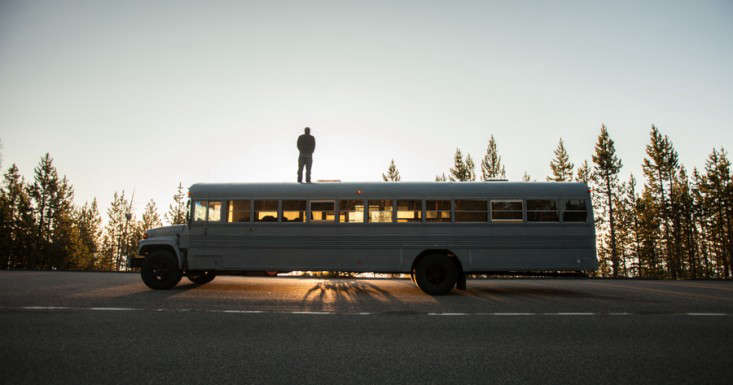
Some people buy a sensible crossover with heated seats and a respectable warranty. Hank bought a bus.
Not a cute little camper van with a matte paint job and a coffee setup that looks sponsored by social media. A bus. A big, rumbling, slightly ridiculous machine that once spent its days hauling humans and now, thanks to Hank’s optimism and a questionable number of online tutorials, is headed toward a second life as a rolling home.
That is the charm of the bus dream. It feels bigger than travel. It feels like escape with storage compartments. It feels like freedom with windshield wipers. And in a culture that still loves the open road, the idea makes perfect sense: if you cannot always choose the weather, the traffic, or the price of gas, at least you can choose your front porch and take it with you.
But the truth about buying a bus is more interesting than the fantasy. It is not just about painting cabinets, hanging string lights, and parking beside a mountain while a kettle gently whistles. It is about choosing the right rig, making it safe, figuring out paperwork, preventing moisture problems, learning how to store your life in about three square feet, and discovering that romance and logistics are legally married.
So yes, Hank bought a bus. Here is what that really means, why the idea is so appealing, and what life on the road starts to look like once the dream gets an ignition key.
Why a Bus in the First Place?
A bus makes emotional sense long before it makes financial sense. That is usually how these stories begin.
Hank did not wake up wanting a traditional motorhome with factory upholstery the color of a dentist’s waiting room. He wanted character. He wanted something sturdy, roomy, and a little gloriously odd. A bus offers all three. The shell is tall, the footprint is generous, and the bones are made for miles. For people drawn to DIY travel, a converted bus promises more than a vacation vehicle. It promises a project, a lifestyle, and a talking point that will absolutely dominate every family barbecue.
There is also the appeal of customization. In a bus, Hank does not have to accept somebody else’s layout, fabric choices, or weirdly aggressive cup-holder strategy. He can build a bed where he wants one, carve out a work nook, add a compact kitchen, and make the whole thing feel less like an RV park default setting and more like a home with tires.
That flexibility is part of why mobile living still grabs people across age groups. The road-trip lifestyle appeals to retirees, remote workers, adventure-seekers, pet owners, and anyone who has ever looked at a rent payment and thought, “What if my living room could move?”
The Day Hank Handed Over the Cash
The first lesson in bus ownership is that the cute part comes later. Before the wood paneling, before the solar dreams, before the tiny potted herb that somehow survives every sharp turn, there is the purchase itself.
And that purchase should be treated less like buying decor and more like adopting a mechanical giant with a complicated past.
Buy the Engine, Not the Fantasy
Hank’s smartest move is not choosing the prettiest bus. It is choosing the soundest one. A bus with tired paint but solid mechanics is a better bet than a photogenic disaster with transmission trouble, mystery leaks, and a floor that feels “soft” in the way a banana feels soft.
That means looking beyond surface charm. Rust matters. Service records matter. Signs of flood damage matter. Tire condition matters. Brake condition matters. Electrical gremlins matter more than your Pinterest board. A vehicle history report can help, but it is not enough on its own. A serious pre-purchase inspection from an independent mechanic is the kind of boring adult decision that saves the future version of Hank from crying beside an interstate shoulder.
In other words, the sofa can wait. The stopping power cannot.
Used-bus shopping also has a sneaky emotional trap: low sticker prices. A retired bus can look cheap at first glance, which is how many people talk themselves into a project that quietly grows teeth. The purchase price is only the opening scene. Repairs, tires, title work, insurance, insulation, plumbing, electrical upgrades, ventilation, and interior build-out all line up immediately behind it, grinning.
Hank learns fast that a “deal” can become an expensive hobby with headlights.
Turning a Bus Into a Home Instead of a Rolling Sauna
Once the bus is parked and the excitement settles, the real conversion begins. This is where the dream either becomes livable or turns into a metal tube that is freezing in the morning, boiling by lunch, and damp enough by evening to make a towel feel philosophical.
Insulation Is Not Sexy, but It Is Everything
People love to show off finished interiors. They do not usually post twelve dramatic photos of insulation, sealing, and ventilation planning. That is a shame, because those unglamorous steps do more to determine comfort than the vintage rug ever will.
A bus is basically a mobile weather experiment. Metal conducts heat. Windows invite sunlight. Temperature swings can be dramatic. If Hank wants a bus that feels cozy instead of punishing, he has to think like a builder, not just a decorator. Good insulation helps regulate temperature, and proper air sealing supports energy efficiency, but neither works well if moisture is ignored.
The Real Villain Is Condensation
Every bus conversion fantasy should come with one warning label: water vapor is sneaky.
Cooking, breathing, showering, and even sleeping create moisture. In a tight small space, that moisture condenses on cool surfaces and starts causing trouble. The result can be mold, musty smells, damaged materials, and a general sense that your tiny house has developed swamp energy.
That is why Hank cannot stop at insulation. He needs ventilation too. Roof fans, planned airflow, and smart moisture control make the bus more comfortable and help protect the build itself. It is not glamorous, but then again, neither is discovering mildew behind your cedar slats and calling it rustic.
Small-Space Living Rewards Ruthless Honesty
Once the shell is sound, Hank confronts the second great truth of bus life: every object is now a roommate.
Small-space design works best when storage is intentional. Under-bed compartments, wall cabinets, slim shelving, mounted containers, and multipurpose furniture help, but none of them can compensate for bringing too much stuff. In a bus, clutter is not merely ugly. It is personal. It is in your way at breakfast. It is on your lap when you need socks. It falls on your foot during left turns.
The happiest bus interiors do not feel full. They feel edited. Hank begins to understand that smart design is less about cramming in more features and more about making the essentials easy to use, easy to reach, and easy to maintain.
The Paperwork Nobody Puts on the Mood Board
This is where the road fantasy meets forms, rules, and emails with subject lines like “Need photos of vehicle exterior.”
Insurance is one of the first rude awakenings. A bus conversion may qualify as a recreational vehicle for personal use, but getting coverage is not always simple. Some insurers do not cover converted school buses at all. Others care deeply about who did the conversion, how old the vehicle is, what condition it is in, and whether it has been properly inspected and reclassified. Hank discovers that the phrase “I built it myself” can sound charming at a campground and less charming to an underwriter.
Registration can be another adventure. In many places, the goal is to convert the vehicle’s status from commercial or bus use into a motorhome or RV classification. That process varies by state, and it often depends on installed features such as sleeping space, cooking facilities, and sanitation components. This is one of those moments when the open road reveals itself to be paved with bureaucracy.
Then come campgrounds. Many public sites are flexible. Some private parks are not. Hank may find that older rigs need approval, and certain campgrounds flat-out reject school buses or conversions, especially if the vehicle looks rough or unfinished. A bus that feels rugged and adventurous to Hank may read as “absolutely not” to a luxury RV resort manager with a photo-approval policy.
That does not mean the trip is doomed. It means planning matters. The more polished, legal, and well-kept the rig appears, the more doors open. Or, more accurately, the more gates rise.
Learning to Drive the Big Yellow Idea
A bus is not hard to romanticize when parked beside a lake. It gets more humbling when merging onto a busy highway while a compact sedan darts around you like it has somewhere to be and a personal grudge.
Driving a bus changes the rhythm of travel. Hank has to think farther ahead, brake earlier, turn wider, and watch height, length, and route choices more carefully than he ever did in a car. Quick detours lose some of their charm when your “shortcut” includes a gas station entrance designed by somebody who hated long vehicles.
The whole mindset shifts. Bus travel rewards patience over speed. It favors route planning over improvisation. It teaches you to respect weather, wind, grades, and the simple miracle of a roomy pull-through site.
And yes, the first fuel stop will likely be spiritually educational.
Still, there is a real pleasure in mastering a machine this large. Hank starts out gripping the wheel like it owes him money. A few weeks later, he is calmer, smoother, and strangely proud of every clean turn and neatly parked arrival. The bus stops feeling like a stunt and starts feeling like a skill.
What Hank Gains That a Normal Vacation Cannot Offer
For all the practical headaches, bus life gives something regular travel rarely does: continuity.
In a hotel, every stop begins from zero. New room. New layout. New noises in the hallway at 2 a.m. In a bus, Hank brings his own bed, his own coffee mug, his own dog, his own books, and his own idea of where the good blanket goes. The scenery changes, but the daily life travels with him.
That creates a particular kind of freedom. He can cook instead of hunting for dinner. He can linger instead of rushing checkout. He can wake up in the desert, work from a shaded campground in the afternoon, and end the day near a river without ever feeling entirely uprooted. The bus becomes less like transportation and more like portable normalcy.
There is also community. Road life has a way of shrinking social distance. Campground neighbors wave. People ask questions. Someone always knows how to fix something or where to dump tanks or why your fan fuse just betrayed you. It is one of the quieter pleasures of mobile living: strangers become helpful very quickly when everybody is carrying sewer hoses and folding chairs.
What Hank Gives Up, Fair and Square
The bus dream is lovely, but it is not effortless. Hank gives up convenience, at least in the polished modern sense.
He gives up endless closet space. He gives up disappearing into anonymity. He gives up the illusion that maintenance can be postponed forever. He gives up easy parking, impulsive downtown stops, and the luxury of not caring where the next fresh water fill is coming from.
He also learns that freedom is not the same thing as simplicity. Living on the road often means trading one set of responsibilities for another. Instead of yard work, he manages batteries. Instead of a mortgage discussion, he has a tire discussion. Instead of arguing with a landlord, he argues with a roof vent that only squeaks when it is raining.
And yet, for the right person, that trade still feels worth it.
Experiences from the Road: What Happens After Hank Actually Moves In
The funniest part of buying a bus is that the bus does not care about the speech you gave yourself while buying it. It does not care that you said words like “intentional living,” “minimalist freedom,” or “a new chapter.” It wants diesel, maintenance, airflow, and a driver who respects turning radius. Everything else is poetry.
At first, Hank treats each overnight stop like an event. He parks, levels, checks the setup twice, makes coffee, and then sits in the doorway like a proud raccoon who has successfully stolen a whole rotisserie chicken. Every little victory feels huge. The sink works. The lights work. The bed does not collapse. The refrigerator remains loyal. These are not small wins when your house is also your vehicle.
Then daily patterns start to form. Morning in the bus becomes its own ritual. Hank learns where the sunlight lands first. He learns that condensation appears fastest after cold nights and pasta dinners. He learns which drawer always sticks and which mug survives rough roads. He figures out that a rainy day in a bus feels cozy only if the bus is dry, organized, and not parked beside a truck stop idling all night.
He also learns that space changes behavior. You stop impulse-buying large objects because you know exactly where they will not fit. You become weirdly passionate about hooks, bins, folding tables, and any bench that can hide tools. You appreciate routines because routines keep tiny spaces sane. Ten extra minutes of cleanup in a bus can mean the difference between “cozy cabin” and “laundry avalanche.”
Travel itself becomes slower and more observant. Hank sees more because he rushes less. He notices the hardware store in a small town, the scenic overlook he would have blown past in a sedan, the campground host with the excellent local pie recommendation, the retired couple two sites over who have been on the road for years and know exactly how to fix a water pump issue with calm, cheerful authority. Bus life can be inconvenient, but it is rarely dull.
There are hard days too. Windy driving days. Repair days. Days when the fuel bill feels like a personal insult. Days when the nearest dump station is farther away than expected and the nearest laundromat looks like a setting for a low-budget thriller. But even those days become part of the texture. The bus teaches resilience in small, practical doses.
And eventually Hank stops thinking of himself as someone who bought a bus and starts thinking of himself as someone who lives this way. That is the real turning point. The bus is no longer a novelty parked in the driveway. It is home. Mobile, imperfect, occasionally expensive home, yes, but home all the same.
That is why this story works. “Hank bought a bus” sounds like a punchline at first. By the end, it sounds like a decision. A bold one, a messy one, and definitely one that requires better route planning than most people expect, but a real decision toward a different kind of life. Not easier. Not magically cheaper. Not permanently filtered in golden-hour light. Just wider, stranger, and more self-directed. Which, for Hank, turns out to be the whole point.
Conclusion
When Hank bought a bus, he did not just buy transportation. He bought responsibility, possibility, inconvenience, mobility, and a front-row seat to his own life. The bus demanded more planning than a typical getaway and more humility than the social media version usually admits. But it also offered something rare: the chance to move through the country without leaving home behind.
That is the real magic of bus life. It is not that everything becomes simple. It is that everything becomes intentional. You notice what matters because there is no room for much that does not. You fix what breaks. You carry what counts. You learn the road, the machine, and yourself at the same time.
So yes, Hank bought a bus. And against all sensible odds, it might have been one of the smartest gloriously impractical ideas he ever had.