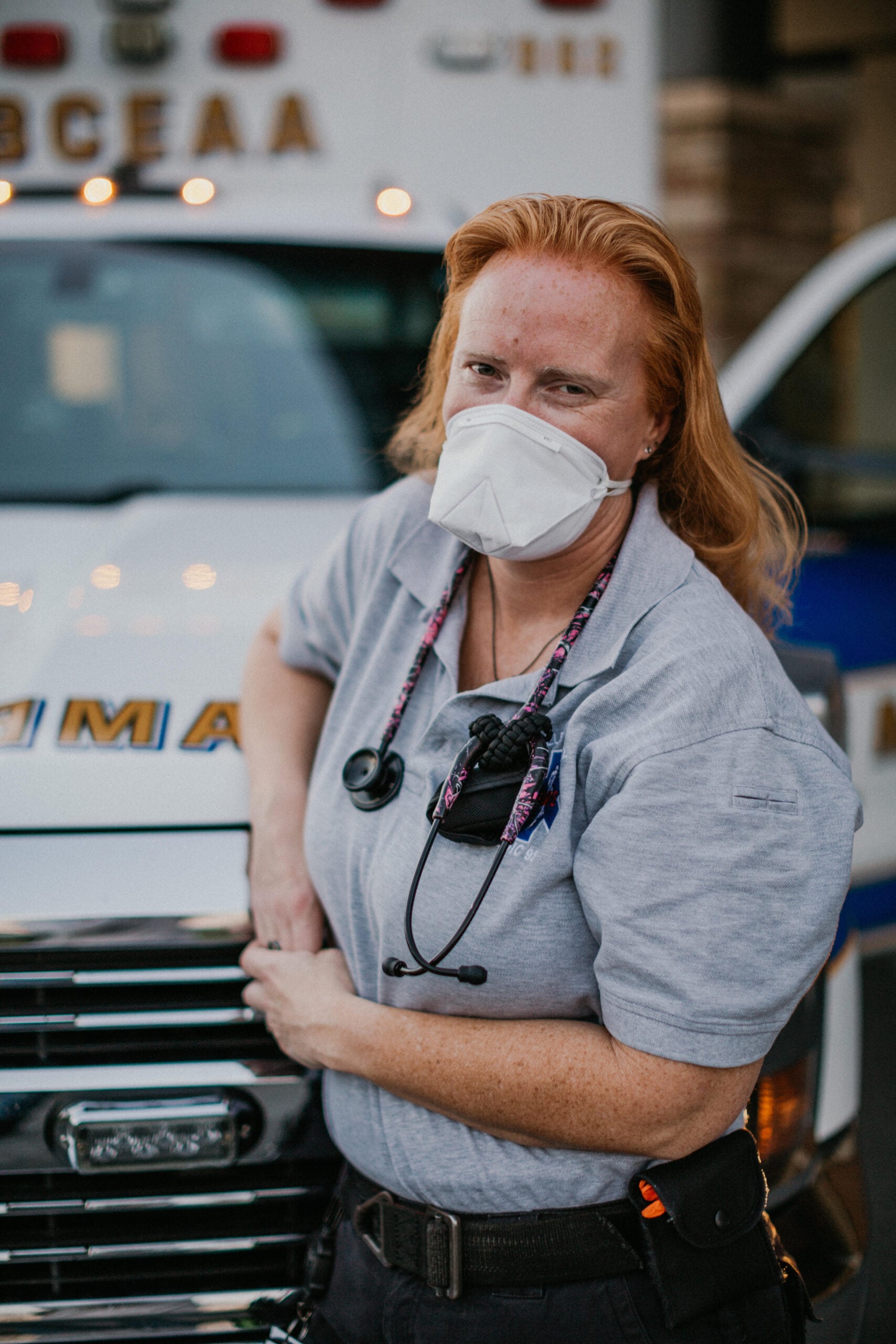
Most people think they understand emergency medical services. A 911 call comes in, an ambulance appears, somebody jumps out with gloves, calm eyes, and a bag full of gear, and then the patient disappears toward the hospital. Scene over. Credits roll. Siren fades.
But that version of the story leaves out the real plot.
The work of EMS professionals is not just dramatic rescue. It is also waiting, lifting, documenting, disinfecting, de-escalating, comforting, rechecking, restocking, teaching, translating, and carrying home the emotional leftovers of everybody else’s worst day. EMTs and paramedics do not simply deliver emergency care. They hold together the messy space between crisis and continuity. They are clinicians, transport specialists, safety managers, family communicators, data collectors, and sometimes reluctant furniture movers with cardiac monitors.
That is why the labor of EMS professionals often feels invisible. The public sees the adrenaline. EMS crews live the accumulation. A spectacular cardiac arrest may last twenty minutes in memory, but the rest of the shift can be consumed by the unpaid-looking, low-glamour, absolutely essential work that makes emergency medicine function at all.
This matters because the hidden parts of the job are not side quests. They are the job. And when they are ignored, EMS burnout rises, turnover accelerates, patient care suffers, and communities lose a crucial piece of their safety net.
What people see versus what EMS actually does
Hollywood loves the flashiest ten minutes of prehospital care. Real life is more crowded. A single call can involve patient assessment, airway management, medication decisions, communication with dispatch, coordination with fire or police, navigation through traffic, family reassurance, hospital notification, handoff reporting, equipment cleaning, vehicle reset, and electronic charting. Then the crew does it again. And again. Possibly without lunch. Possibly at 3:12 a.m. while someone’s coffee is still emotionally unfinished.
Federal career data reflects this broader picture. EMTs and paramedics assess patients, provide emergency medical care, transport patients, transfer patients between facilities, decontaminate ambulance interiors after contagious exposures, and work with police, firefighters, and telecommunicators. In other words, the profession is already bigger than the stereotype. It includes medical judgment, logistics, infection control, communication, and teamwork in unstable settings.
The public often assumes the job begins at the curb and ends at the emergency department doors. In reality, some of the hardest labor starts after arrival.
The handoff is work
Transferring a patient to the hospital sounds simple until you remember that hospitals are busy, emergency departments are crowded, and ambulance offload delays are increasingly common. When crews wait to transfer care, they are not “done.” They are stuck in operational limbo: monitoring the patient, preserving equipment, tracking information, and protecting continuity while their unit remains unavailable for the next emergency.
That delay creates a strange kind of invisible labor. The ambulance is physically present but functionally missing from the community. EMS professionals are still responsible, still alert, still clinically engaged, but no longer visible as active responders. It is work that counts enormously and is noticed almost not at all.
Documentation is care, even when it feels like paperwork in tactical boots
Electronic patient care reports are supposed to improve continuity and accountability, and they often do. But they also add cognitive weight to a job that already demands split-second recall. Crews must document timelines, treatments, medication doses, vital sign trends, scene conditions, and handoff details accurately enough for billing, legal review, quality assurance, and downstream medical care. The chart is not decoration. It is the bridge between the street and the system.
Still, documentation takes time, concentration, and emotional energy. After a physically demanding call, EMS clinicians do not get to simply exhale and move on. They must reconstruct the event in precise language, often while the radio is already threatening the next interruption.
The physical labor nobody can edit out
EMS is frequently described as stressful, but that word is too polite. It makes the work sound like a busy inbox. The job is physically punishing in ways that never make it into motivational posters.
Lifting patients in cramped bathrooms. Lowering stretchers down narrow apartment stairs. Carrying equipment across wet parking lots. Kneeling on concrete. Twisting in moving vehicles. Working in heat, cold, rain, traffic, smoke, and chaos. Federal occupational data consistently shows that EMTs and paramedics face high rates of injuries and illnesses, and injury surveillance has found that overexertion and bodily reactions are major drivers of harm. Violence is also a serious source of injury.
That combination is brutal because the hazards come from every direction at once. One minute the threat is a bad lift. The next it is blood exposure. The next it is a combative patient, a roadside scene, or a speeding car inches from the shoulder. EMS professionals work inside uncertainty, not around it.
Fatigue is not a personal weakness
Many EMS professionals work full time, more than full time, or “full time if your calendar enjoys practical jokes.” Extended shifts are common, including 12-, 18-, and 24-hour schedules. That is not just an inconvenience. Fatigue changes reaction time, memory, attention, mood, and decision-making. In a profession where tiny errors can become enormous consequences, fatigue is a systems problem disguised as individual grit.
The heroic culture of EMS has sometimes encouraged people to treat exhaustion like a badge of honor. But sleep deprivation is not a personality trait. It is a safety hazard. When an industry depends on professionals making critical decisions inside long, irregular, emotionally heavy shifts, fatigue management should be as normal as checking oxygen levels and seat belts.
The emotional labor is clinical labor
There is another hidden workload that rarely appears in budget lines: emotional regulation.
EMS professionals are expected to be calm when families panic, gentle when patients are embarrassed, clear when scenes are loud, and steady when outcomes are uncertain. They must walk into private suffering without becoming part of the chaos. They deliver bad news carefully, answer frightened questions honestly, and keep moving while processing trauma in real time.
That labor is often mistaken for personality rather than skill. But empathy under pressure is work. So is emotional restraint. So is staying respectful toward the intoxicated, the confused, the angry, the grieving, and the people who are not having their best moment because life just turned into a siren soundtrack.
Recent evidence reviews of the EMS and 911 workforces have documented meaningful mental health and occupational stress burdens, including burnout, stress, and related risks. That should not surprise anyone. EMS professionals absorb human crisis at close range and then are expected to reset instantly for the next call. There is no magical psychological rinse cycle in the ambulance bay.
The pay paradox: enormous responsibility, limited reward
One of the most uncomfortable truths in EMS is that the level of responsibility does not always match the level of compensation. According to the U.S. Bureau of Labor Statistics, the 2024 median annual wage was $41,340 for EMTs and $58,410 for paramedics. Those numbers may look decent on paper until you stack them against the realities of training, physical risk, clinical responsibility, shift work, emotional strain, and regional living costs.
This is where the unseen labor becomes economically visible. National EMS workforce findings have pointed to inadequate pay and benefits as a major concern, and survey results have shown that many EMS practitioners work more than one job. That means the profession is not only asking clinicians to carry patients, trauma, and liability. It is often asking them to carry side gigs, overtime, and unstable work-life balance too.
And then people wonder why retention is hard.
It is hard because low pay in a high-consequence profession sends a message. The message is: we need you urgently, but we value you conditionally. That is a fast route to moral exhaustion.
Turnover is not just an HR issue
When EMS professionals leave, communities lose experience, mentorship, institutional memory, and clinical confidence. The replacement problem is not solved by simply hiring new people if the system keeps burning through them. Workforce organizations have warned that turnover and shortages threaten response capacity, especially in rural and underserved areas. Meanwhile, federal labor projections show continued demand for the profession, with roughly 19,000 openings per year projected on average over the next decade.
So yes, EMS remains essential. But “essential” without durable support is just a nicer way to say overused.
The system burden is growing, not shrinking
Another reason EMS labor stays unseen is that the role itself has expanded. EMTs and paramedics are not only responding to car crashes and heart attacks. They are increasingly dealing with behavioral health crises, overdose emergencies, older patients with complex chronic conditions, interfacility transfers, and the downstream effects of housing instability, poor access to primary care, and overloaded hospitals.
In many communities, EMS also plays a role in non-emergent medical care through community paramedicine or mobile integrated healthcare. That means home visits, preventive support, follow-up care, and work that looks less like emergency response and more like bridging the gaps of a strained health system. It is practical, valuable, and very easy for outsiders to miss because it does not arrive with flashing lights.
The irony is hard to miss: when EMS becomes more sophisticated and more integrated into healthcare, more of its labor becomes less visible to the public. The calmer, smarter, and more preventive the work is, the less dramatic it looks. But prevention has always had a branding problem. Nobody throws a parade for the crisis that did not happen.
Why the invisible parts of EMS matter so much
The hidden work of EMS is not extra. It is what allows the visible work to succeed.
Without careful documentation, treatment details disappear. Without decontamination, infection risks multiply. Without structured handoffs, patients fall into informational cracks. Without emotional composure, scenes escalate. Without staffing, fatigue grows. Without fair pay, retention falls. Without faster hospital throughput, ambulances become waiting rooms on wheels. Without real support, the profession loses the very people communities count on when everything goes sideways.
That is the true shape of the unseen labor of EMS professionals: it is the constant conversion of disorder into function.
What real support for EMS professionals should look like
If leaders want to strengthen EMS, the answer is not another inspirational poster about heroes. Heroes are nice. Functional systems are better.
1. Pay people like clinicians
Wages, benefits, and career ladders need to reflect the skill and risk involved. A profession built on advanced responsibility cannot be sustained on symbolic appreciation alone.
2. Reduce avoidable workload
Better charting systems, smarter equipment design, safer lifting policies, and stronger staffing models can reduce the hidden drag that turns every shift into a marathon with random stairs.
3. Fix offload delays
Hospital crowding is not only a hospital problem. It directly affects ambulance availability, response capacity, and community safety. Faster transfers protect patients and return units to service.
4. Treat mental health as infrastructure
Peer support, confidential counseling access, leadership training, and healthy scheduling should be routine, not reactive. Resilience is useful; prevention is better.
5. Respect the full scope of the role
EMS is part emergency response, part healthcare delivery, part public health, and part social stabilizer. Policy should catch up with reality.
Experiences from the field: the part of the shift the public rarely sees
To understand the unseen labor of EMS professionals, it helps to picture a shift not as a highlight reel, but as a chain of demands that never quite resets. Imagine a crew starting before sunrise. The ambulance is checked, medications counted, airway bags confirmed, stretcher batteries tested, radios working, oxygen stocked. None of this looks heroic. All of it matters. A flawless call often begins with boring preparation done well.
The first run is a fall in a small apartment. The patient is kind, apologetic, and heavier than the staircase was designed for. The crew lifts, pivots, braces, and communicates in short bursts. Their backs notice every inch of the descent. At the hospital, they wait for a bed, repeat the story, answer follow-up questions, clean the stretcher, and update the chart. By the time they are back in service, the public memory of that call is already gone. For the crew, it is still in their shoulders.
The second call is very different: an overdose in a parking lot, a frightened friend shouting, traffic building around the scene, police arriving, bystanders filming. The patient survives. That is the good news. The hidden work comes afterward. The crew has to restore order, document times and medications precisely, manage the emotional swing from chaos to control, and then prepare for whatever comes next with no ceremony and no decompression chamber waiting behind the ambulance doors.
Later, the calls blur together in the way only shift work can produce: chest pain, nursing home transfer, shortness of breath, a child with a fever, a person in mental health crisis who mostly needs patience and a calm voice. Meals become theoretical. The charting pile grows. The crew keeps moving because the radio does not care that the last family was crying or that the emergency department hallway is now functioning as a temporary parking lot for stretchers.
And then there is the emotional whiplash. One minute, the crew is joking with each other about terrible gas station coffee. The next, they are kneeling beside somebody’s parent, spouse, or child. They must be steady on demand. They must speak clearly, touch carefully, and project confidence even when a scene is loud, cramped, or unpredictable. People often call this professionalism, which is true, but incomplete. It is also emotional labor performed at a clinical standard.
What makes these experiences so defining is not just the severity of any one call. It is the repetition. The body keeps lifting. The mind keeps switching gears. The heart keeps absorbing tiny shocks. EMS professionals are asked to deliver technical care and human reassurance in compressed timeframes, often with imperfect information and limited control over the environment. Then they are expected to be instantly ready again.
That is why so many EMS clinicians say the job follows them home. Not always as dramatic trauma, but as accumulated tension: the sore back, the unfinished report, the patient they keep replaying, the family member’s face, the sense that they were needed everywhere at once. The public sees a vehicle, a uniform, a rapid response. EMS professionals experience a long chain of physical effort, mental vigilance, and emotional containment that stretches far beyond the moment anyone remembers.
If we want to honor EMS workers honestly, we should stop pretending the job is made of sirens alone. It is made of preparation, pressure, patience, paperwork, pain tolerance, teamwork, restraint, and the daily decision to keep showing up for strangers. That is the unseen labor. And without it, the visible rescue would never happen.
Conclusion
The unseen labor of EMS professionals is not invisible because it lacks value. It is invisible because it happens in motion, in fragments, in transitions, and in the quiet minutes after the dramatic part ends. EMTs and paramedics do far more than arrive fast. They make judgment calls under pressure, manage risk, absorb trauma, move patients safely, document care precisely, and keep communities covered while broader healthcare systems strain around them.
Seeing that labor clearly changes the conversation. EMS burnout is not just about stress tolerance. Workforce shortages are not just about recruitment. Ambulance delays are not just about traffic. These are structural issues tied to how much hidden work the profession carries every day. If communities want reliable emergency care, they need to value the full reality of the job, not just the part with flashing lights.