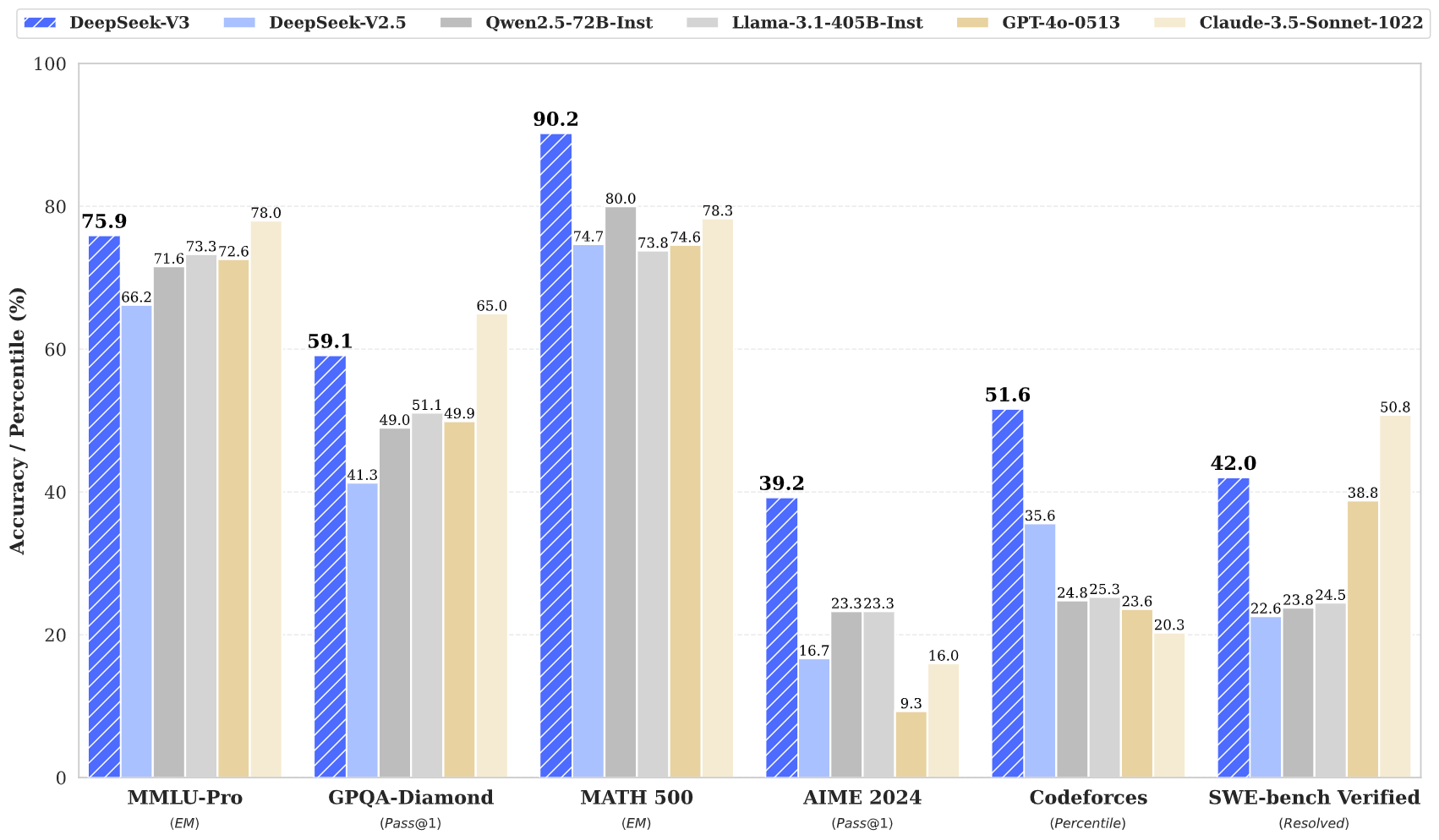
Every so often, a new large language model shows up and the AI industry reacts the way people react when someone brings a surprisingly good homemade pie to a professional bake-off: first disbelief, then curiosity, then a lot of nervous side-eye. That is roughly what happened with DeepSeek V3. In a market dominated by expensive closed systems, DeepSeek V3 arrived with a very different pitch. It was big, fast, openly available, commercially friendly, and at least according to its creators and early benchmark watchers shockingly competitive.
That combination is why the model made such a splash. DeepSeek V3 did not just launch as another chatbot brain in a crowded digital aquarium. It challenged a growing assumption in AI: that frontier-level performance automatically requires eye-watering budgets, giant GPU fleets, and a business model built around locking the good stuff behind an API. Instead, DeepSeek V3 turned the conversation toward efficiency, architecture, and engineering discipline. In plain English, it suggested that brute force is not the only way to get a smart machine to talk back intelligently.
For developers, founders, researchers, and even ordinary AI users, that matters. A lot. DeepSeek V3 became a talking point not only because it performs well on coding, reasoning, and long-context tasks, but because it represents a broader shift in how open source AI models can compete. It is the kind of release that makes rivals adjust their posture, investors recalculate their assumptions, and technically curious people open fifteen tabs at once. Which, to be fair, is also how many of us do all serious research.
What Is DeepSeek V3, Exactly?
DeepSeek V3 is a Mixture-of-Experts, or MoE, large language model. That phrase sounds a little like a corporate retreat exercise, but the core idea is practical. Instead of activating every parameter for every token, an MoE model activates only a smaller subset of specialized “experts” at a time. DeepSeek V3 has 671 billion total parameters, but only 37 billion are activated for each token. That makes the model far more efficient than a dense model of similar total scale while still preserving high-end performance where it counts.
The technical report says the model was trained on 14.8 trillion high-quality tokens and extended to handle a 128K context window. That gives DeepSeek V3 the ability to work through long prompts, long documents, and large coding tasks without immediately falling apart like a folding chair at a barbecue. It also uses several architectural features that help explain why people paid attention so quickly: Multi-head Latent Attention for more efficient inference, DeepSeekMoE for scalable expert routing, and Multi-Token Prediction to improve decoding speed.
DeepSeek also framed the release as fully open-source in spirit, with openly available models and papers, while the Hugging Face listing clarified the licensing picture: the code repository is under MIT, and the model itself is available for commercial use under the model license. That distinction matters for businesses evaluating risk. In other words, this was not just a research flex posted into the void. It was a model positioned for real use, real experimentation, and real deployment.
Why DeepSeek V3 Started Making Waves So Fast
The first reason is simple: performance. Early benchmark summaries and the model card positioned DeepSeek V3 as a top-tier open model, especially in coding, math, and long-context work. Its reported scores were strong enough to put it in conversations usually reserved for closed models from OpenAI and Anthropic. Whether you are building developer tools, writing assistants, coding copilots, or research workflows, that gets attention in a hurry.
The second reason is cost. DeepSeek reported that the full training process for V3 required 2.788 million H800 GPU hours, and outside reporting highlighted the company’s claim that the compute cost was under $6 million. That figure became headline fuel because it landed against a background of U.S. AI giants discussing spending plans measured in the billions. In AI, numbers have a way of becoming mythology before lunch, and this number did exactly that.
But the “waves” were not only technical. DeepSeek’s AI assistant, powered by DeepSeek V3, surged to the top of Apple’s U.S. App Store in early 2025. That made the story visible beyond developer circles. Once a model moves from benchmark charts into mainstream app rankings, it stops being just a research success and becomes a market event. Investors noticed. Competitors noticed. Anyone holding Nvidia stock probably noticed with unusual emotional intensity.
Then there was timing. DeepSeek V3 landed in late December 2024, and the company followed it with DeepSeek R1 in January 2025. Because R1 was built on the V3 foundation, the two releases fed each other’s momentum. V3 established the lab’s credibility. R1 amplified it. By March 2025, DeepSeek had already released the V3-0324 upgrade, adding to the sense that this was not a one-hit wonder but a rapidly evolving model family.
What Makes the Model Technically Interesting
Mixture-of-Experts Without the Usual Baggage
MoE models are not new, but building one that is both efficient and competitive is harder than it sounds. DeepSeek V3 leans on sparse activation so it can behave like a giant model without paying the full price for every forward pass. That makes it especially notable for inference efficiency, one of the most important practical bottlenecks in real-world AI deployment.
Engineering Over Hype
One of the most talked-about parts of the DeepSeek V3 story is that it reads like an engineering triumph more than a marketing spectacle. The technical report emphasizes stable training, FP8 mixed precision support, and infrastructure-level optimizations designed to squeeze more out of available hardware. Some reporting also pointed to low-level GPU tuning and pipeline improvements that may have helped the lab extract unusual efficiency from Nvidia H800 chips.
Speed Matters More Than People Admit
DeepSeek’s release notes touted output speeds of 60 tokens per second, roughly three times faster than V2. That kind of speed is not just a vanity metric. Faster generation makes chat systems feel more responsive, lowers serving costs, and improves the odds that developers will actually want to build products on top of the model. Nobody enjoys staring at a blinking cursor while a language model thinks deep thoughts about your grocery list.
Long Context and Coding Muscle
The 128K context window is another reason DeepSeek V3 resonated. Long-context ability is increasingly important for codebases, legal documents, research synthesis, and enterprise knowledge work. The model card and paper also highlight strong results in code-heavy evaluations, which helps explain why developer communities paid such close attention. For many users, the real test of a model is not whether it can write a poem about the moon. It is whether it can fix a bug without creating three new ones in the process.
Why Open Models Like DeepSeek V3 Matter
The AI industry has spent the last few years drifting toward closed systems, closed weights, and subscription-first access. DeepSeek V3 pushed in the opposite direction. That matters because open models tend to accelerate experimentation. Developers can inspect them, fine-tune them, quantize them, benchmark them, and adapt them for specialized tasks. Open access lowers the barrier to entry for startups, universities, independent researchers, and teams that do not have the budget to rent premium intelligence by the token forever.
It also changes the competitive conversation. If a commercially usable open model gets close enough to top closed systems, then “good enough” becomes a dangerous phrase for incumbents. In enterprise software, open source does not always need to be unquestionably better. Sometimes it only needs to be capable, affordable, and flexible enough to become the default choice for a large class of use cases. DeepSeek V3 looks uncomfortably close to that threshold.
And because the model family kept improving after launch, the story did not freeze in December 2024. The March 2025 V3-0324 update reinforced the sense that DeepSeek was iterating quickly and treating open releases as part of a continuing product strategy rather than a one-time publicity stunt.
The Caveats: Hype, Limits, and Hard Questions
For all the excitement, the DeepSeek V3 story comes with footnotes the important kind, not the dusty academic kind everyone promises to read later. First, many of the most eye-catching comparisons came from DeepSeek’s own benchmarks and technical reporting. That does not make them false, but it does mean sober readers should treat them as strong claims that deserve independent validation.
Second, the famous cost figure has been debated. While DeepSeek’s paper and subsequent coverage focused on the efficiency of the V3 training run, later reporting and analysis suggested the broader infrastructure picture may be more complicated than the headline number implies. So the real lesson is not necessarily that frontier AI suddenly costs pocket change. It is that architecture and systems optimization may matter far more than the industry’s spending arms race has encouraged people to believe.
Third, deployment is not trivial. The DeepSeek paper itself acknowledges that the recommended deployment unit is relatively large, which can be a burden for smaller teams. Yes, the community quickly began quantizing and adapting the model, and later reports showed impressive local runs on high-end Apple hardware. But the full-size model is still massive. This is not exactly something you casually install between lunch and your next Zoom call.
Finally, there is the issue of censorship and alignment. Reporting from WIRED found that DeepSeek models can exhibit application-level censorship and post-training bias around politically sensitive topics when accessed through DeepSeek-controlled channels. That may not matter for every enterprise use case, especially in coding and summarization. But it absolutely matters for evaluation, trust, and broader adoption. A model can be technically brilliant and still raise serious questions about what it will or will not say.
Experiences From the DeepSeek V3 Wave
What has the DeepSeek V3 moment felt like in practice? In one word: jarring. Not because the model appeared out of nowhere DeepSeek had already been earning attention but because V3 changed the tone of the conversation. Before its release, many people in AI had settled into a familiar story: the biggest labs had the biggest budgets, the best chips, the most compute, and therefore the strongest long-term advantage. DeepSeek V3 did not completely demolish that story, but it put a very large dent in it.
For developers, the experience was a mix of excitement and recalibration. A lot of hands-on discussion focused on the model’s coding ability, output speed, and the sheer appeal of having strong weights available for experimentation. Instead of asking, “Can this open model keep up?” people started asking, “How close is close enough for my use case?” That is a much more disruptive question. A startup does not need a model that wins every benchmark trophy. It needs a model that works reliably, costs less, and can be shaped to fit a product.
For researchers and technically inclined users, another striking part of the experience was the return of architecture talk. DeepSeek V3 made people care again about how a model was built, not just how flashy the demo looked. Discussions about sparse activation, FP8 training, inference optimization, and token throughput suddenly moved out of niche corners and into mainstream AI coverage. That is healthy. AI progress should not be judged only by who can afford the biggest GPU bonfire.
For business leaders, the reaction was more strategic. DeepSeek V3 suggested that the cost curve might not behave the way many companies expected. If highly capable open models continue improving, then enterprises may have more negotiating leverage, more deployment options, and more freedom to keep sensitive workloads outside closed platforms. That possibility alone is enough to make product teams revisit their roadmaps and CFOs sit up a little straighter.
For ordinary users, the experience was more straightforward: the model felt like proof that the AI race was getting weird in interesting ways. A chatbot backed by DeepSeek V3 climbed app rankings in the United States, a sign that mainstream users were willing to try something new if it was fast, capable, and easy to access. Most people do not care whether a model uses Multi-head Latent Attention. They care whether it helps them write, code, summarize, and search without making them want to throw their laptop into a decorative pond.
And that may be the real story of DeepSeek V3. It made advanced AI feel less inevitable in one direction and more competitive in several directions at once. More open. More efficient. More global. More unpredictable. In technology, those are usually the early signs that a market is about to get much more interesting.
Conclusion
DeepSeek V3 is making waves because it represents more than a strong open source language model. It represents a challenge to the AI industry’s current assumptions about cost, openness, and technical leadership. With a 671B-parameter MoE design, 37B activated parameters per token, 128K context handling, strong reported coding and reasoning results, and a commercially usable release strategy, it arrived as a serious contender rather than a curiosity.
At the same time, the model’s rise should be read with clear eyes. Some claims are self-reported, deployment at full scale is demanding, and concerns around censorship and broader infrastructure costs remain part of the conversation. Still, even with those caveats, DeepSeek V3 has already done something important: it forced the market to ask whether smarter engineering can rival bigger spending. That question is not going away. If anything, it is just getting warmed up.