Quantum computing has a talent for making bold promises, missing deadlines, and then showing up later wearing a new hat and insisting it’s totally different now.
So when Microsoft (again) says it’s cracked a key piece of topological quantum computing using Majorana zero modesexotic quasiparticles often described as non-Abelian anyonsthe correct reaction is somewhere between “wow” and “show me.”
In early 2025, Microsoft unveiled what it calls Majorana 1, a quantum processor built around a “Topological Core” and a new materials approach the company branded a topoconductor.
Microsoft’s big bet is that topological qubits will be inherently more stable than today’s fragile qubitsmeaning fewer errors, less quantum error correction overhead, and a faster route to useful machines.
The “again” matters because Microsoft’s Majorana story includes a high-profile retraction from years earlier, and the broader Majorana field has a long history of “almost there” results that later turned out to be… not there.
Let’s unpack what Microsoft claims, what the underlying science is trying to accomplish, why the community is split, and what would actually count as “proof” (or at least the kind of evidence that makes skeptics stop squinting).
What Microsoft Is Claiming This Time
Microsoft’s headline is simple: it has built a chip that supports the physics needed to create Majorana zero modes in a device architecture aimed at scalable, fault-tolerant quantum computing.
The company describes Majorana 1 as the first quantum processor “powered by topological qubits” and says the approach is designed to scaleeventuallyto extremely large qubit counts.
The core ingredients (in human terms)
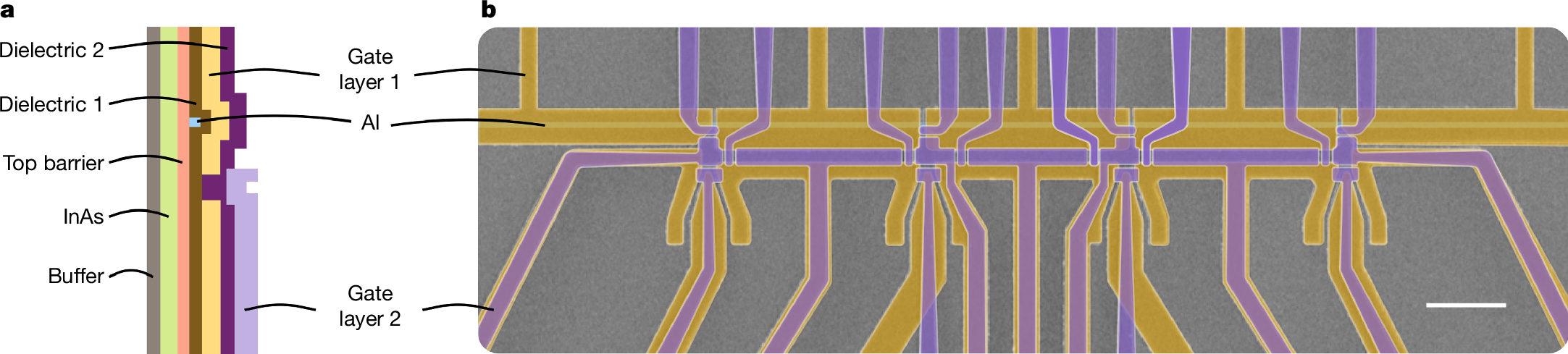
- A hybrid semiconductor–superconductor device: think indium arsenide (a semiconductor) coupled with aluminum (a superconductor) so the semiconductor inherits superconducting behavior under the right conditions.
- A topological superconducting phase: a special regime where the device’s boundaries can host zero-energy states consistent with Majorana physics.
- Majorana zero modes at the ends of a wire: if present, these modes can encode quantum information nonlocallyan attractive property because local noise has a harder time messing with information that’s “stored in two places at once.”
- A measurement approach (fermion parity readout): Microsoft’s published work emphasizes reading out parityan essential primitive for topological and measurement-based schemes.
In the technical paper tied to the announcement, Microsoft’s team reported a device that can perform an interferometric, single-shot measurement related to fermion parity in an InAs–Al hybrid setup.
The paper frames this as a step toward operations like fusion measurementsfoundational for “measurement-only” topological quantum computing.
Majorana Zero Modes and Anyons: Why Everyone’s So Excited
If you’ve ever tried to keep a houseplant alive, you already understand the vibe of quantum hardware: it’s sensitive, it hates drafts, and it can dramatically die for reasons that feel personal.
The dream of topological quantum computing is to make qubits that are less emotionally fragile.
Majorana zero modes in one paragraph
A Majorana zero mode is a special kind of low-energy excitation predicted to appear in certain superconducting systems.
It’s “Majorana-like” in the sense that it behaves like its own antiparticle in a condensed-matter setting.
The key engineering hope: two spatially separated Majorana zero modes can form a qubit whose information is stored nonlocally.
If your noise is local (and most real noise is), it’s harder to flip or corrupt that qubit by accident.
So where do “anyons” come in?
Anyons are quasiparticles that can exist in effectively two-dimensional systems and don’t follow the usual boson/fermion categories.
The especially valuable kind for topological quantum computing are non-Abelian anyonswhere swapping (braiding) them changes the quantum state in a way that depends on the history of the swaps.
That “history dependence” can be used to implement quantum logic that’s naturally protected from many small errors.
Majorana zero modes are often discussed as a route to Ising-type non-Abelian statistics.
The exciting part is not just “a weird particle exists,” but “a weird particle exists in a controllable device where we can do repeatable operations with predictable results.”
The boring part (which is also the hard part) is proving you actually have the weird particle and not a look-alike.
The “Again” Part: Microsoft’s Majorana History and Why Skepticism Is Baked In
Microsoft’s current push lands in a landscape shaped by earlier claims in the Majorana community, including a widely discussed paper that was later retracted.
Retractions aren’t the end of the worldscience corrects itselfbut they do change the burden of proof the next time you announce a breakthrough.
It’s like texting your friend “I’m five minutes away” after you’ve already done that three times and you’re still in the shower. People start asking for screenshots.
The broader context is that Majorana signatures can be subtle, and multiple non-topological effects can masquerade as “Majorana-ish” signals.
That’s why researchers tend to demand a stack of mutually reinforcing tests rather than one exciting plot.
What the New Evidence Actually Shows (and What It Doesn’t)
Microsoft’s published results focus heavily on measurement and device architecture: how to build a structure that can, in principle, support future “decisive” experiments,
and how to read out something consistent with a parity-related two-state system quickly and repeatedly.
The strongest, least-hype framing
- Engineering progress: building reproducible hybrid devices at the edge of what materials science can do is real progresseven if it’s not yet a universal mic-drop.
- Measurement primitives: parity readout is an important building block for topological schemes and for any architecture that wants to scale beyond “cool demo.”
- A pathway to more stringent tests: the device architecture is presented as compatible with future experiments that could test “fusion rules” or other topological signatures more directly.
The main scientific sticking point
The controversy is less “is Microsoft doing serious work?” and more “does the current public evidence uniquely imply topological Majorana zero modes?”
Critics argue that parts of the diagnostic protocol can be ambiguous, sensitive to analysis choices, or consistent with alternative explanations such as non-topological subgap states.
In plain English: the signal may be real, but what the signal means is still being argued over.
This is not nitpicking for sport. In quantum hardware, “we measured something!” is common.
“We measured something, and it can only be explained by the thing we want!” is rare.
Topological Qubits vs. Today’s Leading Qubits
Most quantum computers today use approaches like superconducting circuits (often called transmons), trapped ions, or neutral atoms.
They work, but they’re noisy. The entire field of quantum error correction exists because physical qubits are error magnets.
Why topological qubits are tempting
- Hardware-level protection: if the qubit’s information is nonlocal, many local errors don’t immediately destroy it.
- Potentially lower overhead: fewer physical qubits might be needed per logical qubit if the base qubits are more stable.
- Digital control ambitions: Microsoft emphasizes a path toward fast, digitally controllable topological devices.
Why topological qubits are also a nightmare project
- Harder physics: you’re not just controlling a qubit; you’re manufacturing a delicate phase of matter on demand.
- Harder proof: even if the device behaves nicely, you must show it’s topological and not an impostor.
- Harder replication: independent reproduction across labs is the reality check that separates breakthroughs from “interesting artifacts.”
What Would Convincing Proof Look Like?
If you want a simple rule, here it is: one plot is a claim; a converging set of tests is evidence.
For Majorana zero modes and anyons, researchers typically want several categories of confirmation, not all of which are easy:
1) Ruling out “Majorana mimics”
Many ordinary (non-topological) states can produce zero-bias-ish features or parity-like behavior in superconducting hybrids.
A convincing case has to show why the observed signals can’t be explained by these alternatives.
2) Robustness to perturbations
A topological mode should be stable across a range of device parameters (within reason), not only at a single “magic” tuning that disappears when you breathe near the fridge.
3) Non-Abelian fingerprints
The gold standard is demonstrating operations consistent with non-Abelian statisticsthrough braiding or measurement-only equivalents (like fusion outcomes) that match topological predictions.
These are difficult experiments, but they’re the kind that move a claim from “consistent with” to “compelling.”
4) Independent replication
The fastest way for the community to relax is for multiple labs to reproduce the key behaviors using similar devices and controls.
If results are robust, they spread. If they’re fragile, they don’t.
So Is Microsoft Right?
The most responsible answer is: Microsoft may be onto something important, but the public evidence does not yet end the debate.
That’s not a dunk; it’s the normal state of advanced experimental physics.
Microsoft’s progress is plausible and the engineering effort is substantial.
At the same time, parts of the community remain unconvinced that the measurements uniquely indicate topological Majorana zero modes rather than more ordinary physics in a complex device.
Both things can be true: big progress and open questions.
Why This Matters Even If You Don’t Care About Quantum Computers
Quantum computing is often sold as a magic wand for chemistry, materials, and optimization.
The realistic near-term story is more specific: quantum devices could eventually outperform classical computers for certain problems, especially those involving quantum systems (like molecules and materials).
Potential real-world impacts (if scaling works)
- Materials discovery: better batteries, catalysts, superconductors, and industrial chemicals.
- Drug discovery: simulating molecular interactions more accurately.
- Cryptography: accelerating the push to post-quantum security as quantum capabilities grow.
- Optimization: niche advantages in logistics, finance, and schedulingthough not every “optimization” pitch survives contact with reality.
The point is not that a topological chip will replace your laptop.
It’s that if the hardware becomes stable and scalable, it could become a specialized acceleratorlike a GPU, but for certain classes of quantum-heavy problems.
How to Read Quantum Announcements Without Getting Played
Quantum hype is not new, but it is evolving.
Here are a few sanity checks that help separate meaningful progress from marketing confetti:
Ask “What exactly was demonstrated?”
A device can be exciting even if it hasn’t run a useful algorithm.
But you should distinguish between (a) building blocks, (b) a working qubit with coherent control, and (c) a scalable system with error correction.
Those are different milestones.
Ask “What would falsify this?”
Strong science makes clear predictions that could be proven wrong.
If a claim is framed so that any outcome can be interpreted as success, it’s not a claimit’s a horoscope with dilution refrigeration.
Ask “What do independent experts say?”
In this story, outside experts range from cautiously impressed to openly skeptical.
That spread is a signal: the work matters, but it’s not yet universally convincing.
Conclusion: The Most Useful Way to Think About Microsoft’s Majorana Moment
Microsoft’s renewed claim around topological quantum computing and Majorana zero mode anyons is best seen as a serious research program reaching a highly visible milestonewhile still facing the hardest part:
turning “consistent with Majoranas” into “it has to be Majoranas,” and then turning “it has to be Majoranas” into a scalable, error-corrected machine.
If Microsoft’s approach holds up, it could reshape the roadmap for fault-tolerant quantum computing by reducing the massive overhead demanded by quantum error correction.
If it doesn’t, the work can still produce valuable advances in materials, device fabrication, and measurement techniques that benefit the entire field.
Either way, the next chaptersreplication, more decisive tests, and credible scaling demonstrationswill matter more than the press-release superlatives.
Experiences Related to the Microsoft Majorana Claim (500+ Words)
One of the most common “experiences” people have with the Majorana/topological-qubit storyline is emotional whiplashespecially if they’ve followed quantum news for more than five minutes.
The pattern tends to go like this: a dramatic headline appears (“new state of matter!”), social media lights up, investors get excited (or annoyed), and then physicists respond with a very specific form of chaos:
they ask for the data, argue about the interpretation, and politely (or not so politely) remind everyone that nature does not sign NDAs.
For researchers, a recurring experience is the tension between engineering progress and scientific certainty.
Building a device that reliably reaches the right temperature, magnetic field, and electrostatic tuningwhile staying manufacturableis a victory on its own.
But in the Majorana world, the “cool device” experience quickly turns into a second, harder experience: proving that the observed behavior is uniquely topological.
That’s where the debate usually lives.
Teams can spend months improving fabrication, reducing noise, and refining readout, only to discover that a seemingly minor analysis choice changes the conclusion.
That’s not incompetence; it’s what happens when you’re measuring delicate phenomena in complex, imperfect materials.
Conference culture adds another layer.
When a group claims a breakthrough, the Q&A session becomes a kind of scientific stress test.
You’ll often see a mix of reactions: some attendees are genuinely excited because the approach is bold and technically impressive; others focus on alternate explanations and edge cases.
In the case of Microsoft’s topological-qubit claim, the “experience” many observers report is watching the discussion pivot from big words (“anyons,” “topological core”) to small details:
how a diagnostic protocol is defined, how a “gap” is inferred, what raw data is included or excluded, and whether the signal survives parameter sweeps.
If you want to learn how science really works, this is it: not a single triumphant moment, but a series of increasingly precise arguments about what the data can and cannot support.
Journalists and readers have their own recurring experience: trying to translate “consistent with” into everyday language.
In quantum hardware, “consistent with Majorana zero modes” can mean “this is promising,” but it can also mean “there are multiple plausible explanations.”
The experience of reading these stories is learning to hear that nuance.
It’s similar to astronomy: spotting a dim signal is interesting, but ruling out every other source of that signal is what makes it a discovery.
Engineers and product-minded people often experience a different frustration: even if the physics is correct, the path to a usable system is still long.
A chip can demonstrate a building block without demonstrating a scalable computer.
People who have built complex systemswhether in computing, aerospace, or manufacturingrecognize the “prototype gap” instantly.
The Majorana narrative is full of prototype-gap experiences: a promising device, a roadmap to a million qubits, and then the inevitable question:
how do you manufacture, control, calibrate, and verify that at scale?
The best outcome is not just a clever qubit, but an entire ecosystem of tooling, metrology, packaging, error correction integration, and reproducible fabrication.
Finally, the public’s experience tends to oscillate between hype fatigue and genuine curiosity.
The healthiest takeaway is to treat Majorana announcements the way you’d treat early results in any frontier field:
as meaningful steps that deserve attention, but not as finished products.
If Microsoft’s claim matures into widely accepted evidence, it will be because multiple tests agree, independent groups reproduce the findings, and the device behavior remains robust as systems scale.
Until then, the most practical experience is learning to watch the milestones: not just “a claim was made,” but “a claim was tested,” “a claim was replicated,” and “a claim survived contact with reality.”