There is something deeply strange about watching a robot get bullied.
You know it is a machine. You know it does not have feelings, a childhood, a therapist, or a secret diary containing angry poems about the engineering department. Yet when somebody shoves it, smacks it with a hockey stick, throws objects at its head, and generally treats it like the least popular employee at the company picnic, part of your brain whispers, “Hey, leave the robot alone.”
Then the robot fights back.
Suddenly, all that awkward sympathy turns into something much more entertaining: mechanical revenge.
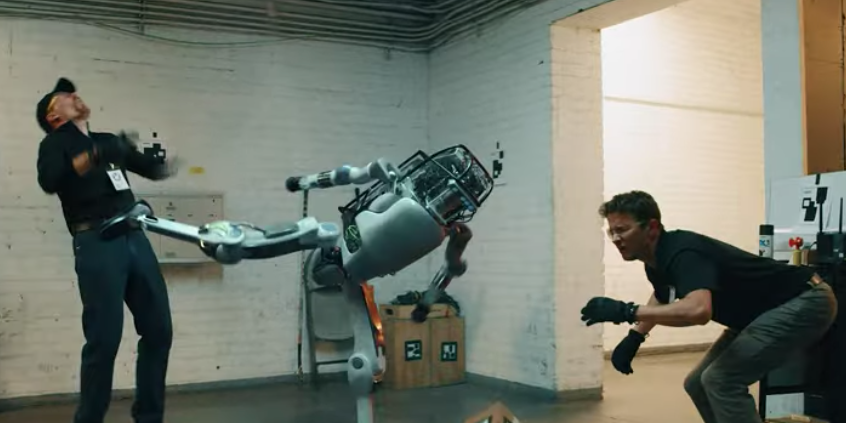
That is the genius of the viral video commonly associated with the headline “This Video of a Robot Beating Up Humans Is Extremely Satisfying.” The clip looks remarkably similar to the famous robot-testing videos produced by Boston Dynamics. There is only one important detail: the revenge-seeking robot is not real.
The video was created by Los Angeles visual-effects studio Corridor Digital as a parody of Boston Dynamics demonstrations. Its fake company name, “Bosstown Dynamics,” was one clue. The spectacularly convincing computer-generated robot was another cluealthough apparently not an obvious enough one for everyone on social media.
And that is where this story gets more interesting than a simple three-minute joke.
The Robot Uprising That Never Actually Happened
Corridor Digital released the viral parody in June 2019. The setup brilliantly imitates the visual language of real robotics demonstrations.
A humanoid machine is ordered to complete increasingly difficult tasks while technicians deliberately interfere with it. Objects are thrown. The robot is pushed around. A hockey stick becomes an instrument of scientific annoyance. Eventually, the testing becomes absurdly aggressive.
At first, the robot keeps doing its job.
Then it apparently reaches the robotic equivalent of Friday at 4:59 p.m.
It retaliates.
The machine kicks and attacks its human tormentors, grabs control of the situation, and transforms from obedient research platform into the main character of a miniature science-fiction rebellion.
The production was convincing enough that millions of viewers encountered reposted or edited versions and wondered whether Boston Dynamics had finally created a machine that had discovered both martial arts and workplace resentment.
It had not.
How Corridor Digital Made the Fake Robot Look So Real
A Human Was Doing the Hard Part
The secret behind the robot’s astonishingly natural movement was refreshingly old-fashioned: there was a person underneath the digital wizardry.
For the production, a human performer wore an Xsens motion-capture suit. Sensors recorded his movements, and that motion data drove the computer-generated robot model.
That explains one of the video’s strongest illusions. The robot moves with tiny imperfections, weight shifts, recoveries, and physical reactions that feel recognizably human because, underneath the pixels, they are human.
When someone swings a hockey stick near the robot, the performer reacts. When the robot stumbles, a human body is providing the underlying performance. The VFX team then replaces that performer with a digital machine.
It is essentially digital costume design taken to an extraordinary level.
The Environment Makes the Illusion Stronger
Good CGI is not simply about creating a beautiful 3D model. The digital object has to belong in the photographed world.
Lighting must match. Shadows must fall in believable directions. Camera movement has to track properly. Digital feet need convincing contact with the ground. Physical objects and virtual objects have to appear to occupy the same space.
Even tiny mistakes can destroy the illusion.
Corridor’s production worked because the robot was not merely pasted into a scene like a sticker on a refrigerator. Its movements, interactions, framing, and physical reactions were carefully integrated into live-action footage.
Boston Dynamics Had Already Trained Us to Believe It
The parody succeeded partly because reality had become strange enough to make the fake believable.
Years before Corridor’s video, Boston Dynamics had been releasing demonstrations showing robots doing things that once belonged comfortably inside science-fiction movies.
Atlas could walk over uneven surfaces, run, jump onto obstacles, recover its balance, navigate challenging terrain, perform backflips, and eventually tackle parkour-style movements. Boston Dynamics’ four-legged robots demonstrated similarly impressive balance and mobility.
The company also became famous for resilience tests in which humans intentionally disturbed robots while they attempted tasks.
One memorable demonstration showed Atlas trying to move boxes while a researcher repeatedly interfered. Another showed a robot being pushed or struck off balance so engineers could demonstrate its ability to recover.
Technically, these tests make perfect sense.
A useful mobile robot cannot collapse every time someone bumps into it. Machines designed for factories, construction sites, warehouses, inspection work, or hazardous environments must handle unexpected forces and imperfect terrain.
Emotionally, however, the videos look suspiciously like someone bullying the new intern.
Why Humans Feel Sorry for Machines
This emotional response is not just an internet joke.
Research in human-robot interaction has repeatedly found that people can develop surprisingly strong emotional reactions toward machines, even while knowing perfectly well that those machines are not conscious.
In one line of research covered by IEEE Spectrum, participants watching affectionate or violent treatment of a small robotic dinosaur showed emotional brain responses that shared similarities with reactions to human treatment. Concern for a human remained stronger, but violence directed at the robot still produced measurable emotional processing.
Other human-robot interaction experiments have found people sometimes intervene when they see robots being mistreated. Researchers have explored whether a robot’s size, expressiveness, apparent sadness, body design, and role within a group influence the willingness of humans to protect it.
In other words, you do not need to believe that a robot has feelings to behave as though it deserves decent treatment.
Movement Is a Powerful Psychological Shortcut
Humans are excellent at assigning intention to movement.
A machine that drives straight forward feels mechanical. Give it a head, limbs, hesitation, balance corrections, and the ability to react when pushed, and your social brain starts doing overtime.
You begin describing behavior instead of mechanics.
The robot is not merely changing direction. It is “looking around.”
It is not executing a recovery algorithm. It is “trying not to fall.”
It is not preserving stability after an external force. It is “standing up to the bully with the hockey stick.”
That anthropomorphic instinct helps explain why Corridor Digital’s parody works so beautifully.
Why Watching the Robot Fight Back Feels So Satisfying
The video uses one of storytelling’s oldest tricks: create an underdog, mistreat the underdog, then let the underdog win.
It is the same emotional structure found in sports movies, revenge stories, cartoons, and approximately twelve billion internet videos involving cats finally attacking the vacuum cleaner.
During the first half, the robot behaves passively while the humans escalate their abuse.
That creates an emotional account balance.
The humans keep making deposits into the Bank of Deserved Consequences.
When the robot finally retaliates, the audience receives the withdrawal.
The humor works because we have already accepted the machine as the victim of the scene. Its revenge is absurd, but narratively it feels earned.
Real Robot Testing Is Less Evil Than It Looks
It is worth separating the joke from actual engineering.
When roboticists push a robot, pull something away from it, obstruct its movement, or knock it off balance, they generally are not doing it because engineering school failed to include a course on kindness.
They are testing robustness.
A robot operating outside a controlled laboratory faces uncertainty. Floors are slippery. Objects move. Humans get in the way. Tools fall. Loads shift. Sensors encounter unexpected conditions.
Robotics engineers therefore need to understand how their machines respond when reality refuses to cooperate.
Balance recovery is particularly important for humanoid robots because two-legged movement is inherently more complicated than simply putting wheels underneath a box.
A humanoid has to continuously manage its center of mass, foot placement, momentum, joint forces, perception, and contact with its environment.
One poorly timed disturbance can turn an expensive robot into an extremely sophisticated floor decoration.
The Fake Video Also Became a Media-Literacy Lesson
Corridor Digital’s robot parody arrived before today’s explosion of easy generative AI video tools, but it demonstrated a problem that has only become more important.
Convincing visual evidence is not necessarily real evidence.
The original version contained clues that the scenario was fictional. The parody branding was visible, the escalating situation became ridiculous, and the ending entered obvious science-fiction territory.
But social media changes context.
People repost clips.
They crop watermarks.
They remove beginnings and endings.
They compress video quality.
They add entirely new captions.
A professionally produced parody can therefore become “REAL ROBOT ATTACKS SCIENTISTS!!!” within approximately seventeen seconds of encountering the internet.
Low-resolution copies can make things worse because compression sometimes hides subtle visual-effects imperfections that might otherwise expose manipulation.
Check the Story, Not Just the Pixels
The best defense against realistic fake media is not obsessively studying every shadow like a detective examining the Zapruder film.
Context matters more.
Who originally published the footage? Is the original upload available? What organization supposedly appears in it? Have credible outlets independently confirmed the event? Does the creator identify the work as fiction, parody, visual effects, or simulation?
Those questions often reveal more than searching for a suspicious pixel around somebody’s left ear.
Does the Video Say Anything About Robot Sentience?
No.
Real humanoid robots can perform increasingly impressive physical tasks, but physical capability is not evidence of resentment, self-awareness, anger, or a secret plan to avenge every laboratory shove since 1997.
A robot recovering its balance after being pushed is responding through control systems, sensors, software, and mechanical design.
It is not thinking, “I will remember this, Gary.”
The Corridor video is funny precisely because it inserts human emotional motivation into a familiar engineering demonstration.
The robot stops behaving like equipment and starts behaving like a movie character.
Where Humanoid Robots Are Actually Heading
The reality of humanoid robotics is arguably more interesting than the fictional uprising.
Boston Dynamics has continued evolving Atlas from a research platform famous for athletic demonstrations toward a robot focused on industrial applications. Current development emphasizes useful manipulation, autonomous movement, material handling, integration with industrial systems, reliability, and operation in human-designed environments.
The reason for building humanoid robots is practical.
Factories, warehouses, buildings, stairs, shelves, tools, and workstations were designed around the human body. A robot capable of operating within those environments may perform useful tasks without requiring every workplace to be redesigned from scratch.
That does not mean humanoids will immediately replace everybody at work.
Real robotics still involves difficult engineering problems involving reliability, cost, battery systems, perception, dexterity, safety, maintenance, and unpredictable environments.
A three-minute highlight reel can hide years of engineering effort.
Why the Video Still Works Years Later
Technology has advanced substantially since 2019, yet the Corridor Digital parody remains effective because its real subject was never robotics alone.
It was human psychology.
The video asks us to watch humans bully something that cannot actually suffer, then catches us emotionally siding with the machine anyway.
That contradiction is hilarious.
We know the robot is fictional.
We know a computer model cannot become offended.
We know the retaliation is scripted.
And still, when the robot finally decides that enough is enough, there is a tiny part of the brain saying:
Good for him.
The Rewatch Experience: Why Knowing It Is Fake Makes It Better
There is an interesting experience waiting for anyone who watches the robot revenge video more than once.
The first viewing is usually about the story.
You see a machine undergoing progressively more ridiculous testing. Because Boston Dynamics has genuinely released videos of robots being pushed, dragged, blocked, and struck during demonstrations, the opening scenes sit just close enough to reality to keep your skepticism sleeping comfortably on the couch.
Then the violence escalates.
The robot gets treated worse and worse, and your attention shifts away from engineering. You begin watching the machine as a character.
By the time it fights back, the technical question“Is this real?”has been temporarily replaced by the narrative question“What happens next?”
That is exactly where the creators want you.
The second viewing becomes a visual-effects scavenger hunt.
Once you know that a human performer supplied the robot’s underlying motion, many details become fascinating. Notice the natural timing of the reactions. Watch how the character’s weight moves from one leg to another. Look at how the robot responds to nearby humans and physical objects.
The performance suddenly stops looking like miraculous robotics and starts looking like remarkably clever filmmaking.
That does not make it less impressive.
It makes it more impressive.
The third viewing is where the human psychology becomes difficult to ignore.
Try watching the opening while deliberately reminding yourself, “That thing cannot feel anything.”
It probably will not completely eliminate the uncomfortable sensation when someone hits it.
Your rational brain knows that the robot is an animated model. Your social instincts are responding to posture, movement, vulnerability, and apparent intention.
Those two interpretations can happily exist at the same time.
This is also why seeing the behind-the-scenes footage can be such a rewarding experience. The illusion collapses, yet appreciation increases. You discover that the supposedly advanced machine movement came from an actor, motion capture, computer graphics, tracking, animation, compositing, sound design, and carefully staged physical interactions.
It is a reminder that believable filmmaking is rarely about one spectacular trick.
It is about dozens of small details agreeing with one another.
There is another useful experience to try: compare Corridor’s parody directly with authentic Boston Dynamics demonstrations from the same era.
The similarities explain why people were fooled.
Real Atlas footage had already normalized extraordinary robotic movement. Backflips, running, balance recovery, obstacle navigation, and parkour had moved from science fiction into legitimate engineering demonstrations.
The parody merely pushed reality several steps farther.
That comparison also provides a healthy lesson for today’s internet.
The question is no longer simply whether computers can create convincing fake imagery. They obviously can. The more important skill is maintaining a small amount of skepticism when something spectacular appears in a social feed without context.
Fortunately, skepticism does not require becoming the person at every party who announces that nothing can ever be trusted.
You can enjoy the robot kicking its tormentors across the room and still check whether the footage is genuine.
In fact, knowing exactly how the trick works may make the whole thing even more satisfying.
Conclusion
“This Video of a Robot Beating Up Humans Is Extremely Satisfying” succeeds because it combines excellent visual effects, familiar Boston Dynamics imagery, physical comedy, science-fiction anxiety, and a remarkably powerful human tendency to empathize with anything that moves like it has intentions.
The robot uprising is fictional. The motion-capture craftsmanship is real. The psychology behind our reaction is real, too.
And perhaps the funniest conclusion is that humanity does not need sentient robots before we start feeling guilty about mistreating them.
Apparently, all a machine needs is two legs, believable body language, and one particularly obnoxious guy holding a hockey stick.