Some tableware asks to be handled carefully, stored behind glass, and brought out only when guests promise not to gesture wildly. Toast’s two-tone enamelware takes the opposite approach. It wants breakfast in the garden, soup beside the campfire, strawberries on the patio, and the occasional clumsy collision with a picnic basket.
With its creamy surfaces, contrasting green details, and pleasantly old-fashioned shapes, the collection turns practical steel dishes into objects worth leaving in plain sight. It is nostalgic without looking like a prop from a pioneer museum and stylish without behaving like a diva. That balance explains why these modest mugs, bowls, plates, and serving dishes became such memorable objects of desire.
Why Toast’s Two-Tone Enamelware Stands Out
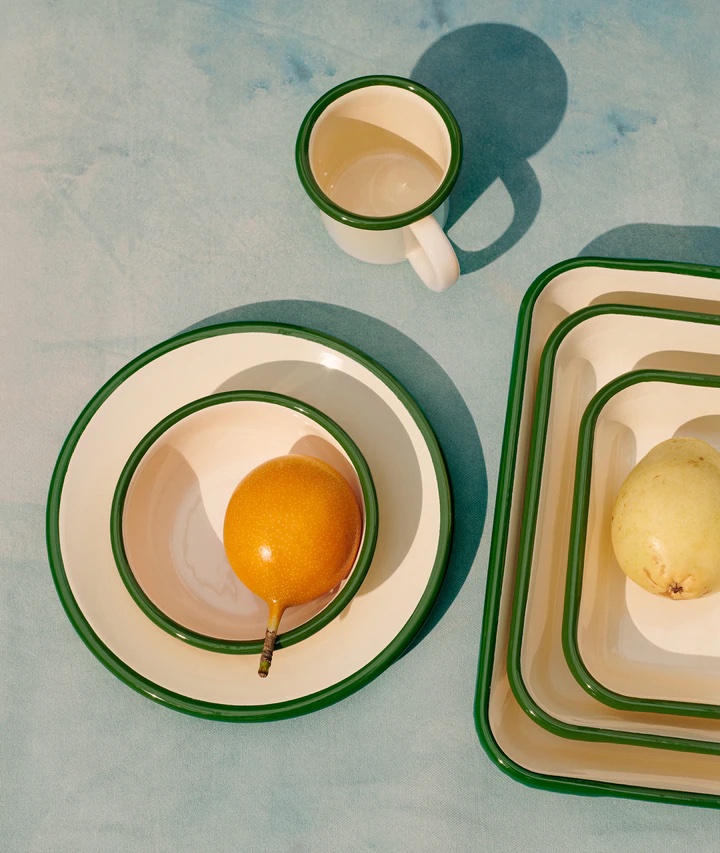
The collection attracted design attention in 2022, when Remodelista and The Organized Home highlighted Toast’s “cream and leaf” color combination. The original assortment included enamel mugs, bowls, plates, and serving dishes in several sizes. Instead of using the familiar white-and-blue camping palette, Toast paired warm cream with a leafy green that felt distinctly garden-ready.
That restrained two-tone treatment is the collection’s smartest move. A single solid color might have looked utilitarian, while a complicated pattern could have turned the pieces into novelty tableware. The contrasting edge creates definition, emphasizes each silhouette, and gives a stacked set enough visual rhythm to look intentional on an open shelf.
Toast currently describes its enamelware as smooth, durable, porcelain-infused tableware suited to picnics and entertaining in the garden. That positioning captures its appeal perfectly: these are useful objects designed for relaxed living rather than formal dining-room theater.
What Enamelware Actually Is
Enamelware is typically made by coating a metal base with a glass-like enamel and firing it at high temperatures. The process bonds the vitreous surface to the metal, creating a smooth exterior that is easier to clean and less reactive than exposed steel. Modern enamelware may look delicate, but beneath the glossy finish is a sturdy metal form.
This construction helps explain why enamelware has appeared in kitchens, cabins, campsites, and picnic baskets for generations. It offers some of the visual charm of ceramic dishes without ceramic’s enthusiasm for shattering into seventeen dramatic pieces when dropped.
Lightweight but Not Flimsy
Compared with stoneware or porcelain dinner plates, enameled steel is relatively lightweight. Architectural Digest has described enamelware as the coated metal dinnerware many people recognize from camping, while outdoor-dinnerware testing by Food & Wine has praised enamel plates for being sturdy yet easier to carry than traditional ceramic dishes.
This makes Toast’s collection especially appealing for anyone who regularly moves meals between the kitchen, balcony, backyard, porch, or park. Carrying four enamel plates outside feels like transporting lunch. Carrying four heavy ceramic plates feels like applying for an unpaid position in warehouse logistics.
Smooth, Practical Surfaces
The fused enamel creates a nonporous, glass-like surface that does not require seasoning. It is generally easy to wash, resists many everyday food stains, and does not absorb the aroma of last night’s garlicky dressing. Enamel should not, however, be confused with a synthetic nonstick coating. Food may still cling to enamel cookware, and serving pieces can still collect marks or scratches through rough handling.
A Color Combination Made for Slow Mornings
Toast is known for palettes influenced by landscapes and natural materials. The company describes its broader design approach as simple, functional, and intended to last, with colors rooted in naturefrom indigo to ochre. The cream-and-leaf enamelware fits comfortably within that philosophy.
The cream base softens the industrial character of metal tableware. It also provides a neutral background for food, allowing tomato soup, green salads, summer berries, or a heroic serving of scrambled eggs to look lively rather than visually crowded.
The green accent performs a different job. It outlines the form and brings the collection outdoors without covering every surface in botanical illustrations. The result works with linen napkins, wooden boards, clear tumblers, stainless flatware, woven placemats, and vintage kitchen linens. It can lean rustic, modern, Scandinavian, cottage-inspired, or quietly eclectic depending on what surrounds it.
Designed for Mixing, Not Matching
One of the pleasures of understated enamelware is that it does not demand a completely coordinated table. Toast’s pieces can sit comfortably beside handmade pottery, clear glassware, wooden salad servers, or plain white dishes.
This flexibility reflects a wider shift in casual table design. Contemporary enamelware collections from brands such as East Fork, Golden Rabbit, Crow Canyon Home, and GSI Outdoors are marketed for patios, picnics, children’s tables, buffets, cabins, and everyday mealsnot only wilderness camping. The material has escaped the supply closet and discovered styling.
Three Easy Styling Approaches
- Garden lunch: Pair cream-and-green enamel plates with washed linen, wildflowers, sparkling water, and a large serving bowl filled with salad.
- Modern breakfast: Use the mugs and bowls with a pale wood table, stainless flatware, black coffee, and toast that is slightly more burned than intended.
- Eclectic dinner: Mix enamel plates with patterned napkins, vintage glassware, and handmade ceramic serving pieces.
Because the design is quiet, a missing piece or mismatched bowl does not ruin the arrangement. In fact, a little variation makes the setting feel collected rather than ordered by committee.
Where Two-Tone Enamelware Works Best
Outdoor Dining
Outdoor meals are the obvious setting. Enamelware is easier to carry than many ceramic alternatives and far more reassuring around stone patios, children, pets, or friends who become expressive while telling stories. Food & Wine’s outdoor-dinnerware testing found enamel plates attractive, lightweight, and sturdy, although scratches and chips remain possible over time.
Small Kitchens
In a compact kitchen, objects must often be both useful and displayable. Toast’s two-tone dishes stack neatly and look decorative enough for open shelving. Their contrasting rims also make individual pieces easy to distinguish when stacked, preventing the familiar kitchen ritual of lifting six plates to locate the one bowl hiding beneath them.
Family Meals
Enamelware is practical for casual family dining because it is less fragile than conventional china. East Fork specifically promotes enamelware for patios, picnics, and children’s tables, demonstrating how naturally the material fits low-stress meals.
That does not mean enamelware is indestructible. It can dent, scratch, or chip. Its advantage is that an ordinary bump is less likely to end with a dustpan, a lecture, and a household debate about who left the plate near the edge.
Picnics and Road Trips
The lightweight metal construction is ideal for car camping, cabin weekends, and picnics where disposable plates feel wasteful and ceramic dishes feel unnecessarily brave. REI continues to carry enamel mugs intended for outdoor use, while GSI Outdoors describes enamelware as a campfire classic equally at home in a farmhouse kitchen.
The Honest Limitations of Enamel Tableware
No material is perfect, and enamelware’s quirks are part of the bargain.
- It can chip: A hard impact may crack or remove part of the glass-like coating.
- Exposed metal can oxidize: Chips that expose steel may develop rust-colored marks, especially if left wet.
- It can become hot: Metal transfers heat efficiently, so mugs and bowls holding very hot food or drinks may feel warmer than thick ceramic versions.
- It is not microwave-safe: Enamelware contains metal and should not be placed in a microwave.
- Not every serving piece is cookware: Check the manufacturer’s instructions before using any plate, bowl, or dish on a burner, in an oven, or over a fire.
Toast previously noted that its enamelware might chip when dropped but would not break like ceramic. The brand also indicated that oxidization of exposed steel did not automatically make a chipped serving piece unusable. Nevertheless, any piece with sharp edges, loose enamel, or severe damage should be retired from food service.
How to Care for Toast Enamelware
The original collection was described as dishwasher-safe, but gentle hand-washing remains the more cautious choice when appearance matters. Outdoor-enamelware manufacturers commonly recommend warm soapy water, thorough drying, and avoidance of abrasive cleaners. Epicurious and Serious Eats offer similar advice for enameled cookware, emphasizing nonabrasive sponges and careful treatment of the finish.
Daily Cleaning
- Let hot pieces cool naturally before washing.
- Use warm water, mild dish soap, and a soft sponge.
- Rinse carefully around rolled rims and handles.
- Dry the piece instead of leaving water pooled on chipped or exposed areas.
- Stack with a soft liner if you want to minimize rubbing and scratches.
Dealing With Stains
For stubborn marks, begin with a soak rather than aggressive scrubbing. A mild baking-soda paste can help lift discoloration from many enameled surfaces. Avoid steel wool, harsh scouring pads, or enthusiastic scraping with metal utensils. Those methods may remove the stain along with the part of the finish you hoped to keep.
Why Enamelware Keeps Returning to Fashion
Enamelware has unusually broad visual range. It can suggest a farmhouse kitchen, a European café, a summer camp, a minimalist apartment, or a flea-market collection. Better Homes & Gardens has highlighted enamelware’s recognizable silhouettes in modern Americana interiors, while Country Living has documented renewed interest in vintage pieces used for serving, storage, displays, and decorative projects.
That adaptability keeps the material from becoming trapped in one decorating era. A speckled blue mug feels outdoorsy. A black-rimmed white plate feels classic. Toast’s cream-and-leaf combination feels softer and more cultivated, as if traditional camp dishes attended a design workshop and came home with better manners.
Enamelware also ages visibly. Small scuffs and chips reveal that the object has been used rather than preserved. For people who prefer immaculate tableware, this may be a drawback. For those attracted to objects that develop character, it is part of the appeal.
Is Toast’s Two-Tone Enamelware Worth Considering?
The strongest reason to choose it is not that enamelware is rare. Plenty of companies make durable enamel mugs and plates. What distinguishes Toast’s interpretation is the combination of useful shapes, restrained coloring, and an aesthetic that works indoors as naturally as it does outside.
It is particularly well suited to buyers who value:
- Lightweight tableware for patios and picnics
- Simple forms with a nostalgic edge
- Pieces that can be mixed with existing ceramics
- Open-shelf storage that looks intentional
- Everyday objects that improve with a little visible wear
It may be less suitable for someone who wants pristine surfaces forever, frequently reheats food in a microwave, or prefers the substantial weight of stoneware. Enamelware is practical, but its beauty comes partly from accepting that practical objects eventually acquire evidence of a life.
The Everyday Experience: Living With Two-Tone Enamelware
Imagine introducing a few Toast enamel pieces into an ordinary week rather than styling them for a flawless catalog photograph. On Monday morning, the mug holds coffee at a kitchen counter crowded with keys, mail, and one banana approaching an urgent deadline. The cream surface makes the coffee look rich, while the green edge gives the mug enough personality that it never feels like camping equipment accidentally left indoors.
The first noticeable difference from a heavy ceramic mug is weight. An enamel mug is easy to carry from room to room, although the metal body can feel warm when filled with a very hot drink. A sensible person uses the handle. A less sensible person touches the side, learns a brief lesson, and becomes sensible immediately.
At lunch, an enamel bowl handles tomato soup, grain salad, or leftover pasta without demanding special treatment. Its relatively light construction makes it convenient for eating outdoors. Carrying the bowl, utensils, napkin, and a glass to the patio can be done in one trip, which is the gold standard of domestic efficiency.
By midweek, the plate begins to show why the two-tone design is more than decoration. The green rim frames food clearly, whether the meal is a carefully arranged salad or toast eaten over the sink. It also blends with neutral linens and wooden serving boards, so setting a pleasant table requires very little effort. The pieces perform the useful trick of making casual food look intentional without making the cook feel underdressed.
During a family dinner, the practical advantages become more obvious. A child bumps a plate. Someone shifts a serving bowl too close to the edge. A guest stacks dishes with the confidence of a person who will not be washing them. Enamelware does not remove the possibility of damage, but it lowers the anxiety. There is less fear of catastrophic shattering, and the table feels more relaxed as a result.
The weekend provides the most convincing test. Pack the enamel plates for a picnic with sandwiches, fruit, cookies, and a container of potato salad large enough to challenge structural engineering. The dishes add more weight than paper plates but remain manageable, and they do not buckle beneath saucy food. After lunch, they can be wiped, stacked, and carried home for a proper wash.
Back in the kitchen, cleaning is uncomplicated. Warm water, dish soap, and a soft sponge remove ordinary residue. Dark marks may require soaking, but the process is not demanding. Drying the pieces thoroughly becomes a useful habit, especially if a rim or edge has begun to show wear.
After several uses, a tiny scuff may appear. This is the moment when ownership expectations matter. Anyone hoping for permanent showroom perfection may regard the mark as a tragedy worthy of sad music. Someone who appreciates patina may see it as proof that the object has joined daily life.
The greatest pleasure is how readily the collection moves between roles. A serving dish holds fruit at breakfast, salad at dinner, and keys during an emergency entryway reorganization. A mug works for coffee, pencils, wildflowers, or teaspoons. A bowl can serve oatmeal indoors and strawberries outside. The objects are appealing not because they perform one task spectacularly, but because they remain useful in changing situations.
That is the real experience Toast’s enamelware promises: less ceremony, more use. It brings color without clutter, nostalgia without costume, and durability without looking aggressively rugged. It may not transform every meal into a sunlit garden party, but it can make Tuesday’s leftovers feel considerably better dressed.
Conclusion
Toast’s two-tone enamelware succeeds because it respects both sides of good household design. It is attractive enough to display and practical enough to use without supervision. The cream-and-leaf palette gives familiar enamel dishes a fresh identity, while the steel construction makes them natural companions for breakfast tables, balconies, gardens, cabins, and picnics.
These are not precious objects in the traditional sense. They may collect scratches, chips, and small signs of age. Yet that vulnerability is part of their charm. The collection is designed to participate in daily life rather than observe it from a shelf.
For anyone seeking lightweight outdoor dinnerware, modern enamel plates, or tableware with understated vintage appeal, Toast’s two-tone collection remains a persuasive example of how a familiar material can feel desirable again. It is proof that even the humble camping mug can receive a sophisticated makeoverwithout forgetting how to survive lunch.