Some cartoonists build entire universes across hundreds of pages. Jimmy Craig needs one square, a handful of lines, and perhaps a character making the worst possible decision at precisely the right moment.
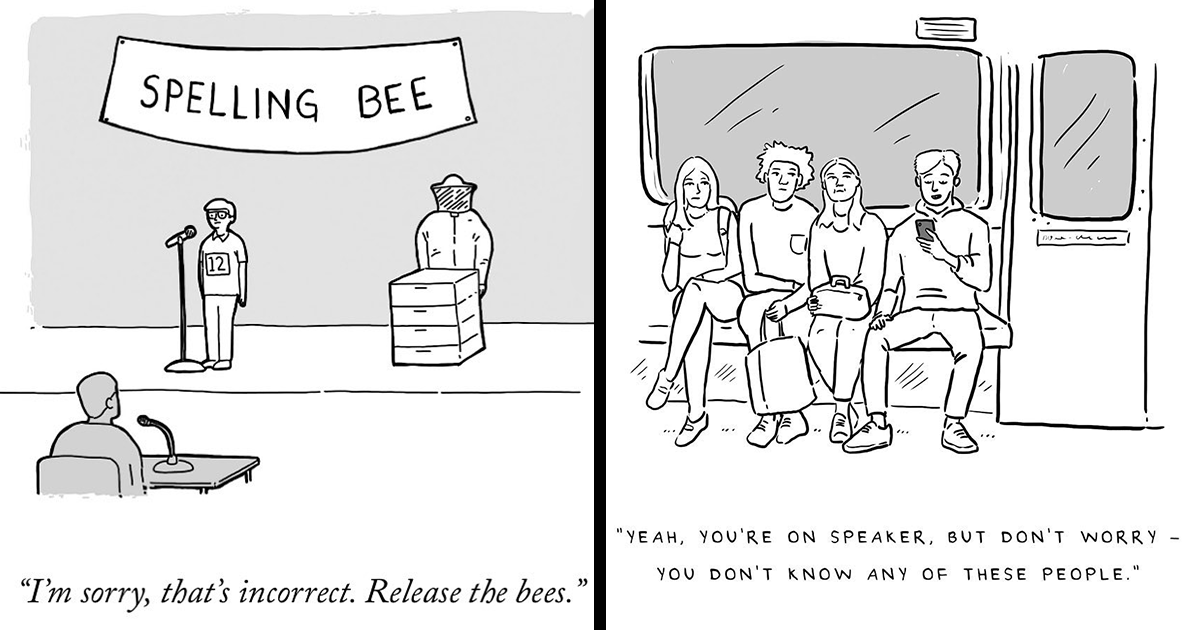
That compact approach drives the collection commonly presented as “40 One-Panel Comics By Jimmy Craig That Prove Humor Is Everywhere.” The cartoons jump between ordinary inconveniences, strange social encounters, monsters, animals, technology, work, and pure nonsense. A spelling bee may become dangerously literal. A private phone call may suddenly involve an audience. A familiar situation can take one sharp turn and land somewhere gloriously ridiculous.
The result is comedy that feels effortless even though successful one-panel humor is anything but easy. Craig must introduce a setting, establish expectations, reveal the contradiction, and deliver the punchline before the reader’s thumb begins scrolling again. Fortunately, his cartoons are built for that brief encounter. They arrive quickly, make their point, and leave behind a tiny comic echo that may return the next time real life behaves suspiciously like a cartoon.
Who Is Jimmy Craig?
Jimmy Craig is best known as the creator of They Can Talk, a comic series that imagines the conversations animals might have when humans are not listening. Cats complain, dogs misunderstand basic household rules, birds behave like feathery criminals, and wild animals display personalities that are often uncomfortably familiar.
That premise gave Craig a large creative playground, but it also established boundaries. Not every joke involves a pet, a woodland creature, or an animal judging humanity from the other side of a window. His jimmytried work became a place for ideas that did not naturally belong in the animal-centered series.
The change opened the door to vampires, giant monsters, awkward employees, strange inventions, mythological figures, lonely people, confident fools, and ordinary citizens caught in extraordinary situations. Instead of asking only what an animal might say, Craig could ask a much larger question: What is the funniest thing that could be happening in this scene?
From Animal Observations to Anything Goes
The creative connection between Craig’s two bodies of work remains clear. Both depend on observation. A They Can Talk cartoon studies recognizable animal behavior and translates it into human dialogue. His broader one-panel comics study recognizable human behavior and push it toward absurdity.
In both cases, the reader recognizes the emotional truth before noticing how ridiculous the situation has become. That combination is the sweet spot. The characters may be monsters, insects, office workers, or cosmic beings, but their insecurities, impatience, vanity, and confusion are unmistakably ours.
Why One-Panel Comics Are So Difficult to Create
A one-panel comic has no warm-up lap. There is no opening scene, no sequence of reaction shots, and no second page where the creator can explain what just happened. Everything must work at once.
The drawing establishes who is present, where they are, and what appears normal. The caption or dialogue introduces a second layer of information. The joke emerges from the collision between the two.
Remove too much information and the reader becomes confused. Add too much and the joke feels like someone explaining a magic trick while performing it. Craig’s best one-panel comics occupy the narrow space between those outcomes.
The Setup and Punchline Arrive Together
In a conventional joke, the setup comes first and the punchline follows. In a single-panel cartoon, readers often receive both almost simultaneously. They see the image, read the words, return to the image, and suddenly understand why the ordinary-looking scene is not ordinary at all.
Consider the basic idea of treating a “spelling bee” as an event involving actual bees. The phrase is familiar, so the reader arrives with one expectation. The drawing replaces that harmless expectation with a literal and potentially alarming interpretation. The mind corrects itself, recognizes the wordplay, and rewards the surprise with laughter.
That mental reversal may take less than a second. Creating it can take much longer.
Every Line Has to Earn Its Place
Craig’s minimalist drawing style is well suited to the format. Backgrounds are generally limited to what the reader needs. Faces are expressive without becoming overly detailed. Dialogue is short enough to remain conversational.
This visual economy is not simply an artistic shortcut. It controls attention. A highly elaborate room could invite readers to inspect furniture, wallpaper, and mysterious objects in the corner. A stripped-down room directs them toward the character who is about to say something profoundly foolish.
The same rule applies to the writing. The strongest captions rarely include a long explanation. They provide the final missing piece and trust the audience to assemble the joke.
How Jimmy Craig Finds Humor in Everyday Situations
The collection’s title claims that humor is everywhere, and the cartoons make a persuasive case. Craig does not need an elaborate adventure. He can begin with a phone call, a workplace conversation, a public announcement, a customer-service exchange, or an uncomfortable pause between strangers.
Social Awkwardness Is an Unlimited Resource
People routinely create their own comic situations by misunderstanding one another, oversharing, pretending to listen, or following social rules without understanding why those rules exist.
One of Craig’s recurring strengths is identifying the exact second when a normal conversation becomes uncomfortable. A character may reveal that a supposedly private call is on speakerphone in a room full of strangers. Another may respond honestly when politeness requires a harmless lie. Someone else may confidently announce information that everyone already knows.
These scenes work because readers have experienced milder versions of them. We have all waved at someone who was greeting the person behind us, forgotten a name midway through an introduction, or answered a question before realizing we heard it incorrectly. Craig merely turns the embarrassment dial until it clicks off in his hand.
Workplace Logic Is Often Cartoon Logic
Offices and service jobs are especially productive settings because they contain rules, hierarchies, jargon, and people attempting to appear competent before lunch.
A supervisor can transform a simple task into an organizational initiative. An employee can misunderstand a motivational slogan with devastating accuracy. A customer can expect one person to fix a problem created by an entire corporation. Everyone knows the system is strange, yet everyone continues using the system because the meeting has already been scheduled.
Craig’s workplace humor does not require detailed knowledge of a particular industry. The underlying experiences are universal: unclear instructions, forced enthusiasm, inadequate tools, uncomfortable teamwork, and the mysterious belief that one more email will solve everything.
Absurd Characters Make Familiar Problems Funnier
Craig frequently places recognizable emotions inside impossible characters. A vampire might worry about fitness. A giant monster may confront a surprisingly mundane inconvenience. Chimpanzees could approach crime with expectations shaped by bananas rather than money.
The fantasy character provides the surprise, while the ordinary problem provides the connection. Readers may not know what it is like to be Godzilla, but they know what it is like to arrive somewhere and discover that reality has failed to meet expectations.
Monsters Become Relatable
Traditional monsters are frightening because they operate outside human rules. Comedy reverses that relationship by forcing them to participate in those rules.
A creature loses some of its terror when it must wait in line, follow gym etiquette, explain itself to a receptionist, or cope with disappointing customer service. The contrast between enormous supernatural power and tiny everyday frustration creates immediate incongruity.
It also quietly flatters the reader. Perhaps we are not handling life badly after all. Even immortal beings apparently struggle with paperwork.
Animals Still Sneak Into the Picture
Although the jimmytried cartoons expand beyond They Can Talk, Craig’s instinct for animal comedy remains visible. Animals are useful because they can be treated as animals, people, or both at once.
A successful animal cartoon often begins with a genuine behavior and adds a human interpretation. A dog’s obsession becomes loyalty, panic, or hunger depending on the context. A cat’s indifference becomes an executive management style. A group of chimps can plan a human activity while retaining hilariously chimp-specific priorities.
The joke feels imaginative, but its foundation is observation. Anyone who has lived with a pet knows that animals already seem to have motives. Craig simply provides subtitles.
The Appeal of Slightly Darker Humor
Not every cartoon in Craig’s wider one-panel work aims for sweetness. Some jokes introduce danger, death, loneliness, failure, or characters facing consequences they absolutely should have anticipated.
Darker humor works when the tone remains controlled. Craig’s simple linework helps create distance between the reader and the disturbing implication. The event may be grim in theory, but the presentation remains playful rather than graphic.
That distance lets the audience laugh at subjects that might otherwise feel uncomfortable. The cartoon does not deny anxiety or disappointment. It shrinks those emotions into a manageable square and gives them a silly hat.
A Laugh Can Have an Aftertaste
The most memorable one-panel comics sometimes produce two reactions. First comes the laugh. Then comes the realization that the joke is saying something accurate about work, relationships, technology, fear, or human selfishness.
This does not turn every cartoon into a philosophical lecture. Thankfully, nobody wants a lecture from a vampire on a treadmill. It does, however, give the comedy a little more staying power.
A disposable joke disappears after the punchline. An observant joke follows the reader into real life.
Why Minimalist Cartoon Art Works So Well Online
Craig’s clean presentation is particularly effective on phones and social platforms. The central action is easy to recognize on a small screen. The caption is brief. The reader does not need to zoom into twelve tiny panels or remember what happened three updates ago.
That accessibility matters in an environment where comics compete with messages, videos, headlines, advertisements, and an urgent notification informing you that somebody you met once has posted a sandwich.
A clear one-panel cartoon can interrupt that noise. It asks for a few seconds and delivers a complete experience in return.
Simple Does Not Mean Careless
Minimalist cartoons are sometimes mistaken for easy cartoons. The assumption is understandable: fewer lines must mean less work. In reality, removing unnecessary details requires strong judgment.
The cartoonist must know which gesture identifies a character, which object defines the setting, and which expression supports the punchline without revealing it too soon. One badly placed prop can distract from the central idea. One unnecessary sentence can flatten the rhythm.
Craig’s work demonstrates that simplicity is often the final result of many decisions rather than the absence of them.
What Aspiring Cartoonists Can Learn From Jimmy Craig
Start With a Recognizable Truth
Absurdity becomes funnier when it grows from something familiar. Begin with an observation: people hate being overheard, pets behave strangely around food, customers misunderstand policies, or employees pretend to understand corporate language.
Once the truth is clear, exaggerate it, literalize it, or transfer it to an unexpected character.
Give the Idea Only What It Needs
A single-panel gag should not arrive carrying luggage for a three-act screenplay. Eliminate extra characters, decorative dialogue, and explanations that repeat what the drawing already shows.
The audience enjoys participating. Let readers connect the final dots themselves.
Protect the Original Voice
Craig’s animal comics and broader one-panel cartoons share a recognizable comic personality even though their subjects differ. That consistency comes from perspective rather than topic.
An original voice is not a specific character, font, or drawing technique. It is the pattern of things the creator notices. Craig notices overconfidence, social discomfort, literal interpretations, animal motives, mundane frustration, and the ridiculous dignity with which people face ridiculous situations.
Generate More Ideas Than You Publish
A finished cartoon is the visible survivor of an invisible selection process. Many concepts will be predictable, overly complicated, or funny only to the person who created them at 1:30 in the morning.
Producing a steady stream of ideas makes it easier to identify the strongest ones. It also reduces the temptation to rescue a weak joke with additional dialogue, elaborate artwork, and emotional support.
Why These 40 One-Panel Comics Connect With Readers
The collection succeeds because it offers variety without losing its identity. One cartoon may focus on awkward communication, another on a supernatural creature, another on an animal, and another on a visual pun. The subjects change, but the method remains recognizable.
Craig takes a familiar assumption and quietly replaces one part of it. A phrase becomes literal. A monster becomes mundane. A private moment becomes public. An animal adopts a human goal but pursues it according to animal logic.
These changes are small enough to understand instantly and strange enough to feel fresh. That balance makes the comics approachable even for readers who do not regularly follow cartoon art.
Most importantly, the collection never treats humor as something reserved for comedians, theaters, or dramatic events. It suggests that comedy is already present in elevators, waiting rooms, kitchens, offices, phone calls, relationships, and the suspicious behavior of household pets. The cartoonist’s job is simply to catch it before it escapes.
The Reader Experience: Spending a Week Looking for One-Panel Moments
Reading a collection like Craig’s can subtly change the way a person observes daily life. Ordinary situations begin to resemble unfinished cartoons waiting for the correct caption.
Imagine starting Monday in an elevator where six adults are silently staring at illuminated numbers. Nobody speaks. Everyone is pretending not to notice that one passenger is holding a giant birthday balloon against the ceiling. The scene needs no dramatic plot. It already contains visual tension, forced politeness, and an object behaving badly in public. A one-panel cartoonist would only need to decide which person speaks first.
On Tuesday, consider the grocery-store self-checkout. A machine announces that an unexpected item is in the bagging area. The item is not unexpected. You selected it, scanned it, paid for it, and placed it exactly where instructed. Yet the machine reacts as though a raccoon has entered the banking system. An employee arrives, taps one button, and restores civilization without explaining what you did wrong.
Wednesday offers a video meeting. One participant is frozen with an expression of deep concern. Another has been speaking while muted. A third believes the camera is off and is conducting an unrelated argument somewhere behind the laptop. The meeting’s official purpose is efficiency. Its practical achievement is proving that technology can gather ten people in one place while allowing each of them to experience a different disaster.
Thursday belongs to pets. A dog begs desperately for food immediately after eating. A cat ignores an expensive toy but forms an emotional attachment to the packaging. A bird outside the window repeats one sound for forty minutes, pauses just long enough to create hope, and begins again. These are not merely domestic inconveniences. Through Craig’s comic perspective, they are negotiations between species with radically different legal systems.
By Friday, the habit of observation becomes automatic. A sign uses wording that is unintentionally threatening. A coworker delivers a motivational phrase with the energy of someone reading a hostage statement. A restaurant server asks whether everything tastes good at the exact moment everyone’s mouth is full. The world has not become stranger. You are simply noticing the strangeness that was already there.
This is one of the most enjoyable effects of observational comedy. It does not require the audience to escape ordinary life. It makes ordinary life more interesting. Minor annoyances become raw material. Social mistakes become stories. Awkward pauses become carefully timed beats.
The experience also reveals why creating a successful cartoon is harder than recognizing a funny situation. Real life supplies clutter. There may be too many people, too much context, and no obvious ending. The cartoonist must identify the essential contradiction and remove everything that weakens it.
A useful exercise is to describe a funny moment in one sentence. Next, imagine it as a frozen image. Who must be visible? What object establishes the setting? What information belongs in the drawing, and what should appear in the caption? Finally, remove one element. If the joke still works, remove another.
By the end of the week, most observations will not become polished cartoons. That is perfectly fine. The real reward is learning to notice how often life accidentally writes comedy. People contradict themselves. Machines misunderstand people. Animals misunderstand machines. Everyone pretends the process is under control.
Jimmy Craig’s one-panel comics capture that condition with remarkable efficiency. They remind readers that humor does not always announce itself with a spotlight and a drumroll. Sometimes it is standing beside you in an elevator, holding an enormous balloon and refusing to make eye contact.
Conclusion: Humor Really Is Everywhere
“40 One-Panel Comics By Jimmy Craig That Prove Humor Is Everywhere” is more than a collection of quick jokes. It is a demonstration of comic compression. Craig transforms familiar phrases, uncomfortable conversations, strange creatures, animal behavior, workplace confusion, and everyday frustration into complete stories that fit inside a single frame.
His minimalist style gives each idea room to land. His observational instincts keep even the wildest scenarios connected to recognizable human behavior. Whether the central character is a caller on speakerphone, an ambitious chimp, a confused employee, or a monster attempting to manage an ordinary problem, the emotional logic remains clear.
The collection’s larger message is encouraging: a person does not need to live an extraordinary life to discover great comic material. The next joke may be hidden in a badly written sign, a pet’s suspicious expression, an unnecessary meeting, or a machine accusing you of placing an unexpected item in the exact location where it demanded you place the item.
All you need is enough attention to notice itand perhaps enough restraint to stop after one panel.
Editorial note: This original commentary analyzes the style, themes, and reader experience associated with Jimmy Craig’s publicly discussed cartoon work. It does not reproduce or transcribe the complete set of featured comics.