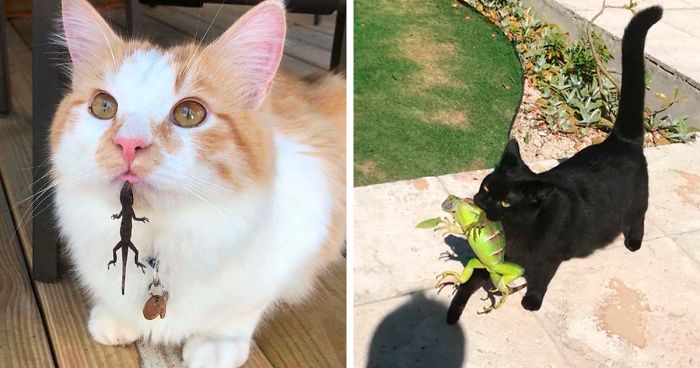
Put a cat and a lizard in the same general area, and nature immediately begins filming a tiny action comedy. The cat becomes a velvet-covered detective. The lizard becomes a nervous parkour instructor. Everyone freezes, nobody explains the plot, and a human nearby reaches for a camera.
These amusing cat and lizard encounters are funny because the animals appear to be participating in completely different stories. The cat believes it has discovered the most advanced moving toy ever invented. The lizard, meanwhile, is trying to survive an unexpected meeting with a predator that has toe beans, excellent night vision, and no respect for personal space.
From suspicious staring contests to failed ambushes, accidental nose boops, dramatic retreats, and lizards hiding in places no cat should logically investigate, these 40 imagined photo moments capture the strange chemistry between curious felines and their scaly backyard neighbors.
Why Cats Find Lizards So Fascinating
Cats are natural hunters, even when their toughest daily assignment is relocating from the couch to a sunny windowsill. Fast, irregular movement activates their instinct to watch, stalk, chase, pounce, and capture. A lizard provides the complete entertainment package: sudden sprints, instant stops, wall-climbing abilities, camouflage, and a tail that seems to have its own emergency escape plan.
A cat does not need to be hungry to become interested. Hunting behavior and eating are related, but they are not identical. A well-fed house cat may still follow a gecko across the patio with the concentration of an airport security officer studying a suspicious suitcase.
Lizards are equally well equipped for the encounter. Many remain motionless to avoid detection, then accelerate rapidly toward cover. Some species can climb vertical surfaces, flatten their bodies, change posture, or shed part of their tail when threatened. The detached tail may continue moving, distracting the predator while the lizard escapes. It is an effective defense, although regrowing a tail requires energy and the replacement may differ from the original.
40 Amusing Cat and Lizard Encounters That Deserve Captions
No two meetings unfold in exactly the same way. Sometimes the cat looks fearless. Sometimes the lizard stands its ground. Frequently, both animals appear to regret attending the meeting.
- The Backyard Inspection: A tabby lowers its nose toward a tiny lizard as though checking whether the visitor has the proper patio permit.
- The Mutual Surprise: The cat turns a corner, the lizard looks up, and both wear the expression of coworkers arriving at the same supposedly private lunch spot.
- The Window Negotiation: A gecko sits safely outside the glass while the indoor cat silently presents several unreasonable demands.
- The Tiny Dinosaur Problem: A kitten discovers a bearded dragon and suddenly realizes toys are less intimidating when they do not stare back.
- The Almost Boop: Cat nose and lizard snout move within an inch of contact before both parties reconsider their life choices.
- The Tail Hypnosis Session: One flick of a lizard’s tail transforms an ordinary house cat into a statue with enormous pupils.
- The High-Ground Advantage: The lizard climbs the wall while the cat remains below, visibly offended by the existence of vertical escape routes.
- The Patio Standoff: A cat crouches low, a lizard stands tall, and neither wants to admit it has no plan for the next ten seconds.
- The Furniture Fortress: A gecko disappears beneath a cabinet while one paw repeatedly searches the gap with the precision of a malfunctioning vending machine.
- The Unsuccessful Camouflage: The lizard blends beautifully into the stone, except for the observant cat staring directly at it.
- The Dragon and the Loaf: A bearded dragon rests beside a loaf-shaped cat, creating a portrait that looks like the strangest fantasy alliance ever assembled.
- The Overconfident Kitten: A young cat charges forward, the lizard moves three inches, and the fearless hunter performs an immediate backward hop.
- The Garden Supervisor: The cat sits beside the flowerpots while a small anole handles pest-control duties without receiving any credit.
- The Blink-and-It’s-Gone Moment: The cat looks away briefly and returns to find that its scaly suspect has disappeared into another dimensionor behind the planter.
- The Screen-Door Rivalry: A secure screen separates hunter and visitor, allowing both animals to act much braver than circumstances would otherwise justify.
- The Paw of Diplomacy: The cat slowly extends one paw, apparently attempting international relations through a method best described as “gentle smacking.”
- The Lizard That Refused to Run: Instead of fleeing, the reptile remains still, leaving the cat deeply confused by prey that will not follow the script.
- The Undercover Gecko: Only a pair of tiny eyes is visible behind a curtain while the cat searches the wrong side with absolute confidence.
- The Sunbeam Dispute: Cat and lizard both select the warmest patch of floor and discover that premium real estate attracts competition.
- The Ceiling Escape: The gecko reaches a spot above the door, and the cat looks upward as if personally betrayed by gravity.
- The Unexpected Roommate: A cat finds a lizard in the bathtub and reacts like someone discovering a stranger using the guest bathroom.
- The Tail Decoy: The cat focuses on a moving tail while the lizard escapes, demonstrating that nature invented the distraction technique before magicians did.
- The Observation Deck: From the back of a chair, a cat monitors a lizard below with the seriousness of an air-traffic controller.
- The Lizard’s Counterattack: A defensive lunge causes the cat to jump sideways, proving that confidence has limits when lunch suddenly objects.
- The Double Cat Committee: Two cats surround one lizard but spend so much time watching each other that the supposed target quietly leaves.
- The Statue Contest: Cat and lizard remain perfectly still until the human photographer becomes the first participant to lose patience.
- The Pots-and-Pans Chase: A kitchen visitor triggers a noisy pursuit involving one lizard, one cat, and several objects that never volunteered to participate.
- The Curious Senior: An older cat observes the lizard without moving, projecting the wisdom of someone who has chased enough nonsense for one lifetime.
- The Suspicious Head Tilt: The lizard performs a quick push-up display, and the cat tilts its head as though evaluating an unusually aggressive fitness video.
- The Box Ambush: A cat waits inside a cardboard box while the lizard remains outside, apparently unaware that every box automatically becomes feline military equipment.
- The Porch Meeting: Both animals pause at opposite ends of a step, creating a photograph that resembles a tense scene from a miniature Western.
- The Grass-Level Pursuit: Only the cat’s ears and the lizard’s tail remain visible above the lawn, making the entire confrontation look remarkably unproductive.
- The Iguana Introduction: A house cat approaches a large iguana, then gradually realizes this particular lizard is closer to management than prey.
- The Food-Bowl Intruder: A gecko appears near dinner, prompting the cat to investigate whether the visitor intends to eat, socialize, or file a complaint.
- The Curtain-Climbing Crisis: The lizard scales the fabric, the cat follows, and the curtain becomes the only true victim of the encounter.
- The Gentle Giant: A large, fluffy cat sits beside a tiny lizard with surprising calm, resembling an oversized bodyguard assigned to a very small celebrity.
- The Mirror Confusion: Cat, lizard, and their reflections create a four-animal standoff in which nobody understands who invited the additional guests.
- The Failed Sneak: The cat approaches with exaggerated slowness while its bell announces every step like a marching band.
- The Leaf Impersonator: A green lizard hides among houseplant leaves until one twitch reveals that the “leaf” has toes and excellent acceleration.
- The Peaceful Ending: After several minutes of suspense, the cat lies down, the lizard slips away, and everyone pretends the meeting was entirely intentional.
What Cat Body Language Reveals During the Encounter
Wide Eyes and Forward-Facing Ears
Large pupils, forward ears, still whiskers, and a lowered head usually signal intense attention. The cat is collecting information and preparing to respond to movement. It may look adorably confused, but the hunting system is already warming up.
The Low, Slow Stalk
When a cat flattens its body and advances one careful paw at a time, it is reducing noise and visibility. The posture may resemble an action hero crawling beneath security lasers, although the target is often a lizard sitting beside a flowerpot.
The Twitching Tail Tip
A sharply moving tail tip can indicate excitement, concentration, or frustration. It often appears when the cat can see the lizard but cannot reach it because of glass, furniture, or the lizard’s unfair ability to walk across a ceiling.
The Sudden Sideways Jump
Cats may be predators, but they are also cautious animals capable of startling dramatically. If the lizard lunges, changes direction, or puffs up, a cat may leap away before returning with an expression that insists the retreat was strategic.
Are Cat and Lizard Encounters Safe?
Funny cat pictures can make these meetings look harmless, but owners should not deliberately place a cat and lizard together. A cat can injure or kill a small reptile in seconds, even when the interaction appears playful. A larger pet lizard may defend itself with claws, teeth, or a powerful tail.
Wild lizards may also carry parasites. In some regions, cats can acquire liver flukes after eating infected lizards, amphibians, or other intermediate hosts. Possible signs include vomiting, diarrhea, reduced appetite, weight loss, lethargy, jaundice, or abdominal enlargement. A cat that has swallowed a lizard and later develops unusual symptoms should be evaluated by a veterinarian.
Reptiles can carry Salmonella bacteria even when they look healthy. Wash your hands after handling a reptile, cleaning its enclosure, or touching contaminated equipment. Keep reptile habitats away from kitchens and food-preparation surfaces.
How to Protect Both Animals
- Keep pet reptiles in secure, escape-resistant enclosures.
- Do not allow cats to sit on top of reptile tanks or paw through ventilation openings.
- Move the cat to another room before opening a reptile enclosure.
- Never stage a cat-and-lizard photograph for social media.
- Use a container and stiff paper to move a wild lizard outside without direct handling.
- Contact a wildlife rehabilitator if a lizard has been bitten or injured.
- Offer indoor cats daily play that safely imitates stalking and capture.
Why Keeping Cats Indoors Helps Lizards and Other Wildlife
Free-roaming cats pursue many kinds of small wildlife, including reptiles, birds, mammals, amphibians, and insects. The behavior is instinctive and may continue even when a cat receives plenty of food at home.
Keeping cats indoors protects native wildlife while also reducing feline exposure to traffic, predators, fights, toxic substances, parasites, and infectious disease. Owners who want to provide outdoor stimulation can consider a secure catio, a screened porch, or supervised harness walks.
Indoor life does not have to be boring. Wand toys, food puzzles, climbing structures, cardboard boxes, window perches, and short interactive play sessions provide healthy outlets for feline hunting behavior. Let the cat stalk, chase, and periodically “catch” the toy so the game has a satisfying conclusion.
Experiences From Living in a Neighborhood Where Cats Meet Lizards
The First Encounter Usually Happens at the Window
For many cat owners, the experience begins with an unexplained clicking sound. The cat is sitting at the window, jaw trembling slightly, staring at what appears to be an empty wall. A closer look reveals a tiny gecko clinging to the outside of the glass.
The cat may remain there for twenty minutes, following every movement with intense concentration. The gecko is completely safe, yet the cat behaves as though one incorrectly timed blink could compromise the entire mission. This is often the moment owners realize that a windowsill can provide better entertainment than a box full of expensive toys.
The Indoor Chase Is Much Less Charming
The mood changes when a lizard gets inside. One moment the living room is peaceful; the next, the cat is sprinting behind a bookshelf while a family member carries a plastic container and attempts to negotiate with both animals.
Closing interior doors helps limit the search area. The cat should be moved away before anyone tries to capture the lizard. Approaching slowly and placing a container over the reptile is usually safer than grabbing it. A sheet of cardboard can then be slid underneath, allowing the visitor to be carried outdoors.
The lizard should be released near shelter, such as vegetation or a protected wall, rather than in the center of an exposed lawn. The cat will probably inspect the empty room for the rest of the evening, convinced the missing reptile is organizing a second appearance.
A Cat’s “Gift” Is Not Always a Gift
Outdoor cats occasionally bring lizards to doorsteps, patios, or even beds. Humans often describe these deliveries as gifts, but the behavior may involve prey transport, play, practice, or the search for a secure place to handle a capture.
The experience can be upsetting, particularly when the lizard is still alive. Owners should avoid punishment because the cat is expressing normal predatory behavior, not acting out of cruelty. The better response is to remove the cat, assess the lizard, and reduce future hunting opportunities through indoor living or controlled outdoor access.
A lizard caught by a cat may have puncture wounds that are difficult to see beneath its scales. Even when it runs away, it may still be injured. A licensed wildlife rehabilitator can advise whether professional care is needed.
What These Meetings Teach Us
Cat and lizard encounters are funny partly because they expose the personalities humans assign to animals. The cat looks offended, the lizard appears unimpressed, and the photograph seems to contain an entire argument. In reality, we are observing two animals responding through instinct, caution, curiosity, and defense.
The most rewarding experience is watching without interfering. A lizard crossing the garden can be enjoyed from a distance. A cat can observe safely through a window or screened enclosure. The result may not produce a dramatic chase, but it protects both animals while still delivering plenty of whisker twitches, intense staring, and excellent photo opportunities.
Responsible observation also makes the humor kinder. The best amusing cat and lizard pictures are not created by forcing animals together. They happen naturally when a curious cat notices a reptile from a safe position and briefly looks as though it has discovered a dragon, an alien, and a personal insult all at once.