Genetic engineering used to sound like something whispered by a villain in a lab coat while lightning flashed outside the window. Today, it is also what helps make medicines, crops, animals, pest-control tools, and even conservation plans. The science has moved from “what if?” to “wait, we can actually do that?” faster than most of us can remember our high school biology notes.
At its simplest, genetic engineering means changing DNA to add, remove, silence, or repair traits. Sometimes that means using CRISPR like molecular scissors. Sometimes it means transferring a useful gene from one organism to another. Sometimes it means telling yeast to make a food ingredient, mosquitoes to stop spreading disease, or pig organs to behave a little less like pig organs inside a human body. Casual stuff, right?
This list explores 10 insane cases of genetic engineering that are real, important, and occasionally eyebrow-launching. Some are inspiring. Some are controversial. Some are both before breakfast. Together, they show why biotechnology is one of the most powerful tools humans have ever builtand why it needs careful oversight, public discussion, and fewer people yelling “designer babies!” before reading the fine print.
What Makes a Genetic Engineering Case “Insane”?
In this article, “insane” does not mean fake, reckless, or automatically bad. It means scientifically astonishing. These cases involve genome editing, transgenic animals, genetically modified organisms, gene therapy, synthetic biology, and conservation biotech. Some are already in stores or clinics. Others are experimental, ethically tangled, or still moving from press release to peer-reviewed proof.
The big pattern is this: genetic engineering is no longer just about changing a single crop trait. It is reshaping medicine, agriculture, animal research, environmental health, and even our imagination of extinction itself. That is thrilling. It is also the kind of power that deserves seatbelts, guardrails, and maybe a stern aunt with a clipboard.
10 Insane Cases of Genetic Engineering That Actually Happened
1. CRISPR Babies: The Case That Shocked the World
In 2018, the world learned that twin girls had reportedly been born after their embryos were edited with CRISPR. The researcher involved claimed the goal was to alter the CCR5 gene, which is connected to HIV infection risk. The announcement created immediate global backlash because the edits were heritable, meaning they could theoretically be passed to future generations.
Why was this so explosive? Because editing an embryo is not the same as treating a consenting adult. It affects a future person who cannot agree to the experiment. It also raises safety concerns such as off-target edits, mosaicism, and unknown lifelong effects. The scientific community largely condemned the work as premature and unethical.
This case became the cautionary tale of human genome editing. CRISPR itself is not the villain; it is a tool. But a powerful tool used without adequate oversight can turn a promising field into a global ethics fire drill. The CRISPR baby controversy forced governments, scientists, and bioethicists to confront a difficult question: just because we can edit human embryos, should we?
2. Casgevy: CRISPR Moves From Lab Buzzword to Real Medicine
If the CRISPR baby story shows the danger of moving too fast, Casgevy shows what responsible gene editing can look like. Casgevy became the first FDA-approved therapy using CRISPR/Cas9 technology for sickle cell disease. Instead of editing embryos, the treatment edits a patient’s own blood-forming stem cells outside the body.
The basic idea is astonishing: doctors collect a patient’s stem cells, use CRISPR to modify them so they can produce fetal hemoglobin, and then return those edited cells after intensive preparation. For patients with severe sickle cell disease, where misshapen red blood cells can cause crushing pain and organ damage, this is not “cool science trivia.” It is potentially life-changing medicine.
Of course, the treatment is not simple. It requires specialized care, chemotherapy-like conditioning, and long-term monitoring. It is expensive and physically demanding. Still, it marks a historic shift. Genetic engineering is no longer only about making crops tougher or fish grow faster; it is now editing human cells to treat diseases at their roots.
3. Gene-Edited Pig Organs for Human Transplants
Few genetic engineering stories sound more futuristic than this: surgeons transplanting gene-edited pig kidneys into human patients. Xenotransplantationthe use of animal organs in humanshas been studied for decades, but the immune system is very good at shouting, “Absolutely not!” when it meets a foreign organ.
Genetic engineering changes the equation. Scientists can edit pigs to remove genes that trigger strong human immune reactions and add human-compatible features. In recent clinical milestones, gene-edited pig kidneys were transplanted into living patients, and research centers reported major steps toward making animal-to-human organ transplants more realistic.
The stakes are enormous. Thousands of people wait for kidney, heart, liver, and lung transplants. Many die before a matching human organ becomes available. If gene-edited pig organs can be made safe, durable, and ethically acceptable, they could help address the organ shortage. That is not just insane science; that is the kind of science that makes hospital waiting lists look at least slightly less terrifying.
4. AquAdvantage Salmon: The Fast-Growing GMO Fish
AquAdvantage Salmon is a genetically engineered Atlantic salmon designed to reach market size faster than conventional farm-raised Atlantic salmon. It contains a growth hormone gene from Chinook salmon controlled by a promoter from ocean pout, allowing growth to continue more efficiently under aquaculture conditions.
In 2015, it became the first genetically engineered animal approved by the FDA for food use in the United States. That sentence alone sounds like it escaped from a science fiction menu. The fish was reviewed for safety, environmental risk, and production controls, including restrictions on where it could be raised.
The debate around GMO salmon reveals a major theme in food biotechnology: the science may focus on safety and efficiency, while the public also asks about labeling, ecosystems, corporate control, and whether dinner should require a genetics footnote. Whether you see it as sustainable aquaculture innovation or a slippery fish-shaped slope, AquAdvantage Salmon made genetic engineering part of the seafood conversation.
5. Genetically Modified Mosquitoes Released to Fight Disease
Mosquitoes are already nature’s tiny flying syringes of doom, so genetic engineering them sounds risky at first. But the goal is not to create super-mosquitoes. It is to reduce populations of Aedes aegypti, a species that can spread dengue, Zika, chikungunya, and yellow fever.
One approach uses genetically modified male mosquitoes carrying a self-limiting gene. When they mate with wild females, female offspring do not survive to adulthood, reducing the local mosquito population over time. These mosquitoes may also carry a fluorescent marker so researchers can track them.
The idea is elegant and weird: fight mosquitoes with mosquitoes. Instead of spraying broad insecticides everywhere like a panic button with fumes, this method aims at a specific disease-carrying species. Still, public concerns remain about ecological effects, transparency, consent from local communities, and long-term monitoring. Genetic engineering can help control disease, but when the technology flies around your neighborhood, people understandably want more than a cheerful brochure.
6. Rainbow Papaya: The GMO Crop That Helped Save an Industry
Not every insane genetic engineering case involves glowing animals or human surgery. Some involve fruit. In Hawaii, papaya ringspot virus threatened to devastate the papaya industry. Traditional control methods were not enough, and growers faced a serious agricultural crisis.
Scientists developed virus-resistant genetically engineered papaya, including the Rainbow papaya, by adding genetic material that helped the plant resist the virus. The result became one of the most famous examples of a GMO crop created to solve a specific disease problem rather than simply improve herbicide tolerance or yield.
Rainbow papaya shows the practical side of agricultural biotechnology. It was not created to make papayas glow, sing, or file taxes. It was created because a crop was in trouble. The case also shows why GMO debates can be too broad. “GMO” is a category, not a single thing. A virus-resistant papaya, a fast-growing salmon, and a CRISPR-edited blood stem cell therapy are all genetic technologies, but they involve different risks, benefits, and ethical questions.
7. Non-Browning Apples and Low-Acrylamide Potatoes
Some genetic engineering sounds less dramatic until you realize how much food waste and food chemistry it touches. Arctic apples were engineered to resist browning after slicing or bruising by reducing the activity of enzymes involved in browning. Innate potatoes were developed to bruise less and produce lower levels of acrylamide when cooked at high temperatures.
This is not the flashy end of biotechnology. No one makes a blockbuster movie called The Apple That Refused to Brown. But it matters. Browning affects consumer behavior, food service, storage, and waste. Potatoes that bruise less can reduce losses in production and processing. Lower acrylamide potential adds another food-safety angle.
These examples highlight a quieter direction for genetic engineering: improving ordinary foods in ordinary kitchens. The weird part is not that the apple stays pale. The weird part is that humanity looked at lunchbox apple slices and said, “This is a molecular engineering problem,” then actually did something about it.
8. Glowing Cats and Fluorescent Fish
Glowing animals sound like a novelty aisle in a wizard pet store, but fluorescent genetic engineering has serious roots. Scientists often use fluorescent proteins as markers to show whether a gene transfer worked. If the animal or cell glows under the right light, researchers can see that the genetic change is active.
In one famous case, researchers created cats that glowed because they carried a fluorescent marker along with an antiviral gene used in research related to feline immunodeficiency virus. The glow was not the purpose; it was the “yes, the gene got in” signal. Meanwhile, fluorescent aquarium fish became a commercial product, turning transgenic technology into something people could buy for their fish tanks.
This case is insane because it bridges high-level biomedical research and consumer novelty. On one side, fluorescent markers help scientists study disease and gene transfer. On the other, people look at neon fish and say, “That would match my gaming keyboard.” Biotechnology contains multitudes.
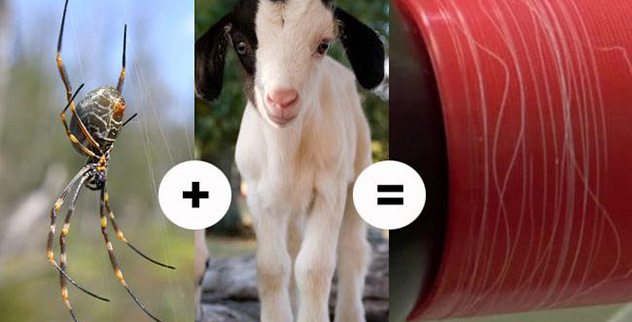
9. Spider-Goats: Goats Engineered to Make Spider Silk Proteins
Spider silk is famously strong, lightweight, flexible, and difficult to farm because spiders are territorial and often cannibalistic. In other words, a spider farm is less “cute craft project” and more “tiny gladiator arena.” So scientists tried a different approach: engineer goats to produce spider silk proteins in their milk.
The idea was to insert spider silk genes so the goats’ mammary glands would produce silk proteins during lactation. Those proteins could then be purified and spun into fibers. The dream was high-performance material for medical sutures, textiles, biodegradable products, and possibly defense applications.
The spider-goat story is both brilliant and humbling. It proved that biology could be used as a manufacturing platform, but scaling the process into reliable commercial material turned out to be hard. That is a recurring lesson in genetic engineering: making the organism is only chapter one. Turning it into a product that works, scales, passes regulation, earns trust, and survives the market is the whole novel.
10. De-Extinction Dreams: Mammoths, BioVaults, and Genetic Rescue
De-extinction may be the wildest corner of genetic engineering. The basic idea is not to resurrect a perfect copy of an extinct animal like pressing “undo” on history. Instead, scientists may use genome sequencing, gene editing, cloning, reproductive technology, and living relatives to create animals with traits similar to extinct species.
The woolly mammoth is the celebrity example. Companies and researchers have explored editing Asian elephant cells to carry mammoth-like traits such as cold adaptation. Related conservation projects now include large-scale genetic biobanking, where cells, tissues, and DNA from endangered species are preserved for future research and potential assisted reproduction.
This is where genetic engineering becomes philosophical. Should humans try to restore lost species? Could these tools help endangered animals today? Are we repairing damage or indulging in biotech nostalgia? The responsible answer is not a simple yes or no. De-extinction captures the breathtaking ambition of modern biotechnologyand the need to ask ecological questions before releasing anything larger than a lab mouse into the world.
The Big Lessons From These Genetic Engineering Cases
Genetic Engineering Is a Tool, Not a Moral Category
One of the biggest mistakes in public debate is treating genetic engineering as automatically good or automatically evil. The truth is more interesting and more annoying: it depends. A gene-edited therapy for sickle cell disease, a mosquito-control program, a fast-growing salmon, and a glow-in-the-dark cat do not belong in the same ethical bucket just because DNA was involved.
Good analysis asks specific questions. What change was made? Who benefits? Who carries the risk? Is it reversible? Is it regulated? Is there informed consent? Are ecosystems involved? Can the technology be monitored? Is the claim supported by evidence or mostly by a marketing department with a fog machine?
The Most Powerful Cases Demand the Most Oversight
Somatic gene therapy, where edits affect treated cells in one patient, is ethically different from heritable embryo editing. A GMO crop contained in fields is different from a gene drive that could spread through wild populations. A modified yeast in a factory is different from a modified mosquito released outdoors. Scale matters. Permanence matters. Consent matters.
The CRISPR baby case remains the brightest warning sign. It showed how a single reckless experiment can damage trust in an entire field. By contrast, FDA-reviewed therapies and regulated agricultural products show that innovation can move forward with evidence, review, and accountability. The future of genetic engineering depends not only on what scientists can build, but on whether institutions can earn public trust while they build it.
The Future Will Be Less Sci-Fi and More Everyday
The next wave of genetic engineering may not always look dramatic. It may appear as drought-tolerant crops, disease-resistant livestock, one-time treatments for rare disorders, engineered microbes that make materials, or conservation tools that preserve genetic diversity. The most revolutionary technologies often become boring once they work. That is how you know they have changed the world.
Still, “boring” does not mean unimportant. When DNA editing touches medicine, food, animals, and ecosystems, the public deserves clear explanations. People should not need a PhD to understand what is being changed, why it matters, and what trade-offs are involved. Transparency is not a decoration; it is part of responsible biotechnology.
Experience Section: What It Feels Like to Live in the Age of Genetic Engineering
Living in the age of genetic engineering feels a little like discovering that the floor beneath everyday life has a laboratory underneath it. You go to the grocery store and see apples, salmon, papaya, potatoes, and plant-based meat. On the surface, it looks like normal shopping. Under the surface, there may be decades of molecular biology, regulatory paperwork, crop trials, safety reviews, and public arguments hiding behind the produce stickers.
The first experience many people have with genetic engineering is confusion. The vocabulary can be intimidating: CRISPR, transgenic, genome-edited, recombinant DNA, gene silencing, somatic therapy, germline editing. It sounds like science is trying to win Scrabble with a microscope. But once you break the ideas down, the basic questions become surprisingly human. Can we reduce suffering? Can we grow food more reliably? Can we prevent disease? Can we fix what we have damaged? Can we do it without creating new problems?
Another experience is awe. It is genuinely hard to sit with the fact that doctors can edit a patient’s cells to treat a blood disorder, or that researchers can change a pig organ so it might function in a human body. For anyone who grew up thinking DNA was a fixed instruction manual, modern biotechnology feels like watching someone open the book, correct a typo, add a footnote, and then politely ask the cell to reread the chapter.
But awe comes with discomfort. Many people are not anti-science when they ask tough questions. They are reacting to the scale of the power. Food is personal. Children are personal. Animals are personal. Local environments are personal. When genetic engineering moves from the lab into bodies, farms, rivers, neighborhoods, or dinner plates, people want to know who decided, who benefits, who profits, who monitors, and who is responsible if things go sideways.
That is why the best experience with this topic is not blind excitement or automatic fear. It is informed curiosity. You can admire CRISPR therapy while rejecting reckless embryo editing. You can support disease-resistant crops while still asking for transparent labeling and ecological review. You can be fascinated by de-extinction while wondering whether endangered species alive today should get more attention than animals lost long ago.
Genetic engineering is not a single doorway into the future. It is a hallway full of doors, and each one opens into a different ethical room. Some rooms contain lifesaving medicine. Some contain smarter farming. Some contain glowing fish. Some contain questions we are not ready to answer casually. The challenge is to walk through them with evidence, humility, and enough public conversation that the future does not feel like it was assembled behind a locked lab door.
Conclusion
The 10 insane cases of genetic engineering above show that DNA editing is no longer a distant fantasy. It is already treating disease, reshaping food, influencing pest control, supporting transplant research, changing pets, creating biomaterials, and inspiring conservation experiments. The same technology family that can help a patient with sickle cell disease can also trigger global outrage when used irresponsibly in embryos.
That is the central truth of genetic engineering: the science is powerful, but power is not the same as wisdom. The best future for biotechnology will require strong research, careful regulation, honest communication, and public trust. Used well, genetic engineering could reduce suffering and solve problems that once seemed impossible. Used badly, it could create ethical disasters faster than you can say “molecular scissors.”
So yes, these cases are insane. But they are also real signals of where science is going. The question is not whether genetic engineering will shape the future. It already is. The real question is whether we can shape genetic engineering with enough intelligence, caution, and humanity to make that future worth living in.