Most mornings, a snow-covered car is less “masterpiece” and more “reason I’m late again.” Every so often, however, winter does something extraordinary. Frost spreads across a windshield like hand-etched feathers. Icicles turn a bumper into a crystal chandelier. Windblown snow reshapes an ordinary sedan into a smooth, mysterious sculpture that looks ready for a modern-art museumor at least a very confused parking attendant.
The 47 frozen cars below celebrate those fleeting moments when cold weather, moisture, wind, and automotive design unexpectedly collaborate. None of the drivers asked for an icy makeover, but winter is the sort of artist that ignores appointment calendars.
How Winter Turns an Ordinary Car Into a Work of Art
Winter’s automotive artwork begins with basic atmospheric science. Depositional frost forms when water vapor changes directly into ice on a surface whose temperature is below freezing. On glass and painted metal, those crystals can spread into fernlike, feathery, or branching designs. Freezing fog and freezing drizzle create different effects because supercooled droplets freeze when they touch exposed surfaces, sometimes covering an entire vehicle in rime or clear glaze.
Snow adds another creative medium. A snowflake may consist of one ice crystal or a cluster containing many crystals, and its structure is influenced by temperature and atmospheric moisture. As flakes collect on a car, wind, gravity, melting, and refreezing reshape them into curves, ridges, overhangs, and miniature drifts. Snow appears white because light scatters through its many ice crystals, which also helps freshly covered cars look unusually soft and luminous.
The result is temporary art with a strict closing time. Sunlight, a warming engine, or one determined person holding an ice scraper can erase the entire exhibition in minutes.
47 Cars Transformed by Snow, Frost, and Ice
Frosted Windshields That Look Hand-Drawn
- The Feathered Windshield: Fine frost branches sweep across the glass like overlapping white feathers. It is beautiful enough to photograph and opaque enough to make driving absolutely impossible.
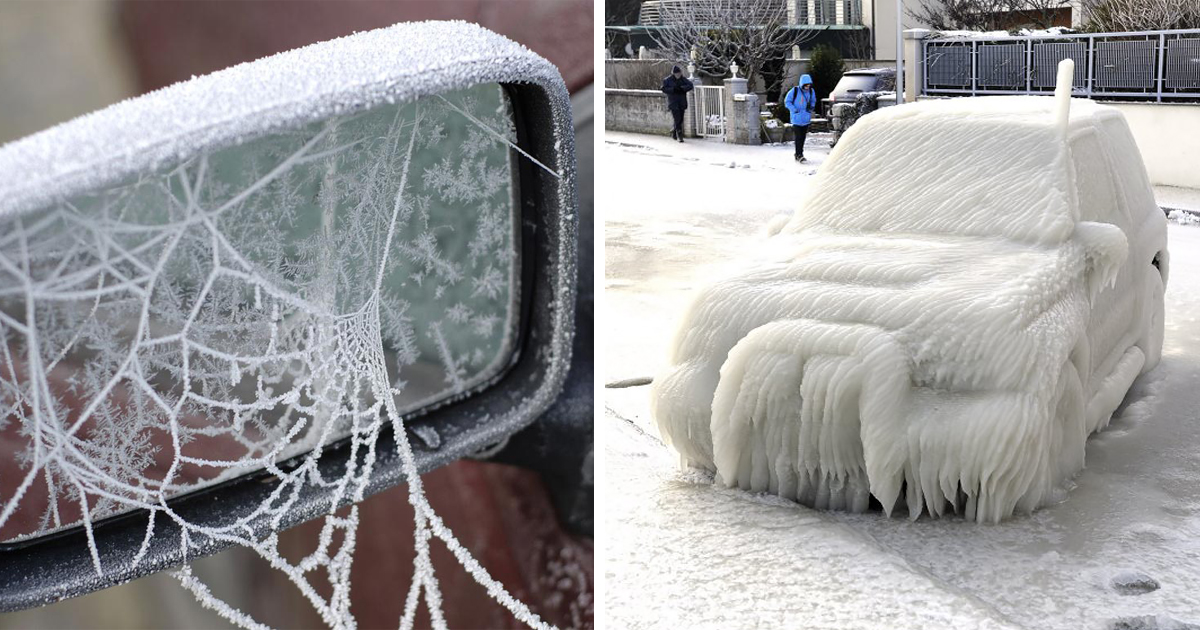
- The Frozen Fern Garden: Crystal leaves appear to grow from the bottom corners of the windshield, turning a commuter car into a mobile greenhouse for plants that strongly prefer 15 degrees Fahrenheit.
- The Ice Forest: Tall, branching frost patterns resemble pine trees rising across the glass. The dashboard becomes the forest floor, while the defroster waits backstage with destructive intentions.
- The Arctic Peacock: Curved crystals radiate outward in a fan-shaped display. The windshield seems to have grown a magnificent tail overnight, proving that even a sensible family sedan can become dramatic.
- The Frozen Fireworks: Circular bursts of frost cover the windows like silent explosions. They offer all the visual excitement of fireworks without the noise, smoke, or neighbor who insists on launching them at midnight.
- The Winter Lace Curtain: Tiny connected crystals form a delicate mesh across the side windows. It looks elegant until someone remembers that lace curtains are not approved visibility equipment.
- The Ghostly Handprints: Warm marks left on the glass the previous evening interrupt the next morning’s frost, producing strange silhouettes that make the car look mildly haunted.
- The Crystal Topographic Map: Uneven frost forms ridges and valleys resembling an aerial map of an undiscovered continent. Explorers are advised to bring gloves and windshield fluid.
- The Frozen Waves: Long bands of ice curve across the windshield like ocean swells. Winter has somehow created a seascape while using the exact opposite of beach weather.
- The Botanical Sketchbook: Leaflike ice crystals overlap in elaborate patterns, as though an invisible illustrator spent the night decorating the vehicle one transparent branch at a time.
- The Half-Finished Canvas: One section of glass is heavily frosted while another remains clear, often because of shelter, residual warmth, or changing airflow. The asymmetry makes the design feel intentionally modern.
Snow Sculptures on Wheels
- The Marshmallow Coupe: Thick, rounded snow hides every sharp body line. Mirrors, door handles, and trim disappear, leaving what appears to be a giant marshmallow that has recently obtained a driver’s license.
- The Accidental Concept Car: Wind smooths the snow into an aerodynamic shell, transforming an aging hatchback into a futuristic prototype apparently designed by a committee of polar bears.
- The Snow Mohawk: A narrow ridge remains on the roof after strong crosswinds remove the surrounding powder. The car suddenly looks rebellious, although it still has a grocery-store loyalty sticker.
- The White Whale: A long sedan buried beneath heavy snow takes on the rounded back of a surfacing whale. Only an antenna or mirror reveals that the creature accepts regular gasoline.
- The Layer Cake: Several snowfalls separated by brief thaws create visible strata on the roof and hood. The vehicle becomes a geological dessert with frosting that should not be tasted.
- The Perfectly Iced Roof: Snow settles in an improbably smooth slab from windshield to trunk. It resembles fondant on a luxury cake, except removing it requires a brush instead of a tiny silver fork.
- The Hood Dune: Wind piles snow into a graceful crest across the hood. Seen from the side, the car appears to be carrying one small piece of the Sahara through a blizzard.
- The Powder Eyebrows: Snow collects above the headlights, giving the front end an expressive face. Some cars look surprised; others look deeply disappointed in the forecast.
- The Sleeping Bear: A compact SUV under soft, undisturbed snow resembles an animal curled up for hibernation. Waking it requires remote start and an unreasonable quantity of brushing.
- The Miniature Mountain Range: Uneven roof snow develops peaks, saddles, and valleys. It is an impressive landscape, though placing climbers on it would probably scratch the paint.
- The Vanishing Vehicle: Deep snow aligns almost perfectly with the car’s roofline, leaving only a small bump in an otherwise white parking lot. This is nature’s version of a disappearing act.
- The Wind-Carved Fastback: Blowing snow extends the rear profile into a sleek taper, giving a boxy vehicle the silhouette it has always secretly wanted.
- The Snow Sombrero: A broad overhang develops around the roof after repeated accumulation. It is festive, impressive, and one door slam away from collapsing down someone’s collar.
Icicles, Rime, and Frozen Details
- The Crystal Grille: Rows of icicles hang from the front bumper, turning an ordinary grille into the entrance of a tiny ice palace.
- The Frozen Mustache: Meltwater refreezes beneath the bumper in two curved sections. The car instantly gains the distinguished expression of a silent-film villain.
- The Icicle Eyelashes: Thin spikes hang below the headlights. The vehicle looks glamorous, although the beauty routine appears dangerously cold.
- The Chandelier Mirror: A cluster of clear icicles forms below a side mirror, sparkling in sunlight like an expensive decorative fixture attached to a very practical crossover.
- The Frozen Waterfall: Water runs down a parked car before freezing in place, leaving vertical ribbons of ice over the doors and fenders.
- The Rime-Coated Rover: Freezing fog covers the vehicle in rough, white crystals. Every exposed edge becomes fuzzy, making metal panels appear strangely soft.
- The Crystal Wheel: Ice accumulates along spokes and wheel rims, creating a frozen radial pattern. It is gorgeous while parked and something that should be cleared or inspected before driving.
- The Ice Armor: Clear glaze coats the body in a transparent shell. The car looks preserved inside glass, as though winter expects archaeologists to discover it centuries later.
- The Frozen Antenna Tower: Rime builds outward around a thin antenna until it resembles a miniature communications mast from a science-fiction movie.
- The Ice-Fringed Fender: Slush thrown into the wheel well freezes into thick, sculpted lumps sometimes nicknamed “fenderbergs.” Their shape can be amusing, but heavy buildup may interfere with steering or tire clearance.
- The Crystal Door Handle: A thin casing of ice perfectly preserves the handle’s shape. It looks like custom jewelry and behaves like a lock designed by someone with a cruel sense of humor.
- The Frozen License Plate Frame: Ice outlines the plate while leaving only a few mysterious letters visible. The car gains an accidental secret identity until the thaw arrives.
When People and Weather Collaborate
- The Snow-Carved Smile: Someone draws a cheerful face across a snowy trunk. The car is still trapped, but at least it seems emotionally prepared.
- The Finger-Painted Mural: Swirls, hearts, stars, and questionable portraits cover the doors. Snow turns a parked vehicle into the neighborhood’s largest reusable sketchpad.
- The Frozen Family Portrait: Handprints of different sizes decorate the windows, recording one family’s enthusiastic encounter with the first snow of the season.
- The Snow Dragon: Carefully shaped snow creates scales, a raised spine, and a long tail across the roof. The exhaust supplies optional dragon breath once the engine starts.
- The Mobile Snowman: Three snowballs are stacked on the hood and accessorized with twigs. This passenger has no seat belt, no travel plans, and approximately 20 minutes before the heater wins.
- The Polar Race Car: Snow is removed in stripes, exposing sections of paint that resemble racing graphics. Aerodynamic benefits remain scientifically doubtful.
- The Negative-Space Masterpiece: A driver clears only the windows and lights, leaving smooth white panels around them. The contrast creates bold geometric shapes across the vehicle.
- The Parking-Lot Petroglyph: Symbols and messages are scratched into frozen grime along the doors. Future historians may interpret “WASH ME” as a sacred winter warning.
- The Snow Crown: Children build pointed towers along the roofline, transforming the family minivan into a temporary royal carriage.
- The Heart in the Frost: A simple heart traced onto an icy window becomes unexpectedly striking as morning light shines through the clear line.
- The Naturally Framed Automobile: Frosted branches, sparkling pavement, falling snow, and a perfectly coated car align for one brief photographic moment. No sculpting is needed; winter handles the composition itself.
Beautiful While Parked, Hazardous on the Road
A frozen vehicle may deserve a photograph, but it is not ready for traffic. Snow and ice should be removed from the windshield, side windows, mirrors, roof, hood, trunk, headlights, taillights, cameras, and driver-assistance sensors before departure. A clear windshield alone is not enough: roof snow can slide forward during braking or fly backward into another driver’s view. Obscured sensors may also limit the operation of safety systems.
Use a proper snow brush and plastic ice scraper rather than improvised metal tools. Do not pour boiling or very hot water onto frozen automotive glass; rapid temperature change can stress and crack it. Allow the defroster to warm the glass gradually, then scrape carefully. Wipers should not be forced through solid ice because frozen blades and overloaded mechanisms may be damaged.
Drivers should also check around the tires and confirm that the exhaust pipe is not blocked. If a stranded vehicle is running with an obstructed exhaust, carbon monoxide can accumulate in the passenger compartment. Winter emergency supplies should include warm clothing, a flashlight, a phone charger, food, water, warning devices, a scraper, a shovel, and basic traction aids.
Winter tires can improve performance in deep snow compared with ordinary all-season tires, but no drivetrain or tire can cancel the laws of physics. Smooth steering, gentle braking, reduced speed, and increased following distance remain essential. Ice is unimpressed by confidence, horsepower, or motivational podcasts.
Experiences From a Morning Among Winter’s Automotive Sculptures
The best way to appreciate cars transformed by winter is to walk through a neighborhood shortly after sunrise, before engines, snow brushes, and impatient commuters dismantle the exhibition. On one especially cold morning, every vehicle on the street seemed to have received a different commission from the weather.
The first car was a dark blue sedan whose windshield had disappeared beneath frost shaped like enormous feathers. From a few feet away, the crystals looked painted on. Up close, each branch divided into finer branches until the design became too detailed for the eye to follow. I photographed it quickly, knowing its owner would soon emerge with a scraper and absolutely no interest in preserving natural art history.
Farther down the block, a compact hatchback had been buried almost symmetrically. Snow rounded its roof, softened its hood, and filled the spaces around its wheels. Only the side mirrors remained visible, making the car resemble a large white animal with tiny ears. A child walking past decided it was a sleeping polar bear. His father decided it was a reason to buy a larger shovel. Both interpretations seemed valid.
The most dramatic vehicle sat beneath the edge of a roof where daytime melting had repeatedly dripped and refrozen. Dozens of icicles hung from its mirrors, door sills, and bumpers. Morning sunlight passed through them and scattered bright reflections across the pavement. It looked luxurious, as though someone had ordered a custom crystal body kit. It also looked completely undrivable.
A pickup truck nearby displayed a different kind of beauty. Strong wind had removed most of the loose snow but left a narrow ridge along the center of the roof and bed cover. The result was a perfect white mohawk. The truck looked several decades younger and considerably more interested in loud music.
These walks also reveal how quickly winter artwork changes. The sun warms dark paint first, creating small clear patches that widen by the minute. Icicles begin dripping. Roof snow slumps toward the windshield. A defroster produces transparent islands in frosted glass. What looked permanent at 7:00 a.m. may be a wet parking space by 9:00.
Photographing frozen cars therefore rewards patience and speed at the same time. Soft morning light reveals crystal textures better than harsh midday sun, while a low camera angle can make a modest snow ridge resemble a mountain. Close-ups capture delicate frost patterns; wider frames show how a vehicle relates to snowy trees, buildings, and streets. The most memorable images often include familiar detailsa badge, headlight, mirror, or wheelpartly hidden beneath winter’s redesign.
There is also something appealing about seeing a manufactured object temporarily reclaimed by natural forces. Cars are engineered to have precise lines, polished surfaces, controlled aerodynamics, and recognizable brand identities. Snow ignores all of that. It rounds a sports car, lengthens a hatchback, erases a luxury emblem, and gives a minivan icicle eyelashes. For a few hours, expensive and inexpensive vehicles become equal participants in the same outdoor gallery.
The experience encourages a useful pause. Before clearing the car, take a moment to notice the patterns. Examine the windshield from different angles. Look under the mirrors for tiny icicles. Notice where the wind deposited snow and where warmth prevented it from settling. Take a photographbut then return to reality. Clear every window, light, sensor, and body surface properly. Check the tires and exhaust, put away the camera, and drive as though the road has not been impressed by your artistic discovery.
Conclusion: Winter’s Most Temporary Car Collection
These 47 cars turned into winter art show how dramatically weather can transform everyday objects. Frost becomes botanical illustration, snow becomes sculpture, freezing rain becomes glasswork, and a humble bumper becomes an icicle chandelier. The exhibition is temporary, unpredictable, and usually located exactly where someone needs to leave for work.
That contrast is part of the charm. A frozen car can be inconvenient and beautiful at the same time. Photograph the masterpiece, admire the crystal details, and enjoy winter’s sense of humor. Then clear the vehicle completely, check that it is safe, and allow the world’s coldest art gallery to close for the day.