It does not schedule golden-hour appearances, repeat dramatic moments on command, or politely wait while a photographer changes lenses. That is precisely why great wildlife photography feels so miraculous: one person, one camera, and one unrepeatable fraction of a second somehow meet at the perfect point.
The winners of the 2021 World Nature Photography Awards were announced in March 2022, celebrating remarkable images from photographers around the globe. The competition recognized work across 14 categories, including animal behavior, landscapes, urban wildlife, plants and fungi, nature art, and photojournalism. American photographer Amos Nachoum received the grand prize for his unforgettable Antarctic image, “Facing Reality.”
Some of these photographs are beautiful. Others are brutal. Several are funny, although probably not intentionallythe animals did not sign comedy releases. Together, the winning pictures reveal a natural world that is tender, competitive, adaptable, dangerous, and considerably better at posing than most humans.
Why the 2021 World Nature Photography Awards Stand Out
The strongest nature photographs do more than prove that a photographer encountered an interesting animal. They reveal behavior, place a species within its environment, or capture a relationship that would otherwise pass unnoticed. A close portrait can create intimacy, while a wide environmental composition can remind us that even the largest animal is only one small participant in a vast ecosystem.
The 2021 winners demonstrate both approaches. There are intimate scenes involving macaques, bears, frogs, ants, and orangutans. There are also sweeping views of glaciers, frozen caves, New Zealand landscapes, and the strange geological formations of Argentina. The collection moves effortlessly from microscopic drama to planet-sized spectacle.
It also refuses to present nature as a permanently peaceful screensaver. Predation, scavenging, pollution, illegal wildlife ownership, and the struggle to survive all appear in the awarded images. That honesty gives the gallery its emotional power. The photographs ask viewers to admire nature without turning it into a fairy tale where everyone shares berries and goes home before dark.
30 Stunning Images From the 2021 Winners
Predators, Families, and High-Stakes Animal Behavior
The first group includes the grand-prize photograph and several mammal portraits officially recognized by the competition. >
-
Amos Nachoum: Leopard Seal and Gentoo Penguin
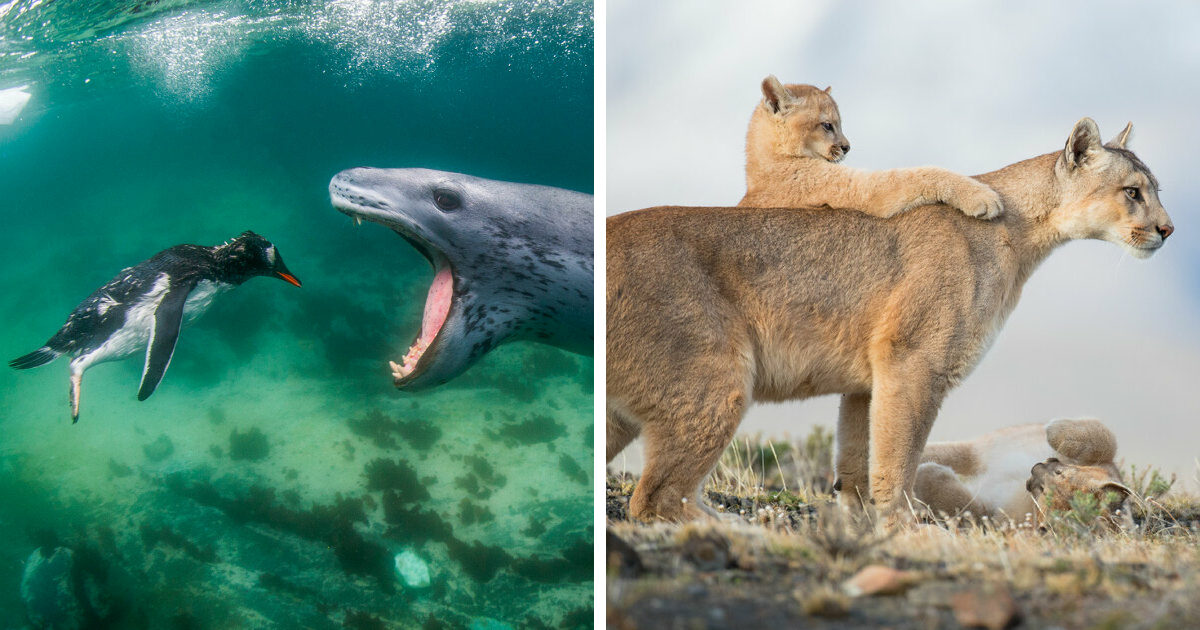
“Facing Reality” shows a leopard seal pursuing a gentoo penguin near the Antarctic Peninsula. Nachoum waited for hours for low tide, then followed the seal into open water. The resulting image won Gold in BehaviorMammals and earned him the title of World Nature Photographer of the Year.
-
William Fortescue: Sparring Bull Elephants
Two bull elephants collide in Amboseli National Park, Kenya. Their enormous bodies, flying dust, and locked tusks make the confrontation look like a heavyweight championship organized by Mother Nature’s least cautious event planner.
-
Buddhilini de Soyza: Cheetahs Crossing a Flooded River
A coalition of male cheetahs battles a powerful river in Kenya’s Masai Mara. The photograph captures exhaustion, determination, and danger as the cats struggle through a current that appears entirely unimpressed by their usual speed.
-
Tom Vierus: Long-Tailed Macaques Huddling Together
Three macaques in Bali press closely against one another, producing a warm, almost human family portrait. Their expressions suggest affection, trust, and perhaps a silent agreement not to discuss who stole the tourist’s lunch.
-
Neelutpaul Barua: A Mother Bear and Her Cubs
After a long day of fishing, a mother bear rests while her energetic cubs continue playing nearby. Photographed at eye level in Russia’s South Kamchatka Sanctuary, the scene contrasts parental vigilance with the apparently unlimited battery life of children.
Small Creatures With Enormous Stage Presence
These winners prove that a compelling wildlife subject does not need to weigh several tons or arrive with dramatic theme music. >
-
Amit Eshel: Puma Mother With Cubs
A female puma stands watch as her cubs play in Patagonia, Chile. The open landscape establishes the animals’ wild setting, while the mother’s alert posture turns the family scene into a portrait of protection.
-
Shayne Kaye: Pacific Tree Frog on a Flower
Kaye found this tiny frog during what initially seemed like an unproductive afternoon in a Canadian city park. Patience, shifting leaf-filtered light, and a cooperative amphibian transformed an ordinary outing into a gold-winning photograph.
-
Massimo Giorgetta: American Crocodile in Cuba
An American crocodile glides through the waters of Jardines de la Reina. The underwater perspective emphasizes the reptile’s streamlined shape and prehistoric presence without requiring it to perform anything more elaborate than existing menacingly.
-
Ashok Behera: Vulture, Fox, and Wildebeest
A vulture feeds on a wildebeest while an African fox watches for an opportunity to scavenge in the Masai Mara. It is an uncompromising picture of nature’s recycling systemefficient, necessary, and unlikely to appear in a cheerful breakfast commercial.
-
Robert J. Ross: Red-Billed Queleas Taking Flight
A dense flock of red-billed queleas rises above Tanzania’s Selous Game Reserve. Thousands of wings turn individual birds into a single shifting form, demonstrating how repetition and movement can create an almost abstract composition.
Ant Bridges, Nighttime Moths, and Natural Abstraction
The next five photographs explore invertebrate behavior and the artistic patterns already present in nature. >
-
Chin Leong Teo: Red Ants Building a Bridge
When scout ants encounter water, they link their bodies so the colony can cross. The winning image turns this practical behavior into a miniature engineering epic. No hard hats, no committee meetings, and somehow the bridge is completed on schedule.
-
Lincoln Macgregor: Hawk Moth Feeding After Sunset
A hawk moth hovers beside garden flowers in New South Wales, sipping nectar while distant lights glow behind it. The photograph celebrates wildlife that flourishes close to homes but often escapes notice because it works the night shift.
-
Irina Petrova Adamatzky: Huntsman Spider and Vinegar Fly
A green huntsman spider encounters a much smaller vinegar fly. The careful macro composition transforms a scene measured in millimeters into a tense meeting between predator and potential prey.
-
Federico Testi: Tuscany as Nature Art
Rolling fields and a small group of trees in San Quirico d’Orcia become waves of tone, shape, and light. Rather than documenting a single animal, the image shows how landscape photography can reveal nature’s talent for minimalist graphic design.
-
Monika Schneider: Floating Dandelion Seeds
Dandelion seeds become delicate sculptural forms when isolated from their familiar surroundings. The photograph encourages viewers to look closely at objects so common that most of us normally notice them only when they invade the lawn.
People Inside Natureand Human Traces Beneath the Water
These photographs examine the relationship between people, wild environments, and the objects humans leave behind. >
-
Sabrina Inderbitzi: Visitors Inside a Lake Baikal Ice Cave
Inderbitzi initially disliked having people and a vehicle inside her composition. On reflection, their tiny scale helped communicate the immensity of the frozen cave. Sometimes the “problem” in a frame is the element that gives it meaning.
-
Mike Eyett: Diver Surrounded by Mackerel
A scuba diver swims near a dense school of mackerel off Cabo San Lucas, Mexico. The human figure becomes a useful scale reference while the fish move like a living silver storm.
-
Gaetano Gargiulo: A Blenny Nest in a Beer Bottle
A discarded bottle has become a nesting site for a small fish. The picture is visually clever but environmentally uncomfortable, showing both wildlife’s adaptability and humanity’s irritating habit of leaving packaging absolutely everywhere.
-
Gautam Kamat Bambolkar: Nature Reclaiming an Abandoned House
Plants push through the entrance of an abandoned building in Goa, India. The image suggests that when human maintenance stops, nature does not submit a renovation proposal. It simply moves in.
-
Vladislav Tasev: Young Pine Beneath the Snow
A small pine stands under a heavy layer of snow in Bulgaria’s Central Balkan Mountains. Its simple form conveys endurance and demonstrates how restrained compositions can say more than crowded scenes.
Wild Cities and Other Unexpected Habitats
Urban wildlife photography reminds us that animals do not always respect the tidy boundary humans imagine between civilization and wilderness. >
-
Jan Czeczotka: Fungi in Bavaria
A group of fungi emerges from the forest floor in Germany’s Allgäu region. Viewed from close range, the modest organisms become architectural forms, complete with curved roofs and excellent woodland property values.
-
Matthijs Noome: Humpback Whale Near New York City
A humpback whale raises its fluke with the Manhattan skyline visible in the distance. The juxtaposition is surprising, yet increasing whale sightings in New York waters have been associated with improved water quality and conservation efforts.
-
Mohammad Murad: Arabian Red Fox Near Kuwait City
A young fox explores outside its den while city lights glow behind it. Murad monitored the unusual urban family for months, creating a photograph that feels both intimate and cinematic.
-
Alex Pansier: Fox in an Industrial Landscape
A fox appears within an industrial area in the Netherlands. Its presence challenges the assumption that meaningful wildlife photography requires an expensive expedition to a location reachable only by helicopter and heroic luggage allowance.
-
Sam Wilson: South Island, New Zealand
Wilson discovered this expansive landscape while traveling along unfamiliar dirt roads. The image rewards curiosity and proves that occasionally ignoring the efficient route produces something better than arriving ten minutes early.
Ice, Orangutans, and Conservation Stories
The final selections range from immense geological scenery to urgent wildlife photojournalism. >
-
Alessandro Gruzza: Argentina’s Pumice-Stone Field
A surreal field of pale pumice formations looks less like Earth than the surface of another planet. Scale, texture, and restrained color turn geology into an otherworldly landscape.
-
Rie Asada: Frozen Waterfalls
Ice formations transform flowing water into a rigid sculptural environment. The photograph captures the strange contradiction of water appearing both dynamic and completely motionless.
-
Vince Burton: Blue-Morph Arctic Fox in Iceland
A rare blue-morph Arctic fox walks through severe winter weather. Presented in black and white, the image emphasizes blowing snow, texture, and the fox’s calm refusal to be impressed by conditions that would make most humans cancel brunch.
-
Thomas Vijayan: Bornean Orangutan in Its Habitat
A mature male orangutan looks toward the camera from the forest. The composition highlights both the animal’s distinctive facial structure and the surrounding habitat, creating a portrait inseparable from place.
-
Alain Schroeder: Surgery for a Rescued Baby Orangutan
At a quarantine center in North Sumatra, a medical team prepares a three-month-old orangutan named Brenda for surgery on a damaged arm. Confiscated from illegal captivity, she is held gently by caregivers as treatment begins. The image won Gold in Nature Photojournalism and transforms a conservation crisis into a deeply personal story.
What Makes These Award-Winning Nature Photographs So Effective?
They Capture Behavior, Not Merely Appearance
A technically sharp picture of an animal can be attractive, but behavior creates narrative. Ants form a bridge. Cheetahs fight a river current. A seal hunts. A mother bear watches her cubs. Each photograph contains an action, relationship, or question that encourages the viewer to remain with the image.
They Use Environment as Part of the Story
The winning photographers frequently resisted the temptation to fill every inch of the frame with an animal. Glaciers, skylines, rivers, gardens, temples, and industrial structures provide context. That wider view tells us how the subject lives and, increasingly, how wildlife adapts to landscapes influenced by people.
They Balance Beauty With Honesty
Nature photography can inspire conservation because it connects audiences emotionally with places and species they may never encounter. However, its power depends on credibility. Established guidance from conservation and photography organizations emphasizes respecting animals, avoiding disturbance, using appropriate distance, and being transparent about how an image was created. >
The animal’s welfare must come before the photograph. A telephoto lens is less expensive than an emergency-room visit and considerably more polite than walking directly toward a bear while whispering, “Just one more shot.”
A Camera-in-Hand Experience Inspired by the Winning Images
Studying these 30 photographs changes the way a person experiences an ordinary walk outdoors. The first lesson is that “ordinary” is usually a failure of attention. A neighborhood park may not contain leopard seals or polar bears, which is probably convenient for the neighborhood, but it still contains insects, birds, plants, weather, reflections, and animal behavior. Shayne Kaye’s gold-winning tree-frog photograph began during an outing that seemed visually unpromising. That experience offers a useful challenge: spend one hour in a familiar place and refuse to leave without noticing something new.
At first, the exercise can feel embarrassingly uneventful. A squirrel performs routine squirrel administration. A pigeon walks in circles as though it has misplaced an appointment. Leaves move. Nothing “award-winning” occurs. Yet after several quiet minutes, patterns begin to appear. Birds repeatedly use the same perch. Ants follow established routes. Light shifts across bark. A dragonfly returns to one stem after each short flight. The photographer stops hunting random subjects and begins anticipating behavior.
That changefrom reacting to predictingis one of the most valuable experiences in wildlife photography. Technical settings still matter, especially when subjects move quickly, but knowledge and patience often matter more. Professional guidance consistently recommends learning an animal’s habits, observing its environment, and allowing enough time for meaningful behavior to unfold. >
A second useful experience is reviewing photographs without judging them only by sharpness. Select five frames and ask different questions. Does the background help explain the subject? Is there room in front of an animal moving through the composition? Does the light direct attention toward the important action? Would a wider frame tell a richer story? The humpback whale photographed near Manhattan works because the skyline is present. Remove it, and the picture remains a whale photograph; include it, and the image becomes a story about wildlife returning to urban waters.
The final lesson is restraint. Ethical wildlife photography sometimes means accepting that a photograph cannot be made. When an animal becomes alert, changes direction, stops feeding, abandons a resting place, or otherwise reacts to a person’s presence, the encounter has already gone too far. Backing away may feel disappointing, but the missing photograph is preferable to a distressed subject. National park and conservation guidance repeatedly recommends maintaining distance and using long lenses rather than approaching wildlife. >
Returning home after such an outing may produce only one strong frameor none. Nevertheless, the experience trains observation, patience, composition, and respect. Those qualities are visible throughout the 2021 World Nature Photography Awards. The winning photographers did not merely arrive at beautiful places. They waited, studied, adapted, and recognized the instant when behavior, environment, and light briefly became one complete story.
Conclusion: Photographs That Make the Wild Feel Personal
The winners of the 2021 World Nature Photography Awards show why wildlife photography remains such a persuasive form of storytelling. A single image can carry us beneath Antarctic water, inside a frozen Russian cave, across an African river, into an Indonesian rescue center, or surprisingly close to a whale swimming within sight of New York City.
The collection’s greatest achievement is not simply that the pictures are stunning. It is that they make distant ecosystems feel immediate. Beauty draws us in, behavior holds our attention, and context gives us a reason to care. Even the uncomfortable images serve an essential purpose: they remind us that conservation is not an abstract discussion about somewhere else. It concerns living creatures, specific habitats, and decisions being made now.
Note: This article is an original editorial synthesis. Photographer names, award placements, depicted subjects, and locations were fact-checked against the official competition record and established photography publications. No original captions have been reproduced in full.