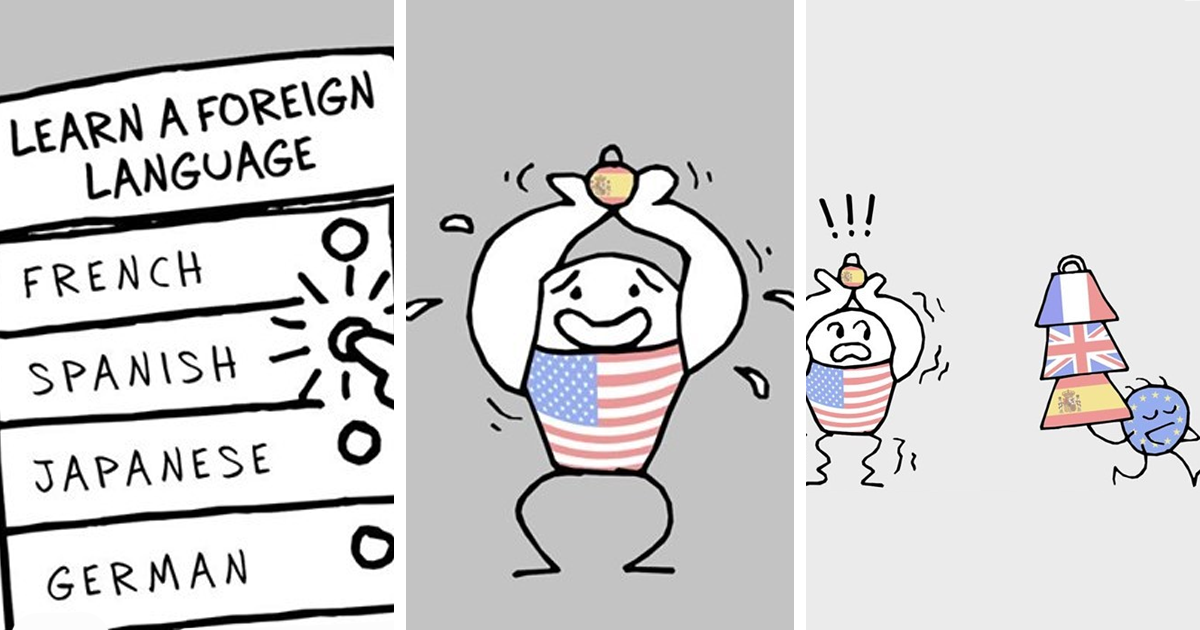
Travel teaches many things: how to fold a shirt into a panic burrito, how to order coffee while pointing at a menu like a tired detective, and how quickly one innocent word can become a comedy grenade in another language. That is exactly why comics about different countries and languages are so easy to love. They take the awkward little moments of global life and turn them into visual punchlines: short, silly, and painfully relatable.
The appeal of “30 New Comics That Show The Funny Differences Between Different Countries And Languages” is not just that the jokes are cute. The real magic is that these comics reveal how culture hides inside everyday habits. Airport rules, food names, greetings, personal space, accents, expressions, and “simple” translations all become funnier when placed side by side. A comic can show in three panels what a travel guide might need three pages to explain: people are wonderfully different, and language is basically a trampoline for misunderstandings.
Why Country and Language Comics Work So Well
Comics are perfect for cross-cultural humor because they combine words, faces, timing, and visual exaggeration. A confused eyebrow can do the work of a paragraph. A tiny character sweating in front of a foreign menu can communicate the emotional journey of every traveler who has ever ordered “something safe” and received a plate that looked like it had plans.
Unlike a long essay about linguistics, a comic moves fast. The setup is visual, the contrast is immediate, and the punchline lands before the reader has time to overthink it. That speed matters. Humor often comes from surprise, and language differences are full of surprises. A word that looks familiar may mean something else entirely. A phrase that sounds normal in one country may sound dramatic, rude, poetic, or mildly insane in another.
For example, English speakers often assume that translation is a neat exchange: one word goes in, one word comes out, everybody claps. Real language is messier. Idioms, slang, tone, and cultural references do not behave like obedient luggage. They leak socks all over the baggage claim. That is why comics about translation mistakes, false friends, and national habits feel so familiar. They exaggerate the truth, but the truth is already doing jazz hands.
The Funny Differences These 30 Comics Highlight
The best country-and-language comics usually revolve around small contrasts rather than giant stereotypes. The humor comes from noticing that people can do the same human activity in completely different ways. Everyone eats, travels, complains, says hello, avoids awkwardness, and pretends to understand train announcements. The differences are in the details.
1. Words That Look Friendly but Betray You
False friends are comedy gold. These are words in two languages that look or sound similar but mean different things. A learner sees a familiar-looking word and relaxes, which is exactly when the trapdoor opens. English and French, English and Spanish, and many other language pairs have these sneaky little vocabulary goblins. A comic only needs one character confidently using the wrong word and another character staring in horror to make the point.
2. Accents That Turn Simple Sentences Into Boss Levels
Every language has accents, regional variations, and local expressions. Even native speakers can be humbled by their own language when they travel far enough. Scottish English, Southern American English, Australian slang, regional French, or local Spanish can make a familiar language suddenly feel like it has grown a mustache and changed its name. Comics capture this beautifully by turning a simple conversation into a dramatic survival quest.
3. Food Names That Refuse to Be Normal
Food is one of the funniest cultural mirrors. Some countries give dishes poetic names. Others sound like they were named by a hungry uncle at midnight. A traveler may learn that a “pudding” is not always dessert, a “biscuit” is not always a cookie, and “chips” may or may not be fries depending on which side of the Atlantic is holding the ketchup. Comics about food differences work because everyone understands hunger, but nobody agrees on vocabulary.
4. Greetings: Kiss, Hug, Handshake, Wave, Panic
Greeting customs are tiny social obstacle courses. In some places, a cheek kiss is friendly. In others, it is a surprise attack. Some cultures prefer handshakes, others hugs, bows, nods, or a polite distance that says, “I respect you and your personal airspace.” A comic can turn a greeting into slapstick: two people leaning in different directions, one person overthinking, and everyone accidentally inventing a new dance.
5. Personal Space Around the World
Personal space is invisible, but people defend it like a national border. In one country, standing close feels warm and friendly. In another, it feels like someone is trying to read your thoughts. Comics exaggerate this by showing one character backing away across the room while another keeps stepping closer, both convinced they are being completely reasonable.
6. Airport Rules and Travel Logic
Airports are international comedy laboratories. Shoes on, shoes off. Laptop out, laptop in. Water bottle forbidden, tiny expensive airport water suddenly acceptable. Different countries and airports follow different procedures, and travelers often learn the rules only after they have already done the wrong thing. A comic about airport security does not need much explanation; the universal punchline is confusion with a boarding pass.
7. “Untranslatable” Words With Big Personalities
Some words carry a whole cultural mood. They may describe a type of longing, cozy togetherness, social embarrassment, or the specific joy of eating carbs while pretending tomorrow will be different. These words become comic material because they show how languages pay attention to different emotional textures. One language may need a sentence where another has one perfect word wearing a tiny crown.
8. Idioms That Sound Like Tiny Crimes
Idioms are normal until translated literally. Then they become surreal poetry. English speakers “spill the beans.” Other languages may involve cats, goats, fish, cabbages, or body parts in ways that sound alarming if taken word for word. Comics can show a character imagining the literal version of an idiom, which is why language learners often laugh and suffer at the same time.
9. Countries Naming Each Other Differently
Country names are not always the same across languages. Germany, Deutschland, Allemagne, Alemania, and Niemcy all point to the same place, but they feel like different characters arriving at the same party. Comics about country names reveal how history, geography, and old contact between peoples survive inside everyday vocabulary.
10. Translation Technology That Almost Gets It
Live translation tools are impressive, but comedy begins in the “almost.” Machines can translate many practical sentences, yet jokes, sarcasm, slang, and cultural context remain slippery. A comic about earbuds or phone translation can show the dream of effortless global conversationand the reality of accidentally telling a waiter that your suitcase is emotionally unavailable.
What These Comics Teach Without Getting Too Serious
The funniest thing about language is that it feels natural to the people who use it. We rarely notice our own weirdness. English speakers say “How are you?” and often do not expect a full medical report. Americans may ask “What’s up?” even when nothing is physically above anyone. A traveler hears these phrases and thinks, reasonably, “Why are you asking me a question if the answer is not wanted?”
That is the educational power of comics about countries and languages. They make us see our own habits from the outside. Suddenly, the “normal” thing is not universal; it is just one local setting on the giant washing machine of humanity.
They also remind readers that misunderstanding is not failure. It is part of communication. Every bilingual person, immigrant, exchange student, expat, tourist, and language learner has a private museum of awkward moments. The wrong word. The wrong gesture. The joke that died on arrival. The menu item ordered with confidence and received with regret. Comics turn these moments into shared laughter instead of private embarrassment.
Why Language Humor Feels So Relatable Online
Online audiences love these comics because the internet is already a multilingual, multicultural neighborhood where everyone is speaking through keyboards, captions, emojis, and translation buttons. A joke can travel from one country to another in seconds, but the meaning may arrive wearing mismatched shoes.
Readers also enjoy recognizing themselves. A French speaker may laugh at English loanwords used differently in French. A German learner may sympathize with compound words that look like someone glued a sentence together. A Japanese learner may relate to politeness levels. A Spanish speaker may smile at regional vocabulary that changes from country to country. And English speakers, bless their chaotic spelling system, have plenty of reasons to sit quietly and not judge anyone.
This is why the “30 new comics” format works especially well. Each comic is like a postcard from a different misunderstanding. One joke might be about travel. Another about grammar. Another about food, airports, names, or customs. Together, they create a friendly tour of human difference.
The Balance Between Funny and Respectful
Good cross-cultural comics do not mock people for being different. They mock the confusion that happens when different systems meet. That distinction matters. The funniest jokes invite everyone to laugh together. They do not say, “This country is strange.” They say, “Isn’t it hilarious that every country has its own version of normal?”
Respectful humor also avoids flattening an entire nation into one trait. Countries are not single personalities. Languages are not monoliths. A language may have regional dialects, class differences, age-based slang, immigrant varieties, heritage speakers, and internet mutations that appear overnight and make everyone over thirty blink slowly. The smartest comics use exaggeration as a wink, not a weapon.
30 Common Comic Themes About Countries and Languages
Here are thirty original theme examples that explain why this kind of comic series keeps finding new readers:
- A tourist discovers that one “simple” English word has five local meanings abroad.
- A language learner trusts a false friend and accidentally says something dramatic.
- Two travelers compare how their countries define “on time.”
- A restaurant menu becomes a vocabulary exam with appetizers.
- A character learns that “spicy” means different things in different countries.
- An airport security line changes rules faster than a phone update.
- One person expects a hug; the other prepares a formal handshake.
- A polite phrase translates literally into something suspicious.
- A country name changes completely from one language to another.
- A translation app gets the words right but the vibe wrong.
- Regional accents turn a familiar language into a riddle.
- A traveler learns that small talk has different social rules.
- Someone tries to pronounce a word and accidentally summons nearby concern.
- A local idiom becomes a bizarre mental image when translated literally.
- A person orders “chips” and receives the wrong potato format.
- A language has one word for a feeling English needs a paragraph to explain.
- A bilingual character switches languages because one has the better insult.
- A tourist misreads a gesture that means something else abroad.
- Two cultures disagree on how much eye contact is friendly.
- A grammar rule appears simple until exceptions arrive with luggage.
- A learner realizes textbooks do not prepare anyone for slang.
- A traveler discovers that “breakfast” has wildly different definitions.
- A character uses a formal phrase in a casual situation and sounds like royalty.
- A local teaches pronunciation by making impossible mouth shapes.
- A person learns that silence can be polite in one culture and awkward in another.
- A suitcase full of souvenirs becomes a customs-declaration comedy.
- A joke works in one language but collapses in translation.
- A country’s weather vocabulary reveals national priorities.
- A learner celebrates understanding one sentence, then hears the reply at full speed.
- A traveler realizes that confusion is the unofficial language of tourism.
Extra Experiences: What These Comics Feel Like in Real Life
The funniest country-and-language comics feel familiar because real travel is basically a long improvisation exercise with luggage. Anyone who has crossed a border, learned a language, worked with international colleagues, or watched a foreign movie without perfect subtitles knows that communication is not only about vocabulary. It is also about timing, tone, confidence, facial expressions, and the heroic ability to laugh when you have just asked for a train ticket in the grammatical style of a pirate.
One common experience is the “menu moment.” You study a few useful food words before a trip and feel prepared. Then the menu arrives with handwriting, regional dishes, and ingredients that never appeared in your language app. You order something based on one recognizable word, hoping it means “chicken” and not “chicken’s mysterious cousin.” When the plate arrives, you learn that language learning is best served with humility and a side of bread.
Another classic experience is the greeting dilemma. You meet someone new and have half a second to choose: handshake, wave, hug, cheek kiss, bow, nod, or freeze like a buffering video. The other person chooses differently. Suddenly both of you are doing a polite collision ballet. No one is offended, but everyone’s soul briefly leaves the building. A comic can make this scene hilarious because it is already perfectly choreographed by anxiety.
Then there is the accent adventure. You may study a language for years and feel proud, only to meet a native speaker from a different region and understand three words: “hello,” “today,” and possibly “cheese.” This is not because you failed. It is because real languages have neighborhoods, histories, jokes, shortcuts, and sounds that textbooks politely hide until you are emotionally ready. Comics about accents remind learners that fluency is not a straight road. It is a scenic route with goats.
Workplaces create their own language comedy too. International teams may use English as a shared language, but “urgent,” “soon,” “maybe,” and “interesting” can mean different things depending on culture. In some offices, “interesting idea” means genuine curiosity. In others, it means “please bury this idea quietly in the garden.” A good comic can show one sentence being interpreted four ways by four people who are all technically speaking the same language.
Even at home, multilingual families live inside these funny differences. One parent may mix languages mid-sentence. A grandparent may use an idiom that makes no literal sense. Children may answer in one language while understanding another. The result is not confusion so much as a living collage. Language becomes family history, comedy, memory, and identity all at once.
That is why these comics are more than quick laughs. They celebrate the awkward beauty of trying. Trying to speak. Trying to understand. Trying to be polite in a place where politeness has different instructions. Trying to order coffee without accidentally proposing marriage to the barista. The humor is gentle because the message underneath is generous: the world is full of different rules, and everybody is improvising.
Conclusion
“30 New Comics That Show The Funny Differences Between Different Countries And Languages” works because it turns global confusion into shared amusement. The comics remind us that language is not a machine; it is a living, laughing, occasionally chaotic human invention. Countries differ in customs, words, food, gestures, accents, and social expectations, but the experience of being confused is wonderfully universal.
That is the heart of the humor. We laugh at the mistranslation, the greeting mishap, the airport rule, the strange idiom, or the impossible pronunciationbut we also recognize ourselves. Every person, in the right country or conversation, can become the confused traveler in the comic. And honestly, that traveler is doing their best. Give them a map, a snack, and maybe a better dictionary.
Editorial note: This article is an original commentary and analysis inspired by public discussions of country-and-language humor comics. It does not reproduce copyrighted comic panels, captions, or artwork.