Pop culture looks polished when it reaches us: the superhero lands perfectly, the alien glows in the moonlight, the video game mascot smiles from a cereal box, and the horror villain waits politely inside our nightmares. But the starting point? Often much stranger. Some of the world’s most iconic pop culture creations began with a half-eaten pizza, a landlord asking for rent, a childhood bug collection, a scuba regulator, or a dog riding shotgun like a furry space cop.
That is the deliciously weird truth about creativity: inspiration rarely arrives wearing a tuxedo. It crawls across a wall, hides in a newspaper clipping, hums inside an old projector, or sits in the passenger seat with its tongue out. The following 15 strange inspirations for iconic pop culture prove that legendary ideas do not always come from grand artistic visions. Sometimes, they come from ordinary objects, odd memories, accidental sounds, and “wait, what if?” moments that refuse to leave.
Why Strange Inspirations Become Pop Culture Gold
The best pop culture ideas often work because they blend the familiar with the unexpected. A turtle is slow; make it a ninja and suddenly it sells comic books, cartoons, toys, movies, lunchboxes, and probably a few pizzas. A kitchen sponge is not heroic; give him optimism, square pants, and a pineapple mortgage, and he becomes one of the most recognizable cartoon characters ever created.
Strange inspiration gives creators something priceless: a memorable hook. It makes a character easier to explain, easier to picture, and easier to love. That is why origin stories matter. They show how raw imagination turns a tiny spark into a cultural wildfire.
15 Strange Inspirations For Iconic Pop Culture
1. Pac-Man Was Inspired by a Pizza Missing a Slice
Few video game characters are as simple or as instantly recognizable as Pac-Man. His design is basically a yellow circle with a mouth, which sounds like something a bored person might doodle during a staff meeting. Yet that simplicity became genius. Creator Toru Iwatani has often connected the shape to a pizza with one slice removed, transforming lunch into one of the most enduring images in gaming history.
The idea was not just visual. Pac-Man’s entire concept centered on eating, chasing, escaping, and turning the tables on enemies. In a time when many arcade games focused on shooting or space battles, Pac-Man felt playful, cute, and accessible. Who knew that one missing slice could feed an empire?
2. Barbie Had a Surprising Connection to an Adult German Doll
Barbie looks like she was born to live in a Dreamhouse, drive a convertible, and maintain a suspiciously perfect résumé. But one of her most unusual inspirations was the Bild Lilli doll, a German figure based on a comic-strip character originally aimed more at adults than children.
Ruth Handler, co-founder of Mattel, wanted to create a doll that allowed girls to imagine adult futures rather than only caring for baby dolls. The German doll helped prove that a three-dimensional fashion doll could work. Barbie was softened, Americanized, and turned into an aspirational toy phenomenon. It is a reminder that pop culture often repackages unexpected source material into something completely new.
3. Mario Was Named After Nintendo’s Landlord
Before he became Super Mario, the mustached hero of Donkey Kong was known as Jumpman. Functional? Yes. Exciting? Not exactly. The name Mario reportedly came from Mario Segale, a Seattle-area real estate developer who leased warehouse space to Nintendo of America.
The story has a wonderfully ordinary flavor: one of gaming’s most famous names came not from mythology, poetry, or a heroic naming ceremony, but from a landlord. That makes Mario’s origin feel almost perfect. He is a working-class hero who jumps, fixes problems, and never seems to complain about being sent into dangerous plumbing situations. Rent may be stressful, but in this case, it helped name a legend.
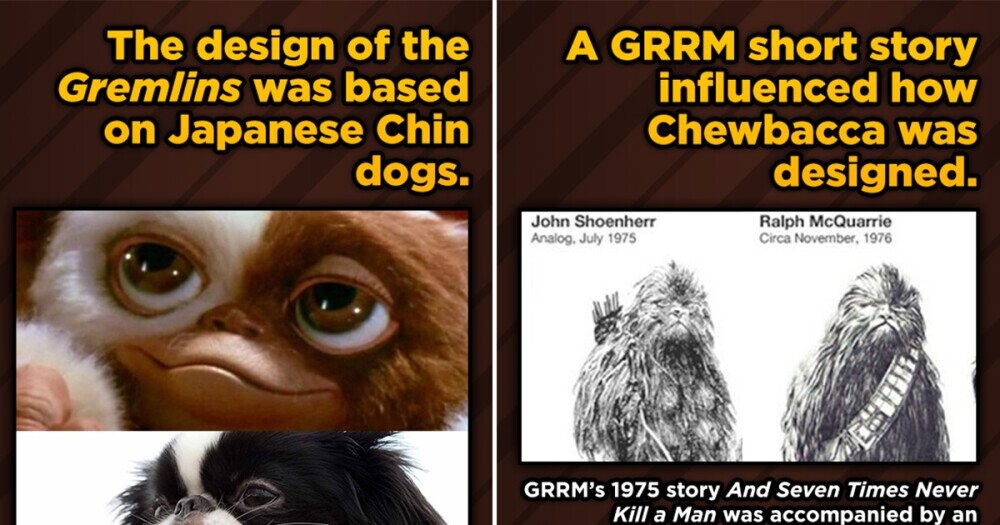
4. Chewbacca Was Inspired by George Lucas’s Dog
Chewbacca, the loyal Wookiee co-pilot of the Star Wars saga, has one of the most charming origin stories in science fiction. George Lucas’s Alaskan Malamute, Indiana, helped inspire the character. The dog reportedly rode in the passenger seat of Lucas’s car, creating the image of a large, hairy companion traveling beside the driver like a trusted first mate.
That real-life dog energy became part of Chewie’s appeal. He is huge, intimidating, and capable of ripping arms out of sockets, but he also feels loyal, expressive, and emotionally direct. In other words, he is basically every big dog who thinks he is a lapdog, except with a bowcaster.
5. Indiana Jones Also Took His Name From a Dog
The same dog, Indiana, also helped inspire the name of another Lucas-linked icon: Indiana Jones. This fact is so delightfully strange that it was even joked about within the film series. The name sounds rugged and adventurous, like it was carved into a treasure map, but its roots were much more domestic.
It works because “Indiana Jones” feels lived-in. It suggests a hero with dust on his boots, academic credentials in his pocket, and terrible luck with ancient traps. Knowing that the name came from a pet does not weaken the myth. It makes it better. Great adventure sometimes begins at home, preferably with a dog who looks like he knows where the Ark is buried.
6. SpongeBob Came From Marine Biology and a Teaching Comic
Before SpongeBob SquarePants became the king of nautical nonsense, creator Stephen Hillenburg worked as a marine science educator. He created an educational comic called The Intertidal Zone to teach students about tide-pool life. That scientific background eventually helped shape Bikini Bottom and its strange, lovable residents.
The truly odd leap was turning a sea sponge into a square kitchen sponge who works at a fast-food restaurant. Biologically accurate? Not exactly. Comedically accurate? Absolutely. Hillenburg understood both marine life and cartoon logic, which is why SpongeBob feels weird, specific, and strangely believable. He is educational inspiration wearing squeaky shoes.
7. Teenage Mutant Ninja Turtles Began as a Joke and a Comic Book Mash-Up
Teenage Mutant Ninja Turtles sounds like four random words pulled from a hat by someone who had eaten too much pizza. That is part of its magic. Kevin Eastman and Peter Laird’s original idea began as a funny drawing of a masked turtle with weapons. The concept also parodied and borrowed energy from popular comics of the era, including teen superheroes, mutants, martial arts, and especially the gritty influence of Daredevil.
Even the mythology plays like a wink: radioactive ooze, a mentor named Splinter, and enemies called the Foot. The joke could have ended on a sketchpad. Instead, it became one of the most durable franchises in pop culture. Sometimes the silly idea is only silly until it starts paying rent.
8. Batman’s Look Was Shaped by Pulp Heroes, Zorro, and Flying Machines
Batman feels timeless now, but his creation came from a stew of influences: masked pulp heroes, detective fiction, Zorro’s double life, and even the idea of bat-like wings connected to Leonardo da Vinci’s flying-machine sketches. Add Bill Finger’s crucial design and story contributions, and the bright early concept became the darker figure readers know today.
The strange part is how many separate ingredients had to collide. A rich masked swordsman, shadowy crime stories, gothic imagery, and mechanical flight all helped shape a hero who has no superpowers yet somehow scares criminals more than people who can shoot lasers from their hands. Batman is basically what happens when old adventure fiction puts on a cape and develops excellent branding.
9. The Joker’s Face Was Inspired by a Silent Film
The Joker’s grin is one of the most unsettling images in comic book history. One major visual inspiration came from Conrad Veidt’s appearance as Gwynplaine in the 1928 silent film The Man Who Laughs. The exaggerated smile, tragic grotesquerie, and theatrical horror of that character helped shape the Clown Prince of Crime.
That origin makes sense because the Joker has always felt like he wandered out of an old nightmare and discovered modern chaos. He is funny in the way a broken carnival ride is funny: technically colorful, deeply unsafe, and probably not inspected recently.
10. Godzilla Grew Out of Nuclear Fear
Godzilla is a giant monster, yes, but he is also a walking metaphor. The original 1954 film reflected postwar anxiety, atomic destruction, and the trauma of nuclear testing. The Lucky Dragon No. 5 incident, in which a Japanese fishing boat was contaminated by fallout from the Castle Bravo hydrogen bomb test, became part of the cultural atmosphere that shaped Godzilla’s birth.
That is why the monster has endured. Godzilla is not merely “big lizard knocks over buildings.” He represents human technology roaring back at humanity with radioactive breath. The strange inspiration is terrifying because it is not really strange at all; it is history wearing scales.
11. Jaws Was Fed by Real Shark Stories
Jaws was fictional, but its fear had real-world ingredients. Author Peter Benchley was fascinated by sharks and drew inspiration from reports of massive great whites caught off Long Island, along with broader public memory of shark attacks that had haunted American beaches. Steven Spielberg’s film then turned that fear into blockbuster history.
The genius of Jaws is that it barely needed to show the shark. The ocean itself became the monster. Every ripple looked suspicious. Every beach vacation suddenly came with dramatic music. Real shark stories gave the fiction teeth, and the movie made audiences afraid of water deeper than a bathtub.
12. E.T. Came From Spielberg’s Loneliness After Divorce
E.T. the Extra-Terrestrial may be about an alien, but its emotional heart came from something deeply human. Steven Spielberg has connected the idea to the loneliness and emotional disruption he felt around his parents’ divorce. The alien friend became a way to explore childhood, separation, and the longing for connection.
That inspiration explains why E.T. does not feel like a typical creature from outer space. He is not here to conquer Earth. He is lost, gentle, and homesick. The strangest part is that one of cinema’s most beloved aliens was really born from a child’s need for comfort.
13. Freddy Krueger Was Inspired by Reports of Nightmare-Related Deaths
Wes Craven’s A Nightmare on Elm Street found horror in the one place people are supposed to be safe: sleep. Craven was influenced by reports about mysterious deaths among Southeast Asian refugees who reportedly feared sleeping after traumatic nightmares. That disturbing real-world seed grew into Freddy Krueger, a villain who attacks inside dreams.
Freddy became iconic because he made rest feel dangerous. You could lock the door, turn on the lights, and check under the bed, but eventually you had to sleep. That is horror with a built-in timer.
14. Alien’s Xenomorph Came From H.R. Giger’s Nightmarish Art
The creature in Alien did not look like a typical movie monster. It looked biomechanical, elegant, obscene, insect-like, and deeply wrong in a way audiences could not forget. H.R. Giger’s artwork, especially his eerie Necronom imagery, heavily shaped the Xenomorph’s design.
The result was a monster that seemed less built than discovered in a forbidden museum. Its long head, skeletal body, inner jaw, and industrial-organic texture made it feel ancient and futuristic at the same time. The Xenomorph is proof that unforgettable pop culture often comes from artists willing to make beauty uncomfortable.
15. Darth Vader’s Breathing Came From a Scuba Regulator
Darth Vader could stand silently in a room and still dominate the scene because of one sound: that mechanical breathing. Sound designer Ben Burtt created the effect by recording breathing through a scuba regulator. It was simple, physical, and incredibly effective.
The sound tells the audience everything before Vader says a word. He is alive, but damaged. Human, but machine. Powerful, but trapped inside his own armor. A scuba device became the heartbeat of one of cinema’s greatest villains. That is the kind of behind-the-scenes detail that makes pop culture history wonderfully weird.
What These Odd Origins Teach Us About Creativity
Looking at these strange inspirations, one pattern becomes clear: creative people notice things other people ignore. A pizza is not just lunch. A dog is not just a pet. A fly on the wall is not just a tiny trespasser refusing to pay rent. To a creator, any of these can become a doorway.
Great ideas also mutate. Barbie did not remain Bild Lilli. SpongeBob did not remain an educational tide-pool comic. The Ninja Turtles did not remain a gag drawing. Pop culture icons grow because creators transform their inspirations instead of copying them. They borrow a shape, mood, sound, fear, or emotional truth, then build something new around it.
That transformation is what separates inspiration from imitation. Anyone can look at a pizza. It takes imagination to see Pac-Man.
Experience Section: Finding Pop Culture Inspiration in Everyday Weirdness
The most relatable thing about these stories is that none of them begin in a perfect creative environment. They do not require a marble studio, dramatic lightning, or a mysterious mentor saying, “You are the chosen content strategist.” They begin in ordinary life. That is encouraging for anyone who writes, draws, films, designs, markets, or simply daydreams too much while waiting in line for coffee.
Think about how many ideas pass by us every day because they look too small. A weird sound from the refrigerator. A neighbor’s dog staring through a fence like it has government clearance. A broken toy on the sidewalk. A phrase overheard at the grocery store. A badly designed sign that accidentally sounds poetic. These things may not look like inspiration at first, but neither did a scuba regulator before it helped define Darth Vader.
One useful creative experience is to keep a “strange ideas” list. Not a polished notebook full of perfect concepts, but a messy place where odd observations are allowed to exist without judgment. Write down the things that make you pause: unusual names, funny misunderstandings, strange fears, awkward memories, objects that look like faces, or dreams that make no sense but still feel emotionally loud. Most entries will go nowhere. That is fine. Compost makes flowers, and creative compost makes better headlines.
Another lesson is to combine unrelated ideas. A turtle is ordinary. A ninja is familiar. A teenage mutant turtle is suddenly unforgettable. Pop culture loves contrast because contrast creates energy. Cute plus dangerous. Funny plus tragic. Domestic plus cosmic. A boy and an alien. A billionaire and a bat. A sponge and an undersea fast-food job. When two ideas should not fit together but somehow do, audiences lean closer.
It also helps to respect emotional truth. The weirdest inspirations last when they connect to something real. E.T. works because loneliness is real. Godzilla works because fear of destruction is real. Jaws works because humans are land animals pretending to be confident in the ocean. Even Pac-Man works because eating, escaping, and wanting one more chance are universal feelings, especially after midnight snacks.
For writers and creators, the takeaway is simple: do not wait for inspiration to arrive as a fully formed masterpiece. Pay attention to the odd details around you. Question them. Twist them. Ask what they could become if pushed into a different genre, a different body, a different sound, or a different emotional setting. The next iconic idea may not walk through the door wearing sunglasses. It might crawl across the wall, bark from the passenger seat, or sit on your plate with one slice missing.
Note: This article is written in original wording for web publishing and synthesizes real pop culture origin stories from reputable entertainment, history, museum, and media sources without adding citation artifacts or unnecessary source-code elements.
Conclusion
The strangest inspirations for iconic pop culture remind us that imagination is not a luxury reserved for perfect moments. It is a habit of noticing. A creator sees a pizza and imagines a game. A filmmaker turns loneliness into an alien friendship. A sound designer breathes into scuba gear and creates a villain’s soul. A dog becomes part of two legendary franchises. These stories are funny, surprising, and sometimes haunting, but they all prove the same point: culture is built from curiosity.
So the next time an idea seems too weird, too small, or too random, give it a second look. Pop culture history is full of strange little sparks that became massive fires. Somewhere, right now, a future icon may be hiding inside an ordinary moment, waiting for someone strange enough to recognize it.