When most people hear the word “rodent,” they picture a mouse darting behind the refrigerator, a squirrel judging them from a tree, or a hamster spinning on a wheel at 2 a.m. like it has rent due. But the rodent family is much bigger, stranger, and more impressive than the tiny snack thieves we usually imagine. Some rodents are built like wetland barrels. Some wear armor made of quills. Some look like rabbits that accidentally joined the wrong taxonomic club. And a few ancient ones were so enormous they make modern rats look like pocket lint.
Rodents are defined by their continuously growing incisors, which they must wear down by gnawing. That dental feature connects everything from house mice to capybaras, beavers, porcupines, pacas, and prehistoric giants. The result is one of the most successful mammal groups on Earth, ranging from tiny seed specialists to semi-aquatic engineers capable of reshaping entire landscapes.
This list of 10 terrifyingly huge rodents focuses on real animals, both living and extinct, that prove “rodent” does not always mean “small.” Some are terrifying because of their size. Others earn the title through ecosystem power, bizarre appearance, defensive equipment, or the simple shock of learning that yes, that 60-pound creature is technically related to a guinea pig.
Why Huge Rodents Are So Fascinating
Large rodents are not just oversized versions of small ones. Many have evolved specialized bodies for swimming, digging, climbing, grazing, or defending themselves. Their size helps them survive in open wetlands, dense forests, alpine slopes, and dry grasslands. A beaver uses its body like a construction machine. A porcupine turns its back into a warning sign with 30,000 sharp exclamation points. A capybara behaves like a calm, four-legged sofa that somehow became the mayor of the marsh.
These animals also remind us that “scary” does not always mean aggressive. Most large rodents are herbivores or omnivores that prefer eating grass, bark, fruit, roots, or aquatic plants over causing drama. Still, meeting one unexpectedly in the dark would make almost anyone reconsider their life choices.
1. Capybara: The World’s Largest Living Rodent
The capybara is the undisputed heavyweight champion of living rodents. Native to Central and South America, this semi-aquatic mammal can grow more than four feet long and may weigh well over 100 pounds. Imagine a guinea pig that found a gym, moved to the wetlands, and became emotionally unbothered by everything.
Capybaras have barrel-shaped bodies, coarse brown fur, small ears, and partially webbed feet. Their eyes, ears, and nostrils sit high on the head, allowing them to keep watch while most of the body remains underwater. This is not just cute design; it is survival engineering. In the wild, capybaras use water to escape predators, cool their bodies, and move through marshy habitat with surprising grace.
Despite their intimidating size, capybaras are famously social and often live in groups. They graze on grasses and aquatic plants, communicate with whistles and barks, and have become internet celebrities because they appear to be friends with nearly every animal they meet. A capybara may look like a creature that could block a doorway, but its real superpower is calm confidence.
2. North American Beaver: The Rodent That Builds Real Estate
The North American beaver is the largest rodent in North America and one of the most powerful ecosystem engineers on the planet. Adults often weigh between 35 and 65 pounds, and the heaviest individuals can be much larger. If the capybara is the relaxed giant of the wetlands, the beaver is the contractor with no permit but excellent results.
Beavers are semi-aquatic mammals with dense waterproof fur, webbed hind feet, strong claws, and a broad flat tail. Their orange front teeth are not decorative; they are iron-strengthened tools capable of cutting down trees. With branches, mud, stones, and relentless determination, beavers build dams and lodges that create ponds, slow water flow, trap sediment, and provide habitat for many other species.
The terrifying part is not that a beaver wants to bother humans. It usually does not. The terrifying part is realizing that a rodent can change hydrology. A single beaver family can transform a stream corridor into a wetland complex. That is not pest behavior; that is landscape architecture with fur.
3. Eurasian Beaver: Europe’s Heavyweight Water Engineer
The Eurasian beaver is the North American beaver’s close cousin and one of the largest rodents in Europe and Asia. It can weigh roughly 35 to 66 pounds on average, with exceptional individuals becoming even heavier. Like its American relative, it is built for water, wood, and long-term construction projects that nobody asked for but many ecosystems appreciate.
Eurasian beavers were once hunted heavily for fur and castoreum, but conservation and reintroduction programs have helped them return to many parts of their former range. Their comeback has changed how people think about wildlife management. Beavers can create wetlands that store water, support fish, attract birds, and reduce the speed of flooding.
Of course, when a huge rodent starts rearranging riverbanks near farms, roads, or gardens, humans suddenly develop strong opinions. Still, the Eurasian beaver proves that big rodents can be more than curiosities. They can be keystone species, helping entire habitats function better. They are basically furry civil engineers, except they chew through their building supplies.
4. African Crested Porcupine: A Walking Fortress of Quills
If the African crested porcupine were a medieval weapon, it would be banned for being too dramatic. This Old World porcupine is one of the largest porcupines on Earth, sometimes reaching 60 pounds or more. Its body is covered with bristles and long black-and-white quills, including a dramatic crest that rises when the animal feels threatened.
Unlike New World porcupines that often climb trees, crested porcupines are mostly ground-dwelling. When alarmed, they rattle hollow quills, stomp, raise their spines, and may charge backward into a threat. The myth that porcupines “shoot” quills is false, but honestly, backing into danger with a wall of spikes is already theatrical enough.
These rodents feed on roots, bark, bulbs, fruit, and other plant material. Their powerful teeth and digging ability make them well adapted to life in rocky areas, forests, croplands, and dry habitats. A crested porcupine is not looking for a fight, but if a predator insists, the porcupine brings the cutlery.
5. North American Porcupine: The Prickly Giant of the Forest
The North American porcupine is one of the largest rodents in North America, second only to the beaver among native species. Adults commonly weigh around 20 pounds, with some reaching 30 pounds or more. They are slow, stocky, and covered with an astonishing number of quills, often estimated at 30,000 or more.
These porcupines live across much of Canada, the western and northeastern United States, and parts of northern Mexico. They are excellent climbers and spend plenty of time in trees, where they feed on bark, twigs, buds, leaves, and needles. Their appetite for wood can irritate foresters and homeowners, but it is part of their natural feeding behavior.
What makes the North American porcupine terrifying is not speed. It has the urgency of a tired sofa. The terror comes from its defense system. A curious dog, coyote, or person who gets too close may learn a painful lesson. The quills detach easily and can embed in skin, making this rodent a walking reminder that “do not touch wildlife” is not just a cute park sign.
6. Nutria: The Invasive Swamp Rodent With Orange Teeth
Nutria, also called coypu, are large semi-aquatic rodents native to South America. Adults commonly weigh 15 to 20 pounds, but some can grow larger. They have webbed hind feet, long whiskers, brown fur, a cylindrical tail, and large orange incisors that give them the look of a swamp creature auditioning for a villain role.
In the United States, nutria became a major invasive species after being introduced for the fur trade. When the market collapsed, many were released or escaped. They established populations in wetlands, especially along the Gulf Coast, Pacific Northwest, and parts of the Atlantic region. Their feeding and burrowing can damage marsh vegetation, weaken banks, accelerate erosion, and reduce habitat quality for native wildlife.
A single nutria may not look like much, but a breeding population can become an ecological wrecking crew. They eat roots and stems, often destroying far more vegetation than they consume. In places where wetlands protect communities from storms and flooding, that damage matters. Nutria are huge rodents with real environmental consequences.
7. Patagonian Mara: The Rodent That Looks Like a Rabbit-Deer
The Patagonian mara looks as if a rabbit, a small deer, and a guinea pig had a confusing family reunion. Native to Argentina, this long-legged rodent can weigh about 18 to 35 pounds and reach more than two feet in body length. It belongs to the cavy family, making it a relative of guinea pigs and capybaras.
Maras live in arid grasslands and scrublands, where open space favors speed and alertness. Their long ears, short tail, and upright posture make many people mistake them for hares. But maras are true rodents, with strong claws and continuously growing incisors. They move by walking, hopping, galloping, and sometimes “stotting,” a springy four-legged bounce more often associated with hoofed mammals.
Patagonian maras are also known for unusual social behavior. Pairs are often monogamous, and multiple pairs may share communal burrows for raising young. They are not terrifying in the monster-movie sense, but seeing a 30-pound “rabbit” sprint across the landscape would absolutely reset your understanding of rodents.
8. Pacarana: The Rare, Chunky Mystery Rodent
The pacarana is one of the strangest large rodents alive today. Found in tropical forests of western South America, it can weigh up to about 33 pounds and measure more than two and a half feet long, not including its thick furry tail. It is the only living member of the family Dinomyidae, a lineage that once included truly gigantic prehistoric rodents.
Pacaranas are nocturnal, slow-moving, and rarely seen. Their dark bodies are marked with pale stripes and spots, giving them a dramatic forest-camouflage look. They have broad heads, strong limbs, heavy claws, and a habit of sitting on their hind legs while using their front paws to handle food. That sounds adorable until you remember this is a 30-pound forest rodent built like a furry tank.
The pacarana’s rarity adds to its mystique. It is not a backyard pest or a zoo animal most people know well. It is a shadowy, oversized survivor from an ancient rodent branch, quietly living in the forest while reminding paleontologists of much bigger relatives from the past.
9. Lowland Paca: The Spotted Night Rodent
The lowland paca is another impressive rodent from Central and South America. Adults often weigh 11 to 29 pounds and may reach roughly two and a half feet in length. With a heavy body, short ears, tiny tail, glossy brown coat, and rows of white spots along the sides, the paca looks like a forest creature designed by someone who wanted a rodent with leopard-print pajamas.
Pacas are mostly nocturnal and often live near water in tropical forests. They are strong swimmers and may retreat into water when threatened. They feed on fruits, seeds, leaves, and other plant material, helping move nutrients through forest ecosystems. Their enlarged cheek structures also act as sound chambers, allowing them to make surprisingly loud vocalizations.
For many people in Latin America, pacas are familiar wildlife and, in some areas, a traditional game species. Ecologically, they are important seed predators and dispersers. From an SEO-friendly “giant rodent” perspective, the paca earns its spot because it is big, secretive, muscular, and best appreciated from a respectful distance after sunset.
10. Josephoartigasia: The Prehistoric Rodent the Size of a Small Car
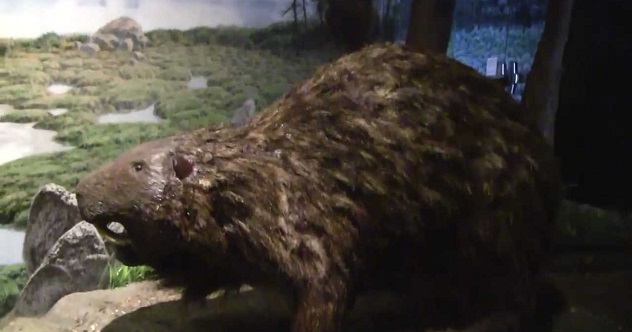
Now we leave the living world and enter the fossil hall of nightmares. Josephoartigasia monesi was an extinct giant rodent that lived in South America millions of years ago. It is widely recognized as the largest rodent ever recorded. Some estimates suggest it may have weighed around 1,000 kilograms, though scientific debate continues over the exact body mass.
Its skull alone measured about 53 centimeters long, roughly comparable to a large cow skull. Research has suggested that its bite force may have been extraordinarily powerful, with incisors potentially used like tusks for digging, defense, or handling tough vegetation. Its closest living relative is thought to be the pacarana, which suddenly makes the pacarana seem less like a curiosity and more like the small surviving cousin of a prehistoric tank.
Was Josephoartigasia terrifying? Absolutely. Even if it was a peaceful herbivore, the idea of a rodent approaching the size of a buffalo is enough to make modern pest control professionals quietly resign. Thankfully, it is extinct. Your pantry is safe.
What Makes These Giant Rodents “Terrifying”?
The word “terrifying” is playful here, but these animals do challenge expectations. We tend to underestimate rodents because the most familiar species are small. Huge rodents flip that mental image upside down. A capybara can outweigh a large dog. A beaver can alter a stream. A porcupine carries thousands of defensive quills. A nutria population can damage wetlands. A prehistoric rodent could have looked across the landscape with a skull the size of livestock.
But size alone is not the full story. The most impressive thing about large rodents is adaptation. Their teeth, claws, feet, tails, fur, and social systems are shaped by the environments they inhabit. Semi-aquatic rodents evolved webbed feet and waterproof coats. Grassland rodents evolved speed and alertness. Forest rodents evolved nocturnal habits and camouflage. Spiny rodents evolved one of the clearest “nope, do not bite me” messages in nature.
Experiences and Encounters With Huge Rodents
Seeing a huge rodent in real life is very different from reading a measurement in a fact sheet. Numbers are polite. Animals are not. A capybara described as “over 100 pounds” sounds interesting; a capybara standing beside you at a wildlife park looks like a coffee table that learned to breathe. Its calm expression almost makes the size funnier. It has the face of an animal that knows it is the largest living rodent and has decided not to brag.
One of the most memorable experiences people often describe with large rodents is the surprise of scale. Beavers, for example, are often imagined as medium-sized cartoon animals with flat tails. Then you see one swimming across a pond at dusk, head low, wake spreading behind it, and the animal suddenly seems serious. A beaver on land is chunky and almost awkward, but in water it becomes powerful and controlled. When you notice the dam, the lodge, the gnawed trunks, and the flooded area, the encounter turns into a lesson: this animal is not just living in the habitat. It is editing the habitat.
Porcupines create a different kind of memory. They are not fast, flashy, or graceful. They shuffle. They climb slowly. They seem almost comically unconcerned. But the quills change the mood. A close look reveals a defensive design that feels ancient and practical. You do not need dramatic behavior to understand the message. The porcupine’s entire back says, “Please make better choices.” For hikers, campers, and dog owners, that message is worth respecting.
Nutria encounters can be more complicated. In places where they are invasive, people may first mistake them for muskrats or small beavers. Then the orange teeth appear, the long rounded tail becomes visible, and the animal’s identity clicks into place. Unlike a capybara in its native wetland or a beaver in a restored stream, nutria often represent ecological imbalance. Seeing one can be fascinating, but it may also mean local wetlands are under pressure.
Zoo encounters with Patagonian maras and pacas are especially good at confusing the brain. A mara looks rabbit-like until someone explains that it is a rodent. A paca looks like an oversized forest guinea pig wearing spotted formalwear. These animals show how flexible rodent evolution has been. The group is not limited to one body plan. It includes swimmers, diggers, climbers, runners, grazers, gnawers, and armored introverts.
The strangest experience of all may be imagining extinct giants like Josephoartigasia. Museums and fossil reconstructions turn abstract deep time into something physical. A giant skull, massive incisors, and weight estimates in the hundreds or thousands of pounds make the modern world feel smaller. They remind us that today’s capybara, impressive as it is, may be only a modest echo of ancient rodent possibility.
For nature lovers, the best takeaway is simple: large rodents deserve more respect than their reputation usually gives them. They are not merely pests, oddities, or punchlines. They are ecosystem engineers, seed movers, prey animals, grazers, burrowers, swimmers, and survivors. Some are adorable. Some are destructive outside their native range. Some are armored like medieval foot soldiers. All of them prove that the rodent world is far more dramatic than a mouse in the kitchen.
Conclusion: Big Teeth, Big Bodies, Bigger Respect
The world of huge rodents is wonderfully weird. The capybara claims the crown as the largest living rodent, while beavers prove that teeth and teamwork can reshape landscapes. Porcupines show how defense can become an art form. Nutria demonstrate why introduced species can become serious ecological problems. Maras, pacaranas, and pacas reveal the astonishing variety of rodent bodies. And Josephoartigasia reminds us that prehistoric nature had a sense of humor and possibly no size limit.
So the next time someone says “rodent” and you picture something tiny, remember this list. Somewhere in the evolutionary family album is a wetland giant, a dam builder, a walking pincushion, a spotted night wanderer, and a fossil beast that could make a modern rat look like a crumb. Terrifying? A little. Fascinating? Completely.