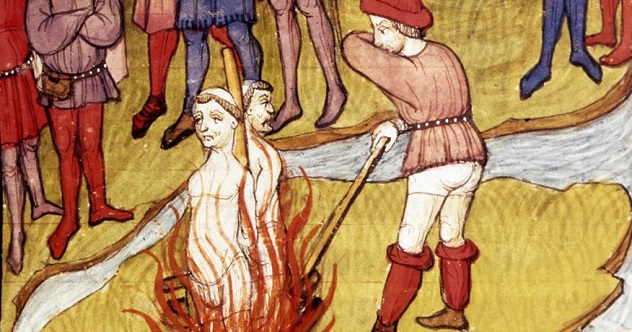
History has a funny habit of giving its sharpest minds the worst customer service. Ask a difficult question, translate a forbidden text, suggest that Earth is not the center of everything, and suddenly someone in a serious hat is muttering, “That sounds like heresy.”
The word “heretic” has often been used for people who challenged religious authority, social order, political convenience, or all three at once. Some of these thinkers were theologians. Some were philosophers. Some were scientists before science had a comfortable office and a coffee machine. What they shared was a dangerous gift: they thought past the edge of what their world allowed.
This article explores ten original thinkers persecuted as heretics, not to turn them into flawless saints, but to understand why powerful institutions feared their ideas. Their stories show that intellectual courage can be costly, messy, dramatic, and occasionally very bad for one’s retirement plan.
Why Were Original Thinkers Branded As Heretics?
In many historical societies, religion was not a private hobby tucked neatly between brunch and laundry. It shaped law, education, politics, morality, and public identity. To question doctrine could mean questioning the entire structure that held society together. A “heretic” was not merely someone with unusual opinions; in the eyes of authorities, a heretic could be a threat to unity, obedience, and power.
That is why the people below were rarely punished for one idea alone. Galileo was not simply a man with a telescope. Tyndale was not simply a translator. Anne Hutchinson was not simply a woman hosting discussions in her home. Each person represented a crack in the wall: personal conscience against official interpretation, observation against inherited cosmology, direct access to God against clerical control, or reason against tradition.
1. Peter Abelard: The Man Who Argued Too Well
A medieval mind with a dangerous habit of asking “why”
Peter Abelard, the brilliant 12th-century philosopher and theologian, was famous for logic, debate, and a talent for making enemies faster than most people make breakfast. He believed that faith should be examined with reason, not merely repeated by memory. In an age when theological language was guarded carefully, Abelard’s approach felt bold, even reckless.
His work on the Trinity was condemned at the Council of Soissons in 1121, and he was reportedly forced to burn his own book. Later, his teachings were again challenged by powerful religious opponents. Abelard’s trouble was not that he rejected Christianity. It was that he tried to explain sacred mysteries with philosophical tools sharp enough to cut the fingers of authority.
Today, Abelard is remembered as a pioneer of scholastic thought. His story reminds us that even inside religious tradition, original thinking can be treated as rebellion when it sounds too independent.
2. Marguerite Porete: The Mystic Who Would Not Be Quiet
Her book outlived the fire
Marguerite Porete was a medieval French mystic associated with the Beguine movement, a form of religious life that allowed women unusual independence. Her book, The Mirror of Simple Souls, described the soul’s union with divine love in language that was poetic, intense, and suspiciously free from the usual institutional traffic lights.
Authorities condemned her book as heretical and ordered her not to circulate it. Porete refused to stop. She also refused to cooperate with the inquisitorial process in the expected way. In 1310, she was burned at the stake in Paris as a relapsed heretic.
The irony is almost too obvious, but history enjoys irony the way cats enjoy knocking cups off tables: her book survived. It circulated anonymously for centuries and later became an important text in the study of medieval mysticism. Porete’s persecution shows how female intellectual and spiritual authority could terrify a male-dominated religious world.
3. Jan Hus: The Reformer Before the Reformation
A Czech preacher who challenged corruption
Jan Hus, a Czech priest and reformer, criticized church corruption and promoted ideas influenced by John Wycliffe. He argued for moral reform, preached in the language of ordinary people, and challenged abuses connected to clerical power. This made him popular in Bohemia and deeply inconvenient elsewhere.
Hus was summoned to the Council of Constance with a promise of safe conduct. That promise turned out to have the durability of a wet paper umbrella. He was arrested, tried, urged to recant, and burned at the stake in 1415 after refusing to abandon his views.
Hus became a national and religious symbol, and his death helped ignite the Hussite movement. More than a century before Martin Luther, Hus showed that reform ideas could spread through preaching, language, and public frustration. He also showed that institutions often fear reformers most when the crowd starts listening.
4. Girolamo Savonarola: The Firebrand Who Played With Fire
Florence, prophecy, politics, and one very dangerous sermon voice
Girolamo Savonarola was a Dominican friar in Renaissance Florence who denounced corruption, luxury, tyranny, and moral decay. His preaching helped shape the politics of Florence after the Medici were expelled, and he called for a purified Christian republic. If subtlety had been a room, Savonarola rarely entered it.
His movement became famous for the “bonfire of the vanities,” where luxury goods, cosmetics, books, and artworks associated with moral corruption were destroyed. But his attacks on church leadership and his refusal to obey papal commands brought disaster. Pope Alexander VI excommunicated him. In 1498, Savonarola was arrested, tortured, condemned, hanged, and burned in Florence.
Savonarola is difficult to categorize. Was he a prophet, fanatic, reformer, political revolutionary, or all of the above wearing a friar’s robe? His case shows that heresy charges often mixed theology with politics. When religion and government share a steering wheel, anyone grabbing at it risks getting run over.
5. William Tyndale: The Translator Who Changed English Forever
Putting scripture into common language was not considered polite
William Tyndale believed ordinary English-speaking people should be able to read the Bible in their own language. That sounds harmless today, like suggesting libraries should have doors. In the 16th century, however, unauthorized translation of scripture could be seen as a direct attack on religious authority.
Tyndale translated the New Testament and parts of the Old Testament from Greek and Hebrew into English. His language later influenced the King James Bible and, through it, English literature itself. But his work and reformist theology made him a hunted man. He was arrested near Brussels, convicted of heresy, strangled, and burned in 1536.
Tyndale’s case is one of the clearest examples of how control over language can become control over thought. Translate a sacred text, and you do more than change words; you change who gets to interpret reality. No wonder authorities panicked. A Bible in the hands of the people was basically the printing press saying, “Good luck keeping secrets.”
6. Michael Servetus: The Doctor Who Challenged the Trinity
A medical mind caught between Catholic and Protestant power
Michael Servetus was a Spanish theologian, physician, and polymath. He made important observations related to pulmonary circulation, but his theological writings were what placed him in mortal danger. Servetus rejected the traditional doctrine of the Trinity, a position that angered both Catholics and Protestants. That is not an easy achievement; it is like getting banned from both rival restaurants on the same street.
After being condemned by Catholic authorities in France, Servetus fled and eventually arrived in Calvinist Geneva. There, he was arrested, tried, and burned at the stake in 1553. His execution became one of the most controversial moments of the Reformation because it forced Protestants to confront an uncomfortable question: if they opposed Catholic persecution, should they persecute dissenters themselves?
Servetus reminds us that reform movements can become intolerant once they gain power. Yesterday’s rebels can become tomorrow’s gatekeepers, sometimes with alarming speed.
7. Giordano Bruno: The Infinite Universe Was Too Much Universe
A philosopher with cosmic imagination and theological trouble
Giordano Bruno, the Italian philosopher and former Dominican friar, imagined an infinite universe filled with countless worlds. His cosmology was daring, but his troubles with the Roman Inquisition involved more than astronomy. Bruno’s ideas touched theology, scripture, magic, memory, metaphysics, and the nature of God. In other words, he did not step on one doctrinal toe; he tap-danced across the whole foot.
Bruno was imprisoned and tried for years. In 1600, he was declared an unrepentant heretic and burned at the stake in Rome’s Campo de’ Fiori. Later generations turned him into a symbol of free thought, though historians rightly warn against simplifying him as merely a “martyr for science.” His case was tangled, theological, philosophical, and political.
Still, Bruno’s intellectual courage is undeniable. He dared to think of reality on a scale that made the official universe look like a studio apartment. His punishment shows how dangerous imagination can be when it expands faster than authority can tolerate.
8. Galileo Galilei: The Telescope That Caused a Headache
When observation challenged the old cosmic seating chart
Galileo Galilei did not invent heliocentrism, but he gave it powerful observational support. His telescopic discoveries, including the moons of Jupiter and the phases of Venus, strengthened the argument that Earth was not the unmoving center of the cosmos. This was scientifically thrilling and institutionally awkward.
In 1633, Galileo was tried by the Roman Inquisition and found “vehemently suspected of heresy.” He was forced to recant and spent the rest of his life under house arrest. The famous story of Galileo is often told as a simple battle between science and religion, but the real situation included politics, personality, biblical interpretation, academic rivalry, and papal embarrassment. History rarely gives us clean movie scripts.
What makes Galileo’s case so powerful is that his method pointed toward the modern scientific mindset: look, test, compare, and revise. The telescope did not care about tradition. It simply showed moons where old assumptions preferred silence.
9. Anne Hutchinson: The Woman Who Out-Argued the Colony
A Puritan dissenter in early America
Anne Hutchinson was a religious thinker and midwife in the Massachusetts Bay Colony. She hosted meetings where people discussed sermons and theology, and she criticized ministers whom she believed preached a flawed understanding of grace. Her intelligence, popularity, and confidence alarmed Puritan leaders.
In the Antinomian Controversy, Hutchinson was accused of spreading dangerous religious errors. Her trial revealed not only theological tension but also anxiety about gender and authority. A woman teaching, interpreting, and attracting followers was considered deeply threatening. She was banished from the colony in 1637 and excommunicated in 1638.
Hutchinson later became associated with the broader history of religious liberty in America. Her story is especially important because it happened in a colony often remembered as a refuge from persecution. The lesson is sharp: people fleeing intolerance do not automatically become tolerant when they gain control of the meetinghouse.
10. Baruch Spinoza: The Philosopher Too Radical for His Community
Reason, God, and the loneliness of independent thought
Baruch Spinoza, the 17th-century Dutch philosopher, developed ideas about God, nature, scripture, and freedom that challenged traditional religious belief. In 1656, the Portuguese-Jewish community of Amsterdam issued a severe herem, or ban, against him. The writ accused him of “abominable heresies” and cut him off from communal life.
Spinoza’s later philosophy identified God with nature in a way that rejected a personal, interventionist deity. He also defended freedom of thought and argued for critical approaches to scripture. These ideas helped shape modern philosophy, biblical criticism, and political thought. At the time, however, they were explosive.
Spinoza did not die at the stake. He lived quietly, ground lenses, wrote carefully, and became one of the most influential philosophers in history. His persecution shows that heresy can mean social death as well as physical punishment. Sometimes the stake is replaced by exile, silence, and locked doors.
What These Heresy Cases Have In Common
Original thinking often threatens more than ideas
These ten thinkers were different in personality, belief, era, and method. Some were devout reformers. Some were mystical writers. Some were philosophers. Some were scientists. Yet their stories share several patterns.
First, they challenged monopoly control over truth. Tyndale challenged who could read scripture. Hutchinson challenged who could interpret sermons. Galileo challenged who could describe the heavens. Spinoza challenged who could define God. In each case, the problem was not simply the idea; it was the transfer of authority from institution to conscience, observation, language, or reason.
Second, heresy accusations often became political tools. Savonarola’s fall cannot be separated from Florentine politics. Hus was entangled in church councils and imperial power. Servetus became a test case for Protestant authority. Heresy was frequently a theological word with political muscles.
Third, persecution did not always destroy the idea. Sometimes it advertised it. Burning a book can make people wonder what was so interesting inside. Executing a thinker can turn a local controversy into a long-term legacy. The persecutors often won the day and lost the century.
Experiences and Lessons From Studying Original Thinkers Persecuted As Heretics
Why these stories still feel uncomfortably modern
Reading about original thinkers persecuted as heretics is not just an exercise in historical curiosity. It feels strangely current. The clothing has changed, the legal systems have changed, and thankfully most arguments now end with angry comment threads rather than public executions. Still, the emotional structure remains familiar: someone questions a sacred assumption, a community feels threatened, and the machinery of punishment begins to move.
One experience that stands out when exploring these stories is how rarely the conflict is purely intellectual. We like to imagine debates as clean contests between true and false, reason and error, evidence and superstition. Real history is messier. A new idea may be judged not only by whether it is accurate, but by who says it, when they say it, what social class they belong to, whether they obey proper channels, and whether their critics already dislike their face. Abelard might have survived more comfortably if he had been less brilliant and less annoying. Hutchinson might have been treated differently if she had been a man with an official pulpit. Bruno might have been safer if his imagination had arrived wrapped in softer language.
Another lesson is that courage does not always look calm. Some of these figures were stubborn, dramatic, proud, or politically naïve. That does not cancel their originality. Modern readers sometimes expect historical heroes to behave like perfectly edited inspirational posters. They did not. They were human beings under pressure, and pressure rarely produces tidy behavior. The value of their stories lies not in their perfection, but in their willingness to keep thinking when obedience would have been easier.
There is also a practical lesson for writers, researchers, teachers, and creators today: language matters. Tyndale’s translation changed history because words placed power into new hands. Porete’s mystical language frightened authorities because it described spiritual experience without asking permission at every sentence. Galileo’s observations mattered because he translated the sky into evidence that others could examine. If you control language, you control access. If you open language, you open possibility.
These stories also warn us not to become too smug about the past. It is easy to laugh at old authorities for rejecting ideas we now accept. But every age has its untouchable assumptions. Every profession, community, and institution has ideas that are easier to repeat than question. The real challenge is not to congratulate ourselves for agreeing with Galileo after four centuries. The challenge is to ask which uncomfortable voices we dismiss today because they disturb our habits, budgets, identities, or reputations.
Finally, studying persecuted thinkers teaches patience. Some ideas need decades or centuries to be understood. Recognition often arrives late, sometimes embarrassingly late, like a guest showing up after the dishes are washed. But the survival of these thinkers’ names proves that intellectual courage leaves traces. A banned book, a forced recantation, an exile, or a trial record can become evidence that someone once dared to think beyond the permitted map.
Conclusion: Heresy, Memory, and the Price of Thinking Differently
The history of original thinkers persecuted as heretics is not a simple parade of heroes and villains. It is a complicated record of fear, faith, power, conscience, and imagination. Some condemned thinkers were right about many things; some were wrong about plenty. But each forced their society to confront questions it preferred to bury.
That is why their stories still matter. They remind us that progress is not always welcomed with applause. Sometimes it arrives in court records, prison cells, exile orders, burned manuscripts, and whispered conversations. The people called heretics in one century may become pioneers in another.
Perhaps the safest lesson is also the most uncomfortable: whenever a society decides that asking questions is more dangerous than enforcing silence, it has already begun to fear the future. And the future, as history repeatedly proves, has a habit of showing up anyway.
SEO Tags
Note
This HTML article is written in standard American English for web publication, with clean structure, natural SEO keyword placement, and no source-code placeholders or citation artifacts inside the article body.