Some insects inspire a polite swat. Others inspire a sudden interest in moving to Antarctica. The world’s most terrifying insects combine extreme pain, parasitic life cycles, disease transmission, coordinated swarms, or the deeply rude habit of developing beneath skin. This editorial ranking is not a formal scientific danger scale. Instead, it weighs medical risk, disturbing behavior, biological weaponry, and overall nightmare value. A giant hornet may look scarier than a mosquito, but appearances are not always the best survival guide.
What Makes an Insect Truly Terrifying?
Fear is subjective, but the biology is real. Venom can cause severe pain or allergic reactions. Blood-feeding insects may transmit pathogens. Parasitoids use living animals as nurseries, while social species turn thousands or millions of small bodies into a coordinated force. Many intimidating insects avoid people unless disturbed; others look harmless yet create major public-health problems. In other words, the insect wearing the villain costume is not always the one doing the most damage.
10. Giant Water Bug
The “Toe-Biter” Waiting in the Shallows
Giant water bugs are broad, flattened freshwater predators found in ponds, wetlands, ditches, and slow-moving water. Their powerful front legs seize insects, tadpoles, small fish, frogs, and other prey. Some species can reach several inches long, which is a surprising amount of insect to discover beside your bare foot.
The nickname “toe-biter” comes from their painful defensive bite. A giant water bug uses a piercing beak to inject saliva that immobilizes and begins digesting prey. Humans are not normal menu items, but a bug that is stepped on or handled may defend itself. Its ambush stylemotionless among underwater vegetation until something approachesgives every murky pond a little extra suspense.
9. African Driver Ant
A Moving Army With Millions of Mouths
Driver ants, also called safari ants or siafu, are Old World army ants known for enormous colonies and organized raids. Hundreds of thousands of workers may move across the forest floor while large soldiers guard the column with oversized, scissor-like mandibles.
The fear comes from scale. A dense swarm can flow across trails, vegetation, camps, and buildings while capturing insects and small animals that cannot escape. Healthy adults can normally step away from a raid, but restrained or immobile animals face greater danger. Watching a living river reorganize around obstacles is a powerful reminder that teamwork becomes unsettling when every team member carries pliers on its face.
8. Tarantula Hawk Wasp
The Spider Hunter With a Nightmare Nursery
Female tarantula hawks hunt tarantulas, sting them into paralysis, drag them to a burrow, and lay an egg on the immobilized spider. The larva later feeds on its living host. Nature could have chosen a sandwich. Nature chose this.
For humans, the main concern is an exceptionally painful defensive sting. These large wasps are not usually aggressive, and adults often feed on nectar, but handling or trapping one is a terrible experiment. Their bright warning colors advertise the equipment clearly. Admire from a distance and do not test the heroic pain tolerance you claimed during brunch.
7. Bullet Ant
A Tiny Insect With an All-Day Punishment
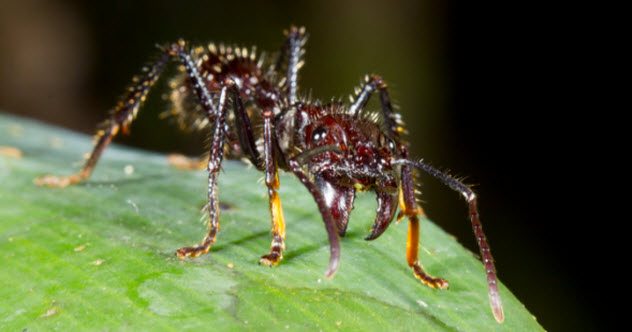
The bullet ant, Paraponera clavata, lives in Central and South American rainforests and is famous for an extraordinarily painful sting. Descriptions compare the sensation to being shot, burned, or struck by an electric jolt. The intense throbbing may continue for many hours.
Bullet ants do not patrol the jungle looking for tourists. Stings generally happen when a nest is disturbed or an ant becomes trapped against skin. What earns the species its reputation is duration: one careless encounter may keep delivering reminders long after you have apologized to the forest, reconsidered your personality, and promised never to complain about a paper cut again.
6. Northern Giant Hornet
The Heavyweight Hornet That Can Dismantle a Hive
The northern giant hornet, Vespa mandarinia, is the world’s largest hornet and can approach two inches in length. Native to parts of Asia, it has a broad orange head, powerful jaws, and a buzzing flight that sounds like a small appliance with bad intentions.
Its sting is extremely painful, and multiple stings can be medically serious, especially when a nest is disturbed. The hornet is also a formidable predator of honey bees; coordinated groups can devastate a hive within hours. It does not normally hunt people, but it should be treated like a flying power tool: impressive, biologically useful in its native ecosystem, and not something to poke with a stick.
5. Human Botfly
The Larva That Develops Beneath the Skin
The adult human botfly, Dermatobia hominis, resembles a stout, fuzzy bee. The disturbing stage is its larva, which develops beneath mammalian skin and creates a boil-like lesion called furuncular myiasis.
A female botfly may attach eggs to a mosquito or another blood-feeding insect. When the carrier lands on a warm host, the larvae can enter through the bite site or nearby skin. The growing larva keeps an opening for air while feeding below the surface. Infestations are treatable and the fly is not known for transmitting disease pathogens, but the discovery that a “pimple” has breathing equipment is enough to damage anyone’s trust in their own skin.
4. Kissing Bug
A Misleading Name and a Dangerous Parasite
Kissing bugs are blood-feeding triatomine insects that may bite exposed skin, sometimes near the face, while a person sleeps. The nickname sounds romantic. The follow-up is not: an infected bug may leave feces containing Trypanosoma cruzi, the parasite that causes Chagas disease.
Infection can occur when contaminated material is rubbed into a bite, the eyes, mouth, or broken skin. Early symptoms may be mild or absent, while some chronic infections later cause serious heart or digestive problems. Finding a kissing bug does not automatically mean transmission occurred, but any insect that feeds during sleep and leaves behind a parasitic possibility has earned its place here.
3. Tsetse Fly
The Blood-Feeder Linked to Sleeping Sickness
Tsetse flies live in sub-Saharan Africa and feed on blood. Certain flies transmit parasites that cause human African trypanosomiasis, commonly called sleeping sickness. Despite the dreamy name, the disease is a medical emergency, not an aggressive nap.
Early illness may involve fever, headaches, weakness, and swollen lymph nodes. Once parasites invade the central nervous system, they can disrupt sleep and cause neurological or behavioral changes. Untreated disease can be fatal, although only a small percentage of tsetse flies carry the parasites. The insect looks ordinary, which is part of the fear: no giant stinger, just a small fly capable of delivering a microscopic passenger to the brain.
2. New World Screwworm Fly
Larvae That Feed on Living Tissue
The New World screwworm fly, Cochliomyia hominivorax, has one deeply unpleasant specialty: its larvae feed on living tissue. Adult females lay eggs in wounds or body openings such as the eyes, ears, nose, or mouth. After hatching, larvae burrow into flesh and enlarge the injury as they feed.
Livestock, pets, wildlife, birds, and, more rarely, humans can be infested. Untreated cases may become severely painful, foul-smelling, and potentially fatal. The name refers to the way larvae drive into a wound using mouth hooks and body spines. That is not a metaphor created by a horror writer; it is simply the insect completing its life cycle with unnecessary enthusiasm.
1. Mosquito
The Quiet Winner in the Deadliest-Insect Category
A mosquito lacks the cinematic menace of a giant hornet and the body-horror résumé of a botfly. Yet mosquitoes are considered the world’s deadliest animals because some species transmit malaria, dengue, yellow fever, West Nile disease, Zika, chikungunya, and other infections.
Female Anopheles mosquitoes can spread malaria parasites, while certain Aedes and Culex species transmit important viruses. Global estimates cited by the CDC recorded hundreds of thousands of malaria deaths in 2023. The mosquito succeeds through abundance, mobility, proximity to humans, and efficient blood feeding. It arrives with a faint whine, leaves a tiny bump, and may carry something far more dangerous than its appearance suggests.
How to Reduce Your Risk Around Dangerous Insects
Most encounters can be prevented with boring, effective precautions. Use appropriate insect repellent, wear protective clothing, sleep behind intact screens or bed nets where recommended, cover open wounds, and follow destination-specific travel-health guidance. Do not handle unfamiliar wasps, ants, caterpillars, or large aquatic bugs, and never disturb a nest for a better photo.
Seek medical care for severe allergic reactions, fever after travel, worsening wounds, unexplained boil-like lesions, or suspected exposure to a disease vector. Identification matters: many harmless insects resemble dangerous ones, and frantic swatting can turn a calm wasp into a defensive wasp. A photograph taken from a safe distance is usually more useful than a heroic capture attempt involving a drinking glass and misplaced confidence.
Experience From Insect Country: What Fear Feels Like in Real Life
The following is a realistic composite experience based on documented insect behavior and common travel situations, not a claim of one personal expedition.
The first surprise in tropical insect country is that terror rarely arrives with dramatic music. It begins with small decisions. You leave a window open because the room is hot. You wear sandals because the trail looks dry. You set your backpack beside a tree for two minutes. Nothing happens, so confidence quietly replaces caution.
Then a local guide points to a column of ants crossing the path. At first, it resembles spilled coffee grounds. A closer look reveals movement in every direction, workers flowing around leaves and soldiers standing along the edges with their jaws open. The guide does not scream or perform an action-movie leap. He simply says, “Walk around.” That calm instruction is more persuasive than panic. You walk around.
Later, a large wasp passes at knee height. The sound reaches you before the color does: a low, mechanical buzz. Everyone freezes, but the wasp continues toward a flowering shrub. The moment teaches an important lesson. Dangerous insects are not tiny villains patrolling for human victims. Most are busy feeding, nesting, defending territory, or searching for hosts suited to their life cycle. Respect reduces risk better than theatrical fear.
The psychological challenge is what comes after sunset. Every sensation becomes suspicious. A bead of sweat feels like a crawling larva. A leaf brushing the tent sounds like six million driver ants filing a noise complaint. The mosquito whining near your ear is especially effective because you cannot see it. You turn on a light, find nothing, turn it off, and hear the buzz again. The insect has apparently studied psychological warfare.
Good routines gradually replace anxiety. Shoes are shaken before wearing. Screens are checked. Repellent is applied before mosquitoes become active, not after the first bite. Open scratches are cleaned and covered. Clothing is not left in a heap on the ground. These habits are simple, but simplicity is the point. Most protection comes from removing easy opportunities.
The experience also changes how you see insects. A giant water bug becomes less like a monster and more like a specialized freshwater predator. A tarantula hawk becomes an extraordinary parasitoid rather than a flying syringe. Even mosquitoes become biologically impressivealthough admiration remains difficult while one is drilling into your ankle.
The lasting lesson is not that nature is malicious. Insects have no interest in starring in our nightmares. Their stingers, mouthparts, parasites, and swarm behaviors evolved for survival, feeding, and reproduction. Humans experience those adaptations as terrifying because our bodies can become obstacles, food sources, accidental hosts, or simply the wrong thing in the wrong place.
Fear is useful when it encourages preparation. It becomes unhelpful when it turns every beetle into a medical emergency. The best traveler leaves insect country with two things intact: healthy respect and unbitten ankles. Achieving both is less heroic than fighting a hornet, but considerably smarter.
Conclusion
The most terrifying insects prove that size is only one route to fear. Hornets intimidate with power, bullet ants specialize in pain, driver ants weaponize numbers, and parasitic flies transform ordinary wounds into biological horror. Yet the delicate mosquito remains the most consequential threat because of the diseases certain species transmit.
Terrifying does not mean unavoidable. Distance, repellent, protective clothing, screens, wound care, and the revolutionary technique known as “do not touch that” prevent many bad encounters. Learn what lives in the area, respect its space, and remember: the insect is usually not hunting you. Usually.
Note: This ranking is editorial and educational rather than a formal scientific danger index. Medical risk varies by species, location, exposure, allergies, access to care, and whether an insect carries a pathogen.