The British monarchy has survived civil wars, revolutions, constitutional crises, and several centuries of uncomfortable family dinners. Yet some of its most memorable challenges have involved something far less majestic: public embarrassment.
Royal life is designed around ceremony, discipline, and carefully polished appearances. That makes every leaked telephone call, disastrous interview, security failure, and irritated encounter with office supplies especially noticeable. An ordinary person can lose an argument with a fountain pen and move on. When a king does it on television, the clip travels around the world before the ink dries.
Some incidents on this list are amusing public-relations blunders. Others exposed serious failures of judgment, security, or institutional leadership. Together, these embarrassing British monarchy incidents reveal how difficult it is to preserve royal mystique in an age of cameras, tabloids, television interviews, and instant public reaction.
10. “It’s a Royal Knockout” Turns the Royal Family Into a Game Show
A medieval spectacle with distinctly unroyal results
In 1987, Prince Edward helped organize The Grand Knockout Tournament, better remembered as It’s a Royal Knockout. The televised charity event placed celebrities in medieval costumes and featured royal team captains, including Princess Anne, Prince Andrew, Sarah Ferguson, and Edward himself.
The concept probably sounded harmless in a planning meeting: famous people completing silly challenges to raise money for charity. Unfortunately, the finished program looked less like a dignified modernization of the monarchy and more like a palace staff party that had accidentally been broadcast nationwide.
The event was widely mocked for making senior royals appear undignified. Edward’s awkward post-event interaction with unimpressed reporters only deepened the embarrassment. The tournament did raise money, but it also became a lasting example of what happens when the House of Windsor tries too hard to look casually entertaining. Sometimes the crown should simply leave foam obstacles and fake castles to professional game-show hosts.
9. King Charles III Loses His Patience With a Leaky Pen
The pen was not mightier than the king, but it did go viral
Shortly after becoming king in September 2022, Charles III encountered one of the oldest enemies of important people everywhere: unreliable stationery. During a televised signing, a leaking fountain pen stained his hand and prompted an irritated outburst.
The incident was small, understandable, and deeply relatable. Unfortunately for Charles, relatability was not necessarily the quality viewers noticed. Critics interpreted the flash of frustration as evidence of royal privilege and impatience, while social media transformed the clip into a miniature global comedy.
Most people have argued with a printer, jammed stapler, or malfunctioning pen. Most people, however, do not have cameras recording the argument for international distribution. The episode demonstrated how quickly a routine annoyance can become a royal public-relations problem when every movement is being analyzed.
8. Michael Fagan Walks Into Queen Elizabeth II’s Bedroom
A palace security system with more holes than a tea strainer
On July 9, 1982, Michael Fagan climbed into Buckingham Palace, wandered through its corridors, triggered alarms that were reportedly dismissed as malfunctions, and eventually reached Queen Elizabeth II’s bedroom.
The story was alarming rather than funny for the queen, but it was acutely embarrassing for the institution responsible for protecting her. Buckingham Palace was supposed to be among the most secure residences in Britain. Instead, an intruder reportedly entered through an unlocked window and traveled surprisingly far before being stopped.
The breach exposed failures in communication, alarm procedures, staffing, and physical security. It also produced a question that palace officials could not answer comfortably: If one man could reach the monarch’s private rooms with relatively little resistance, what exactly were all those guards guarding?
The incident prompted intense scrutiny and became one of the most notorious security failures in modern royal history. Queen Elizabeth reportedly handled the confrontation with remarkable composure. The palace security operation looked considerably less composed.
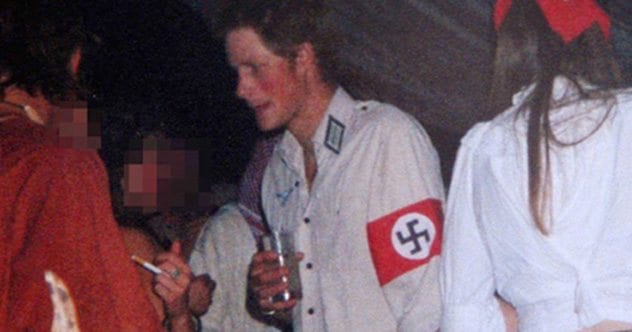
7. Prince Harry Wears a Nazi Costume
A party decision with no defensible explanation
In January 2005, photographs emerged showing 20-year-old Prince Harry attending a costume party while wearing an outfit featuring Nazi insignia. The image provoked immediate outrage, particularly because of the royal family’s historical connection to Britain’s fight against Nazi Germany and the continuing trauma of the Holocaust.
Harry issued a written apology, acknowledging that the costume had been a poor choice. That description was technically accurate in the same way that sinking the Titanic could be called an unfortunate scheduling disruption.
The scandal demonstrated the risks facing young royals who are simultaneously private individuals, public symbols, and magnets for photographers. Youthful foolishness can be forgiven, but royal status dramatically increases its consequences. A bad costume selected by an unknown college student might embarrass a few friends. The same costume worn by a prince can trigger an international controversy and demands for a history lesson.
6. Sarah Ferguson’s Vacation Photos Reach the Tabloids
The royal scandal that became known by one unfortunate foot
In 1992, months after Sarah Ferguson and Prince Andrew announced their separation, the Duchess of York was photographed vacationing with American financial adviser John Bryan. One image showed Ferguson reclining while Bryan held one of her feet against his mouth.
The photographs appeared in the British press while Ferguson was still legally married and reportedly staying with the royal family at Balmoral. The timing turned an intimate vacation into a world-famous embarrassment.
The episode became permanently known as the “toe-sucking scandal,” proving that tabloids are extremely efficient at reducing complicated relationships to two memorable words. It accelerated Ferguson’s fall from popular, energetic royal newcomer to a frequent source of palace headaches.
It is also worth acknowledging the invasive nature of the photography. The pictures were taken during a private holiday, and modern audiences may view the press tactics more critically than readers did at the time. Even so, their publication created one of the defining royal scandals of the 1990s.
5. The Windsor Castle Fire Creates a Taxpayer Backlash
When a family disaster became a national argument about money
Queen Elizabeth II famously described 1992 as her annus horribilis, or horrible year. Three of her children experienced marital separations or divorce-related turmoil, private conversations reached the press, and public confidence in the royal family weakened.
Then, on November 20, a faulty spotlight started a major fire at Windsor Castle. The blaze damaged or destroyed 115 rooms and required hundreds of firefighters working for roughly 15 hours. Although many important artworks were saved and no one was seriously injured, the physical destruction was enormous.
The embarrassment intensified when the initial expectation emerged that taxpayers would cover the restoration costs. Many citizens questioned why public money should repair a royal residence while the queen did not then pay income tax in the same manner as ordinary taxpayers.
The palace eventually opened Buckingham Palace to paying visitors to help finance repairs, and the queen began voluntarily paying income tax. Those decisions helped calm the controversy, but the episode permanently changed discussions about royal finances and accountability. Even a castle fire, it turned out, could become a debate over the national household budget.
4. “Camillagate” Exposes an Intimate Royal Phone Call
A private joke becomes a very public nightmare
In December 1989, then-Prince Charles and Camilla Parker Bowles had an intimate telephone conversation while both were married to other people. A recording eventually reached the press, and the transcript was widely published in 1993.
The conversation contained affectionate exchanges, discussions about arranging private meetings, and one spectacularly unfortunate joke involving Charles imagining himself reincarnated as a feminine hygiene product. That single remark supplied newspapers with enough material to power headlines for years.
The leak was a gross invasion of privacy. Nevertheless, its political and personal consequences were significant. It reinforced allegations that Charles and Camilla had maintained a relationship during his marriage to Princess Diana and further damaged his reputation during an already bitter marital breakdown.
The episode also revealed a new reality for the monarchy: technology had made supposedly private royal conversations vulnerable. Once the recording became public, centuries of regal language and ceremony were overwhelmed by one very awkward joke.
3. The Royal Family Misreads Public Grief After Diana’s Death
Tradition collides with a nation demanding visible emotion
Diana, Princess of Wales, died following a car crash in Paris on August 31, 1997. Her death produced extraordinary public mourning in Britain and around the world. Crowds gathered, flowers accumulated outside royal residences, and millions looked to the monarchy for leadership.
Queen Elizabeth II remained at Balmoral with Princes William and Harry, prioritizing the privacy and welfare of Diana’s grieving sons. That decision was understandable at a family level, but the palace initially offered little visible public response. The royal standard did not fly at half-staff over Buckingham Palace, and the queen’s physical absence from London became a focus of criticism.
The monarchy’s traditional instinct was restraint: protect the children, maintain routine, and avoid displaying private emotion. The public wanted something entirely different. It wanted acknowledgment, comfort, and evidence that the royal family understood the scale of national grief.
On September 5, the queen returned to London and delivered a televised tribute to Diana, speaking both as monarch and grandmother. The address helped repair the damage, but the preceding days remain one of the clearest examples of the palace misjudging public sentiment. This was not an amusing embarrassment. It was a profound communications failure during a tragedy.
2. Edward VIII Abdicatesand Later Visits Nazi Germany
A romantic constitutional crisis followed by a darker controversy
King Edward VIII created a constitutional crisis in 1936 by insisting on marrying Wallis Simpson, an American who was divorcing her second husband. As king, Edward was also the ceremonial head of the Church of England, whose position on remarriage created a serious conflict.
After Prime Minister Stanley Baldwin rejected proposed compromises, Edward gave up the throne in December 1936. His radio address describing his inability to rule without “the woman I love” transformed the abdication into one of history’s most famous royal romances.
Romance, however, is only part of the story. In October 1937, after marrying Simpson and becoming the Duke of Windsor, Edward toured Nazi Germany and met Adolf Hitler. The visit created propaganda opportunities for the Nazi regime and deepened concerns about Edward’s political judgment and sympathies.
The abdication itself reshaped the line of succession, placing Edward’s brother George VI on the throne and eventually making George’s daughter, Elizabeth II, queen. Edward did not merely generate embarrassing headlines. His choices altered the future of the monarchy while leaving historians with uncomfortable questions about what might have happened had he remained king during World War II.
1. Prince Andrew’s Newsnight Interview Becomes a Public-Relations Catastrophe
The interview intended to end a scandal made it dramatically worse
In November 2019, Prince Andrew agreed to an extended BBC Newsnight interview about his friendship with convicted sex offender Jeffrey Epstein and allegations made against the prince. Andrew denied the allegations, including accusations by Virginia Giuffre, and said he had no recollection of meeting her.
The apparent objective was to provide a convincing human explanation and bring years of damaging speculation under control. Instead, the interview was widely criticized as awkward, defensive, and lacking empathy for Epstein’s victims.
Andrew defended aspects of his relationship with Epstein and offered an unusually detailed account of taking his daughter to a Pizza Express restaurant as part of his denial of one alleged encounter. The specificity did not create the credibility his advisers presumably hoped it would. It became one of the interview’s most memorable and ridiculed details.
More seriously, Andrew’s failure to communicate concern for exploited young women made the performance appear emotionally disconnected from the gravity of the subject. Within days, he announced that he would step back from public duties for the foreseeable future.
Few royal media appearances have failed so completely. The interview did not merely produce embarrassment; it caused lasting institutional damage and became a case study in why a high-risk television appearance should never proceed without clear answers, genuine empathy, and advisers willing to say, “Your Royal Highness, perhaps this is not the plan.”
Experiencing Royal Embarrassment in the Modern Media Age
Why these incidents feel different when watched in real time
Reading about an old royal scandal in a history book is a controlled experience. The dates are organized, the consequences are known, and historians have already separated reliable facts from frantic gossip. Watching a scandal develop in real time feels entirely different. Information arrives in fragments. Television commentators repeat the same footage. Newspapers compete for sharper headlines, and social media turns minor details into jokes before official statements have been approved.
The leaky-pen incident illustrates that speed. Viewers did not need to understand constitutional monarchy or royal protocol. They only needed a short clip showing an irritated king and an uncooperative pen. Within hours, millions of people had formed an opinion about Charles’s personality based on a few seconds of frustration. That is the modern royal experience: tiny moments can travel farther than carefully planned speeches.
Older scandals traveled more slowly but often felt more dramatic because newspapers controlled access to the evidence. Readers encountering Sarah Ferguson’s vacation photographs or the Charles-Camilla transcript saw private behavior suddenly transferred to the breakfast table. There was no gradual introduction. One morning, the royal image was intact; the next, intimate details were sitting beside the toast.
For communications professionals, these cases offer a practical lesson in crisis management. Silence may preserve dignity when the issue is trivial, but it can look evasive when the public expects accountability. Quick statements can help, but only when they sound sincere. A defensive interview may create more problems than no interview at all. The response must match the seriousness of the event rather than the comfort level of the institution.
The handling of Diana’s death remains especially instructive. The queen’s priority was protecting two grieving grandsons, while the public interpreted the family’s privacy as emotional coldness. Both perspectives can be understood. The failure occurred because the palace did not explain its actions quickly enough or recognize that the monarch’s symbolic responsibilities continued during a family crisis. Public institutions cannot assume that people will automatically understand private motives.
Royal embarrassment also encourages viewers to reconsider the difference between legitimate scrutiny and invasive entertainment. Michael Fagan’s break-in revealed a genuine security failure. Prince Andrew’s interview raised questions about judgment, accountability, and associations with a convicted offender. Those matters clearly concerned the public role of the monarchy.
A secretly recorded romantic conversation or long-lens vacation photograph occupies more complicated territory. Such material can expose hypocrisy or behavior relevant to public duties, but it can also depend on serious invasions of privacy. Laughing at the headline is easy. Deciding whether the public had a right to obtain the underlying information is harder.
Finally, these incidents make the monarchy feel unexpectedly human. Royals become annoyed, make foolish decisions, choose terrible costumes, misunderstand public opinion, and trust advisers whose plans should have been placed gently into a fireplace. That humanity may weaken the old image of flawless majesty, but it can also make the institution more understandable.
The lasting experience of following royal scandals is therefore a mixture of amusement, discomfort, curiosity, and historical perspective. The crown survives not because its members never make mistakes, but because the institution repeatedly adapts after making themsometimes gracefully, sometimes reluctantly, and sometimes only after the entire planet has watched the mistake several million times.
Conclusion
The most embarrassing incidents involving the British monarchy are rarely just amusing stories about badly chosen costumes, malfunctioning pens, or disastrous television programs. They reveal the tension between private family life and public duty, between traditional royal silence and modern demands for openness.
Edward VIII’s abdication changed the succession. The Windsor Castle fire transformed royal finances. The response to Diana’s death forced the palace to communicate with greater emotional awareness. Prince Andrew’s interview demonstrated that status cannot rescue a person from an unconvincing explanation delivered before millions of viewers.
The British monarchy has endured because it learnseventually. Its history suggests that crowns are remarkably durable, but royal dignity is considerably more fragile.
SEO Metadata