A Water Glider Prototype sounds like something a superhero would ride into a secret underwater cave, preferably while wearing sunglasses and ignoring basic maritime paperwork. In real engineering, however, it is even more interesting: a low-energy autonomous vehicle designed to glide through water, collect ocean data, test hydrodynamic ideas, and prove that robotics does not always need roaring motors to be impressive.
Most modern water glider prototypes are inspired by autonomous underwater gliders, a class of marine robots that move by changing buoyancy rather than continuously spinning propellers. Instead of charging forward like a speedboat with commitment issues, they rise and sink in a controlled sawtooth pattern. Wings convert that vertical motion into forward travel. The result is slow, quiet, efficient movement across long distances.
That simple idea has become a serious tool for ocean science, climate monitoring, fisheries research, defense testing, and marine engineering. From university-built research gliders to commercial platforms such as Slocum, Seaglider, and Spray-style vehicles, the water glider prototype has evolved from a clever concept into one of the most practical machines in ocean robotics.
What Is a Water Glider Prototype?
A Water Glider Prototype is an early-stage or experimental version of a waterborne or underwater glider built to test design, performance, stability, navigation, sensors, and mission capability. In many contexts, the term refers to an autonomous underwater vehicle, or AUV, that uses buoyancy changes and wings to move through the water column.
The word “prototype” matters. A production glider may be ready for long missions, harsh weather, and months of data collection. A prototype, meanwhile, is where the messy learning happens. Engineers experiment with hull shape, center of gravity, ballast systems, battery placement, pressure sealing, wing angle, communication hardware, and software logic. It is the stage where “beautiful computer model” meets “why is there water inside the electronics bay?”
Prototypes can range from small student-built models tested in pools to sophisticated ocean-ready platforms designed for deep dives. Some are used for educational robotics. Others are designed for serious fieldwork, such as collecting temperature, salinity, oxygen, chlorophyll, acoustic, or current data. The best prototypes are not just miniature submarines. They are complete systems that combine mechanical design, electronics, autonomy, communication, and mission planning.
How a Water Glider Works
The core principle is surprisingly elegant. A water glider changes its buoyancy to move up and down. When it becomes slightly heavier than the surrounding water, it descends. When it becomes slightly lighter, it rises. Wings or hydrofoils create lift as water flows over them, pushing the glider forward during both descent and ascent.
The Buoyancy Engine
The buoyancy engine is the heart of many underwater glider designs. It may use an internal piston, pump, bladder, oil-filled chamber, or ballast system to change the vehicle’s volume or density. A small change is enough. Unlike a propeller-driven AUV, a glider does not need to fight the ocean every second. It only uses energy at key moments, then lets physics do the heavy lifting. Physics, for once, gets to feel appreciated.
This is why underwater gliders are known for endurance. They travel slowly, often at walking speed or less, but they can stay at sea for weeks or months depending on battery capacity, sensor load, communications, and mission profile. A prototype designer must therefore think less like a race-car engineer and more like a backpacker crossing a continent with one granola bar and a very strict power budget.
Wings, Trim, and Glide Angle
Wings transform vertical motion into horizontal progress. Their shape, size, and placement affect stability, glide efficiency, maneuverability, and drag. A prototype may use fixed wings, swept wings, removable wings, or even experimental flying-wing layouts. The glide angle determines how steeply the vehicle dives or climbs and how far it moves forward during each cycle.
Trim is equally important. Internal batteries or movable mass systems can shift the center of gravity to adjust pitch and roll. A small trim error can turn a graceful robot into a confused underwater lawn dart. During prototype testing, engineers often spend a surprising amount of time adjusting weight distribution because water is unforgiving and has no interest in your deadline.
Navigation and Communication
Underwater navigation is difficult because GPS signals do not travel through seawater. A water glider typically surfaces periodically to get a GPS fix and transmit data through satellite, radio, or cellular communication when close to shore. Underwater, it may rely on dead reckoning, pressure sensors, compasses, acoustic systems, Doppler instruments, or current models.
This creates one of the great challenges in glider design: the vehicle is often navigating through moving water while being pushed by currents it cannot fully control. A prototype must therefore be tested not only for mechanical performance but also for software decision-making. Good autonomy helps the glider adapt. Bad autonomy sends it on a scenic tour of nowhere.
Key Components of a Water Glider Prototype
Hull and Pressure Housing
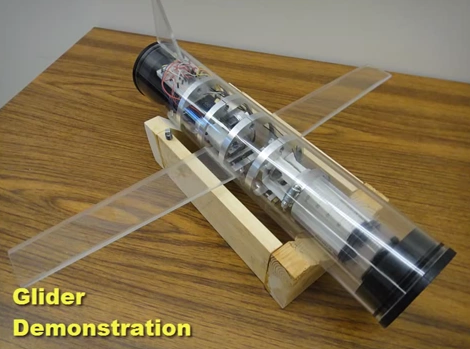
The hull protects the electronics, batteries, sensors, and mechanical systems. In shallow prototypes, PVC tubes, acrylic housings, aluminum bodies, or 3D-printed parts may be used. Ocean-capable prototypes require stronger materials, careful seals, pressure testing, corrosion protection, and a design that can survive repeated dives.
Hydrodynamic shape matters. A smooth body reduces drag and improves range. Cylindrical hulls are common because they handle pressure well and are easier to manufacture. More experimental designs may use blended bodies or wide flying-wing shapes, especially when testing long-range or payload-heavy concepts.
Power System
Because efficiency is the main advantage of a water glider, power management is critical. Batteries must support the buoyancy system, onboard computer, sensors, navigation electronics, communication hardware, and safety devices. Every extra sensor adds value but also consumes energy. Every extra gram changes trim. Every extra connector becomes one more place where water can try to become the project manager.
Designers often use low-power microcontrollers or embedded computers for prototype control. Larger research platforms may use more advanced processors, but the philosophy remains the same: spend energy only when it earns its keep.
Sensors and Payloads
A water glider prototype may carry sensors for temperature, salinity, depth, dissolved oxygen, turbidity, fluorescence, acoustics, pH, current profiles, or imaging. Scientific gliders are valuable because they collect repeated vertical profiles through the water column. Instead of measuring only the surface, they reveal what is happening below, where satellites cannot see directly.
For environmental monitoring, this can help track storm impacts, harmful algal blooms, ocean heat content, fisheries conditions, marine mammal activity, and climate-related changes. For engineering teams, sensor data also reveals whether the prototype is behaving as expected. A pressure curve, pitch record, or battery log can say more than a dramatic dockside speech ever will.
Why Water Glider Prototypes Matter
Oceans cover most of Earth, but they remain difficult and expensive to observe. Research ships are powerful but costly. Satellites are excellent for surface measurements but limited below the top layer. Moored instruments are useful but fixed in place. A water glider fills an important gap by moving through the ocean for long periods while collecting subsurface data.
Prototype development matters because ocean needs are changing fast. Scientists need better information about warming waters, shifting currents, oxygen loss, coastal ecosystems, hurricanes, fisheries, and carbon cycles. Engineers need platforms that are cheaper, tougher, quieter, and easier to deploy. A well-designed water glider prototype can become a testbed for new sensors, smarter autonomy, improved navigation, and more sustainable ocean observation.
There is also a strong educational value. Building a glider forces students and engineers to understand buoyancy, fluid dynamics, electronics, coding, waterproofing, batteries, materials, and field testing. It is a floating classroom with a habit of exposing weak assumptions. That may sound harsh, but in engineering, a failed pool test is much cheaper than a failed ocean mission.
Real-World Examples That Inspire Prototype Design
Several well-known glider families have shaped the field. Slocum gliders use buoyancy-driven motion and are widely used for coastal and open-ocean missions. Seaglider platforms are known for endurance and deep profiling. Spray gliders, developed through oceanographic research, demonstrated that compact autonomous vehicles could collect valuable observations across long distances.
Rutgers helped make glider history with the Scarlet Knight, also known as RU27, which crossed the Atlantic from New Jersey to Spain in 2009. That mission showed the public that a slow, persistent underwater robot could do something bold without needing to look like a Hollywood submarine. More recent long-distance and global mission concepts continue to push the idea that fleets of autonomous gliders could become a major part of ocean monitoring.
Experimental work has also explored larger flying-wing underwater gliders, miniature gliders, and hybrid vehicles that combine gliding efficiency with thrusters or advanced control surfaces. These designs highlight an important truth: there is no single perfect water glider. A prototype must be designed around the mission. A coastal reef monitor needs maneuverability. A climate-observing glider needs endurance. A student demonstrator needs simplicity. A defense platform may need stealth, payload capacity, and range.
Design Challenges in Building a Water Glider Prototype
Waterproofing Is Not Optional
The first rule of marine robotics is simple: water always wants in. Seals, cable penetrators, pressure housings, O-rings, adhesives, and connectors deserve serious attention. A glider can have perfect software and beautiful wings, but one poor seal can turn it into a very expensive maraca.
Buoyancy Is a Balancing Act
A prototype must be close to neutrally buoyant. Too heavy, and it sinks with enthusiasm. Too light, and it refuses to dive. The buoyancy engine must provide enough change to overcome natural variation caused by water density, temperature, salinity, and payload adjustments. Engineers often test ballast repeatedly because “almost neutral” is still not neutral when the vehicle is 200 yards offshore.
Currents Can Rewrite the Mission
Water gliders are efficient but not fast. Strong currents can push them away from intended routes. Navigation planning must account for ocean forecasts, surfacing intervals, safety boundaries, and recovery strategy. A prototype should include fail-safe behaviors such as emergency surfacing, location beaconing, mission abort logic, and low-battery protection.
Data Quality Requires Discipline
Collecting data is easy. Collecting useful data is harder. Sensors must be calibrated, time-stamped, protected from bubbles or biofouling, and matched to the mission. A prototype should log engineering data as carefully as science data. Battery voltage, pump cycles, pitch angle, internal humidity, temperature, and leak detection can help diagnose problems before they become dramatic sea stories.
Testing a Water Glider Prototype
Testing should happen in stages. The first stage is dry testing: electronics, code, pumps, servos, valves, leak sensors, battery safety, and communication. The second stage is bench buoyancy testing in a tank or pool. The third stage is controlled glide testing in calm water. Only after those steps should a prototype go into lakes, bays, or coastal environments.
A practical test plan includes pre-mission checklists, recovery equipment, chase boats if needed, waterproof labels, emergency contact information, and clear abort conditions. It also includes humility. The ocean is not impressed by your CAD model. It has been moving continents for fun.
During early tests, engineers look for repeatable dive and climb cycles, stable pitch, predictable roll, clean surfacing behavior, accurate depth readings, successful communication, and reliable recovery. Each test should answer a specific question. Does the ballast system work? Does the glider hold heading? Does it leak after repeated cycles? Does the software recover from bad sensor values? Does the team remember where they parked the recovery kayak?
Future of Water Glider Prototype Technology
The next generation of water glider prototypes will likely focus on smarter autonomy, better energy systems, smaller sensors, quieter operation, easier deployment, and fleet coordination. Instead of one glider collecting one path of data, future systems may involve many gliders working together with surface vehicles, satellites, buoys, and ocean models.
Artificial intelligence may improve route planning, anomaly detection, adaptive sampling, and fault prediction. For example, a glider could change its path when it detects a plankton bloom, low-oxygen layer, unusual temperature front, or marine mammal signal. Better onboard processing could reduce the need to transmit huge datasets, saving energy and bandwidth.
Materials will also improve. Lighter pressure housings, better coatings, modular payload bays, and compact buoyancy engines can make prototypes more capable and affordable. The dream is not just a single heroic robot crossing an ocean. The bigger vision is persistent, scalable ocean observation that helps scientists, coastal communities, weather forecasters, fisheries managers, and conservation teams understand the water before problems arrive wearing a villain cape.
Practical Experiences Related to a Water Glider Prototype
Working around a water glider prototype teaches lessons that do not always appear in clean technical diagrams. The first experience many builders remember is the shock of how small details become big problems in water. A cable that looks tidy on a workbench may create drag. A battery moved two inches forward may change the glide angle. A wing mounted slightly unevenly may cause a slow roll that ruins the mission path. On land, these issues look minor. In water, they become the robot’s entire personality.
Another common experience is learning that buoyancy testing takes patience. New builders often expect the prototype to behave correctly after one round of ballast adjustment. It rarely does. The glider may float nose-up, sink tail-first, refuse to dive, or bob at the surface like a confused pool noodle. The solution is methodical testing: add small weights, record changes, measure displacement, check trim, and repeat. It is not glamorous, but it is where the prototype becomes real.
Field testing also teaches respect for recovery planning. A prototype does not need to travel far to become difficult to retrieve. Wind, current, glare, low battery, weak radio signal, or simple human misjudgment can turn a short test into a shoreline scavenger hunt. Smart teams attach visible colors, tracking beacons, recovery lines, and fail-safe surfacing logic. The best recovery system is the one that feels excessive until the day it saves the entire project.
There is also a valuable software lesson: autonomy should be boring before it becomes clever. A prototype does not need fancy behavior on its first day. It needs reliable states: start, dive, climb, surface, communicate, sleep, and abort. Many teams discover that simple control logic, carefully tested, beats complicated autonomy that nobody fully trusts. In marine robotics, “boring and alive” is better than “advanced and missing.”
Sensor integration provides another memorable experience. Installing a temperature or pressure sensor may seem straightforward, but the data must be clean, calibrated, and synchronized. If the pressure sensor reads incorrectly, the glider may misunderstand its depth. If timestamps drift, the science data becomes harder to interpret. If the sensor opening traps air bubbles, the readings may look like the ocean is having a nervous breakdown. Good data requires careful mounting, testing, and documentation.
Perhaps the most important experience is learning that a water glider prototype is never only a vehicle. It is a system. The glider, laptop, mission software, batteries, charger, tools, spare seals, data workflow, launch method, recovery plan, and team communication all matter. A beautiful prototype can fail because nobody charged the satellite modem or packed the correct hex key. Marine engineers become checklist people for a reason.
Finally, building and testing a water glider prototype is rewarding because progress is visible. The first stable glide feels like magic. The first successful surfacing and data transmission feels even better. Watching a quiet machine move through water using tiny energy pulses and smart design makes the whole effort worthwhile. It reminds builders that innovation does not always roar. Sometimes it sinks gently, rises gracefully, and sends back a neat little packet of data like it just returned from a secret mission.
Conclusion
A Water Glider Prototype is more than an experimental marine robot. It is a practical doorway into the future of ocean exploration. By combining buoyancy control, hydrodynamic wings, low-power electronics, smart navigation, and useful sensors, water gliders can collect data where ships are expensive, satellites are limited, and fixed instruments cannot move.
The best prototypes succeed because they respect the basics: waterproofing, trim, buoyancy, data quality, power management, and recovery. They also leave room for innovation, from smarter route planning to modular payloads and fleet-based ocean monitoring. Whether built by a university lab, research institute, startup, or ambitious engineering team, a water glider prototype represents a powerful idea: slow can be smart, quiet can be capable, and the ocean still has plenty to tell us if we build the right machines to listen.