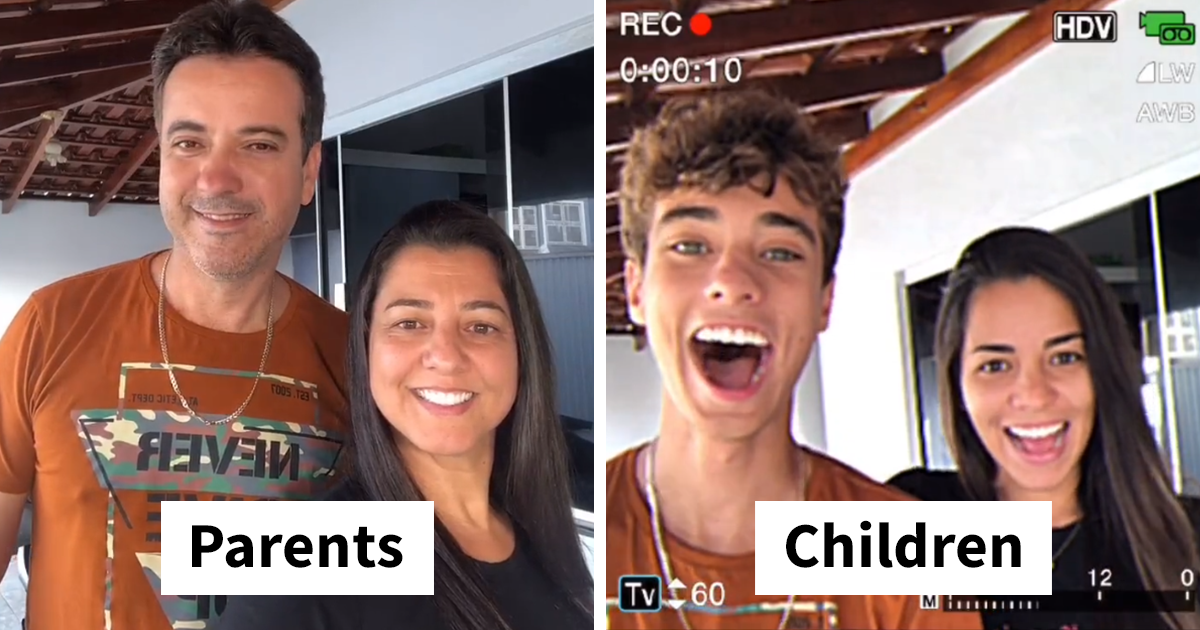
Every so often, TikTok gives the internet a trend that feels like a magic trick performed at a family reunion. The “parents and kids look alike” trend is one of those rare viral moments that makes people laugh, pause, and immediately start digging through old photo albums. The idea is simple: a parent appears on camera, often with a retro or VHS-style filter, and then the video cuts to their child dressed, posed, or styled almost exactly the same. For one deliciously confusing second, viewers wonder whether they are looking at a throwback clip, a time traveler, or the family printer set to “copy-paste.”
What makes the trend so addictive is not just the visual joke. It taps into something almost everyone understands: the strange thrill of seeing family resemblance in action. A teenager suddenly has their mother’s smile. A son stands at the same angle as his father and somehow unlocks the entire family archive. A daughter copies her grandmother’s old hairstyle and becomes the living proof that genetics has a flair for drama.
The viral TikTok trend proves how similar parents and kids look, but it also opens a bigger conversation about genetics, identity, nostalgia, and the way social media turns everyday family moments into shared entertainment. It is cute, funny, surprisingly emotional, and occasionally so accurate that someone in the comments has to ask, “Are you sure that isn’t the same person?”
What Is the Viral TikTok Parent-Child Look-Alike Trend?
The trend became widely recognized when TikTok users started using a retro-style filter to create the illusion of an old home video. In many versions, a parent appears first, then the child steps in wearing similar clothes, hair, makeup, or accessories. The result looks like a person has been digitally de-aged, but the secret is delightfully low-tech: it is usually just a family resemblance, smart styling, and a well-timed transition.
The format works because it blends nostalgia with surprise. The retro filter makes the clip feel like a rediscovered tape from the 1980s or 1990s. Then the child appears, and suddenly the viewer’s brain has to process two ideas at once: “That looks like the parent,” and “Wait, that is not the parent.” It is the TikTok version of finding an old photo in a shoebox and realizing your face has been living rent-free in your family tree for decades.
Why the Trend Feels So Watchable
Many viral trends are loud, fast, or absurd. This one is different. It is visual, personal, and instantly understandable. You do not need to speak the same language, know the creator, or understand a complicated meme format. A parent and child appear side by side, and the resemblance does the storytelling.
That makes the trend perfect for TikTok’s short-form format. Viewers can understand the punchline in seconds, rewatch to catch details, and then share it with someone in their own family. It also invites participation. Anyone with an old jacket, a similar haircut, or a parent willing to stand still for thirty seconds can join in. No professional camera crew required. Just genetics, lighting, and maybe a strong Wi-Fi connection.
Why Parents and Kids Often Look So Similar
The science behind parent-child resemblance starts with heredity. Children inherit genetic information from both biological parents, and that genetic information influences many visible traits, including hair color, eye color, skin tone, height, face shape, and other physical features. In simple terms, your face is not a random character design. It is more like a remix of family features, with a few surprise tracks thrown in.
Humans inherit one copy of each chromosome from the female parent and one from the male parent. This is why a child may have their mother’s eyes, their father’s chin, a grandparent’s dimples, and an uncle’s mysterious ability to look exactly the same in every photo. Facial resemblance is especially interesting because the face is influenced by many genes, not just one. There is no single “looks like Dad” switch or “Mom’s smile” button hidden in DNA.
Researchers have identified many genes associated with facial features, but the way those genes interact is complex. Face shape, nose structure, cheekbones, jawline, lips, and eye spacing can all be influenced by multiple genetic factors. That complexity explains why siblings can look wildly different even though they share the same parents. One child may strongly resemble Mom at age seven, Dad at age twenty, and Grandma after discovering a middle part haircut.
Genetics Is Not a Copy MachineIt Is a Remix Studio
The TikTok trend is funny because it makes resemblance look obvious. But in real life, family similarity is not always immediate. Some babies look like one parent at birth and gradually grow into the other parent’s features. Some children look more like a grandparent than either parent. Some families have one extremely dominant feature, such as a chin, eyebrow shape, or smile, that appears in every generation like a signature stamp.
This is why family resemblance can feel almost spooky. A child may never have met a great-grandparent, yet a photo comparison reveals the same eyes or posture. In these moments, people are not just seeing a face. They are seeing continuity. They are seeing proof that families carry stories in more than words. Sometimes, the story is written in cheekbones.
Why the Internet Loves “Copy-Paste” Families
One reason this TikTok trend spread so easily is that it delivers instant emotional payoff. Viewers love spotting patterns. The human brain is basically a tiny detective wearing pajamas, constantly scanning for similarities. When we see a parent and child who look alike, we get the satisfaction of recognition: same smile, same eyes, same dramatic eyebrow lift when someone says “We need to talk.”
Social media also loves transformation videos, and this trend feels like a transformation without needing special effects. The “before” is the parent. The “after” is the child. The twist is that both people are real, related, and often laughing at the same joke. That gives the content warmth. It is not just a beauty filter or a fashion transition. It is a tiny family story.
The Nostalgia Factor
The retro filter is a key ingredient. It makes modern clips look like old home movies, and that instantly adds emotional texture. Even if viewers do not know the family, the grainy look suggests memory, childhood, and the kind of footage that used to live on bulky tapes labeled “Summer 1998” in someone’s handwriting.
By pairing the retro look with a parent-child switch, creators create a playful illusion: the child looks like the parent’s younger self. For families, the result can be hilarious. For viewers, it can be oddly touching. It reminds people that time moves forward, but family resemblance has a habit of looping back around with excellent comedic timing.
How TikTok Turned Family Resemblance Into a Social Moment
TikTok thrives on trends that are easy to repeat and personalize. The parent-child look-alike trend checks both boxes. It offers a clear structure, but each family brings its own twist. Some creators use matching outfits. Others recreate old photos. Some use hairstyles, poses, glasses, or facial expressions. The best versions often include tiny details: a parent’s old jacket, the same necklace, a similar smirk, or a childhood photo recreated so accurately it deserves a museum plaque.
The trend also fits into a larger online fascination with family resemblance. People have long shared side-by-side photos of parents and children at the same age. TikTok simply made that comparison move. Instead of two static photos, the platform lets creators add timing, music, editing, facial expressions, and a reveal. It turns a family comparison into a mini-performance.
Why Comments Make the Trend Even Bigger
Comments often become part of the fun. Viewers rush to point out who looks like whom. They vote for Mom’s eyes, Dad’s nose, Grandma’s smile, or “the exact same face, just with better lighting.” The comment section can feel like a digital family gathering where everyone has an opinion and nobody can agree on whether the kid is the mother’s twin or the father’s clone.
This interactivity helps trends spread. When people feel invited to participate, they watch longer, comment more, and tag relatives. A video about one family suddenly becomes a prompt for thousands of other families: “We should try this.” That is the secret sauce of viral TikTok culture. The trend is not just something to watch. It is something to do.
Specific Examples of Parent-Child Look-Alike Moments
Some of the most memorable videos follow a simple formula: the parent appears in a familiar pose, then the child steps in with the same outfit and expression. A mother might wear a denim jacket and hoop earrings, then her daughter appears in the same look with matching hair. A father might stand in a baseball cap and flannel shirt, then his son takes over the frame and suddenly looks like a throwback photo from Dad’s high school yearbook.
Other videos recreate family photos more carefully. Creators match the background, clothing, camera angle, and facial expression. The results can be uncanny. A young adult recreating a parent’s prom photo may reveal the same smile and posture. A daughter copying her mother’s old haircut may discover that she has been carrying vintage glamour in her genes all along. A son recreating his father’s teen photo may realize that family resemblance is strongest when everyone is making the same “I definitely know how to fix this car” face.
When the Resemblance Is More Than Physical
The trend also shows that resemblance is not only about facial features. People inherit habits, gestures, and expressions through family life. A child might tilt their head like a parent, laugh the same way, or raise one eyebrow with suspicious precision. Some similarities are genetic; others come from years of watching, copying, and living together.
This is why parent-child look-alike videos can feel so accurate even when the faces are not identical. A shared gesture can complete the illusion. The way someone crosses their arms, smiles before speaking, or side-eyes the camera may be enough to make viewers say, “Yep, that is absolutely your child.”
The Psychology Behind Why We Love Family Resemblance
Family resemblance carries emotional meaning. It can make people feel connected to relatives, generations, and family history. For parents, seeing themselves in their children can be moving. For children, seeing themselves in a parent’s old photo can be funny, strange, or even comforting. It says, “You come from somewhere.” It also says, “Your awkward phase may be hereditary, but at least you are not alone.”
There is also a social bonding effect. Families often use resemblance as a language of affection. “You have your mom’s smile” or “You look just like your dad at that age” can be a way of placing someone inside a family story. The TikTok trend gives that everyday comment a visual stage.
The Debate: Do Kids Look More Like Mom or Dad?
People love debating whether children look more like their mother or father. Some relatives treat this like an Olympic event, complete with confident judging and zero scientific equipment. Research on the question has produced mixed and nuanced findings, and modern explanations generally avoid the old myth that babies always look more like their fathers. The reality is more complex. Children can resemble both parents in different ways and at different stages of life.
A newborn may have one parent’s face shape but the other parent’s coloring. A toddler’s features may change quickly. A teenager may suddenly grow into a jawline or expression that was not obvious before. By adulthood, resemblance can shift again. This is one reason the TikTok trend works so well across ages: sometimes the “copy-paste” moment does not appear until a child reaches the same age the parent was in an old photo.
How to Create a Parent-Child Look-Alike Video Safely and Creatively
For families who want to try the trend, the creative process can be simple and fun. Start by choosing a parent’s old photo or a recognizable family look. Focus on strong visual details: hairstyle, glasses, outfit, pose, and background. Matching the expression is often more important than matching every item of clothing. A shared smirk can outperform an expensive costume every time.
Lighting matters, too. A soft, even light helps viewers compare faces. A retro filter can add charm, but it should not hide the features that make the resemblance interesting. The best videos usually avoid over-editing. The whole point is to let the family similarity shine. If the resemblance is strong enough, the video does not need fireworks, lightning bolts, or a dramatic fog machine borrowed from a middle school play.
Privacy and Consent Matter
Because many parent-child resemblance videos include minors, families should think carefully before posting. A sweet video can still become part of a child’s digital footprint. Parents should ask whether the child is comfortable, whether the content could embarrass them later, and whether identifying details should be kept private. If a child is old enough to understand, asking permission is not just polite; it teaches healthy digital boundaries.
Simple privacy choices can help. Avoid sharing school names, addresses, daily routines, or personal documents in the background. Consider using private sharing options for family-only versions. Keep the tone kind. The trend should celebrate connection, not pressure a child to perform for likes.
What This Trend Says About Modern Family Storytelling
Before social media, family resemblance lived in albums, framed photos, and conversations at the dinner table. Today, those comparisons can become short videos seen by thousands or even millions of people. That shift is powerful. It turns private nostalgia into public entertainment. Sometimes that is joyful. Sometimes it deserves caution. Either way, it shows how family storytelling has changed.
The parent-child look-alike trend is basically a modern family album with music, filters, and comments from strangers who are weirdly invested in your cheekbones. It proves that people still love the old question, “Who do you look like?” TikTok just made the answer more cinematic.
Why the Trend Feels Refreshing
Not every viral family trend is positive. Some online challenges involve pranks or uncomfortable situations. This trend, when done respectfully, is different. It can be collaborative, affectionate, and low-risk. Parents and kids can laugh together, recreate a memory, and preserve a moment. It is not about humiliation or shock. It is about resemblance, creativity, and the wholesome chaos of realizing your face has family history.
Experience Section: What It Feels Like to Discover You Look Exactly Like a Parent
There is a special kind of surprise that happens when you find an old photo of a parent and realize, with mild alarm, that you are basically looking at yourself in vintage clothing. At first, it feels funny. Then it feels strange. Then someone in the family says, “I told you!” with the satisfaction of a person who has been waiting twelve years for photographic evidence.
Many people experience this moment in stages. Stage one is denial: “No way, we do not look that much alike.” Stage two is comparison: holding the photo next to your face, checking the eyes, nose, smile, and hairline like an amateur detective. Stage three is acceptance: “Fine, I am my mother’s daughter,” or “Apparently Dad just hit print.” Stage four is sharing it with the group chat, because a discovery this dramatic deserves witnesses.
Trying the TikTok trend can make the experience even more vivid. When a child dresses like a parent did at the same age, the resemblance becomes easier to see. Clothes and hairstyle act like a time machine. A pair of glasses, a jacket, or a side-part can suddenly reveal similarities that were hiding in plain sight. It is not that the child changed; the styling simply gave the family resemblance a spotlight.
Parents often have emotional reactions, too. Seeing a child recreate an old look can bring back memories of school dances, first jobs, old friends, and younger versions of themselves. A funny TikTok video can unexpectedly become a small moment of reflection. Parents may laugh at the outfit, cringe at the hairstyle, and then feel touched that their child is standing there like a living echo of the past.
For kids and teens, the experience can be surprisingly grounding. It can make family history feel less abstract. Instead of hearing “You look like your dad,” they can see it. Instead of imagining what their mother looked like at seventeen, they can recreate the photo and notice the same smile. These comparisons can create conversations about childhood, culture, fashion, and family stories that might otherwise stay tucked away in albums.
The best part is that the trend does not require perfection. In fact, the funniest videos often include imperfect details: the wig is a little off, the jacket is too big, the parent cannot stop laughing, or the child refuses to recreate the exact serious face from the old photo. Those imperfections make the video feel real. They remind viewers that family resemblance is not a polished brand campaign. It is messy, warm, silly, and human.
One practical experience from this trend is that small details matter more than expensive production. Matching posture can be more powerful than matching clothes. A familiar expression can be more convincing than a perfect background. Even the way someone squints at the camera can unlock a resemblance that makes relatives gasp. If you want a stronger result, study the old photo carefully. Notice where the shoulders are, how the head is tilted, whether the smile is wide or shy, and what the hands are doing. The family face is important, but the family pose might be the secret ingredient.
Another experience is that these videos can become keepsakes. Even if the clip never goes viral, it captures a playful connection between generations. Years later, the same family may watch it and laugh again. That is the real value. Views disappear, trends move on, and TikTok’s algorithm finds a new obsession by lunchtime. But a well-made family resemblance video can become part of the family archive, right next to the old photo that inspired it.
Still, the sweetest lesson is this: looking like a parent does not mean becoming the same person. A child may inherit a smile, face shape, or laugh, but they also build their own identity. The trend celebrates similarity, not sameness. It says, “Look at this connection,” while leaving room for individuality. In a world obsessed with filters and reinvention, that feels refreshingly honest. Sometimes the most interesting thing about a face is not how flawless it looks, but how many stories it carries.
Conclusion
The viral TikTok trend proves how similar parents and kids look because it transforms family resemblance into something visible, funny, and emotionally satisfying. With a retro filter, a clever transition, and a little styling, creators can make viewers feel like they are watching time fold in half. But beneath the humor is a real reminder: family traits travel across generations in fascinating ways.
Genetics helps explain why children may inherit familiar eyes, smiles, hair, or facial structure. Family life explains why gestures, expressions, and habits can look just as inherited as cheekbones. TikTok simply gives these similarities a stage. When done with consent, care, and creativity, the trend is more than a viral moment. It is a modern family keepsake, a mini science lesson, and a very funny reminder that sometimes the strongest filter is DNA.