Sometimes a photograph does not merely show an old object. It presses a hidden button in your brain and suddenly you can hear a dial-up modem, smell a warm cassette player, and remember exactly how painful it was to step on a plastic toy in the dark.
That is the appeal of I Love Nostalgia, a social media page devoted to ordinary treasures from the 1960s through the early 2000s. Its posts feature familiar toys, household objects, entertainment technology, school equipment, cars, clothing, and cultural references. None of these items looks especially powerful on its own. Together, however, they form a surprisingly effective time machine.
When the page was featured in 2024, creator Ian Wright explained that it had grown from an interest in the 1980s into a broader celebration of several decades. The goal was simple: create a positive community where people could remember, laugh, and compare experiences without turning every discussion into an online wrestling match.
Why Sentimental Nostalgia Feels So Powerful
Nostalgia is usually described as a bittersweet emotional response to the past. The “sweet” part comes from remembering people, places, routines, and experiences that mattered. The “bitter” part is the knowledge that the moment cannot be recreated exactly. You may still find the same toy on an auction site, but it will not come with your childhood living room, your best friend, or a summer afternoon that seemed to last nine years.
Everyday objects become memory shortcuts
Researchers have found that familiar sounds, smells, photographs, songs, and keepsakes can trigger autobiographical memories. This helps explain why an image of a VHS box may create a stronger emotional reaction than a photograph of a major historical event. The VHS tape belonged to your life. It may remind you of family movie nights, recorded cartoons, handwritten labels, and the terrible realization that someone had taped a cooking program over your favorite film.
Our youth supplies especially vivid memories
Many people remember adolescence and early adulthood with unusual clarity, a pattern psychologists often call the reminiscence bump. Those years contain countless firsts: first concerts, first jobs, first independent purchases, first friendships that felt permanent, and first encounters with technologies that later became ordinary. That is why a calculator watch or cassette deck can carry more emotional weight than its practical value would suggest.
Nostalgia is also a social experience
A successful nostalgia post rarely ends with the picture. The comments quickly become a community archive. One person remembers the object’s official purpose. Another remembers using it completely incorrectly. A third announces that their grandmother still owns one and would defend it with the intensity of a museum security guard.
That participation matters. Psychological research associates nostalgic reflection with greater feelings of connection, continuity, meaning, and positive emotion. It does not prove that everything was better in the past. It shows that remembering shared experiences can make the present feel less lonely.
30 of the Page’s Best Sentimental Nostalgia Posts
The following posts succeed because they do more than display retro objects. They revive the sounds, frustrations, rituals, and tiny victories surrounding them.
-
1. The Playground Merry-Go-Round of Total Carnage
A bare-metal playground spinner reminds viewers of an era when recreational equipment appeared to have been designed by people conducting informal gravity experiments. Children held on, older kids pushed faster, and adult supervision often consisted of someone shouting, “Be careful!” from another ZIP code.
-
2. Recording Music From the Radio
A cassette recorder captures the delicate art of making a homemade playlist. Success required perfect timing, patience, and the ability to accept a radio host talking over the first eight seconds of every song. Streaming offers convenience; cassette recording offered a minor technical apprenticeship.
-
3. The Familiar VHS Tape Designs
Scotch, Polaroid, and TDK video cassettes recall shelves filled with handwritten titles, mysterious recordings, and family members who never rewound anything. Choosing between standard play and extended play felt like a serious engineering decision, especially when a long movie had to fit on one tape.
-
4. The Black Film Canister
A simple plastic film container once protected precious rolls of photographs. After development, the empty canister became storage for coins, screws, buttons, fishing hooks, and objects nobody could identify. It was the original multipurpose container, long before every household owned seventeen reusable food tubs without matching lids.
-
5. Covering Schoolbooks With Grocery Bags
Brown paper grocery bags became homemade textbook covers through a combination of folding, trimming, and cautious optimism. Students then decorated them with band names, doodles, phone numbers, and elaborate declarations of eternal friendship that occasionally lasted until third-period lunch.
-
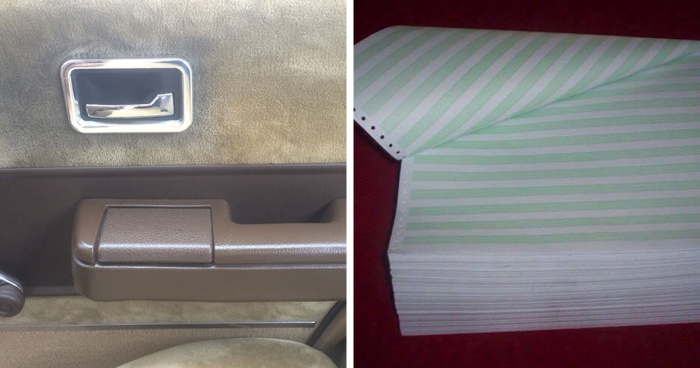
6. Continuous-Feed Printer Paper
Green-striped computer paper with perforated edges recalls noisy dot-matrix printers and the satisfaction of tearing away the side strips. Separating the pages cleanly required concentration. One careless pull could transform a school report into a paper accordion with strong modern-art energy.
-
7. The View-Master
The red View-Master and its circular picture reels offered miniature 3D adventures before virtual reality required headsets, controllers, updates, and a small financial meeting. Clicking through each frame made cartoons, landmarks, and distant places feel almost magical.
-
8. A Sweet “School of Rock” Then-and-Now Post
A post comparing two young performers from School of Rock with a later photo delighted viewers who remembered the movie’s classroom scenes. Then-and-now images are powerful because they show time passing without erasing the connection between who people were and who they became.
-
9. The Towering Hi-Fi Stereo System
A component stereo behind glass doors represents the peak of living-room audio ambition. It had knobs, equalizers, cassette decks, a CD player, and enough illuminated indicators to suggest that the household was quietly controlling air traffic.
-
10. The Mysterious Compartment in an Old Handle
One post asks viewers to identify a tiny compartment hidden inside a familiar handle. The object matters less than the recognition game. Nostalgia pages thrive on these visual quizzes because remembering the answer feels like passing a secret generational entrance exam.
-
11. The Blue-Floral Casserole Dish
The classic white casserole dish with blue flowers instantly evokes family kitchens, holiday meals, church gatherings, and recipes measured with phrases such as “a little of this.” Its durability also explains why many examples remain in service decades later, quietly outliving trendier cookware.
-
12. The Water Ring-Toss Game
This handheld water toy required players to press buttons that propelled tiny plastic rings toward narrow pegs. It contained no Wi-Fi, no batteries, and no downloadable content. It still managed to consume entire car rides through the ancient motivational technique known as “almost getting it.”
-
13. Minesweeper on the Family Computer
The gray grid of Minesweeper brings back memories of pretending to understand what the numbers meant. Many players clicked randomly, discovered a mine, frowned thoughtfully, and began again as though conducting serious research.
-
14. The Compact Aiwa Stereo
A stacked Aiwa system with a CD changer, radio, equalizer, and dual cassette deck represents the 1990s dream machine. The display used every possible symbol, while the bass-boost button made users feel they had personally improved the recording industry.
-
15. The Building That Looks Like a Science-Fiction Walker
A strangely shaped structure becomes a visual test for science-fiction fans. This kind of post demonstrates how nostalgia changes perception: an ordinary building can resemble a machine from a beloved movie because pop culture has permanently joined the brain’s pattern-recognition department.
-
16. The Annual Christmas-Movie Debate
A familiar action film reappears in the argument over whether it qualifies as a Christmas movie. The debate is now almost as traditional as decorating a tree, losing a roll of tape, and discovering that someone ate the cookies reserved for guests.
-
17. The Pen With a Digital Clock
A pen containing a tiny digital clock captures the wonderfully unnecessary creativity of 1980s gadgets. It was top-heavy, awkward to write with, and undeniably impressive. Practicality was optional; possessing a secret electronic feature was the entire point.
-
18. Learning to Type on Manual Typewriters
A classroom filled with typewriters recalls physical keys, ink ribbons, correction fluid, and the bell announcing the end of a line. Mistakes could not be removed with one cheerful tap of the backspace key. Every error became a negotiation.
-
19. Pixelated Cellphone Messages
Monochrome screens, tiny icons, missed-call alerts, and basic picture messages represent a time when phones performed fewer tasks but inspired considerable excitement. Creating a recognizable image from a few black pixels felt like digital artistry.
-
20. Sliding Climate Controls in Old Cars
An old dashboard with mechanical sliders recalls vehicles in which adjusting the temperature felt satisfyingly physical. Drivers moved a lever from cool to warm and hoped the car understood. There were no touchscreens, submenus, or software agreements involved.
-
21. Wooden Exercise Sandals
Wooden-soled sandals revive memories of footwear that was fashionable, noisy, and capable of announcing its wearer from three rooms away. They promised exercise benefits while providing a daily reminder that wood and toes have unresolved differences.
-
22. An Unsettling Old Horror-Movie Face
A famously eerie figure from an older horror film proves that practical makeup, patient camera work, and one disturbing smile can remain frightening for generations. Modern effects may be sharper, but some vintage nightmares never required a software update.
-
23. Reconsidering the “Home Alone” Family Budget
Adults revisiting Home Alone often stop worrying about the traps and start calculating the family’s housing and travel expenses. Childhood viewers saw adventure. Grown viewers see property taxes, international airfare, heating bills, and a father whose occupation deserves a documentary.
-
24. The Mystery Switch in an Old Car
A small control near a manual gearshift challenges viewers to explain its purpose. The comments become a mechanical-history seminar as former drivers, repair enthusiasts, and confident guessers debate the answer.
-
25. Raising Tadpoles in a Jar
A jar filled with tadpoles recalls childhood science experiments conducted with enthusiasm and questionable planning. The discovery stage was thrilling. The later realization that growing animals required proper care, space, and parental approval was more complicated.
-
26. Calculator and Data-Bank Watches
Digital watches loaded with tiny buttons promised the future on your wrist. Calculator models were especially desirable, even though entering a basic equation required the precision of a watchmaker and the fingertip of a newborn.
-
27. The Television With Only a Few Channels
A bulky CRT television prompts people to remember when families chose among three, five, or perhaps twelve channels. Reception depended on antennas, weather, furniture placement, and one relative standing in exactly the right spot.
-
28. A Timeline of Early Mobile Phones
An image tracing phones from enormous handheld bricks to smaller Nokias and early color-screen models shows how quickly technology changed. Each device once looked impossibly advanced. Today, several appear capable of surviving a fall from orbit.
-
29. The Early School Computer Lab
A row of beige computers with CRT monitors recalls shared machines, simple educational programs, floppy disks, and lessons that began with instructions for turning the computer on. Access was limited, so computer time felt like an event rather than a background condition of existence.
-
30. The Sandwich Toaster With Lava Filling
The triangular sandwich press created crisp bread and fillings heated to temperatures normally associated with industrial metalwork. Everyone knew to wait before taking a bite. Almost nobody waited.
Why These Posts Work Better Than Perfect Historical Photographs
The page’s strongest posts focus on objects that were once too ordinary to photograph. Families documented birthdays and vacations, but few people deliberately photographed their printer paper, dashboard heater controls, blank videotapes, or casserole dishes. Those objects quietly disappeared as technology and taste changed.
Seeing them again creates surprise because they have been absent without being consciously missed. A person may not have thought about a View-Master for 25 years. One image can suddenly restore the clicking sound, the feel of the lever, the circular reels, and the disappointment of discovering that a favorite reel was bent.
The posts also welcome several generations. Older viewers supply firsthand memories. Younger viewers encounter technologies they know only from films, family stories, thrift stores, or retro-inspired products. The resulting conversation is not simply “the past was better.” It is a comparison of habits, inconveniences, creativity, and expectations.
There is also an important distinction between reflective nostalgia and blind idealization. Old cars had wonderfully direct controls, but they lacked many modern safety features. A small number of television channels encouraged shared viewing, but choices were limited. Film cameras encouraged careful photography, yet failed pictures remained invisible until development. The pleasure lies in remembering the complete experience, not pretending every obsolete inconvenience deserves a triumphant return.
Experiences That Make Sentimental Nostalgia So Relatable
Scrolling through a nostalgia collection often begins casually. You recognize a cassette, laugh at a playground photo, and continue. Then one specific object appears and the experience changes. Perhaps it is the exact casserole dish your grandmother carried to every family gathering. The picture is not of her dish, yet your mind supplies the kitchen, the tablecloth, the voices in the next room, and the warning not to touch the lid because it was hot.
Music technology produces particularly vivid reactions. Creating a cassette mix was not simply choosing songs. You had to locate each track, monitor recording levels, avoid cutting off the opening note, and estimate whether the final song would fit. The finished tape carried evidence of effort. Its handwritten label, uneven volume, and accidental fragments of radio conversation became part of the listening experience. A playlist can contain the same music, but it does not contain the same fingerprints.
School technology creates another kind of memory. Early computer labs often had limited machines, so students worked in pairs or waited for a turn. Programs were slow, graphics were blocky, and saving work required physical media. Nevertheless, the experience felt futuristic. A glowing cursor on a dark screen suggested access to something enormous, even when the assignment was merely typing three sentences about a pet.
Old television habits also shaped social life. Viewers could not instantly summon any episode. They checked schedules, hurried home, negotiated with relatives, and waited through commercials. Missing an episode meant depending on a friend’s description or hoping for a rerun. The inconvenience created anticipation, and anticipation made ordinary broadcasts feel like appointments.
Family photographs reveal the more tender side of nostalgia. Printed photos were finite objects passed from hand to hand. Their imperfections mattered: red eyes, crooked framing, faded colors, and the mysterious thumb covering part of the lens. Because each image was physical, it often accumulated notes, fingerprints, creases, and stories. Proper labeling and preservation are important because a photograph without names, dates, or context can eventually become an attractive picture of strangers.
Retro toys remind us that imagination often supplied what technology could not. A View-Master offered still images rather than an immersive digital world, but a child could spend an afternoon inventing stories around them. The water ring-toss game repeated one simple action, yet its difficulty turned a few plastic rings into a personal rivalry. Simple did not necessarily mean boring; it often meant the player had to contribute more of the entertainment.
The funniest nostalgic experiences involve objects that were objectively inconvenient. Dot-matrix printers screamed. Typewriters punished mistakes. VHS tapes tangled. Wooden sandals attacked ankles. Sandwich toasters concealed molten cheese behind innocent-looking bread. Remembering these flaws keeps nostalgia warm rather than preachy. We are not demanding that society abandon modern technology and return to printer paper with detachable edges. We are laughing because inconvenience was once normal, and we adapted.
Perhaps the deepest experience is recognizing continuity. The child who stared into a View-Master, waited beside a radio with a blank cassette, or played Minesweeper without understanding it has not completely disappeared. Nostalgic objects provide evidence that our earlier selves existed. They connect past preferences, relationships, and ambitions with the person reading the post today.
That is why the best nostalgia pages feel less like museums and more like reunions. The objects are conversation starters, but people supply the meaning. One photograph becomes hundreds of recollections, corrections, jokes, and family stories. The original item may be obsolete. The human need to share what it meant remains fully operational.