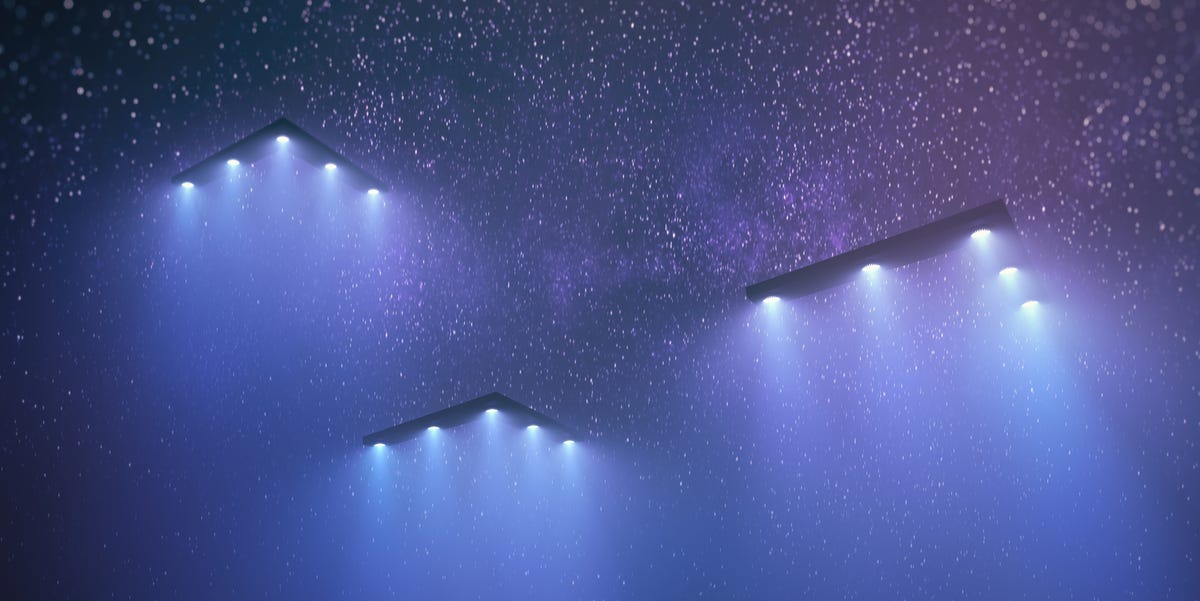
Forget the spinning chrome saucer, the blinking dashboard, and the suspiciously human-sized doorway. If an extraterret it would be designed less like a Hollywood prop and more like an exceptionally stubborn piece of engineering: compact, autonomous, energy-efficient, difficult to damage, and possibly very hard to notice.
The uncomfortable twist is that an alien probe might not look alien at all. It could resemble an asteroid, a dormant satellite, a reflective sheet, a cluster of tiny machines, or an object so dark that astronomers detect it only when it briefly blocks a star. Its artificial nature would probably be revealed by what it doesnot by whether it has dramatic fins.
Editorial note: This article draws on published scientific studies and public explanations from NASA, the SETI Institute, Breakthrough Listen, spacecraft engineers, astronomers, and technosignature researchers. It does not invent direct interview quotations.
Research basis:
The First Surprise: An Alien Probe Might Be Boring
When engineers build spacecraft, beauty loses arguments to mass, power, temperature, reliability, and cost. Every extra kilogram makes a mission harder. Every moving component creates another possible failure. Every watt of power must come from somewhere and eventually escape as heat.
The same laws of physics would apply to technology built around another star. An alien probe may use materials, computing systems, and propulsion methods beyond our current abilities, but it cannot negotiate with momentum, radiation, gravity, or thermodynamics. Even futuristic machines must pay the universe’s utility bills.
Function Would Determine Form
A fast flyby probe might be narrow, heavily shielded, and built to survive collisions with interstellar dust. A long-term observer could carry a large antenna or optical system. A solar-powered craft might unfold broad collecting surfaces near the Sun, while a machine operating in the outer solar system would need another source of energy.
That means scientists would not expect one universal alien-probe shape. They would expect a family of designs optimized for different assignments: reconnaissance, communication, sampling, monitoring, construction, or waiting quietly until the locals invent radio.
Six Forms a Real Alien Probe Could Take
1. A Small, Heavily Shielded Scout
The most plausible interstellar probe may be smaller than science fiction suggests. Large craft require more material and more energy to accelerate. A compact probe could carry cameras, spectrometers, navigation sensors, a computer, and a directional transmitter without needing a bridge, cafeteria, or dramatic captain’s chair.
Its forward side might include thick shielding to absorb impacts from dust grains encountered at high speed. Even a tiny particle can release enormous energy during a relativistic collision. The machine’s sensitive instruments could remain folded or protected until it slowed down or reached its observation zone.
2. A Sail That Looks Like a Shimmering Sheet
A light sail is another serious possibility. Solar sails use the pressure of photons rather than carrying large supplies of propellant. Human engineers have already demonstrated versions of this technology, and researchers have proposed laser-driven sails for much faster interstellar missions.
Such a probe could appear as a thin, reflective structure with an attached instrument package. Depending on its orientation, it might brighten sharply and then disappear, much as an orbiting satellite produces a brief glint. A damaged or folded sail could look even strangermore like metallic wrapping caught in a cosmic breeze than a conventional spacecraft.
Research basis: Asteroid Impersonator
Camouflage does not require advanced cloaking technology. A probe could hide near, inside, or on the surface of a natural object. Asteroids offer shielding, raw materials, stable platforms, and excellent opportunities to blend into a population containing millions of irregular rocks.
A machine embedded in an asteroid might expose only an antenna, sensor, radiator, or collection panel when needed. It could spend most of its life inactive, waking periodically to observe Earth, receive instructions, or transmit stored information. To a telescope, it might look like one more dim point moving against the stars.
4. A Swarm Instead of One Spacecraft
Sending one giant probe creates one giant opportunity for failure. A civilization capable of interstellar missions might prefer hundreds or millions of smaller units. Some could map planets, others could relay messages, and still others could examine moons, atmospheres, magnetic fields, or artificial radio emissions.
A distributed swarm would be resilient. Losing several members would not end the mission. The units could also combine observations, creating an enormous virtual telescope without requiring a single enormous structure.
From Earth, such a swarm might appear as a sequence of faint objects with related trajectories or synchronized radio activity. Unfortunately, “tiny coordinated dots” is not the easiest thing to notice in a solar system already full of dust, debris, satellites, and rocks behaving badly.
5. A Dormant “Lurker” in a Stable Neighborhood
Some technosignature researchers have proposed searching for dormant probessometimes called lurkersnear locations that provide useful views of Earth and require relatively little energy for station-keeping.
Possible hiding places include Earth co-orbital asteroids, certain Lagrange-point regions, the lunar surface, and other small bodies near our planet. A probe positioned there could monitor Earth for centuries while avoiding the difficulties of hovering close to the planet.
The Moon is especially interesting because its surface changes slowly. An artificial object, excavation site, unusual material deposit, or geometric arrangement could survive for an extremely long time. Researchers have therefore suggested examining high-resolution lunar imagery for anomalies, ideally using automated image-analysis tools.
Research basis: elf-Replicating Factory
The most ambitious concept is a probe capable of using local resources to manufacture components, repair itself, or construct additional probes. Such machines are often associated with mathematician John von Neumann, although proposed designs range from complete self-replication to much more limited robotic industry.
A manufacturing probe might seek metal-rich asteroids, water-bearing bodies, or the Moon. Rather than looking like one spacecraft, it could resemble a mining operation: excavated material, refined deposits, machinery, waste products, power systems, and transport vehicles.
This remains highly speculative. Building a machine that can reproduce every essential componentincluding advanced electronicsis vastly more difficult than building a robot that merely digs and assembles simple structures. Still, even partial replication could allow an extraterrestrial mission to grow after arrival instead of hauling an entire industrial base across interstellar space.
What Would Power an Alien Probe?
Near a star, solar energy is an obvious choice. Farther away, sunlight becomes weak, making large collectors necessary. A long-lived probe in the outer solar system might instead use nuclear decay, a compact reactor, stored energy, or a technology we have not developed.
Human deep-space missions provide useful comparisons. Radioisotope power systems convert heat from radioactive decay into electricity and can operate where solar panels are impractical. Ion propulsion, meanwhile, produces low but continuous thrust while using propellant efficiently. An alien civilization could employ more advanced versions of these familiar principles without needing to break known physics.
Power creates one of the most important detection opportunities: waste heat. Any operating computer, transmitter, motor, reactor, or instrument must dispose of heat. A probe may be radio-silent and optically dark, but a sufficiently warm object could produce unusual infrared radiation.
Research basis:
The Probe Would Probably Be Highly Autonomous
Interstellar distances make real-time remote control impossible. A command sent to a probe several light-years away would take years to arrive, and its response would take years to return. The machine would need to navigate, diagnose failures, select targets, manage power, and make scientific decisions without constantly phoning home.
Human spacecraft are already moving in this direction. Autonomous optical navigation allows a vehicle to estimate its position by observing stars, planets, asteroids, or other known objects. Onboard fault-protection systems can detect problems, switch to backups, enter safe mode, and wait for further instructions.
A true interstellar probe would need far more capable autonomy. It might arrive long after its creators had changed, disappeared, or forgotten the mission. Its software would need to remain functional across centuries, repair corrupted data, adapt to unexpected conditions, and avoid mistaking every shiny ocean for a parking lot.
Research basis:
How Scientists Would Recognize Artificial Technology
An unusual shape would not be enough. Nature is an enthusiastic producer of bizarre objects. Comets split, asteroids tumble, dust creates unexpected brightness changes, and poorly understood outgassing can alter trajectories. Scientists would therefore search for multiple independent clues.
Motion That Natural Forces Cannot Explain
A probe might accelerate, brake, change direction, maintain a precise position, or enter an orbit without showing the gas or dust expected from a comet. However, unexplained acceleration would begin an investigation, not finish one. Researchers would first test gravity, radiation pressure, outgassing, measurement errors, collisions, and other natural explanations.
Coherent Radio or Laser Emissions
Narrowband radio signals are attractive technosignatures because natural sources rarely concentrate energy into extremely small frequency ranges. Pulsed lasers, structured transmissions, repeated mathematical patterns, or signals that track an object’s motion would also attract immediate attention.
The most persuasive signal would contain information or respond to observation. A mysterious tone is interesting. A mysterious tone that changes after receiving a carefully designed transmission is the astronomical equivalent of something answering the door.
Unusual Heat or Reflective Properties
An object could reflect light in a way inconsistent with ordinary rock or ice. Spectroscopy might reveal processed metals, manufactured composites, or other materials that are difficult to produce naturally. Infrared observations could identify concentrated heat inconsistent with the object’s size, distance from the Sun, and surface properties.
Coordinated or Purposeful Behavior
One anomaly may have a natural explanation. A network of objects performing synchronized maneuvers would be more difficult to dismiss. Investigators would look for repeated timing, stable formations, communication between objects, deliberate approaches to scientifically interesting locations, or activity linked to events on Earth.
What About ‘Oumuamua and Other Interstellar Visitors?
The 2017 discovery of 1I/‘Oumuamua intensified public interest in possible alien probes. The object followed an interstellar trajectory, displayed unusual brightness variations, and showed a small nongravitational acceleration without a visually obvious cometary tail. Those characteristics generated scientific debate and a great deal of enthusiastic headline manufacturing.
Researchers considered many natural explanations, including outgassing involving difficult-to-detect material, unusual shapes, surface effects, and the behavior of unfamiliar interstellar objects. Breakthrough Listen also searched for artificial radio emissions and reported no detection.
The second confirmed interstellar object, 2I/Borisov, behaved much more clearly like a comet. The third, 3I/ATLAS, was also examined for radio technosignatures, with observations finding no evidence of artificial transmissions. These searches were still valuable: a nondetection helps scientists establish what kinds of transmitters were not present or active during the observations.
The lesson is not that interstellar objects are alien spacecraft. It is that every newly discovered visitor provides a rare opportunity to test instruments, improve follow-up procedures, and learn how naturally occurring bodies from other planetary systems behave.
Research basis:
Why an Alien Probe Could Be Surprisingly Hard to Find
Our solar system is enormous, and our surveillance of it is incomplete. Astronomers have discovered vast numbers of small bodies, yet many regions remain poorly cataloged. A probe only a few meters across could escape detection unless it passed nearby, reflected sunlight at the right angle, transmitted a signal, or produced noticeable heat.
A machine designed for longevity might also remain dormant most of the time. Sleeping reduces energy use, heat output, mechanical wear, and visibility. It could activate for only minutes per yearor once per century.
There is also the problem of our assumptions. Searches often target signals and technologies that humans understand: radio, lasers, solar collectors, propulsion exhaust, and familiar industrial materials. That is scientifically sensible because known physics gives researchers testable predictions. It also means a genuinely unfamiliar technology could sit outside our search filters like an important email trapped in the universe’s spam folder.
Recent reviews of solar-system technosignatures conclude that current limits remain crude. Depending on its size, location, brightness, and activity, even a relatively large artifact might not yet have been noticed.
Research basis:
Where Researchers Think We Should Look
A practical search would combine several strategies rather than betting the observatory on one favorite hiding place.
- Interstellar objects: Quickly examine new arrivals with optical, infrared, radar, and radio instruments.
- Earth co-orbitals: Study small bodies sharing Earth’s orbital neighborhood for unusual structures, spectra, or emissions.
- Lagrange-point regions: Survey gravitationally useful locations where long-term observation may require relatively little station-keeping.
- The Moon: Reanalyze high-resolution imagery for geometric objects, unusual excavations, reflective materials, or changes between observations.
- Asteroids and comets: Search for anomalous motion, thermal behavior, material composition, or repeating signals.
- Earth orbit: Compare tracking catalogs and investigate objects whose origins or behavior remain uncertain.
The most cost-effective approach may be “commensal” searching: using data already collected for planetary science, asteroid defense, satellite tracking, and astronomy. Software can flag unusual objects for human review without requiring every telescope to become a full-time alien-probe detector.
A Genuine Discovery Would Begin With Skepticism
A credible alien-probe announcement would not begin with a blurry video and a dramatic soundtrack. It would begin with repeated measurements.
Researchers would confirm that the object exists, determine its trajectory, compare observations from independent facilities, and rule out satellites, aircraft, sensor artifacts, software errors, reflections, natural bodies, and deliberate human interference. Radio astronomers would check whether a signal came from local electronics or an orbiting satellite. Optical astronomers would test whether an apparent maneuver resulted from changing brightness or an incorrect orbital model.
Only after ordinary explanations failed would the artificial hypothesis become competitive. Even then, responsible researchers would describe evidence and probabilities rather than declaring that Galactic Customer Support had finally returned our call.
The strongest case would combine several clues: controlled motion, engineered materials, waste heat, coherent communication, and behavior that could be independently observed. Extraordinary evidence does not mean one spectacular measurement. It means many measurements that survive increasingly aggressive attempts to prove them wrong.
Conclusion: Look for Engineering, Not Movie Magic
If an alien probe exists in our solar system, it probably does not look like a classic flying saucer. It may be a compact scout, a reflective sail, a dormant observer, a swarm of miniature machines, an asteroid-based instrument, or an automated industrial system.
Its most revealing features would be practical ones: how it obtains energy, controls its motion, sheds heat, communicates, reacts to its environment, and survives for long periods without maintenance. Scientists are therefore searching not for something that merely looks strange, but for evidence of purpose.
That distinction matters. The universe contains no shortage of odd rocks. Finding a machine requires demonstrating that an object is doing something rocks cannot.
Extended Experience: What the Search for an Alien Probe Would Really Feel Like
Imagine joining an observing team after an automated sky survey flags an object moving through the outer solar system. The first alert is not labeled ALIEN PROBE. It arrives as a row of coordinates, brightness measurements, timing data, and uncertainty estimates. The object is dim, fast, and irritatingly close to the detection limit.
The initial mood is curiosity mixed with suspicionnot suspicion of extraterrestrials, but of the data. A hot detector pixel can impersonate a star. Reflected sunlight from a satellite can create a convincing flash. A software pipeline can link unrelated points into a fictional orbit. Before anyone debates interstellar engineering, the team checks calibration files and weather records.
A second telescope finds the object. That changes the atmosphere. It is real.
Over the next several nights, astronomers measure its path. Early calculations suggest a slight acceleration that gravity alone does not explain. Someone mentions outgassing. Someone else asks whether radiation pressure could account for it. A third person quietly checks the spacecraft catalogs, because discovering an unlisted rocket stage would be embarrassing but useful.
Radio observatories are asked to listen while optical telescopes measure brightness and color. Millions of apparent radio detections pour into the analysis system. Nearly all are interference from satellites, aircraft, electronics, or terrestrial transmitters. Filtering them is less like hearing a cosmic greeting and more like cleaning a stadium after a championship game.
One narrowband signal appears to move with the object. Excitement rises for approximately eleven minutes. Then another observatory identifies a human satellite crossing the telescope’s beam. The signal is rejected. Coffee quality declines.
Infrared observations reveal no unexpected heat. Spectroscopy suggests a carbon-rich surface, although the uncertainty remains large. The unexplained acceleration becomes smaller after researchers improve the object’s shape and rotation model. A natural explanation begins to look more likely.
None of this feels like failure. The team has characterized a rare object, improved detection software, tested international coordination, and established stronger limits on possible artificial emissions. Every false alarm teaches researchers how a real discovery would differ from ordinary noise.
Now imagine the outcome changes. The object makes a second course correctionone that cannot be explained by sunlight, outgassing, or a collision. Independent telescopes confirm it. A radio signal appears only when the object points toward Earth, and its frequency shifts exactly as predicted from the object’s motion. The signal repeats in a structured sequence.
Even then, the scientists do not rush to a podium. They invite competing teams to attack the analysis. They release data, test instruments, search for hidden contamination, and ask whether any human organization could have launched the object. Skepticism becomes more intense because the implications are enormous.
The experience would probably involve less screaming than a science-fiction movie and far more spreadsheets. Yet beneath the caution would be a realization unlike any other: humanity may be examining a device built under another sun. Not a rumor, a light in the sky, or an ambiguous storybut a measurable piece of engineering sharing our solar system.
That is why scientists keep refining the search. The odds may be uncertain, the targets faint, and the false positives plentiful. But the first confirmed alien probe would transform astronomy, biology, engineering, philosophy, and human history in a single observation. It would also prove that somewhere, somebody else had the same basic idea we did: build a robot, point it toward the darkness, and see what is out there.