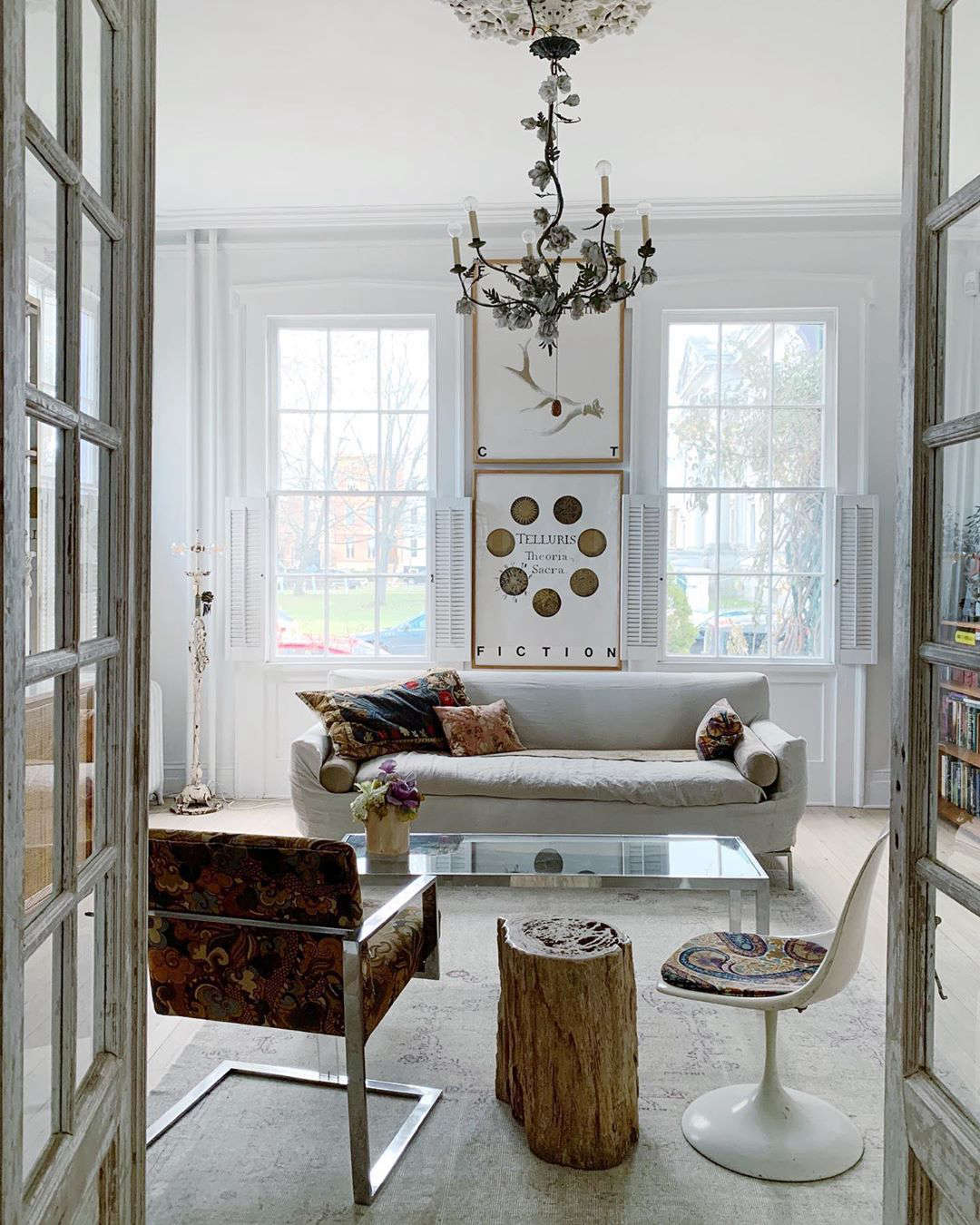
Some houses whisper. Some houses creak. And then there is The Lavender Ghost, a Victorian-era Hudson Valley home that seems to float between past and present like it has a standing invitation to every art opening, garden party, and slightly mysterious moonlit dinner within a hundred-mile radius.
Owned and lovingly reimagined by designer and creative director Amy Ilias and painter Jim Denney, The Lavender Ghost is not a stiff showpiece or a “do not touch the antique chair” museum. It is a living, breathing home filled with art, vintage treasures, textiles, cats, white walls, lavender light, handmade details, and the kind of personality that cannot be ordered with two-day shipping.
Set in New York’s scenic Hudson Valley, the house has become a design-world favorite because it does something surprisingly rare: it honors old architecture without treating the past like a glass cabinet. The result is a home with original details, modern comfort, bohemian energy, and a lavender exterior that practically deserves its own fan club.
What Is The Lavender Ghost?
The Lavender Ghost is the name Amy Ilias and Jim Denney gave to their old Hudson Valley home, a Victorian-era Italianate residence with distinctive lavender-gray paint. The name comes from the way the house seems to nearly disappear into the sky on gray days. Romantic? Absolutely. A little spooky? Delightfully so. Better than naming it “The Mortgage Monster”? Without question.
The home was purchased in 2017, after the couple had already experienced the joys and bruises of maintaining a historic Brooklyn brownstone. Jim, understandably, was not eager to take on another demanding old-house renovation. His reported wish was simple: not another old Victorian with plaster moldings. Naturally, fate heard this, put on its mischievous little hat, and led them straight to an old Victorian with plaster moldings.
What changed everything was the feeling of the house. The rooms had generous light, original details, wavy glass, plasterwork, and a top-floor studio that made sense for an artist’s life. The couple saw not just a project, but a place where their creative identities could expand. Soon, the house was no longer just a weekend escape. It became home.
A Hudson Valley Victorian with an Artistic Past
The Hudson Valley has long attracted artists, writers, designers, preservationists, gardeners, and New Yorkers who suddenly realize that sirens are not technically birdsong. The region is known for historic homes, river views, old towns, creative communities, and a slower rhythm that still allows for deep ambition. In that context, The Lavender Ghost feels completely at home.
The house also carries an artistic connection from its previous owners, painter Brice Marden and Helen Marden, who were responsible for the lavender exterior. That color choice became one of the home’s defining features. Instead of repainting the exterior in a safer neutral, Amy and Jim kept it, understanding that the unusual shade was part of the home’s evolving story.
This is where the house becomes more than a renovation case study. It is a lesson in stewardship. Good restoration is not always about returning a building to one frozen historical moment. Sometimes it is about recognizing that a house has lived many lives, and that some later layers deserve to stay because they have become meaningful in their own right.
The Design Philosophy: Preserve the Soul, Update the Rest
The clearest design principle behind The Lavender Ghost is simple: preserve what is original and meaningful, then modernize what is broken, dated, or impractical. That sounds easy until you are standing in an old kitchen with questionable flooring, tired finishes, and the sneaking suspicion that the house has more secrets than your group chat.
Amy and Jim approached the renovation as creative stewards rather than conquerors. Original windows, plasterwork, proportions, and character-giving details were respected. New interventions were allowed to be honest and modern. The home does not pretend that everything was installed in 1870 by a gentleman in a waistcoat. Instead, it lets old and new sit together with confidence.
White Walls as a Creative Backdrop
Inside, the couple chose white walls, ceilings, and moldings, creating a gallery-like setting for art, textiles, vintage finds, antique objects, and Jim’s paintings. This was not a timid “builder white” decision. It was a strategic design move. In a home filled with collected objects, sculptural furniture, patterned textiles, and personal history, white becomes less of a blank and more of a stage.
The effect is light, calm, and flexible. The house can hold a Victorian cabinet, a modern sectional, inherited mid-century pieces, antique bowls, bold artwork, and a cat named 3 without visually combusting. That is not luck. That is editing.
Vintage, Modern, Bohemian, and PunkAll at Once
The Lavender Ghost’s interiors work because they avoid a single rigid style label. The home is part bohemian, part modern, part romantic, part punk, part antique shop, and part painter’s studio. It mixes inherited furniture with handmade pieces, streetwise attitude with old-world details, and refined design with the kind of imperfection that makes a space feel alive.
Many homes try to “mix old and new” and end up looking like a showroom had an awkward lunch with a flea market. The Lavender Ghost avoids that fate because the objects have personal meaning. Amy’s collecting history, Jim’s artwork, family pieces, rescued furniture, textiles from different cultures, and functional modern updates are all woven into the same story.
The Kitchen: A Practical, Personal, Silver-Toned Workhorse
One of the most talked-about parts of The Lavender Ghost is the kitchen renovation. When Amy and Jim took it on, the kitchen was in rough shape and required serious work. Rather than create a precious, untouchable culinary temple, they imagined a practical “silver box”a functional space where mess, cooking, and real life could happen.
The renovation included cabinetry, tiling, structural work, and a rethinking of how the kitchen connected to light, stairs, and the dining area. The result shows one of the best lessons for old-house renovation: a kitchen does not have to mimic the past to belong in a historic home. It has to respect the house’s proportions, support daily life, and feel intentional.
There is also a refreshing honesty in the do-it-yourself spirit of the project. Renovation stories often glide over the labor, dust, problem-solving, and snack requirements. The Lavender Ghost does not. It reminds us that old houses are not passive. They negotiate. They reveal. Occasionally, they sulk. And if you are smart, you listen before swinging the hammer.
Original Details: The Real Luxury
In an era when “luxury” is often marketed as oversized islands, cold marble, and faucets that look like they require a software update, The Lavender Ghost makes a quieter argument: original details are luxury. Wavy glass, old windows, plaster moldings, sunlight moving through tall rooms, and imperfect surfaces give the home a depth that cannot be faked.
This is especially important in historic homes. Replacing everything may make a space look new, but it can also flatten the very qualities that made the house worth saving. Amy and Jim’s approach shows how much power there is in restraint. They did not need to erase age. They needed to stabilize it, frame it, and let it glow.
The Lavender Exterior: A Color with a Mood
The exterior color is the home’s signature. Lavender can be a risky shade for architecture. Done poorly, it can look like a cupcake opened a bed-and-breakfast. Done well, as at The Lavender Ghost, it becomes atmospheric. The color shifts with sky, season, and light. On gray days, the house can seem to dissolve into the weather. At sunset, it takes on a strange, romantic charge.
That exterior also creates a conversation between house and landscape. The garden plantings, plum foliage, catmint, sedum, grasses, Black-eyed Susans, Japanese maple, and other layered textures play against the lavender paint. Instead of treating the house and garden as separate projects, the couple allowed them to become one composition.
The Garden: A Slow-Blooming Companion to the House
The Lavender Ghost’s garden did not appear overnight with a wand, a wheelbarrow, and a suspiciously photogenic hat. Like most real gardens, it evolved through phases, patience, drainage fixes, hardscape decisions, plant experiments, and the slow magic of things returning each year.
Amy and Jim’s outdoor work included addressing crumbling steps, solving drainage issues, designing a bluestone patio and paths, and adding plantings that could thrive in the local climate. Native and low-maintenance plants were important, as were texture, color, and staggered bloom times. This is a smart strategy for anyone designing around an old house: create a garden that supports the architecture rather than competing with it like an over-caffeinated bridesmaid.
Why the Garden Works
The garden succeeds because it balances geometry and softness. Bluestone paths and steps give structure. Curving steel edging introduces movement. Plants bring looseness, seasonal change, and color. The result feels considered but not over-controlled.
That balance mirrors the interiors. In both places, Amy and Jim combine discipline with freedom. The house has white walls and careful preservation, but also bold art and eccentric collections. The garden has hardscape and planning, but also the wild pleasure of plants doing plant things, which is mostly growing wherever they feel emotionally supported.
Lessons from The Lavender Ghost for Your Own Home
You do not need a Hudson Valley Victorian, an art studio, or a lavender exterior to learn from this house. The Lavender Ghost offers practical ideas for anyone trying to create a home with character, especially if that home has a little age on it.
1. Let the House Tell You What It Wants
Before renovating, observe. Where does the light fall? Which original details matter most? Which awkward areas are simply old, and which are truly failing? Amy and Jim’s renovation shows the value of moving thoughtfully instead of attacking every surface with a crowbar and a Pinterest board.
2. Use White Space to Highlight Personal Objects
If you collect art, textiles, books, ceramics, or vintage furniture, consider giving those pieces room to breathe. White walls can make colorful objects feel intentional rather than chaotic. The key is warmth, texture, and personal layering so the room does not feel like a dental office with better chairs.
3. Mix Eras, But Keep the Story Personal
Old and new pieces work best together when they reflect your actual life. Inherited furniture, handmade objects, travel finds, rescued pieces, and contemporary lighting can coexist if they share a sense of purpose. The Lavender Ghost proves that style is more powerful when it is autobiographical.
4. Modernize Without Erasing
Historic homes need modern kitchens, bathrooms, heating, insulation, and functional layouts. But modernization does not have to mean wiping away character. Preserve distinctive features where possible, and make new additions clean, useful, and honest.
5. Treat the Garden as Part of the Architecture
A house does not stop at the front door. Paths, patios, plantings, steps, and outdoor seating all shape how a home feels. The Lavender Ghost’s garden shows how landscape can deepen the mood of a historic property and make daily life more expansive.
Why The Lavender Ghost Feels So Memorable
The reason The Lavender Ghost lingers in the imagination is not just the color, the Victorian bones, or the Hudson Valley setting. It is the emotional intelligence of the design. The house feels curated but not controlled. Romantic but not frilly. Artistic but not self-important. Old but not dusty. Modern but not cold.
That balance is difficult to achieve. Many renovations make old homes look too polished, stripping away the quirks that created charm in the first place. Others preserve every detail so rigidly that the house becomes impractical for actual living. The Lavender Ghost lands in the sweet spot: it respects age while making room for contemporary life.
It also reminds us that homes are not finished products. They are ongoing relationships. A garden fills in. A room changes. A painting moves. A cat claims the best chair. A wall color looks different in February than it did in July. A house with an old soul continues to evolve, and that is the point.
Experience: What It Feels Like to Live With an Old-Soul Home
Living with a home like The Lavender Ghost is less like owning a property and more like joining a long-running conversation. You do not simply decorate it; you respond to it. The floors, windows, old plaster, doors, and odd little corners all have opinions. Some are charming. Some are expensive. A few are charming and expensive, which is the historic-home specialty.
The first experience is usually wonder. Morning light through old glass does not behave like light through new glass. It bends, softens, and flickers. In a room with white walls, that light becomes part of the decor. It turns a plain corner into a painting and makes ordinary objects look temporarily profound. A coffee cup on an old table can suddenly appear ready for its museum label.
The second experience is humility. Old homes remind people that perfection is overrated and maintenance is real. A door may not close the way a modern door closes. A wall may not be perfectly straight. A window may need repair instead of replacement. These details can be frustrating, but they also create intimacy. You learn the house by caring for it.
The third experience is creative permission. A home with history often makes overly coordinated decorating feel unnecessary. The Lavender Ghost demonstrates that a room can hold a Victorian cabinet, modern seating, inherited mid-century furniture, antique textiles, handmade art, and still feel coherent. Why? Because the deeper consistency is not a catalog style. It is the owners’ eye.
That is an important lesson for anyone designing a personal home. Trends can be useful, but they are terrible bosses. A room becomes memorable when it includes pieces that could not belong to just anyone. A family sofa, a flea-market lamp, a painting made by someone you love, a rescued chair with a dramatic backstorythese are the things that give a house its pulse.
There is also a special rhythm to improving a house slowly. The modern internet encourages instant before-and-after transformations, but old houses often resist that pace. They prefer chapters. First, you fix what is urgent. Then you make one room functional. Then another. The garden may take years. The exterior may wait. The perfect piece for a hallway may appear only after you stop looking for it. Annoying? Yes. Wise? Also yes.
The Lavender Ghost’s outdoor transformation is especially relatable because gardens are never truly finished. Plants fail, surprise you, spread, sulk, or return like old friends. Drainage must be solved before beauty can flourish. Patios and paths have to support real use, not just photographs. And eventually, the garden begins to look as if it was always meant to be there.
For homeowners inspired by The Lavender Ghost, the best experience to borrow is not the exact lavender paint or the exact furniture mix. It is the attitude. Be patient. Keep what matters. Repair before replacing when possible. Let art into everyday rooms. Let the garden become part of the house. Choose colors that respond to light. Give old materials dignity, but do not be afraid to add modern function.
Most of all, make room for personality. A house without personality may be easier to stage, but a house with personality is easier to love. The Lavender Ghost is loved because it feels specific: to its owners, its region, its history, its color, and its creative life. It does not chase timelessness by becoming bland. It becomes timeless by being deeply itself.
Conclusion
The Lavender Ghost is more than a beautiful Hudson Valley Victorian home. It is a thoughtful example of how old houses can be preserved, modernized, and filled with creative energy without losing their soul. Amy Ilias and Jim Denney did not treat the home as a blank slate. They treated it as a collaborator.
From its lavender exterior and white-walled interiors to its art-filled rooms, handmade details, and evolving garden, the house shows how design becomes richer when it honors memory. It is romantic, practical, unusual, and deeply personal. In other words, it is exactly what an old home should be: not perfect, not frozen, but wonderfully alive.
Note: This original article is written for web publication and synthesized from publicly available information about The Lavender Ghost, Hudson Valley historic homes, interior design, gardening, and preservation principles.