Some people travel for museums. Some travel for beaches. And some travel because they heard there is a town where adults sprint downhill after a runaway wheel of cheese. Humanity is wonderfully unpredictable, and the world’s most bizarre festivals prove that a calendar can be far more entertaining than a streaming service.
These unusual celebrations range from tomato battles and mud wrestling to underwater concerts and competitive facial contortions. They may look ridiculous from a distance, but most are rooted in local history, community pride, religion, harvest traditions, or the simple human urge to turn a strange idea into an annual event.
This guide to the top 10 bizarre festivals around the world explores the stories behind the chaos, what actually happens, and why travelers continue to show up with cameras, old clothes, and very questionable footwear choices.
What Makes a Festival Bizarre?
A bizarre festival is not necessarily silly or meaningless. Often, the strange-looking parts are tied to local customs that have survived for generations. A tomato fight can become a symbol of town identity. A procession can reflect fertility traditions. A race through mud can become an excuse for a community to celebrate its sense of humor.
The best unusual festivals combine spectacle with spirit. They give visitors a story worth telling later, preferably after everyone involved has recovered from the smell of tomatoes, swamp water, or whatever happens when a person gets hit by an airborne orange.
1. La Tomatina: Spain’s Giant Tomato Fight
Every year, the town of Buñol in Spain becomes the setting for what may be the world’s largest food fight: La Tomatina. Participants gather in the streets, trucks arrive loaded with tomatoes, and then the town turns red faster than a pasta sauce commercial.
The event takes place on the last Wednesday of August and lasts about one intense hour. Participants throw softened tomatoes at one another while music, shouting, and slippery chaos fill the streets. The tomatoes used are typically grown specifically for the event and are not intended for grocery-store dinner plates.
La Tomatina began as a local tradition in the 1940s and eventually became one of Spain’s most recognizable festivals. Today, it is a ticketed event with rules designed to keep the tomato warfare from becoming a produce-based emergency room situation.
Why it is bizarre: It is difficult to explain to someone that thousands of adults voluntarily pay money to be pelted with tomatoes. It is even harder to explain why it looks so fun.
2. Cooper’s Hill Cheese-Rolling: Chase the Cheese, Regret Nothing
In Gloucestershire, England, the Cooper’s Hill Cheese-Rolling event asks a very important question: what would happen if people chased a wheel of Double Gloucester cheese down a terrifyingly steep hill?
The answer is gravity, chaos, and a lot of rolling. Competitors race downhill after a large wheel of cheese, although “race” may be too polite a word. Many participants tumble, cartwheel, slide, or briefly discover new positions previously unknown to modern sports science.
The cheese can move far too quickly for runners to catch, so the real competition is about reaching the bottom first. Winners receive the cheese, which feels like a strangely delicious trophy after surviving a hill that appears to have been designed by a mischievous mountain goat.
Why it is bizarre: The prize is cheese. The track is a near-vertical slope. The athletes are mostly trying not to become human bowling balls.
3. El Colacho: Spain’s Baby-Jumping Festival
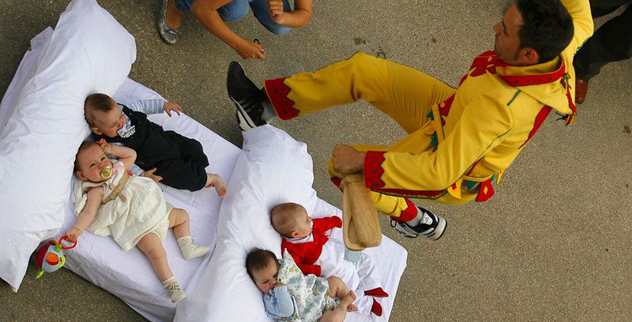
El Colacho, held in Castrillo de Murcia, Spain, is one of the world’s most talked-about and misunderstood traditional festivals. During this event, men dressed in colorful devil costumes leap over babies placed on mattresses in the street.
The ceremony is connected to Corpus Christi celebrations and is commonly interpreted as representing the triumph of good over evil. The ritual has roots going back centuries and is deeply connected to local religious and cultural traditions.
For visitors, the scene can seem unbelievable: bright costumes, drums, processions, families, and a man dressed as a devil preparing to jump over infants. For the local community, however, it is not a stunt for social media. It is a serious tradition carried out within a larger religious celebration.
Why it is bizarre: A sentence containing the words “traditional blessing” and “jumping over babies” is not one people expect to hear in the same conversation.
4. Battle of the Oranges: Italy’s Citrus Warfare
Italy’s Historic Carnival of Ivrea includes one of the most dramatic food fights on Earth: the Battle of the Oranges. For several days, teams on foot throw oranges at opponents riding in horse-drawn carts.
The event is tied to a local legend about rebellion against a tyrant. The people on foot represent townspeople, while the riders in carts represent the forces of oppression. In other words, it is historical storytelling with citrus ammunition.
Unlike La Tomatina, this is not a gentle tomato toss. Oranges are firmer, heavier, and capable of making their point rather clearly. Participants who want to enter the battle are wise to wear protective gear. Spectators who do not want to become part of the fruit supply chain should stay in designated safer areas.
Why it is bizarre: It combines medieval rebellion, carnival costumes, horses, and enough oranges to make a supermarket manager nervous.
5. Boryeong Mud Festival: South Korea’s Dirtiest Party
The Boryeong Mud Festival in South Korea turns mud into entertainment, cosmetics, sport, and an excuse to look like a cheerful swamp creature for the day. Held near Daecheon Beach, the festival began as a way to promote local mud-based beauty products.
What started as a marketing idea grew into a huge international event. Visitors can enjoy mud pools, mud slides, mud wrestling, obstacle courses, body painting, concerts, and plenty of activities that make clean laundry feel like a distant dream.
The mud used in the festival is associated with Boryeong’s local mud flats and cosmetic products. While visitors may arrive hoping for glowing skin, most leave with muddy shoes, muddy hair, muddy elbows, and a new respect for waterproof phone cases.
Why it is bizarre: Most people spend money to avoid getting covered in mud. Here, people line up for the privilege.
6. Kanamara Matsuri: Japan’s Festival of Fertility
Kanamara Matsuri, held in Kawasaki, Japan, is widely known outside Japan for its unmistakable phallus-shaped portable shrines, decorations, candy, and souvenirs. Yet beneath the shock value is a festival connected to fertility, marriage, childbirth, health, and prayers for protection.
The event is held at Kanayama Shrine and has become internationally famous because its imagery is impossible to ignore. Visitors may see large symbolic shrines carried through the streets, colorful costumes, street stalls, and crowds taking photographs with expressions that range from respectful curiosity to complete disbelief.
It is important to understand that Kanamara Matsuri is not merely a joke festival. It has religious and cultural significance, and many people attend to pray for good health, fertility, safe childbirth, and strong relationships.
Why it is bizarre: The souvenir selection is memorable in ways your refrigerator magnet collection may not be prepared for.
7. Wife-Carrying World Championship: Finland’s Most Athletic Relationship Test
In Sonkajärvi, Finland, couples compete in the Wife-Carrying World Championship, a race in which one partner carries another through obstacles, water, and uneven terrain. Despite the old-fashioned name, competitors do not need to be married, and the event has become an international competition built around teamwork and athletic skill.
The race course includes obstacles that test balance, speed, stamina, and a couple’s ability to avoid shouting directions at each other in public. The most famous carrying style is the Estonian carry, where the carried partner hangs upside down with their legs around the runner’s shoulders.
The winner traditionally receives a prize based on the carried partner’s weight in beer. It is hard to imagine a more Finnish combination of endurance sports, practical reward systems, and a refusal to make romance overly sentimental.
Why it is bizarre: Couples counseling usually involves talking. This version involves sprinting through water while upside down.
8. World Bog Snorkelling Championship: Wales Gets Swampy
The World Bog Snorkelling Championship in Wales is exactly what it sounds like, except somehow even muddier. Competitors wear snorkels, masks, and flippers, then race through a water-filled trench cut into a peat bog.
The challenge is not traditional swimming. Competitors are expected to use their flippers to move through the murky trench as quickly as possible. The water is dark, the course is cold, and the glamorous appeal is approximately zero. That is precisely why people love it.
The event attracts participants from different countries, many of whom arrive in costumes or with an enthusiasm that suggests they have made peace with being wet, muddy, and photographed by strangers.
Why it is bizarre: Snorkeling usually brings to mind coral reefs and tropical fish, not peat bogs and the strong possibility of meeting a leaf from 1987.
9. Underwater Music Festival: Florida’s Concert Beneath the Waves
The Underwater Music Festival in the Florida Keys takes the idea of live music and sends it diving. Held near Looe Key Reef, the event encourages snorkelers and divers to enjoy music broadcast underwater while also learning about coral reef conservation.
Participants wear snorkeling or diving gear and descend into a colorful marine environment where waterproof speakers play ocean-themed music. Some divers wear costumes, and artificial musical instruments are sometimes used for playful underwater performances.
The festival is entertaining, but it also promotes awareness about protecting coral reefs. That gives the event a useful purpose beyond proving that humans will invent a festival for literally every environment available, including the ocean floor.
Why it is bizarre: You have not truly attended a concert until the audience is wearing fins and the soundtrack competes with bubbles.
10. World Gurning Championship: England’s Funniest Face Contest
At the Egremont Crab Fair in Cumbria, England, competitors take part in the World Gurning Championship. “Gurning” means making an exaggerated, distorted facial expression, usually while sticking one’s head through a horse collar called a braffin.
Contestants twist their faces into shapes that would concern a dentist, a portrait painter, and possibly their own relatives. The goal is not beauty. The goal is to create the most dramatic, hilarious, and unforgettable face possible.
The competition has been associated with the historic fair for generations and proves that human beings do not need expensive equipment to create competitive entertainment. Sometimes all you need is a horse collar, confidence, and a willingness to let your eyebrows explore new territory.
Why it is bizarre: It is an international championship for making the least attractive face possible. Finally, a sport for people who blink during every family photo.
How to Experience Bizarre Festivals Respectfully
Unusual festivals can be incredible travel experiences, but they deserve more than quick photos and “I cannot believe this exists” captions. Before attending, learn the local rules, understand whether the event has religious or historical meaning, and follow the guidance of organizers.
Wear appropriate clothing, especially at food fights, mud events, and bog competitions. Bring eye protection for tomato or orange battles, carry a waterproof bag for your phone, and avoid standing in restricted zones because you are trying to capture the perfect video.
Most importantly, remember that these events belong to the communities that host them. Visitors are welcome when they participate with curiosity, good humor, and respect. You may be there for the cheese, mud, tomatoes, or absurdity, but the local tradition existed long before your camera arrived.
What It Feels Like to Attend a Bizarre Festival
Reading about bizarre festivals is entertaining. Attending one is something else entirely. The first thing that surprises most travelers is how quickly the event stops feeling strange and starts feeling completely normal. For about an hour, throwing tomatoes at strangers, cheering for someone chasing cheese downhill, or watching adults snorkel through a bog becomes the most logical activity in the world.
At La Tomatina, for example, the experience is not simply red. It is noisy, slippery, hot, crowded, and strangely joyful. At first, people stand around nervously protecting their clothes and phones. Then the tomatoes start flying, and all dignity disappears. One moment you are a responsible adult with travel insurance. The next moment you are laughing while trying to remove tomato seeds from your ears.
At the Boryeong Mud Festival, the mud changes the social rules almost immediately. Everyone looks ridiculous, so nobody has much reason to feel self-conscious. Business travelers, students, families, and tourists all end up covered in the same gray-brown layer. It is difficult to maintain a serious personality when you are sliding down a mud-covered inflatable while someone nearby is wearing a plastic Viking helmet.
The smaller festivals can feel even more memorable because they are so rooted in local identity. At a cheese-rolling event or gurning competition, you are not just watching an attraction created for tourists. You are watching a town celebrate something it has kept alive through generations. The crowd often knows the rules, the regular competitors, the best viewing spots, and the exact moment when someone is about to make a spectacularly bad decision.
There is also a powerful sense of shared permission. In daily life, adults are expected to act organized, polished, and mildly concerned about their laundry. Bizarre festivals temporarily remove that pressure. They create a space where being muddy, loud, awkward, or dressed like a devil is not only acceptable but encouraged.
Travelers often remember the small details more than the headline moments: the sound of laughing strangers, a local vendor explaining a tradition, the smell of wet grass, the strange quiet after a festival ends, or the relief of finally finding a shower. Those details turn an unusual event into a real travel memory.
The best bizarre festivals leave people with more than funny photos. They remind us that traditions do not have to be elegant to be meaningful. Sometimes a community celebrates history through music and processions. Sometimes it celebrates through oranges, mud, cheese, radishes, or the most impressive ugly face ever made by a human being.
That is the charm of these festivals. They are ridiculous, heartfelt, messy, historic, and impossible to forget. And somewhere in the world, right now, a local organizer is probably looking at a perfectly ordinary object and wondering whether it could become next year’s championship event.
Conclusion
The top 10 bizarre festivals show that travel is not always about luxury hotels, famous landmarks, or postcard-perfect views. Sometimes the best stories begin with a tomato in your shoe, mud in your hair, or a wheel of cheese rolling away faster than your common sense.
Whether you want to witness a strange cultural tradition, join a food fight, take part in an absurd competition, or simply see how inventive people can be when given enough enthusiasm and a public square, these unusual festivals offer unforgettable experiences. Just pack old clothes, a sense of humor, and a willingness to explain yourself later.
SEO Tags
Research verification references: