Hollywood loves an origin story almost as much as it loves a sequel. Give people a red carpet, a breakout role, and a tuxedo that costs more than a sensible used car, and somebody will eventually ask the awkward question: Did this person get here because they were brilliant, because they knew the right people, or because their family’s address already had a gate?
That question powered a lively online discussion about actors who built careers without arriving through a famous surname, a studio-friendly family tree, or a bank account large enough to treat unpaid auditions as a charming hobby. The answers were energetic, imperfect, and refreshingly skeptical of the idea that fame is a meritocracy with flattering lighting.
Why This Question About Hollywood Nepotism Keeps Coming Back
People are not annoyed by famous families merely because they are famous. They are frustrated by the shortcut disguised as a fairy tale. A young performer with parents who can pay rent in Los Angeles, introduce an agent, finance years of classes, or make one strategic phone call starts the race several laps ahead. Talent still matters, but the starting line is not the same for everyone.
That is why stories about restaurant servers, community-theater regulars, scholarship students, former firefighters, accountants, and performers who slept in cars have such staying power. They do not prove that the industry is fair. Quite the opposite: they show how much persistence, timing, and plain old survival are required when the safety net is made of dental floss.
The most useful version of this conversation is not “Who deserves fame?” It is “What kinds of access make an artistic career possible?” Some actors had modest but stable homes. Some grew up in poverty. Some were discovered through open calls, while others built enough skill in theater, comedy, dance, or self-made videos that an opportunity finally found them. Their routes were different, but none began with a relative waiting beside a studio gate with a laminated pass.
30 Actors Whose Paths Began Beyond the Hollywood Shortcut
-
Steve Buscemi
Before becoming one of cinema’s most recognizable character actors, Buscemi worked as a New York City firefighter. His later return to firefighting work after September 11 made the earlier chapter impossible to dismiss as a cute publicity footnote.
-
Viola Davis
Davis has spoken plainly about growing up in severe poverty in Rhode Island. Acting became a way to be seen and heard, but training, scholarships, and years of stage work—not family entertainment connections—built the foundation.
-
Hilary Swank
Swank’s family struggled financially, and she and her mother briefly lived in their car after moving to Los Angeles. Her eventual success was not a magic audition montage; it was a long climb through small roles and stubborn preparation.
-
Jessica Chastain
Chastain has described a low-income upbringing and attended Juilliard with scholarship support. Her career is a useful reminder that elite training can help enormously when a gifted student is actually given a way through the front door.
-
Adam Driver
Before Juilliard and major film roles, Driver served in the U.S. Marine Corps. He entered acting through training and perseverance rather than a family pipeline, then made patience look strangely intimidating in every role that followed.
-
Donald Glover
Glover grew up with a postal-worker father and a mother who ran a daycare. He turned writing, sketch comedy, music, and performance into a multi-lane career, proving that sometimes the best networking strategy is learning to do several jobs brilliantly.
-
Mark Ruffalo
Ruffalo spent years taking small parts and working regular jobs while trying to establish himself. His breakthrough came after a long period of near-misses, which makes his career feel less like an elevator ride and more like a staircase with missing steps.
-
Chris Pratt
Pratt has described living in a van in Hawaii before an opportunity arrived while he was working at a restaurant. His story should not be romanticized—housing insecurity is not a personality trait—but it does show how unpredictably careers can turn.
-
Channing Tatum
Tatum worked construction and pursued dance before modeling opened another door. His early experiences gave him movement, comic timing, and the ability to sell a dance routine without looking as though he is calculating his tax return.
-
Brad Pitt
Pitt arrived in Los Angeles without a show-business family network and took odd jobs while auditioning, including mascot work. The famous chicken suit anecdote survives because it captures an unglamorous truth: future movie stars still need groceries.
-
Octavia Spencer
Spencer came from a practical family that initially encouraged a more secure profession. She spent years in small parts before her breakthrough, a career arc that honors the underrated art of staying prepared long after the applause has gone home.
-
Taraji P. Henson
After graduating from Howard University, Henson moved to Los Angeles with her young son and supported herself with day jobs while auditioning. Her career illustrates that professional ambition can coexist with very real responsibilities and very little margin for error.
-
Tiffany Haddish
Haddish has spoken about foster care and periods of homelessness during her youth. Comedy became both craft and survival tool, eventually leading to a screen career built on an unmistakable voice rather than inherited access.
-
Quinta Brunson
Brunson developed her audience through sketch comedy and internet videos before breaking out on television. Her path demonstrates how digital platforms can create an alternate entrance to an industry that once treated gatekeeping like an Olympic event.
-
Ayo Edebiri
Edebiri’s rise came through stand-up, writing rooms, independent comedy, and carefully chosen performances. She is a modern example of a performer building credibility one sharp joke, script page, and scene-stealing role at a time.
-
Dev Patel
Patel was cast in Skins after an open audition, not because a famous relative had a producer on speed dial. That first opportunity became a career, but only after he showed the emotional precision that made viewers keep watching.
-
Simu Liu
Liu worked in accounting before pursuing acting and comedy. His career demonstrates a familiar reality for aspiring performers: the day job may be boring, but it can be the bridge that keeps the dream from becoming an unpaid utility bill.
-
Awkwafina
Awkwafina developed a distinctive public voice through music, comedy, and self-created work before major film roles followed. Her path is a reminder that being memorable is often more useful than trying to resemble the industry’s default setting.
-
Kelly Marie Tran
Raised by parents who came to the United States as Vietnamese refugees, Tran worked in online comedy and smaller projects before landing a major franchise role. Her success expanded the idea of who gets to occupy the center of a blockbuster universe.
-
Ke Huy Quan
Quan arrived in the United States as a refugee and was discovered through an open casting process as a child. His later comeback, after years behind the camera, turned perseverance into one of Hollywood’s most satisfying second acts.
-
John Boyega
Boyega grew up in south London and developed his craft through youth theater before finding film work. His early career shows the value of local arts programs: the next great screen presence may be practicing above a community center, not inside a private club.
-
Barry Keoghan
Keoghan spent part of his childhood in foster care in Dublin and entered acting through local opportunities and persistence. His unusual screen presence feels earned because it is: nobody can hand you that kind of raw, unnerving specificity.
-
Jodie Comer
Comer came up through school drama and regional work in Liverpool before international recognition. Her route underscores how much talent can be nurtured outside the capital cities and celebrity family circles that dominate entertainment headlines.
-
Paul Mescal
Mescal trained in theater and moved from stage work into screen acting through auditions and strong early performances. His rise is less a story of instant discovery than one of a prepared actor meeting the exact role that let audiences notice him.
-
Rachel McAdams
McAdams grew up in a family outside the entertainment industry and developed her craft through theater and formal study. Her career demonstrates that a conventional background can still produce a performer with unusually elastic screen presence.
-
Anna Kendrick
Kendrick began in community theater and earned attention through stage work long before movies made her a household name. She is proof that local productions can be serious training grounds, even when the lobby sells cookies wrapped in plastic.
-
Sandra Oh
Oh pursued acting despite parents whose work was outside show business, paying her own way through drama training. Her career grew from serious theater discipline, not an inherited publicity machine, and it shows in every precise, restless performance.
-
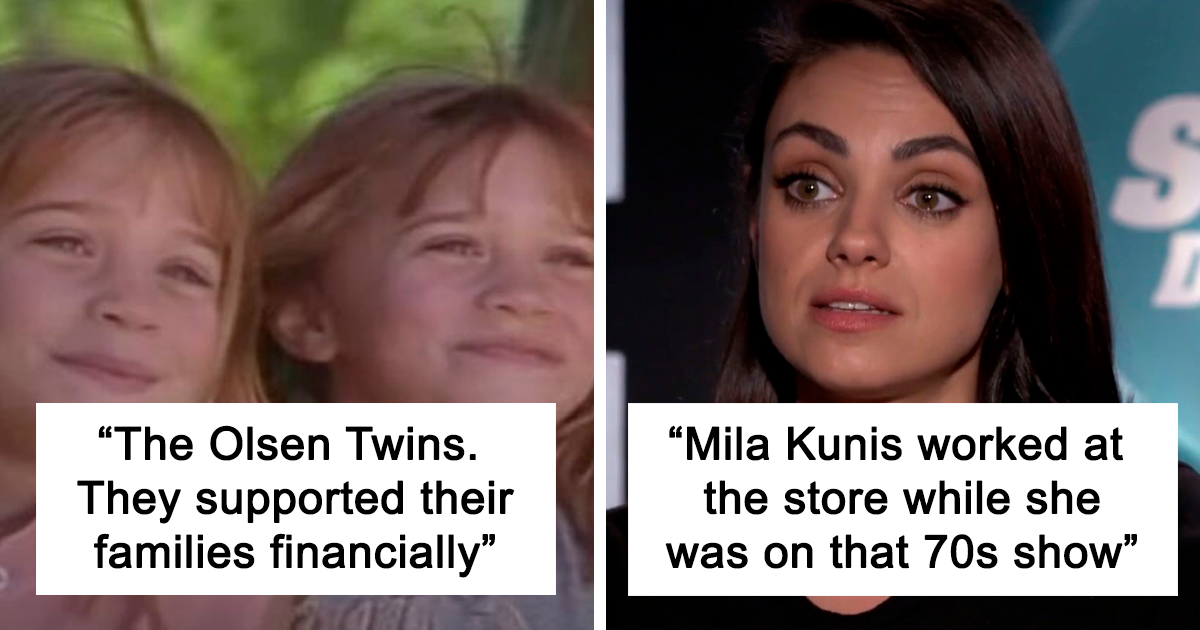
Mila Kunis
Kunis immigrated to the United States from Ukraine as a child and began auditioning while her family adjusted to a new country. Her early success came through persistence, training, and auditions—not a preexisting Hollywood dynasty.
-
Seth Rogen
Rogen started performing stand-up as a teenager in Vancouver, writing material while other kids were still figuring out locker combinations. Comedy, writing, and collaboration created his runway long before he became a major screen presence.
-
Pedro Pascal
Pascal’s family escaped Chile’s military dictatorship, and he spent years taking guest roles and theater work before becoming widely known. His slow-burn success is an antidote to the myth that every popular actor was “discovered” on a Tuesday.
What These Career Stories Actually Teach Us
The lesson is not that poverty makes people better artists. That is a lazy myth with excellent public relations. Poverty can limit time, training, housing, health care, and the ability to accept low-paid opportunities. The lesson is that talent exists everywhere, while access does not.
These performers also had help: teachers, casting directors, scholarship committees, theater groups, fellow writers, mentors, agents, and relatives who encouraged a risky dream. The difference is that support is not the same as inherited industry power. A parent driving a child to auditions after work is not equivalent to a parent calling the head of a studio.
It also matters that many of these actors found indirect routes. Comedy rooms, open calls, local theater, dance, web series, modeling, commercial work, service jobs, and military service are not detours from an acting career. For many people, they are the road itself. The map is messy, the rent is late, and someone is probably eating cold noodles between auditions. But the road exists.
Experiences From the Long Road to Visibility
Spend enough time around aspiring performers and you notice that the glamorous part of the story usually begins after the least glamorous part has already lasted years. Before anyone is photographed at a premiere, there may be a run of background work, a shift at a restaurant, a commuter train to a regional audition, a self-tape recorded beside a laundry basket, and a polite rejection email that arrives two minutes after you finally decided to believe in yourself. The experience is not cinematic. It is logistical.
For actors without money or connections, the first challenge is often not talent but time. Acting classes, headshots, travel, union fees, child care, and the hours needed for auditions all cost something. A performer with a flexible job, a spare bedroom, or a parent who can cover one difficult month has a meaningful advantage. That does not erase their work; it simply explains why access deserves to be discussed with more honesty than a red-carpet interview usually allows.
Another common experience is learning to make useful work before anyone grants permission. A comedian writes sketches with friends. A theater actor joins a tiny production with a coffee-shop budget. A writer performs their own material online. A dancer takes a commercial gig and discovers an unexpected camera presence. These steps can look small from the outside, but they build the most valuable early asset in entertainment: evidence. Someone can see what you do, not merely hear that you want to do it.
There is also a strange emotional education in repeated auditions. You learn that a “no” may mean the role changed, the project lost financing, the casting team chose a different height, accent, chemistry, or eyebrow situation. It may have nothing to do with your ability. That uncertainty can be brutal, but it can also force a performer to separate their worth from one room’s decision. The strongest careers often belong to people who keep preparing after a rejection that would make a normal human consider becoming a beekeeper.
Finally, many of the stories above show that luck is real, but luck is not random magic. It tends to meet people who have already been working where opportunity can find them: in a community theater, at an open casting call, on a comedy stage, in a student film, or behind a restaurant counter where a casting director happens to be ordering shrimp. The point is not to worship struggle. It is to build wider doors, fund local arts, pay emerging talent fairly, and stop mistaking inherited access for destiny.
Conclusion: Talent Needs More Doors, Not More Myths
The fascination with actors who were not born into Hollywood is really a fascination with possibility. Their careers do not prove that anyone can make it if they simply want it badly enough. They prove something more practical: gifted people can emerge from ordinary homes, difficult circumstances, local stages, day jobs, and unexpected second chances when the industry leaves enough doors unlocked.
The best response to nepotism is not resentment toward every famous child. It is a larger, fairer pipeline for everyone else. Celebrate the performers who climbed without a map, then make sure the next generation has more than a ladder made of luck.