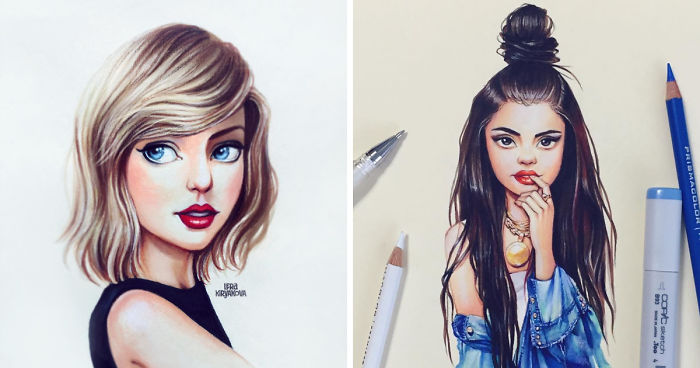
Some celebrity portraits try to capture glamour. Others try to capture status, mystery, cheekbones, or that “I woke up like this” lighting that clearly required a team of twelve. Then there are the celebrity illustrations of Russian artist Lera Kiryakova, which ask a much sweeter question: What if famous faces looked like they had wandered out of a charming animated movie, carrying just enough sparkle to melt the internet?
Kiryakova has become known for turning celebrities, musicians, actors, and pop-culture icons into adorable cartoon characters. Her portraits are instantly recognizable, but they are not stiff copies of photographs. They are soft, stylized, expressive, and lightly exaggerated, with big eyes, delicate shading, polished hair, and a playful “puppet-like” quality. The result feels familiar and fresh at the same time, like seeing Rihanna, Emma Stone, Beyoncé, or Benedict Cumberbatch invited to a very fashionable animated tea party.
The appeal is easy to understand. In a digital world crowded with filters, AI effects, and quick edits, Kiryakova’s work has the warmth of illustration. It has personality. It has hand-crafted charm. Most importantly, it has that rare online magic: you can recognize the celebrity immediately, but you still want to stare a little longer and say, “Wait, why is this so cute?”
Who Is Lera Kiryakova?
Lera Kiryakova is a Russian illustrator and character artist whose celebrity cartoon portraits have circulated widely across art blogs, entertainment galleries, and social media platforms. Her work gained attention for transforming well-known public figures into cute, stylized characters while preserving the features that make each person recognizable.
Her portfolio includes portraits inspired by modern pop stars, Hollywood actors, music legends, and fictional characters played by famous performers. Over the years, her style has expanded from celebrity caricature-style portraits into broader character design and polished digital illustration. That growth is part of what makes the phrase “continues drawing” so fitting. This is not a one-time viral trick. It is an evolving visual language.
Early shared examples often emphasized the hand-drawn nature of her work, including colored-pencil and marker-like textures. More recent public profiles describe her as an illustrator and character designer, showing that her creative identity has matured alongside her audience. The heart of the work, however, remains consistent: take a face people know, simplify it, sweeten it, exaggerate it just enough, and turn it into a character that feels ready for its own animated universe.
Why These Celebrity Cartoon Portraits Went Viral
Celebrity fan art performs well online for a simple reason: it gives audiences two pleasures at once. First, there is recognition. Viewers enjoy spotting the person, the outfit, the hairstyle, or the character reference. Second, there is transformation. The artwork changes the celebrity into something new, which makes the viewer feel like they are seeing a secret version of a familiar face.
Kiryakova’s celebrity cartoon drawings work especially well because they are friendly rather than mean-spirited. Traditional caricature can sometimes exaggerate features for comedy or satire. Her approach leans toward affection. A famous jawline becomes softer. Dramatic eyes become enormous and luminous. A hairstyle becomes cleaner, shinier, and more animated. The celebrity remains recognizable, but the mood becomes warmer.
That warmth matters. In a pop-culture environment where celebrity coverage can be harsh, gossipy, or brutally overanalyzed, these drawings feel like a tiny vacation. They do not ask who wore it better, who unfollowed whom, or who looked tired at the airport. They simply say: here is a famous person, but make them adorable. Honestly, the internet could use more of that energy and fewer comment sections that need adult supervision.
The Signature Style: Cute, Polished, and Recognizable
Kiryakova’s style is often described as puppet-like or doll-like, and that description fits. The faces tend to have large eyes, smooth skin, small noses, expressive lips, and neatly shaped hair. The heads are stylized, sometimes slightly enlarged or narrowed, while the bodies and clothing are simplified to support the portrait instead of competing with it.
1. Big Eyes With Emotional Pull
The eyes are usually the first thing viewers notice. In cartoon portraiture, enlarged eyes can instantly make a subject feel more innocent, expressive, or emotionally open. Kiryakova uses this device carefully. The eyes are not randomly huge; they still reflect the subject’s original expression, angle, and personality. Rihanna’s gaze remains confident. Emma Stone’s smile still feels bright and playful. A dramatic character like Sherlock Holmes still carries intensity, even when softened into a more charming form.
2. Selective Exaggeration
Good caricature is not about enlarging everything. If every feature is exaggerated equally, the portrait becomes noise. Kiryakova’s strength is selectivity. She highlights a celebrity’s most identifiable traits: a hairstyle, eyebrow shape, lip line, cheek structure, pose, costume, or expression. The resemblance comes from the relationship between features, not from photographic realism.
3. Soft Color and Gentle Shading
Her portraits often use warm skin tones, blush, carefully shaded hair, and bright but controlled colors. This gives the illustrations a polished, almost collectible quality. The softness also supports the “adorable cartoon character” feeling. The images are cute without becoming flat, and glamorous without becoming cold.
4. Fashion as Character Clue
Celebrity portraits are rarely just faces. Clothing, accessories, and styling help audiences identify the subject. A striped hat, a black outfit, a detective coat, red hair, dramatic makeup, or a famous stage look can become visual shorthand. Kiryakova uses these details efficiently, almost like a character designer preparing a cast sheet.
Famous Faces Reimagined in Cartoon Form
Part of the fun of Kiryakova’s work is seeing how different kinds of celebrities translate into her style. Pop stars often become especially striking because their public images already include strong visual branding. Artists like Rihanna, Beyoncé, Ariana Grande, and Billie Eilish are recognizable not only by facial features but also by attitude, styling, makeup, and hair. When translated into cartoon form, those details become even more concentrated.
Actors offer a different challenge. Someone like Emma Stone brings expressive comedy and bright facial energy, while Benedict Cumberbatch as Sherlock Holmes brings sharp features, a serious stare, and a costume that fans immediately recognize. Leonardo DiCaprio, Selena Gomez, Lana Del Rey, and other familiar faces work because their public images contain clear visual cues. The portrait becomes a puzzle: how few lines and shapes can an artist use while still making the viewer say the name instantly?
Music legends create another layer of emotion. When artists illustrate icons such as Michael Jackson, Freddie Mercury, or David Bowie, the image carries nostalgia. These are not just celebrity portraits; they are tiny visual tributes. A cartoon version can soften the distance between audience and icon, making a larger-than-life figure feel almost storybook-like.
Why Adorable Celebrity Art Feels So Shareable
There is a reason this type of artwork travels well across social platforms. It is visually immediate. You do not need a long caption to understand it. A viewer can glance at the portrait, recognize the celebrity, admire the transformation, and share it in seconds. That is social media gold, with a cherry on top and possibly a tiny animated sparkle.
But the shareability is not only about speed. It is also about emotional safety. Cute celebrity illustrations are easy to enjoy. They do not demand a controversial opinion. They do not require deep background knowledge. Fans can appreciate them, casual viewers can admire the technique, and artists can study the choices behind the style. That broad appeal is one reason celebrity cartoon portraits remain popular years after the first wave of viral posts.
They also satisfy a common fan-art fantasy: what if real celebrities existed inside the animated worlds we love? Kiryakova’s drawings suggest that possibility without directly copying one studio’s formula. The portraits borrow the emotional vocabulary of animation: expressive faces, simplified shapes, clean silhouettes, and personality-first design.
The Art Behind the Cuteness
It is tempting to look at an adorable portrait and assume it is simple. Big eyes, soft cheeks, nice hair, done. Easy, right? Unfortunately for anyone who has ever tried it, cute is not easy. Cute is a trap wearing pastel shoes.
To make a celebrity cartoon portrait work, the artist has to balance likeness and stylization. Too realistic, and the drawing loses cartoon charm. Too stylized, and the celebrity becomes unrecognizable. The sweet spot is narrow. Kiryakova finds it by preserving the structure that matters most: eye spacing, face shape, hairline, expression, and signature styling.
This is where illustration becomes analysis. The artist is not merely copying a photo. She is deciding what makes a person visually “them.” Is it the eyebrows? The smile? The tilt of the head? The sleepy gaze? The sharp cheekbones? The famous haircut? Once those details are identified, everything else can be simplified.
That is also why the drawings appeal to aspiring artists. They show a lesson that is useful far beyond celebrity fan art: style is not the absence of observation. Style is observation with decisions.
Fan Art, Celebrity Culture, and the Modern Illustrator
Celebrity fan art sits at an interesting intersection of admiration, entertainment, and creative practice. For illustrators, famous faces make excellent studies because viewers already know the subject. That creates a built-in test: if the portrait is successful, recognition happens quickly. If it misses, the audience can tell.
For fans, the artwork offers a new way to interact with pop culture. Instead of simply watching a movie, listening to a song, or following a red-carpet look, viewers can see that celebrity reinterpreted through another artist’s imagination. It becomes a conversation between fandom and craft.
There is also a practical reason artists often create celebrity portraits: discoverability. A drawing of a globally recognized singer or actor is easier for new audiences to find than an original character with no existing fan base. That does not make the work less creative. It simply means the artist is using shared cultural language. The challenge is to add enough personal style that the piece feels like more than a copy. Kiryakova’s portraits do exactly that.
What Artists Can Learn From Kiryakova’s Celebrity Cartoons
For artists studying this kind of work, the first lesson is restraint. Cute portraiture often fails when every feature becomes rounded, shiny, and oversized. Kiryakova’s work shows that stylization needs hierarchy. The eyes may be enlarged, but the hairstyle, pose, and facial proportions still need discipline.
The second lesson is reference selection. A strong reference photo gives the artist clear lighting, recognizable styling, and a useful expression. Not every celebrity photo makes a good cartoon portrait. A bland image can lead to a bland illustration. A strong image gives the artist something to translate.
The third lesson is consistency. Kiryakova’s portraits feel connected even when the subjects are very different. That consistency is what turns individual drawings into a recognizable brand. For any illustrator trying to grow online, a consistent visual voice can be just as important as technical skill.
The fourth lesson is emotional tone. These drawings are not only accurate; they are affectionate. They show that fan art can celebrate a subject without becoming stiff or overly serious. The best pieces feel like they were made by someone who enjoys both the person and the process.
Why the Style Still Works Today
The internet changes fast. A trend can be born on Monday, overused by Wednesday, and mocked by Friday. Yet celebrity cartoon portraits continue to attract attention because they tap into something older than any platform: the pleasure of transformation.
People have always enjoyed seeing familiar figures reimagined. Portrait painters, caricaturists, animators, comic artists, and editorial illustrators have been doing versions of this for generations. What social media changed was speed and scale. Now one charming drawing can travel across countries, fandoms, and languages in a single afternoon.
Kiryakova’s work remains appealing because it does not depend only on novelty. The drawings are technically polished, emotionally clear, and easy to enjoy. They belong to a category of art that feels both contemporary and timeless: famous people, transformed by a distinct imagination.
Experiences and Reflections: Why This Topic Connects With So Many People
Anyone who has ever tried to draw a celebrity knows the experience can humble a person quickly. You begin with confidence. You choose a reference photo. You sharpen your pencil or open your drawing app. You tell yourself, “This will be fun.” Then, somewhere around the second eye, the portrait starts looking less like a famous actor and more like that actor’s confused cousin who sells artisanal candles. This is where artists learn the first truth of portrait drawing: likeness is fragile.
That is why work like Lera Kiryakova’s feels so satisfying. It makes a difficult process look light, charming, and effortless, even though it clearly is not. The viewer sees the final image and enjoys the cuteness. The artist sees the same image and notices the decisions: how the eyes were placed, how the mouth was simplified, how the hair was shaped, how much detail was kept, and how much was removed. The drawing becomes both entertainment and education.
For fans, these portraits often create a surprisingly personal reaction. A favorite singer or actor already lives in memory through songs, movies, interviews, and iconic looks. When that person is reimagined as a cartoon character, the emotional connection shifts. The celebrity feels less distant and more approachable, almost like a character from a beloved childhood film. That softness can make fans feel nostalgic even when the artwork is new.
There is also a shared experience of recognition. When people view a celebrity cartoon portrait together, they often play a tiny guessing game. “Is that Beyoncé?” “Wait, is that Sherlock?” “Oh, that has to be Rihanna.” This quick moment of discovery makes the artwork interactive. It invites the audience to participate rather than passively scroll. In a world where people consume hundreds of images a day, that little pause matters.
For beginner artists, Kiryakova’s work can be especially motivating because it shows a path between realism and fantasy. Many new illustrators feel trapped by the idea that a portrait must look photographic to be “good.” Cartoon portraiture proves otherwise. A drawing can be simplified, cute, exaggerated, and still skillful. In fact, simplification often reveals skill more clearly because every choice becomes visible. There is nowhere to hide behind excessive detail.
The topic also connects with people because it celebrates joy. Not every artwork needs to be dark, ironic, or conceptually difficult enough to require a museum wall label and a strong espresso. Sometimes art can simply make people smile. Kiryakova’s celebrity cartoon characters do that with grace. They remind viewers that cuteness can be intelligent, fan art can be sophisticated, and a familiar face can still surprise us when seen through the right artist’s eyes.
Conclusion
Lera Kiryakova’s continuing series of celebrity cartoon portraits stands out because it combines recognition, sweetness, and strong illustration fundamentals. Her adorable cartoon characters are not random cute versions of famous people; they are carefully designed portraits that preserve likeness while adding warmth, charm, and personality.
From pop stars and actors to music legends and fictional roles, her drawings show how powerful stylization can be when guided by observation. The big eyes, soft colors, expressive faces, and polished details all serve a larger purpose: turning celebrity images into characters people want to remember, share, and revisit.
In the end, that may be the secret behind her enduring appeal. Kiryakova does not simply draw celebrities. She translates them into a visual language of animation, affection, and playful imagination. And in an online world that can sometimes feel louder than a drum solo in a glass elevator, a little adorable artistry is not just welcome. It is practically necessary.
Note: This article is based on publicly available information about Lera Kiryakova’s celebrity cartoon portraits, illustration style, social media presence, and broader character-design practices. Source links are intentionally not inserted, following the publishing requirements.