Every so often, the internet serves up a project so delightfully unreasonable that it feels like a dare from the laws of physics. “KFC Winged Aircraft Actually Flies” is exactly that kind of story: an RC airplane that traded ordinary wings for two spinning fried-chicken buckets and still managed to get airborne. No, this was not a fast-food commercial. No, Colonel Sanders did not quietly launch an aviation division. And yes, the strange little aircraft really did fly.
The build, created by maker and model aircraft designer Peter Sripol, became a favorite among RC plane fans, engineering tinkerers, and anyone who enjoys seeing serious science wear a paper-bucket hat. The aircraft used empty KFC buckets as rotating cylindrical wings. As those buckets spun, they interacted with airflow through a phenomenon known as the Magnus effect. In plain English: spin plus forward motion can create lift. In even plainer English: the buckets were not just decoration; they were doing actual aerodynamic work, even if they were not exactly Boeing-grade components.
What makes this KFC bucket airplane fascinating is not that it points to the future of commercial aviation. Nobody is boarding Flight 11 Herbs & Spices next Tuesday. The real magic is that it turns a complicated physics concept into something visible, funny, and surprisingly educational. It proves that engineering is not always polished aluminum and wind-tunnel budgets. Sometimes it is foam board, motors, propellers, tape, trial and error, and two buckets that once held dinner.
What Is the KFC Winged Aircraft?
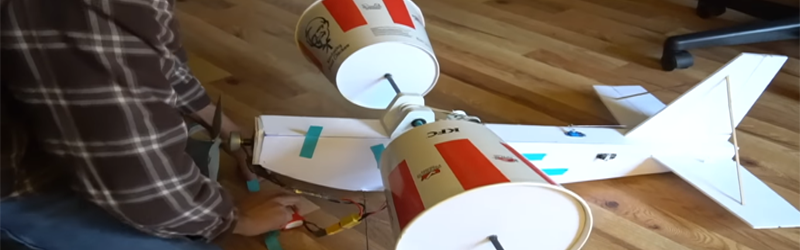
The KFC winged aircraft is a custom remote-controlled airplane built around an unusual idea: replace normal fixed wings with spinning cylindrical objects. Instead of using smooth, carefully shaped airfoils, the plane used two KFC buckets mounted sideways where wings would normally be. Motors spun the buckets, while front propellers pulled the aircraft forward.
The aircraft was not a joke in the sense of being fake. It was a real RC build, and the flight attempts showed the familiar rhythm of maker projects: optimism, wobble, crash, redesign, more wobble, more crash, and finally a moment where the machine rises into the air just long enough for everyone to cheer and pretend they never doubted it.
The design also included a conventional fuselage and tail surfaces, which helped make the plane controllable. That point matters. The KFC buckets created lift through rotation, but the rest of the aircraft still needed to provide stability, forward thrust, and directional control. In other words, the buckets were the star of the show, but they had a supporting cast.
The Science: How Can Buckets Work as Wings?
The Magnus Effect, Explained Without a Lab Coat
The key idea behind the aircraft is the Magnus effect. This is the same aerodynamic phenomenon that helps a curveball bend, a spinning soccer ball swerve, and a basketball with backspin behave differently in flight. When a spinning object moves through air, the airflow around it becomes uneven. On one side, the surface motion helps the airflow move faster. On the other side, it works against the airflow. That difference changes the pressure around the object and creates a force at an angle to the direction of travel.
For a rotating cylinder, that sideways force can be arranged to point upward. When the cylinder is mounted like a wing and spun in the correct direction, the airflow is turned in a way that produces lift. A traditional aircraft wing creates lift by shaping and redirecting airflow. A rotating cylinder creates lift by spinning and dragging the nearby air around with it. The details get mathematically spicy, but the basic recipe is simple: move air, turn air, get force.
Why the KFC Buckets Had to Spin
A plain bucket mounted sideways on a plane would mostly be a drag machine. It would resist forward motion like a tiny airborne trash can with ambition. But a spinning bucket behaves differently. Once the bucket rotates fast enough while the plane moves forward, it can create lift through the same rotating-cylinder principle used in Flettner rotor experiments.
The catch is that the bucket shape is far from ideal. A proper Flettner rotor is usually a smooth cylinder, often with end plates, designed to produce useful lift while managing drag. A KFC bucket is tapered, light, flexible, and decorated with branding that was never optimized for laminar flow. It is a food container, not an aircraft component. The fact that it worked at all is the engineering equivalent of wearing flip-flops to a marathon and somehow finishing.
Why This Aircraft Is More Than an Internet Gag
It would be easy to dismiss the KFC bucket plane as a stunt, but that misses the point. The project demonstrates a real aerodynamic principle in a form people instantly remember. Most people forget equations. Almost nobody forgets the phrase “KFC buckets for wings.”
That is why projects like this are powerful teaching tools. They connect abstract physics to everyday objects. A student may not care about Kutta-Joukowski lift theory on first contact, but tell that student a fried-chicken bucket can create lift when spun fast enough, and suddenly the classroom has attention. Science wins when curiosity walks through the door wearing a ridiculous costume.
The build also highlights the maker mindset. Instead of asking, “What is the perfect way to demonstrate this?” the project asks, “What do I have nearby, and can I make it fly?” That attitude is behind countless breakthroughs, prototypes, and hobby experiments. Not every idea becomes practical. Some ideas simply teach us where the limits are, preferably with a camera rolling.
Design Challenges: Why It Flew, But Not Gracefully
Lift Is Only One Part of Flight
Getting an aircraft into the air is not only about producing lift. It also needs thrust, stability, control, and enough structural strength to survive the awkward parts between takeoff and landing. The KFC winged aircraft had to balance all of those requirements while dragging two large spinning buckets through the air.
That is a big ask. The spinning buckets introduced gyroscopic forces, torque effects, drag, vibration, and control complications. If the buckets spun too slowly, they would not produce enough lift. If they spun too quickly or unevenly, they could make the aircraft harder to manage. If the plane did not have enough forward speed, the airflow over the rotating cylinders would be weak. If it had too much drag, the motors would struggle. Every design choice was a negotiation with physics, and physics is not known for generous payment plans.
Why Dual Propellers Helped
One clever part of the design was the use of dual propellers spinning in opposite directions. Counter-rotating propellers can help reduce unwanted torque effects and provide more balanced forward thrust. For a plane already dealing with spinning buckets, this was not just a nice touch; it was a survival strategy.
The result was an aircraft that could be controlled in flight, although not with the smooth confidence of a normal trainer plane. It worked, but it worked in the way many great garage experiments work: enough to prove the concept, not enough to make insurance companies relax.
The Magnus Effect Has a Real Aviation History
The idea of using spinning cylinders for lift is not new. Engineers have explored Magnus-effect aircraft and Flettner rotor concepts for decades. The Flettner rotor is better known in marine applications, where tall spinning cylinders can help propel ships by using wind. In aviation, the concept is more difficult because aircraft must carefully manage weight, drag, stability, and safety.
Historical rotor aircraft designs, including early experimental machines such as the Plymouth A-A-2004, show that the concept has been taken seriously before. These aircraft replaced or supplemented conventional wings with rotating cylinders. The appeal is obvious: a spinning cylinder can generate strong lift at relatively low forward speeds. The problem is equally obvious: the system needs power to keep spinning, creates drag, and introduces control challenges that ordinary wings avoid.
That is why conventional airfoils won the mainstream aviation race. Wings are efficient, passive, reliable, and well understood. They do not require a separate motor just to continue being wings. A rotor wing, by contrast, is more like a wing that insists on being entertained at all times. Stop the spin, and the lift drops dramatically.
Could a Full-Size KFC Bucket Aircraft Work?
In theory, a full-size aircraft using rotating cylinders could fly. In practice, making it safe, efficient, and useful would be a major engineering challenge. A full-scale version would need strong rotors, reliable power systems, precise control, and serious testing. It would also need to solve the classic rotor-wing problems: high drag, mechanical complexity, and emergency behavior if rotor power failed.
A giant aircraft with branded fast-food buckets is probably not the future. But a carefully engineered rotating-cylinder lift system could still be useful in niche research, unmanned aircraft, or experimental vehicles. The KFC bucket plane belongs in the same family as many maker experiments: it is not a production blueprint, but it is a brilliant conversation starter.
And that conversation matters. Many practical technologies started as “that will never work” moments. The KFC bucket aircraft may not change aviation, but it changes how people see aviation. It reminds us that flight is not magic. It is a stack of physical principles, and sometimes those principles can be tested with materials that smell faintly like fried chicken.
Why the Internet Loved It
The project became popular because it checks every box for viral engineering. It is visual. It is strange. It is easy to understand at a glance. It contains failure, recovery, and a satisfying payoff. Most importantly, it has the perfect headline: a plane with KFC buckets for wings actually flies.
People love builds that look impossible but obey real science. The humor lowers the barrier to entry. You do not need an aerospace degree to enjoy watching a bucket-wing plane lumber into the air. But once you are hooked, you might start learning about lift, rotating cylinders, stability, propeller torque, and control surfaces. That is the best kind of science communication: dessert first, vegetables hidden inside.
It also taps into a deep maker-culture truth: absurd constraints produce memorable solutions. Anyone can admire a polished commercial drone. But a homemade aircraft built from foam board and chicken buckets feels personal. It says, “You can try weird things too.” It turns engineering from something distant and professional into something playful and accessible.
Lessons for RC Builders and Curious Makers
Start With the Principle, Not the Perfect Part
The KFC bucket aircraft shows that you do not always need perfect materials to learn something meaningful. If the goal is to explore a physical principle, a rough prototype can be more useful than a flawless drawing. The buckets were inefficient, but they made the Magnus effect visible. They turned theory into motion.
Expect Failure, Then Make It Useful
Trial and error was not a weakness of the project; it was the method. Every failed takeoff revealed something about balance, thrust, control, or lift. Good builders treat crashes as data, provided nobody is standing in the impact zone holding nachos.
Respect the Difference Between “Works” and “Works Well”
The plane flew, but it was not a model of efficiency. That distinction is important. A proof of concept can be successful even when it is messy. The first goal is to show that an idea can function. The next goal is to improve it. In the KFC bucket plane’s case, smoother cylinders, better end plates, lighter materials, and refined control systems would likely outperform the original buckets.
Experience Section: What the KFC Winged Aircraft Teaches in Real Life
Watching a KFC bucket aircraft fly feels like watching a science fair project escape the gymnasium and head for open air. The first reaction is laughter, because the machine looks wonderfully wrong. The second reaction is surprise, because it does not immediately fall out of the sky. The third reaction is curiosity, because once the joke lands, the question remains: how did that thing actually work?
That sequencelaughter, surprise, curiosityis exactly why this topic is so effective for hands-on learning. In real maker spaces, RC clubs, classrooms, and garage workbenches, the hardest part is often not explaining the science. It is getting people to care long enough to ask the first question. A KFC bucket airplane solves that problem instantly. It is impossible to ignore. It invites people closer. It turns aerodynamics from a textbook chapter into a flying object that looks like it should come with mashed potatoes.
For hobbyists, the project is a reminder that unusual builds require patience. A normal RC airplane already demands careful attention to center of gravity, wing loading, motor thrust, control throws, battery placement, and structural stiffness. Add spinning bucket wings, and every small mistake becomes louder. Vibration can loosen parts. Drag can overpower the motor. Torque can twist the airframe. A slight imbalance in the rotating buckets can turn a clever aircraft into a washing machine with ambitions.
That is why the most valuable experience connected to this topic is not simply “it flew.” The real lesson is how it got there. The build needed revisions. It needed crashes. It needed observation. It needed the willingness to accept that a first attempt may be more comedy than aviation. This is the honest rhythm of experimental making. You design, test, fail, repair, simplify, test again, and slowly move from ridiculous to possible.
The KFC bucket aircraft also teaches humility. Physics does not care how funny the project is. Airflow still has rules. Lift still needs speed, rotation, and direction. Stability still matters. A clever concept cannot rescue a badly balanced aircraft forever. In that sense, the project is more honest than many polished demonstrations. It shows the rough edges of invention, where success is not a straight line but a series of increasingly informative mistakes.
For educators, this is gold. A teacher could use the KFC winged aircraft to introduce the Magnus effect, compare rotating cylinders with traditional airfoils, discuss why drag matters, and ask students to improve the design. Should the buckets be replaced with smooth tubes? Should the ends be capped differently? How would changing spin speed affect lift? What happens if one rotor slows down? Suddenly, students are not just memorizing vocabulary. They are thinking like engineers.
For casual viewers, the takeaway is even simpler: curiosity is allowed to be silly. Not every experiment must look serious to be serious. Sometimes the path to understanding lift begins with a fast-food bucket spinning in the breeze. That is not a downgrade from “real science.” That is real science doing what it does bestturning a strange question into a testable idea, then letting the results speak for themselves.
Conclusion: A Flying Bucket of Physics
The KFC winged aircraft actually flies, and that small fact carries a lot of charm. It is funny, yes, but it is also a memorable demonstration of the Magnus effect, rotating-cylinder lift, and experimental design. The aircraft did not prove that chicken buckets are the future of aviation. It proved something better: science can be playful, messy, and wonderfully surprising.
By turning ordinary KFC buckets into rotating wings, Peter Sripol created a project that still earns attention because it lives at the intersection of comedy and engineering. It makes people laugh first and learn second, which is often the most effective order. The build reminds us that flight is not limited to elegant airfoils and expensive materials. Sometimes, with enough spin, thrust, and stubbornness, even a bucket can help lift an aircraft into the sky.
Note: This article is written for web publication and is based on real public information about the KFC bucket RC aircraft, the Magnus effect, and rotating-cylinder lift. Source links are intentionally not inserted in the body text per the publishing requirement.