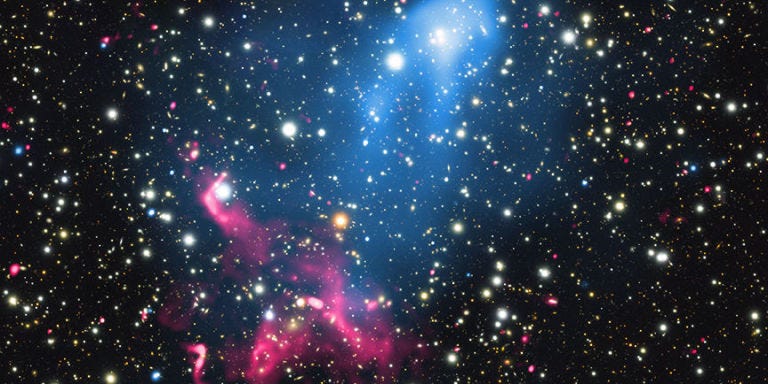
Somewhere in deep space, about two billion light-years from Earth, the universe appears to have built a particle accelerator so enormous that the Large Hadron Collider would need a motivational poster and a very large cup of coffee just to stand next to it. Astronomers studying the colliding galaxy clusters Abell 3411 and Abell 3412 found evidence of a cosmic “double boost” system: first, particles are launched by jets from supermassive black holes; then, they are swept into massive shock waves created as galaxy clusters crash together. The result is one of the most powerful natural particle acceleration systems ever observed.
This discovery is not about a shiny metal ring hidden behind Saturn. It is about galaxy clusters, the largest gravitationally bound structures in the universe, turning into cosmic engines. These structures contain hundreds or thousands of galaxies, enormous reservoirs of dark matter, and clouds of hot gas glowing in X-rays. When clusters collide, they do not politely exchange business cards. They plow through each other, creating shock waves that stretch across millions of light-years and energize particles until they move close to the speed of light.
The phrase “universe’s largest particle accelerator” sounds dramatic, but in this case, dramatic is simply accurate. Instead of superconducting magnets and vacuum tubes, the machinery is made of black hole jets, magnetic fields, superheated plasma, and merger shock waves. Instead of a lab control room, the experiment takes place across a region nearly 10 million light-years wide. Space, as usual, has decided to be extra.
What Did Astronomers Actually Find?
The key system is Abell 3411 and Abell 3412, a pair of galaxy clusters in the constellation Hydra. These clusters are in the process of merging, and that merger has created a spectacular structure visible across multiple wavelengths. NASA’s Chandra X-ray Observatory revealed hot, diffuse gas. Radio telescopes, including the Giant Metrewave Radio Telescope, detected enormous regions of radio emission. Optical observations from the Subaru Telescope showed the galaxies themselves.
When researchers combined those views, they saw a cosmic chain reaction. A supermassive black hole in one of the galaxies had launched jets of energetic particles into space. Those particles were already moving at extreme speeds. Then the collision between the galaxy clusters generated enormous shock waves, similar in concept to sonic booms but on a scale that makes human engineering look like a toy train set. The shock waves re-accelerated the particles, giving them a second kick.
That “one-two punch” is the heart of the discovery. For years, astronomers had observed strange radio structures known as radio relics in merging galaxy clusters. These relics suggested the presence of high-energy electrons spiraling through magnetic fields. The puzzle was how relatively weak cluster shock waves could energize electrons efficiently enough to produce such strong radio signals. Abell 3411 and Abell 3412 offered a compelling answer: the shock waves may not be starting from scratch. They may be re-energizing fossil electrons that were already accelerated by black hole jets.
Why Galaxy Clusters Make Excellent Cosmic Accelerators
To understand why this discovery matters, it helps to compare the cosmic accelerator with a human-made one. CERN’s Large Hadron Collider is the largest and most powerful particle accelerator on Earth, with a 27-kilometer ring that pushes protons or ions close to the speed of light. It is an astonishing machine. It also fits comfortably inside a tiny dot compared with the scale of a galaxy cluster merger.
Galaxy clusters contain vast clouds of hot ionized gas called the intracluster medium. This plasma can reach tens of millions of degrees, making it visible in X-rays. When two clusters collide, the galaxies mostly pass through one another because space is mostly empty. The gas, however, slams together. That collision drives shock fronts through the plasma, compressing and heating it while stirring magnetic fields.
Charged particles caught in those magnetic fields can bounce back and forth across shock fronts. Each crossing gives them a little more energy, a process known as shock acceleration. Imagine a ping-pong ball trapped between two moving paddles, except the paddles are cosmic shock waves and the ping-pong ball is an electron that would absolutely ruin your electronics if it visited your living room.
In Abell 3411 and Abell 3412, the shock waves appear to work together with supermassive black holes. Black holes are often described as cosmic vacuum cleaners, but that nickname is unfair and a little lazy. Many supermassive black holes are also powerful engines. As gas spirals toward them, magnetic fields can channel some material into narrow jets that blast away from the black hole at near-light speed. These jets seed the surrounding space with energetic particles. Later, cluster shocks can sweep up those particles and accelerate them again.
The Role of Radio Relics, X-Rays, and Multi-Wavelength Astronomy
The discovery did not come from a single telescope snapping one lucky picture. It required multi-wavelength astronomy, which is the scientific equivalent of asking several witnesses what happened, then realizing the quiet one in the corner has the best details.
X-rays Reveal the Hot Gas
Chandra’s X-ray vision showed the hot gas inside the merging clusters. In composite images, this gas has a comet-like shape, a sign that one cluster’s atmosphere is pushing through the other. The X-ray data help astronomers locate shock fronts and understand how the cluster collision is unfolding.
Radio Waves Reveal the Energetic Particles
Radio observations reveal synchrotron emission, which occurs when high-energy electrons spiral around magnetic field lines. This is the smoking neon sign of particle acceleration. In Abell 3411 and Abell 3412, radio structures connect with regions influenced by black hole jets, strengthening the case that fossil electrons are being re-accelerated by merger shocks.
Optical Data Show the Galactic Landscape
Optical observations show the galaxies in the clusters, helping researchers map the environment and understand where supermassive black holes may be contributing energy. Put together, X-ray, radio, and optical observations create a layered portrait of a cosmic machine in action.
Why This Discovery Solves a Long-Standing Mystery
Radio relics have been a thorny problem in astrophysics. They are often found in the outskirts of merging galaxy clusters, where shock waves should be present. The basic theory says shocks can accelerate particles. So far, so tidy. The difficulty is that many cluster shocks are relatively weak, at least compared with the violent shock waves from supernova remnants. Yet radio relics can be bright and enormous.
That mismatch raised a question: how can weak shocks create so many high-energy electrons? The Abell 3411-3412 system suggests the answer may be recycling. Supermassive black holes inject energetic particles into the cluster environment. Over time, those particles cool and fade, becoming “fossil” plasma. When a cluster merger sends a shock wave through that region, the old particles get a fresh energy boost. Cosmic recycling: less aluminum can, more relativistic electron.
This scenario helps explain why radio relics often appear near disturbed cluster regions. It also shows that black holes and cluster mergers are not separate stories. They are part of the same cosmic energy economy. A black hole can energize particles on a galactic scale, while a cluster collision can amplify and spread that energy across millions of light-years.
The Newer Twist: Even Larger Particle Clouds
The Abell 3411-3412 discovery remains a landmark because it clearly links black hole jets with cluster shock re-acceleration. But more recent observations have made the story even bigger. Astronomers studying the massive galaxy cluster PLCK G287.0+32.9 reported a record-breaking cloud of energetic particles spanning nearly 20 million light-years. This cluster, located about five billion light-years away, appears to be wrapped in a vast radio glow that fills much more space than earlier observations had revealed.
That newer finding does not replace the Abell 3411-3412 result; it expands the context. It suggests that galaxy clusters may host even more enormous reservoirs of energetic particles than scientists previously thought. In PLCK G287.0+32.9, the particle cloud seems to be energized by giant shock waves and turbulence moving through hot gas between galaxies. The scale is jaw-dropping: nearly 20 times the diameter of the Milky Way.
The deeper message is that particle acceleration in the universe is not limited to neat, compact objects. It can happen across the cosmic web, inside clusters, around black holes, and along shock fronts created as large-scale structures grow. The universe is not just expanding; it is also stirring, colliding, reheating, and occasionally behaving like a physics department with no budget limit.
What Are Cosmic Rays, and How Do They Fit In?
Cosmic rays are high-energy particles, mostly protons and atomic nuclei, that travel through space at nearly the speed of light. Some originate in the Sun, many come from within the Milky Way, and the highest-energy examples may come from extreme extragalactic environments. Supernova remnants can accelerate many cosmic rays, but they struggle to explain the most energetic particles ever detected.
That is why galaxy clusters are so interesting. Their shock waves are huge, their magnetic fields are widespread, and their mergers release staggering amounts of energy over billions of years. A single cluster collision can involve more total energy than almost any event since the Big Bang. If nature wanted a place to build a particle accelerator with ridiculous mileage, a galaxy cluster merger would be a strong candidate.
Still, astronomers are careful. The particles producing radio relics are mainly electrons, while many cosmic rays detected near Earth are protons or heavier nuclei. Electrons are easier to trace through radio emission because they radiate energy as they spiral in magnetic fields. Protons are more stubborn. They can travel longer distances and do not announce themselves as clearly. That leaves plenty of open questions about how cluster shocks accelerate different particle types.
Why This Matters Beyond “Wow, Space Is Big”
The discovery matters because it connects small-scale particle physics with the largest structures in the universe. It shows how microscopic particles can be shaped by cosmic events spanning millions of light-years. That bridge between the tiny and the enormous is one of the most beautiful parts of astrophysics. An electron is small enough to make an atom look spacious, yet its behavior can reveal the history of two colliding galaxy clusters.
It also helps astronomers understand how energy moves through the universe. Galaxy clusters are not static ornaments hanging in space. They grow through mergers and accretion, pulling in gas, galaxies, and dark matter. Their internal environments are turbulent, magnetized, and energetic. Studying particle acceleration in clusters helps researchers model how heat, magnetic fields, cosmic rays, and black hole feedback shape these enormous systems.
There is also a practical scientific payoff. Multi-wavelength studies of cluster mergers improve the way astronomers interpret radio surveys from instruments such as MeerKAT, LOFAR, the VLA, and future observatories. As radio telescopes become more sensitive, scientists are likely to find more faint halos, relics, and megahalos. Some may reveal new versions of the same cosmic acceleration process. Others may force everyone back to the whiteboard, which is science’s favorite form of exercise.
Experiences and Reflections: What This Discovery Feels Like From Earth
Thinking about the universe’s largest particle accelerator is a strange experience because it turns scale into emotion. On Earth, a particle accelerator is a machine with tunnels, magnets, engineers, safety systems, and coffee cups abandoned near keyboards. In deep space, the same basic idea appears as a natural process spread across millions of light-years. The comparison makes human technology feel both tiny and magnificent. Tiny, because our biggest accelerator is microscopic beside a galaxy cluster. Magnificent, because our species figured out enough physics to recognize the same principles operating in both places.
For a reader encountering this topic for the first time, the most memorable part may be the “double boost” idea. A black hole launches particles first. Then a cluster collision accelerates them again. It feels almost cinematic, like a spacecraft using one planet for a gravity assist and another for a final slingshot. Except this is not science fiction choreography. It is plasma physics, gravity, magnetism, and time working together on a stage too large to imagine comfortably.
There is also something humbling about the timescale. The cluster collision did not happen in a dramatic weekend. Galaxy cluster mergers unfold over hundreds of millions to billions of years. The energetic particles we observe today are part of an ancient process. The radio waves reaching our telescopes left their source long before modern humans existed. By the time that signal arrived, Earth had grown cities, satellites, and astronomers capable of saying, “Wait a minute, that looks like a cosmic particle accelerator.” Not bad for a species that still occasionally loses the TV remote.
This discovery also changes how we experience images of space. A colorful composite image is not just pretty wallpaper. Blue X-rays trace hot gas. Pink or red radio emission marks energetic particles. Optical light reveals galaxies. Once you know what the colors mean, the image becomes a map of violence, motion, and invisible forces. It is like learning to read weather radar, except the storm is made of galaxies and the forecast is “shock waves for the next few hundred million years.”
For students, science fans, and casual sky-watchers, the lesson is encouraging: the universe is understandable, but never boring. Every answer opens another door. Abell 3411 and Abell 3412 help explain how radio relics can shine so brightly. PLCK G287.0+32.9 raises new questions about how enormous clouds of particles stay energized across nearly 20 million light-years. The more sensitive our instruments become, the more the universe seems to whisper, “Nice theory. Now look at this.”
That is the real experience of modern astronomy. It is not just collecting facts; it is adjusting your sense of reality. The universe is larger, louder, more energetic, and more interconnected than everyday life suggests. Somewhere far beyond our galaxy, clusters collide, black holes fire jets, shock waves roll through plasma, and particles gain energy in a natural accelerator of almost absurd size. We cannot visit it, repair it, or put a gift shop beside it. But we can observe it, model it, and understand a little more of how the cosmos turns chaos into physics.
Conclusion
Astronomers did not find a giant metal machine floating in space. They found something better: evidence that nature builds particle accelerators from galaxy clusters, black holes, shock waves, magnetic fields, and time. The Abell 3411 and Abell 3412 system shows how particles can receive an initial blast from supermassive black hole jets and then a second boost from cluster merger shock waves. That discovery helps explain mysterious radio relics and gives scientists a clearer view of how energy moves through the largest structures in the universe.
Recent observations of enormous particle clouds around other galaxy clusters, including PLCK G287.0+32.9, suggest that this field is only getting more exciting. The biggest accelerators in the universe may not be rare curiosities. They may be woven into the growth of cosmic structure itself. In other words, the universe has been running high-energy physics experiments for billions of years. We just finally built the telescopes good enough to notice.
Note: This article is based on real astronomy findings from major observatories and research institutions, including NASA’s Chandra X-ray Observatory, Harvard-Smithsonian Center for Astrophysics research, radio telescope observations, and peer-reviewed studies on galaxy cluster shocks, radio relics, and cosmic particle acceleration.