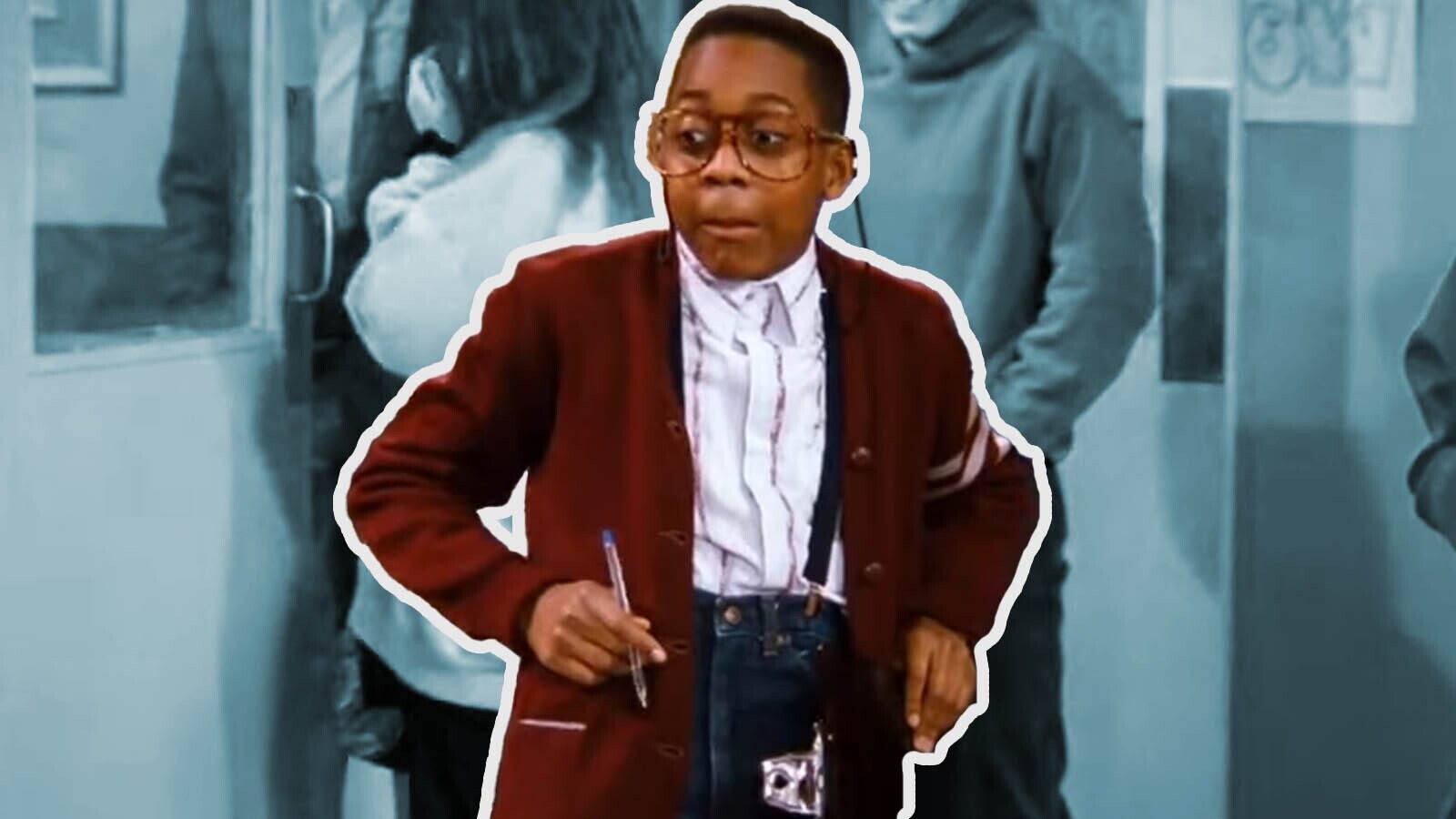
Before Steve Urkel became the high-water mark of 1990s sitcom nerd-dom, before the suspenders became a visual warning sign, before every broken lamp in America seemed to whisper “Did I do that?” in a nasal squeak, Family Matters had a problem: its breakout character needed the right verbal button.
That may sound simple. Give the kid with the giant glasses a funny line. Let him knock over a plant. Print the T-shirts. Retire early. But sitcom history is littered with forced catchphrases that landed with all the grace of Urkel entering a china shop on roller skates. The surprising thing about Steve Urkel’s signature line is not just that it worked. It is that other lines were tested firstand compared to “Did I do that?”, they feel like alternate-universe relics from a TGIF laboratory where someone spilled orange soda on the script.
Jaleel White, who played Urkel from 1989 to 1998, later explained that producers tried multiple catchphrases before finding the one that stuck. Some were polite. Some were borrowed. Some involved cheese. None had the perfect mix of guilt, innocence, chaos, and nasal musicality that turned “Did I do that?” into one of the most recognizable sitcom catchphrases of the decade.
Why Steve Urkel Needed a Catchphrase in the First Place
Family Matters began as a Winslow family sitcom, a warm spin-off from Perfect Strangers centered on Harriette Winslow, her husband Carl, and their children in Chicago. Steve Urkel was not originally designed to swallow the show whole like a cardigan-wearing black hole. He arrived as a guest character: the awkward neighbor, the nightmare date, the kid who seemed genetically engineered to irritate Carl Winslow.
Then something happened. The audience reacted. White’s performance had that rare sitcom spark: instantly readable, physically specific, and loud enough to bounce off the back row without needing a translator. Urkel’s hunched walk, high voice, enormous glasses, too-short pants, and relentless confidence made him more than a stock nerd. He was a one-boy weather event.
Once a side character starts pulling focus, producers naturally look for repeatable comedy. In sitcom language, that often means a catchphrase. A good catchphrase does not merely repeat; it announces the character’s entire operating system. Fonzie had “Ayy.” J.J. had “Dyn-o-mite!” Bart Simpson had several. Urkel needed something that made sense after he destroyed furniture, offended Laura, wandered into the Winslow kitchen uninvited, or accidentally turned a normal evening into a property-insurance claim.
The Rejected Steve Urkel Catchphrases
The rejected Steve Urkel catchphrases are funny partly because they reveal how close the show came to missing the bullseye. They were not all terrible ideas in isolation. They simply were not Urkel’s soul in miniature.
“Excuse Me” Too Polite for a Human Disaster Zone
One early attempt had Steve bumping into objects, knocking them over, and saying “Excuse me.” On paper, this has logic. Urkel is formal, fussy, and oddly sincere. He absolutely would apologize to an end table as if it had social standing.
The problem is that “Excuse me” is too small. It is a napkin of a catchphrase. It wipes up the mess but does not explain the mess. When Steve knocks over a lamp, “Excuse me” makes him seem mildly courteous. “Did I do that?” makes him seem like a walking contradiction: brilliant enough to build inventions, oblivious enough to deny physics.
Comedy needs escalation. “Excuse me” ends the joke. “Did I do that?” reopens it, turns to the audience, and gives them permission to laugh at both the accident and the ridiculous innocence of the culprit.
“I’ve Fallen, and I Can’t Get Up” Too Borrowed to Belong to Urkel
Another tested line was “I’ve fallen, and I can’t get up,” a phrase already famous from medical-alert commercials of the era. It was everywhere in late-1980s and early-1990s pop culture, which made it recognizablebut also made it feel secondhand.
That is the catchphrase equivalent of showing up to prom in someone else’s tuxedo with their name still written on the tag. Audiences might laugh because they knew the reference, but the line could never fully belong to Steve Urkel. It carried the baggage of the commercial, not the personality of the character.
Urkel did not need to borrow a meme before memes had a name. He needed his own. “Did I do that?” worked because it was flexible, original to the character’s rhythm, and endlessly reusable. It did not depend on the audience remembering another advertisement. It depended on the audience knowing Steve.
“Do You Have Any Cheese?” The Snack-Based Mystery
Then there is the cheese line, remembered in Urkel lore in slightly different forms, including “Do you have any cheese?” or “Got any cheese?” This one is fascinating because it feels almost too weird to dismiss. Steve Urkel asking for cheese is exactly the kind of absurd detail a 1990s sitcom might decide is comedy gold after three cups of writers’ room coffee.
But as a defining catchphrase, cheese has a problem: it does not connect to the central joke. Urkel was not famous because he was hungry. He was famous because he was socially fearless, physically clumsy, scientifically ambitious, romantically doomed, and somehow impossible to defeat. Cheese does not capture that. It sounds less like a character-defining line and more like something a lunchbox would say if it gained consciousness.
Still, the cheese line deserves respect. It represents the experimental phase of Urkelmania, when producers understood they had something big but were still poking it with a stick to see what sound it made.
Why “Did I Do That?” Beat Them All
“Did I do that?” wins because it is perfectly engineered for Steve Urkel. It is short. It is musical. It arrives after chaos. It contains denial, guilt, surprise, and a tiny pinch of self-admiration. Most importantly, it gives Jaleel White room to perform.
The phrase is ordinary on the page. Anyone can say it. But Urkel’s version was not just words; it was a full-body apology with plausible deniability. The eyes widened. The shoulders tightened. The voice climbed into that unforgettable squeak. The line did not ask the audience for forgiveness. It asked the audience to admire the wreckage.
That is why the live studio audience mattered. In the 1990s sitcom world, a line either worked in the room or it limped back to the writers’ table wearing a tiny cast. White has said that audience reaction helped determine what survived. “Did I do that?” survived because it triggered immediate recognition. Viewers understood the joke before the laugh track finished breathing.
The Anatomy of a Great Sitcom Catchphrase
A strong sitcom catchphrase usually has three ingredients: character truth, repeatability, and performance flavor. “Did I do that?” has all three.
First, it tells the truth about Steve. He is almost always responsible for the problem, but he is rarely malicious. Second, it can be repeated in dozens of situations: broken furniture, failed inventions, social disasters, dance mishaps, and Carl Winslow meltdowns. Third, it depends on White’s delivery. Without that voice and timing, the line would be ordinary. With them, it becomes a pop-culture ringtone stuck in the national brain.
The rejected lines fall short in different ways. “Excuse me” has character but not enough comic charge. “I’ve fallen, and I can’t get up” has recognition but not ownership. “Do you have any cheese?” has oddness but not meaning. “Did I do that?” has everything: setup, punchline, confession, and escape hatch.
Urkelmania and the Business of Being Quotable
Once Steve Urkel exploded, he became more than a character. He became a brand. The early 1990s saw Urkel dolls, merchandise, cereal, posters, clothing, and enough suspenders to make every school photo look like a junior accounting convention. The talking doll even leaned into Urkel’s verbal identity, proving that the character’s voice was as marketable as his look.
This matters because catchphrases are not just jokes. They are portable pieces of a show. A viewer can quote them at school, on the playground, at the mall, or in the family room. They turn television into social currency. When someone said “Did I do that?”, they were not merely quoting Family Matters. They were performing Urkel, even if their impression sounded like a goose arguing with a bicycle horn.
That portability helped the character outgrow his original function. Steve was not just the neighbor anymore. He became the comic engine, the marketing hook, the Halloween costume, the lunchroom impression, and eventually the reason many people remember Family Matters first as “the Urkel show.”
The Risk of a Catchphrase Becoming Too Powerful
Of course, a successful catchphrase can become a blessing wearing noisy shoes. For Jaleel White, Steve Urkel was career-making, but also defining. When a child actor becomes permanently attached to one voice, one walk, and one line, the audience can become stubborn. They may love the character so much that they refuse to see the actor behind him.
White has spoken over the years about the complexity of growing up with that kind of fame. Urkel gave him opportunities, awards, and cultural permanence, but also the burden of typecasting. The same line that made audiences roar could become a shadow he had to outrun as an adult performer.
That is the strange magic of “Did I do that?” It belongs to Steve Urkel, but it also belongs to television history. It is funny, but it is not disposable. It reminds us how much performance can transform plain language into cultural memory.
What the Rejected Lines Teach Us About Comedy
The rejected Steve Urkel catchphrases teach a useful lesson: comedy often looks obvious only after it works. Today, “Did I do that?” feels inevitable. Of course that was the line. Of course the audience laughed. Of course the kid in suspenders became a 1990s icon.
But inevitability is usually edited history. Behind most famous lines are failed attempts, awkward drafts, and jokes that sounded better near the vending machine than in front of 200 people. The creative process is messy. Sometimes the writers try politeness. Sometimes they borrow a commercial slogan. Sometimes they ask the nerd if he wants cheese. Then, finally, someone finds the phrase that clicks.
That is why these rejected catchphrases are worth remembering. They make the final version look even better. “Did I do that?” was not merely lucky. It was the right phrase meeting the right performer at the right cultural moment, with a live audience ready to vote by laughing.
Experience Section: Why This Catchphrase Still Feels So Familiar
Part of the reason “Did I do that?” still works is that everyone has lived a tiny Urkel moment. Maybe not the full version. Most people have not destroyed a neighbor’s living room, built a transformation chamber, or pursued their crush across nine seasons with the emotional stamina of a cartoon coyote. But everyone has caused a small disaster and hoped, for one beautiful second, that nobody noticed.
You bump a glass of water with your elbow. You send a text to the wrong group chat. You press the wrong button during a presentation and suddenly the screen is sharing your desktop, your music player, and your questionable file-naming system. In that frozen second, the spirit of Steve Urkel appears beside you in suspenders and whispers, “You know what to say.”
That is the everyday power of the line. It turns embarrassment into theater. Instead of simply being the person who made a mistake, you become the star of a tiny sitcom scene. The phrase gives you a way to survive the awkwardness with humor. It says, yes, something went wrong, and yes, I am probably responsible, but let us all enjoy the absurdity before Carl Winslow starts yelling.
For viewers who grew up with TGIF, the catchphrase also carries the feeling of appointment television. Friday night meant family sitcoms, snack bowls, carpeted living rooms, and theme songs that sounded like optimism had learned to clap. A line like “Did I do that?” did not live only inside the show. It followed viewers into school hallways and family conversations. Someone would drop a pencil case, miss a basketball shot, or knock over a chair, and there it wasthe Urkel voice, summoned like a goofy national anthem.
In that sense, the rejected catchphrases feel like paths not taken in our collective memory. Imagine a world where kids spent the 1990s saying “Excuse me” after every accident. Polite? Yes. Iconic? Absolutely not. Imagine Steve Urkel becoming known for “Do you have any cheese?” America might have survived, but dairy marketing would never have been the same. “Did I do that?” gave audiences something better: a compact ritual for laughing at harmless chaos.
The line also ages well because it is not mean. A lot of comedy catchphrases depend on insult, swagger, or superiority. Urkel’s line is funny because it is vulnerable. He is not mocking someone else. He is standing in the ruins of his own mistake, trying to look innocent while wearing pants that are already an admission of guilt. That softness makes the joke easier to revisit. It belongs to a kind of sitcom comedy where embarrassment could be loud, silly, and oddly comforting.
Today, social media manufactures catchphrases at terrifying speed. A sound goes viral on Monday, becomes a brand post on Wednesday, and feels ancient by Friday. “Did I do that?” came from a slower machine: writers, actors, a studio audience, weekly viewing habits, and repeated exposure over years. It stuck because people had time to live with it. They heard it, copied it, exaggerated it, and passed it around without hashtags or algorithmic CPR.
That is why the rejected lines are more than trivia. They show how fragile pop culture can be. One tiny choice can shape decades of memory. If the show had gone with “Excuse me,” Steve Urkel might still have been funny, but he would have lost the perfect punctuation mark. “Did I do that?” gave the character his comic signature, and it gave audiences a phrase for every small, ridiculous, deeply human mess we accidentally create.
Conclusion
The rejected Steve Urkel catchphrases are delightful little fossils from the evolution of a sitcom icon. “Excuse me” was too mild. “I’ve fallen, and I can’t get up” was too borrowed. “Do you have any cheese?” was too random, though it deserves a place in the Museum of Brave Television Choices. But “Did I do that?” captured the exact frequency of Steve Urkel: guilty, innocent, irritating, adorable, and somehow proud of the disaster smoking behind him.
Great catchphrases cannot simply be forced into existence. They have to fit the character, serve the joke, and survive contact with a real audience. In Steve Urkel’s case, the line that worked became more than a punchline. It became a shorthand for 1990s sitcom comedy, a tribute to Jaleel White’s performance, and a reminder that sometimes the best pop-culture moments arrive only after the bad ideas trip over the coffee table first.
Note: This article is based on publicly reported interviews, entertainment reporting, television-history coverage, and pop-culture analysis. Source links are intentionally omitted from the body for clean web publishing.