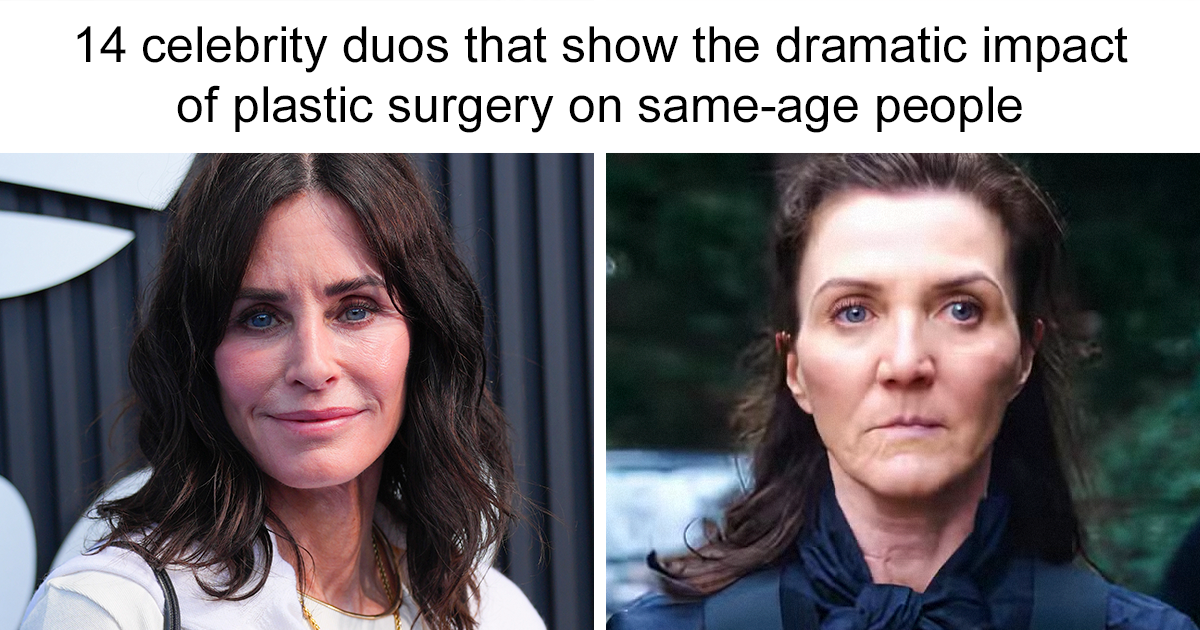
There is something oddly hypnotic about looking at two celebrities who are the same age and realizing they seem to be aging in completely different visual languages. One face may look sculpted, polished, lifted, and red-carpet ready at 9 a.m. on a Tuesday. Another may look softer, more relaxed, more expressive, and perhaps more obviously touched by time. Cue the internet: “Wait, they’re the same age?” Cue everyone else: “Please let me check my own mirror in terrible bathroom lighting.”
The title “The Striking Impact Of Plastic Surgery On Same-Age Celebrities In 14 Pairs Of Photos” sounds like a gallery built for shock value, but the real story is more interesting than a before-and-after gasp. Celebrity appearance is shaped by plastic surgery, yes, but also by injectables, skincare, lighting, genetics, weight changes, stress, sleep, styling, money, camera lenses, makeup artists, photo editing, and the tiny miracle known as standing next to someone with worse overhead lighting.
Most importantly, photos are not medical records. Unless a celebrity has publicly confirmed a procedure, it is unfair to state as fact that they had surgery. Still, same-age celebrity comparisons can reveal something powerful about modern beauty culture: we are no longer simply watching people age. We are watching people choose, resist, revise, regret, celebrate, conceal, or openly discuss cosmetic procedures under the world’s brightest spotlight.
Why Same-Age Celebrity Comparisons Go Viral
Same-age celebrity photo pairs work because they create instant contrast. A 61-year-old actor standing next to another 61-year-old actor becomes a mini social experiment. People start looking for clues: smoother forehead, fuller cheeks, tighter jawline, lifted eyelids, sharper nose, different lips, fewer expression lines, or a face that appears surprisingly unchanged across decades.
But the comparison is often unfair from the beginning. A magazine cover is not the same as a paparazzi shot outside a grocery store. A studio portrait with professional lighting cannot be compared honestly with a candid airport photo taken while someone is carrying three bags and emotionally negotiating with TSA. Makeup, hair color, posture, and camera angle can visually “subtract” or “add” years before any cosmetic procedure enters the chat.
That said, cosmetic procedures can absolutely change how aging appears. Dermal fillers can restore volume in areas that naturally hollow with age. Botulinum toxin can soften lines caused by repeated muscle movement. A facelift may reposition deeper facial tissue rather than simply pulling skin. Laser resurfacing can improve skin texture and pigmentation. When these tools are used conservatively, the result may look like rest, health, and good lighting. When overdone, the result can look stiff, puffy, overly tight, or oddly disconnected from the person’s age, body, and natural expressions.
The 14 Photo-Pair Lessons: What Same-Age Celebrity Comparisons Really Show
1. Smooth Skin Is Not the Same Thing as Youth
One common reaction to celebrity plastic surgery photos is, “They look so young.” But youth is not just smooth skin. A youthful face also moves freely, has balanced volume, and matches the person’s energy. Sometimes a very smooth forehead on an older face creates a visual mismatch, especially if the mouth, neck, hands, or eyes tell a different story. The best work is often the work people do not notice.
2. Volume Can Be Friend or Foe
Facial aging often involves volume loss, especially around the cheeks, temples, and under-eyes. Fillers can help restore that volume, which is why they became so popular. The tricky part is moderation. Too little may not make much difference; too much can create the famous “pillow face” look that social media loves to diagnose from a single red-carpet photo. A same-age pair can make this contrast obvious: one face looks gently supported, while another looks inflated rather than refreshed.
3. The Jawline Has Become a Celebrity Battleground
In many same-age comparisons, the jawline attracts the most attention. A crisp jaw can come from genetics, weight, dental structure, makeup contouring, photo retouching, or surgery. Facelifts and neck lifts can also sharpen the lower face. This is one reason “deep plane facelift” discussions have become so common in beauty media. The modern goal is usually not the old-fashioned pulled look, but a more natural repositioning of facial tissues.
4. Eyes Reveal More Than Foreheads
Brows, eyelids, and under-eyes can change dramatically with age. Some celebrities appear more alert because of makeup, false lashes, brow styling, or lighting. Others may have publicly discussed eyelid surgery, brow lifts, or nonsurgical treatments. In same-age photo pairs, the eyes often reveal whether the face still looks expressive. A perfectly smooth face that cannot show surprise, sadness, joy, or mischief may photograph well but perform poorly in motion.
5. A Natural Look Is Often Highly Produced
One of the funniest myths online is that “natural aging” means doing absolutely nothing. Many celebrities who look natural may still use excellent dermatologists, sunscreen, lasers, facials, prescription skincare, nutritionists, trainers, sleep coaches, glam teams, and lighting so flattering it deserves its own agent. Natural-looking does not always mean untouched. It often means subtle, consistent, expensive maintenance.
6. Public Honesty Changes the Conversation
Stars such as Courteney Cox, Jane Fonda, Kris Jenner, Sharon Osbourne, Marc Jacobs, and others have publicly discussed cosmetic procedures, regrets, or recoveries. Their openness makes the conversation less creepy and more human. Instead of forcing fans to play detective with zoomed-in photos, public honesty allows a better discussion about pressure, confidence, risk, and personal choice.
7. Regret Is Part of the Story
Plastic surgery is often marketed as empowerment, and for many people it can be. But regret exists too. Some celebrities have said they went too far with fillers, disliked a facelift result, or felt pressured by an industry obsessed with youth. Same-age photo comparisons should not become a courtroom. They should remind readers that cosmetic procedures are real medical decisions, not casual Instagram filters with anesthesia.
8. Men Are in the Conversation Too
Celebrity plastic surgery discussions often focus on women, partly because women face harsher beauty standards. But men in Hollywood are not immune. Hair restoration, eyelid procedures, jawline treatments, Botox, fillers, and facelifts are increasingly discussed among male public figures. Same-age male celebrities can show the same split: one appears rugged and weathered, another appears unusually polished, and both may be responding to industry pressure in different ways.
9. Makeup Can Imitate Surgery
A skilled makeup artist can visually lift eyes, sharpen cheekbones, narrow a nose, reshape lips, and carve a jawline without a scalpel. Contouring and strategic highlighting can make a face look dramatically different in photos. This is why claiming “plastic surgery” based on one image is risky. Sometimes the procedure is not a procedure. Sometimes it is bronzer with a master’s degree.
10. Weight Loss Can Be Mistaken for Cosmetic Work
Major weight changes can alter the face quickly. Weight loss may make cheekbones sharper and the lower face looser. Weight gain may soften lines and add facial fullness. A celebrity who looks different at the same age as a peer may not have had surgery at all. They may simply be living in a different body composition, health phase, or stress season.
11. The Neck Often Tells a Different Story
The face may receive the most attention, but the neck is usually less forgiving. This is why neck lifts, laser treatments, and skin-tightening procedures are so popular. In same-age celebrity photos, the face and neck sometimes appear to age at different speeds. That contrast can make cosmetic work look more visible, especially when the face is extremely smooth but the neck has more natural texture.
12. Trends Age Too
Every era has its beauty fingerprint. The 1980s loved bold glamour. The 1990s loved thin brows and matte everything. The 2000s were complicated, and our eyebrows are still filing complaints. Recent years brought fuller lips, sharper jawlines, lifted eyes, and “snatched” facial structure. The problem is that surgical and injectable trends do not always age gracefully. What looks fashionable at 35 may look less harmonious at 55.
13. Subtle Work Usually Wins Long-Term
When people praise a celebrity for “aging beautifully,” they may be praising restraint without realizing it. The most successful cosmetic work tends to preserve identity. The person still looks like themselves, just rested, balanced, and camera-ready. The biggest compliment after good work is not “Who is your surgeon?” It is “Did you just come back from vacation?”
14. The Best Comparison Is Not Who Looks Younger
The healthiest question is not “Who looks younger?” It is “Who looks comfortable in their face?” Some celebrities choose surgery and feel fantastic. Others avoid it and feel equally strong. Some try procedures, change their minds, dissolve fillers, or stop. The real impact of plastic surgery is not just visual; it is emotional, cultural, professional, and deeply personal.
Specific Celebrity Examples That Shaped the Conversation
Courteney Cox has become one of the most-cited examples in celebrity filler conversations because she openly discussed having fillers dissolved and realizing that small changes can add up gradually. Her story resonates because it is not framed as scandal. It is framed as recognition: sometimes the mirror adjusts slowly, while old photos reveal the truth all at once.
Jane Fonda has also spoken honestly about having a facelift and later expressing discomfort with that choice. Her comments matter because she has spent decades in an industry that rewards youth while pretending aging is a personal failure. Fonda’s honesty gives readers something more useful than gossip: a reminder that even icons can feel pressure, make decisions, and later revise how they feel about them.
Kris Jenner represents another version of the conversation: transparency without apology. Her cosmetic procedures have been part of reality television and public discussion for years. For some fans, that openness is refreshing. For others, it raises questions about how normalized surgical maintenance has become in celebrity families. Either way, her example shows that plastic surgery is no longer hidden in Hollywood the way it once was.
Cindy Crawford offers a useful counterpoint. She has publicly discussed feeling tempted by facelifts while also choosing less invasive options and emphasizing personal choice. That middle ground may be the most realistic place for many people: curious, cautious, aware of pressure, and not interested in turning aging into a full-time combat sport.
The Medical Reality Behind the Glamour
Cosmetic procedures exist on a wide spectrum. At one end are nonsurgical treatments such as Botox, fillers, lasers, chemical peels, and skin-tightening devices. At the other are surgical procedures such as facelifts, neck lifts, eyelid surgery, rhinoplasty, implants, and fat transfer. The public often throws all of these into one bucket called “plastic surgery,” but they differ in cost, downtime, risk, reversibility, and outcome.
Botulinum toxin treatments temporarily relax certain muscles and can soften dynamic wrinkles, especially around the forehead and eyes. Fillers can restore volume or reshape areas such as the lips, cheeks, temples, and jawline. Lasers may improve texture, discoloration, scars, and fine lines. Facelifts can reposition deeper tissue and address sagging, but they are still surgery, with real recovery time and real medical risks.
This is the part glossy celebrity galleries often skip. Cosmetic surgery may be elective, but it is not imaginary medicine. Risks can include infection, scarring, bleeding, nerve changes, anesthesia complications, poor wound healing, and dissatisfaction with results. Fillers can cause swelling, bruising, asymmetry, infection, and, rarely, serious vascular complications. Choosing a qualified, licensed, experienced medical professional matters far more than chasing a discount or a trending face shape.
Why These Photos Hit a Nerve
Same-age celebrity photos fascinate us because they touch a private fear: “Am I aging correctly?” The answer, thankfully, is that there is no single correct way to age. There is only aging with more pressure or less pressure, more intervention or less intervention, more privacy or less privacy. Celebrities simply do it in public, under lighting that turns every pore into a breaking-news event.
The danger is turning photo comparisons into beauty math. If one 58-year-old looks 45 and another looks 62, the internet may declare a winner. That is a shallow game. A face is not a scoreboard. It carries expressions, history, grief, laughter, illness, recovery, stress, confidence, and sometimes excellent eyeliner.
The better takeaway is visual literacy. When you see a dramatic celebrity transformation, ask better questions. Was the photo edited? Is the lighting different? Has the person lost weight? Are they wearing different makeup? Did they confirm any procedure? Are we comparing a red-carpet image to a candid shot? Is the commentary respectful, or is it just age-shaming wearing a fake lab coat?
Experience Notes: What These Celebrity Photo Comparisons Teach in Real Life
Anyone who has ever compared two photos of themselves taken five minutes apart knows the truth: the camera is a liar with confidence. One photo says, “You are glowing.” The next says, “Have you considered becoming a mysterious forest creature?” This is why celebrity photo comparisons should be handled with caution. If lighting can betray ordinary people at a birthday dinner, imagine what it can do to celebrities photographed thousands of times a year.
Real-life experience also shows that people rarely want cosmetic treatments for one simple reason. Some want to look less tired. Some want to restore a feature they had before weight loss, illness, stress, or aging. Some want to feel more aligned with how they see themselves inside. Others are reacting to pressure from social media, dating, work, or a culture that keeps moving the beauty goalpost and then charging admission to chase it.
The healthiest conversations happen when people separate curiosity from judgment. It is fair to be interested in how cosmetic procedures affect appearance. It is not fair to mock someone’s face, demand confessions, or treat aging like a public mistake. A celebrity who chooses surgery is not automatically insecure. A celebrity who refuses it is not automatically morally superior. Both may simply be making personal choices inside an industry that can be brutal about age.
For readers considering cosmetic procedures, celebrity photos can be inspiration, but they should never be a blueprint. A good consultation should be about anatomy, health, expectations, budget, recovery, and risk. Bringing in a photo of a celebrity jawline or nose may help explain a preference, but the goal should be harmony with your own face, not renting someone else’s features. Faces are not copy-and-paste documents. Thank goodness, because most of us still have enough trouble formatting an email.
For readers who do not want any cosmetic work, these comparisons can be freeing too. They reveal that aging naturally is not “letting yourself go.” It is simply one valid path. Lines can be evidence of expression. Texture can be normal. A changing face can still be charismatic, stylish, attractive, and powerful. The presence of plastic surgery in celebrity culture does not mean everyone must participate.
The best experience-based lesson is balance. Enjoy the photos. Notice the differences. Appreciate the artistry of subtle work and the confidence of natural aging. Laugh at the absurdity of pretending famous people wake up looking like magazine covers. But do not turn someone else’s face into a weapon against your own. Plastic surgery can change a face, but it should not define a person’s worth. Same-age celebrity comparisons are most useful when they teach us to look more closely, think more kindly, and remember that beauty is not a race against time. It is a relationship with the face you live in.
Conclusion
The striking impact of plastic surgery on same-age celebrities is not just about who looks younger in 14 pairs of photos. It is about how fame, beauty standards, medical technology, money, personal choice, and public judgment collide on the human face. Some celebrities use cosmetic procedures openly. Some regret them. Some avoid them. Some say nothing at all, which is also their right.
The smartest way to view these comparisons is with curiosity and compassion. Plastic surgery can create dramatic changes, but photos can mislead, trends can distort expectations, and aging is not a flaw to be solved. Whether a celebrity looks sculpted, untouched, refreshed, tired, radiant, or simply human, the real lesson is clear: faces change, culture changes, and the kindest gaze is usually the most accurate one.