Note: This article is based on publicly available U.S. Navy, GAO, congressional, defense-industry, and reputable defense-news reporting. It is written as original web content and contains no source-link placeholders.
The U.S. Navy’s Littoral Combat Ship program has never had an easy voyage. It was supposed to be the sleek, fast, modular answer to coastal warfare: a ship that could zip through shallow waters, chase small boats, hunt mines, and swap mission packages like a tactical Swiss Army knife. Instead, the LCS has often looked less like the future of naval warfare and more like a very expensive group project where everyone forgot to read the instructions.
The latest headache is especially awkward because it attacks the very feature that made the Littoral Combat Ship famous: speed. Several Independence-class LCS hulls have experienced structural cracking, and in certain sea conditions, restrictions have reportedly limited some ships to around 15 knots. That is a dramatic drop for vessels associated with 40-plus-knot performance. When a warship designed to sprint has to tiptoe through the waves, the problem is not cosmetic. It is operational.
This is not simply a “ship got a scratch” story. Hull cracks affect readiness, deployment planning, maintenance costs, sailor confidence, and the Navy’s ability to justify a program already criticized for cost growth, mission-module delays, survivability concerns, and early retirements. In other words, the LCS has collected more controversy than a group chat during Thanksgiving dinner.
What Is the Littoral Combat Ship?
The Littoral Combat Ship, usually shortened to LCS, is a class of small U.S. Navy surface combatants designed for operations close to shore. “Littoral” refers to coastal waters, where threats can include mines, diesel-electric submarines, fast attack craft, drones, and land-based missiles. The Navy wanted a ship that could move quickly, operate in shallow areas, and perform focused missions with modular packages.
The program produced two very different variants. The Freedom class is a steel monohull design associated with Lockheed Martin and Fincantieri Marinette Marine. The Independence class is an aluminum trimaran built by Austal USA in Mobile, Alabama after the first two ships. Both were intended to offer speed, flexibility, and lower cost compared with larger combatants such as destroyers.
On paper, the idea was attractive. Instead of building one large ship packed with every possible weapon and sensor, the Navy could build smaller vessels and change their capabilities depending on the mission. Need mine countermeasures? Load the mine package. Need surface warfare? Use that package instead. In theory, it sounded efficient. In practice, the mission packages were delayed, some capabilities underperformed, and the “plug-and-fight” dream became more complicated than expected.
The Hull Crack Problem: Why Speed Became the Warning Light
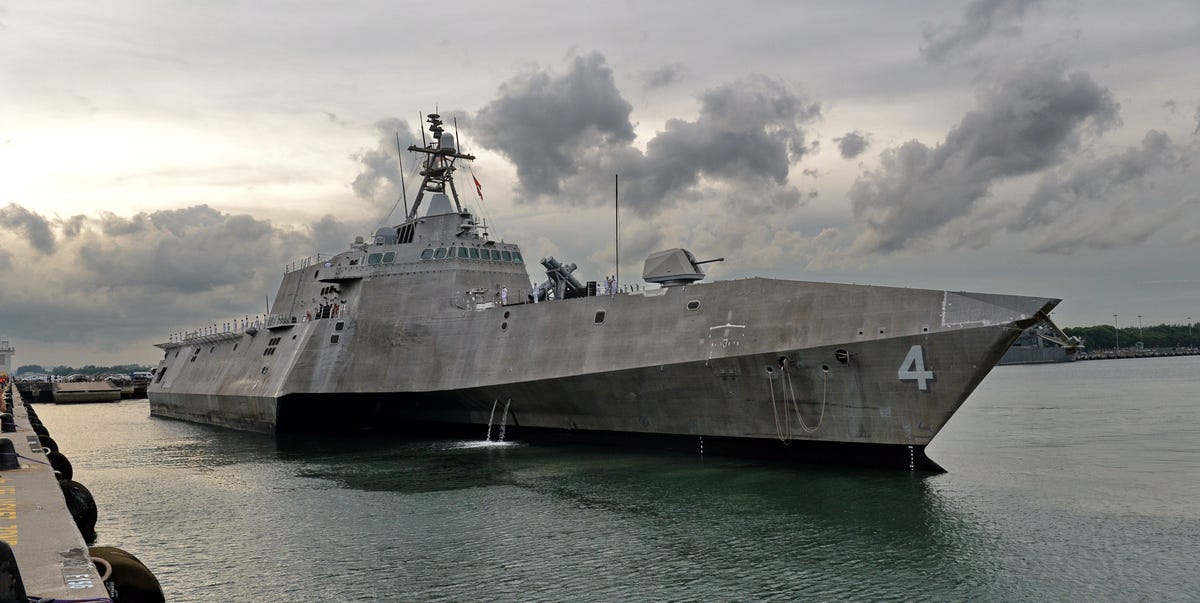
The hull cracking issue has been most closely associated with the Independence-class LCS, the distinctive aluminum trimaran with a wide beam and futuristic profile. Reports indicated that cracks appeared in high-stress areas where deck and shell plating meet. The Navy has said the cracks did not present a direct safety risk to sailors, but documents and reporting showed that certain operating conditions could cause crack growth.
The most eye-catching restriction involved avoiding speeds above about 15 knots in seas with wave heights around eight feet. For a ship class built around high speed and rapid response, that is a serious limitation. Fifteen knots is not useless; many naval ships transit efficiently at moderate speeds. But for the LCS, speed is not a decorative brochure feature. It is central to the concept.
The LCS was meant to race into coastal zones, reposition quickly, evade certain threats, support distributed operations, and provide flexible presence. A speed restriction changes the tactical math. If a ship cannot reliably use its designed performance envelope in rougher conditions, commanders must plan around that weakness. That means route changes, slower response times, reduced availability, and potentially more reliance on other ships.
Why Hull Cracks Matter More Than They Sound
A crack in a ship’s structure is not like a cracked phone screen. You cannot slap on a screen protector and call it “character.” Warships live in a brutal environment. Waves repeatedly flex the hull. Saltwater attacks materials. Engines vibrate. Heavy equipment shifts loads across decks. Combat ships also face shock, impact, and fatigue over years of service.
When cracks appear in high-stress areas, engineers must ask several questions: How fast are they growing? Are they limited to one design detail or part of a broader structural issue? Do they affect mission equipment, watertight integrity, or long-term fatigue life? Can repairs be made during routine maintenance, or do they require major shipyard availability? How much weight will reinforcement add?
The reported fix involved replacing deck plate and shell plate with thicker material, among other actions. That sounds straightforward until you remember this is a naval vessel, not a backyard shed. Cutting out and replacing structural plating is complex work. It can require dry-docking or major maintenance periods, specialized labor, inspections, testing, and certification. Every day in the yard is a day the ship is not fully available to the fleet.
The Independence Class: Fast, Wide, and Structurally Demanding
The Independence-class LCS is visually striking. Its trimaran hull has a central hull and two smaller side hulls, giving it a very wide deck and large internal mission space. That design offers advantages: stability, aviation space, mission-bay volume, and shallow draft. It looks like something a science-fiction admiral would order after three cups of coffee.
But the same design choices also create engineering challenges. Aluminum saves weight, which supports speed and payload. However, aluminum structures require careful design and fatigue management. The trimaran form can experience complex loads from waves, especially as the main hull and side hulls interact with the sea in different ways. The bigger and faster the ship, the more important structural margins become.
The LCS program’s emphasis on speed and rapid acquisition left critics arguing that the Navy accepted too much risk too early. Testing, maintenance experience, and real-world operations gradually revealed problems that were harder to solve once ships were already built. The hull cracking issue fits that broader pattern: design ambition meeting saltwater reality.
USS Omaha and the Real-World Impact
USS Omaha became one of the most discussed examples connected to the cracking reports. The ship was reportedly subject to a temporary standing order limiting speed under certain sea-state conditions. That matters because Omaha was not an ancient vessel limping into retirement. It was a relatively young ship, commissioned in 2018, and part of a class expected to provide useful service for decades.
The problem with restrictions is that they do not only affect one mission. They affect planning culture. If commanders know a vessel may need to slow dramatically in rough seas, they must account for it when assigning patrol areas, coordinating with other ships, scheduling maintenance, or responding to time-sensitive events. A high-speed ship that cannot count on high speed becomes a different asset.
That does not mean every affected LCS is useless. Ships can still perform tasks, especially in calmer waters or lower-threat missions. But the Navy does not buy warships to be useful only on polite days when the ocean is in a good mood. The sea has never been known for its customer service.
Another Problem in a Long List of LCS Troubles
The hull cracks did not arrive in isolation. They landed on a program already carrying a heavy backpack of criticism. The Freedom-class ships suffered major propulsion and combining-gear problems that affected reliability and delivery. The mission-module concept took far longer than hoped. The anti-submarine warfare package was canceled for the LCS. Mine countermeasure systems faced years of development and testing issues. Several early ships were retired far ahead of their expected service lives.
The Navy originally promoted the LCS as a lower-cost, flexible vessel that would help expand the fleet. But sustainment costs, repair demands, and capability gaps complicated that story. The Government Accountability Office repeatedly warned that the Navy had not fully demonstrated the operational and warfighting capabilities needed for LCS missions and that cost estimates and sustainment planning needed improvement.
In plain English, the LCS became a lesson in how a good idea can become painfully expensive when technology, requirements, testing, and fleet needs do not line up neatly. The Navy wanted speed, modularity, affordability, and rapid delivery. Getting all four at once turned out to be like asking for a sports car, pickup truck, submarine detector, minehunter, and budget-friendly commuter in the same parking space.
Why Speed Was So Central to the LCS Concept
Speed was not just marketing glitter. It was supposed to help the LCS survive and succeed. A fast ship can reposition quickly, respond to threats, intercept small craft, cover larger patrol areas, and complicate an enemy’s targeting process. In coastal waters, where geography can compress reaction times, mobility matters.
The LCS also depended on speed because it was not built like a heavily armored battleship. Modern warships rarely rely on armor in the old-fashioned sense, but larger surface combatants generally have more robust sensors, weapons, redundancy, and survivability features. The LCS concept leaned heavily on avoiding danger, operating with networked forces, and using mission-specific tools.
If a speed restriction removes a major tactical advantage, the ship’s weaker points become more visible. Limited air defense, modest armament compared with frigates and destroyers, and survivability concerns all become harder to overlook. A fast lightly armed ship is one thing. A slower lightly armed ship is another conversation entirely.
Repairing the Ships: Possible, but Not Painless
The Navy and Austal developed revised structural configurations for ships still under construction or warranty, while affected in-service ships require fixes through maintenance and modernization schedules. Strengthening plates and modifying high-stress areas can reduce crack growth and restore confidence, but repairs come with trade-offs.
First, there is cost. Structural repairs are not cheap, and the total expense can be difficult to estimate until each ship is inspected and planned individually. Second, there is time. Shipyard availability is already a bottleneck across the Navy. Third, there is weight. Thicker material can strengthen a structure, but added weight may affect performance, fuel use, range, and margins for future upgrades.
Warship design is always a negotiation with physics. Add more strength, and you may add weight. Add more speed, and you may increase stress. Add more weapons, and you need more power, cooling, space, and crew support. The LCS program repeatedly shows what happens when those trade-offs are pushed aggressively.
What This Means for U.S. Naval Strategy
The timing of LCS problems is uncomfortable because the Navy needs more distributed platforms in the Pacific. China’s naval expansion, missile forces, and pressure in contested waters have increased demand for ships that can operate forward, conduct presence missions, support allies, and complicate enemy planning. A small combatant with anti-ship missiles, aviation capability, and shallow-water access could be useful in that environment.
That is why the Navy has not simply thrown every LCS into the scrap heap. Some ships have received upgrades such as Naval Strike Missiles, and officials have looked for practical roles in surface warfare, mine countermeasures, training, and forward presence. Even a troubled ship can provide value if used wisely and maintained realistically.
But the hull crack issue reinforces a hard truth: the fleet cannot rely on optimistic assumptions. If a ship requires speed restrictions in certain sea states, that must be built into operational planning. If repairs reduce availability, that must be counted. If long-term maintenance costs rise, budgets must reflect it. Strategy built on brochure performance is not strategy; it is wishful printing.
Lessons from the LCS Hull Crack Controversy
1. Speed Is Valuable, But Structure Comes First
A ship that cannot safely sustain its intended operating profile loses much of its purpose. Speed should never be treated as a free gift. It creates loads, fatigue, heat, vibration, and maintenance demands. The LCS shows that chasing high speed in a light structure requires conservative engineering and relentless testing.
2. Modular Design Is Harder Than It Sounds
The mission-package idea was clever, but swapping complex combat systems is not like changing phone cases. Sensors, weapons, software, crew training, maintenance support, and command procedures must all work together. Delays and cancellations weakened the business case for the ship itself.
3. Early Production Before Full Testing Can Be Expensive
Building many ships before fully understanding design limits can lock a navy into costly fixes. The LCS program delivered hulls while key mission systems and performance questions remained unresolved. That helped create a fleet with uneven capability and expensive modernization needs.
4. Sailors Pay the Price for Acquisition Optimism
When ships are unreliable, sailors deal with the consequences: extra inspections, schedule changes, maintenance strain, and uncertainty. The public often sees procurement charts and congressional hearings. Crews live the reality, usually with less drama and more coffee.
Experience-Based Perspective: What the LCS Story Feels Like from the Deck Plates
Anyone who has spent time around ships, shipyards, or complex machinery understands one basic rule: the ocean finds shortcuts through your assumptions. A design may look excellent in renderings, perform well in calm trials, and impress everyone at the commissioning ceremony. Then the ship begins regular operations, and the sea starts asking questions no PowerPoint slide can dodge.
The LCS hull crack story feels familiar because it reflects a common pattern in high-speed engineering. Designers push for lighter structures to gain performance. Operators push for availability. Budget planners push for affordability. Strategists push for capability. Each demand is reasonable by itself. Together, they can create a machine with very little room for surprise. And surprise is the ocean’s favorite hobby.
On a ship, speed is not an abstract number. It changes the whole personality of the vessel. At higher speeds, vibration patterns shift. Slamming loads increase. Structural members flex. The crew feels the difference in their knees, backs, tools, and coffee cups. A ship designed to sprint must absorb repeated punishment while still keeping equipment aligned, watertight boundaries intact, and sailors safe.
That is why a 15-knot restriction sounds so dramatic. Fifteen knots is perfectly respectable for many transit situations, but for an LCS it feels like telling a racehorse to stay in the kiddie lane. The ship may still move, still train, still patrol, and still contribute. Yet the confidence changes. Planners begin asking, “Can it make the schedule?” Engineers ask, “Will the cracks grow?” Commanders ask, “Is this the right asset for the mission?” Once those questions enter the room, the ship’s reputation takes a hit.
There is also a maintenance culture lesson here. Cracks are not always catastrophic, but they demand discipline. Crews must inspect, record, report, and monitor changes. Shipyards must understand root causes, not just symptoms. Program managers must resist the temptation to call every fix final until enough operational data proves it. The Navy is full of talented engineers and sailors who can solve difficult problems, but even talented people cannot repeal fatigue physics.
The LCS controversy also shows how hard it is to recover public trust after repeated setbacks. One mechanical issue can be explained. Two can be managed. But when a program accumulates propulsion failures, mission-module delays, survivability debates, early retirements, and now hull cracking, every new problem confirms the existing narrative. At that point, even a successful repair has to fight uphill against years of skepticism.
Still, the story should not be reduced to a punchline. The Navy learned from LCS, sometimes painfully. Future frigates, unmanned vessels, and small combatants will benefit if leaders apply those lessons honestly. Test earlier. Be realistic about modularity. Do not confuse speed with survivability. Give crews enough people and support. Build maintenance costs into the plan before the first hull hits the water. Most importantly, respect the difference between a promising concept and a proven warship.
The Littoral Combat Ship may continue to serve in useful roles, especially where its aviation facilities, shallow draft, mission bay, and upgraded anti-ship missiles make sense. But the hull crack issue is a reminder that naval power is not just about how fast a ship can go on a spec sheet. It is about how reliably it can perform when weather worsens, schedules tighten, equipment ages, and the mission does not care about excuses.
Conclusion
The hull cracks affecting U.S. Littoral Combat Ships are more than another embarrassing footnote. They strike at the core promise of the program: fast, flexible, near-shore combat power. When structural concerns force speed restrictions in certain conditions, the Navy loses part of what made the LCS concept attractive in the first place.
The Independence-class ships may still have operational value, especially after repairs and upgrades. But the broader message is clear. Warship programs cannot succeed on ambition alone. They need mature designs, realistic testing, honest cost estimates, sustainable maintenance plans, and enough humility to let physics have the final vote. The LCS was designed to move fast. Unfortunately, some of its problems moved even faster.