Note: This article discusses religious and cultural symbols in context. A symbol’s meaning depends on history, community, design, and usenot panic, rumors, or that one horror movie soundtrack that starts playing in your head.
Introduction: Why One Flipped Star Causes So Much Drama
An upside-down star can make people stop scrolling, squint at a necklace, or suddenly become amateur detectives in the parking lot of a vintage shop. Is it Satanic? Is it Wiccan? Is it just a star that had a long day and fell over? The answer is: sometimes, but not always.
The upside-down star meaning is more complicated than the internet usually admits. A five-pointed star can be decorative, religious, magical, mathematical, patriotic, protective, or rebellious depending on where it appears and who is using it. The inverted pentagram is associated with modern Satanism in some contexts, especially when it appears with a goat head or Baphomet imagery. But the same general shape has also appeared in Christian literature, ceremonial magic, Wicca, fraternal organizations, architecture, and pop culture.
So before anyone declares a jewelry charm, tattoo, album cover, or old building “definitely Satanic,” it helps to slow down and ask better questions. What exact symbol are we looking at? Is it a plain star, a pentagram, or a pentacle? Is there a circle around it? Are there letters, animals, ritual tools, religious names, or other clues? Symbols are like emojis with centuries of baggage: context changes everything.
Upside-Down Star, Pentagram, and Pentacle: What Is the Difference?
The five-pointed star
A five-pointed star is simply a star shape with five points. It can appear on flags, badges, holiday decorations, school stickers, military medals, and children’s drawings. On its own, a five-pointed star is not automatically occult, religious, or Satanic. Sometimes a star is just a starradical concept, we know.
The pentagram
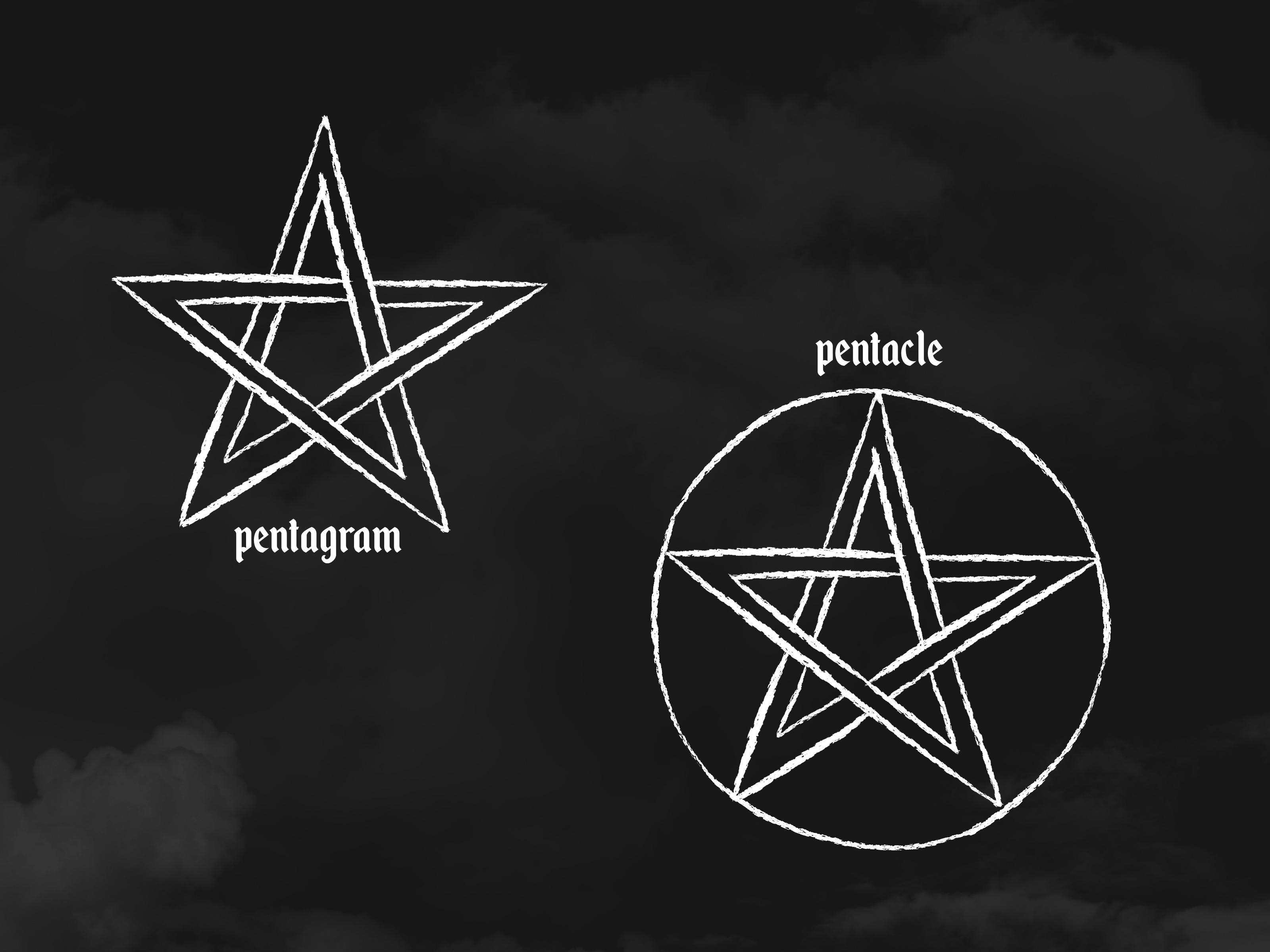
A pentagram is usually a five-pointed star drawn with five straight lines that cross one another. It is often formed in one continuous stroke. Historically, the pentagram has been connected with mathematics, beauty, protection, magic, the human body, and spiritual ideas. Its internal proportions are linked with the golden ratio, which is one reason the shape has fascinated artists, philosophers, and designers for centuries.
The pentacle
A pentacle is commonly understood today as a pentagram enclosed in a circle, especially in Wiccan and modern Pagan contexts. In many Wiccan interpretations, the five points represent earth, air, fire, water, and spirit. The circle may symbolize unity, wholeness, protection, nature’s cycles, or the connection of all elements. This meaning is positive for many practitioners and should not be confused with devil worship.
The inverted pentagram
An inverted pentagram is a pentagram turned so that one point faces downward and two points face upward. This is the version most often linked with darker symbolism in modern Western culture. When combined with a goat head, Hebrew letters, or Baphomet imagery, it is commonly associated with modern Satanic iconography. But even here, the meaning depends on the specific tradition and intent behind the symbol.
Is the Upside-Down Star Really Satanic?
The honest answer is: it can be, but it is not always. In popular culture, the upside-down pentagram is frequently treated as a Satanic symbol. Horror films, metal album art, haunted-house posters, and Halloween decorations have trained many people to see it as a visual shortcut for “something spooky is happening; please do not open that basement door.”
In modern Satanism, the inverted pentagram gained strong visibility through the Sigil of Baphomet, which places a goat head inside an inverted pentagram. The Church of Satan adopted this imagery as a major symbol of its philosophy. However, it is important to note that LaVeyan Satanism is generally atheistic and symbolic rather than a literal worship of Satan as a supernatural being. The figure of Satan is often used as a symbol of individualism, rebellion, skepticism, and opposition to traditional religious authority.
That does not mean everyone who wears or draws an upside-down star is a Satanist. A teenager may use it because it looks edgy. A designer may use it because it creates visual tension. A musician may use it because it matches the mood of a song. A historian may point to it in medieval or architectural settings where the meaning is not Satanic at all. In short, the symbol has a Satanic association, but the association is not universal.
A Short History of the Pentagram: From Protection to Pop Culture
Ancient and classical meanings
The pentagram is one of those symbols that refuses to stay in one lane. Ancient cultures used five-pointed star forms in different ways, sometimes as marks of order, protection, divinity, or cosmic harmony. The Pythagoreans, a Greek philosophical and mathematical school, valued the pentagram as a sign connected to health, proportion, and recognition among members. For them, it was not a horror-movie logo; it was closer to a sacred geometry badge with excellent symmetry.
Medieval Christian symbolism
One of the most surprising facts for modern readers is that the pentagram was not always seen as anti-Christian. In medieval Christian literature, the pentangle appears in Sir Gawain and the Green Knight, where it decorates Gawain’s shield. The poem connects the five points with moral and religious ideals, including the five wounds of Christ, the five joys of Mary, and the knightly virtues Gawain is supposed to represent. That is a long way from “secret basement cult.”
This matters because it shows how drastically symbols can shift across time. A shape that once represented Christian virtue in a medieval poem can later be interpreted as occult, magical, or even demonic in another cultural setting. Symbols do not carry a single meaning forever; they gather meanings as human communities use them.
Renaissance and occult interpretations
During the Renaissance and later occult revival periods, the pentagram became associated with ceremonial magic, astrology, alchemy, and esoteric philosophy. Writers connected the five points with the elements, the human body, and the relationship between spirit and matter. In some systems, an upright pentagramwith one point uprepresented spirit above matter. An inverted pentagramwith two points upcould be read as matter over spirit or instinct over higher reason.
This “matter over spirit” interpretation helped shape later negative associations. Once the inverted pentagram was described as a reversal of spiritual order, it became easier for later artists, occult writers, and religious critics to frame it as sinister. Add a goat head, dramatic lighting, and a thunderclap, and pop culture did the rest.
The Baphomet Connection: Why the Goat Head Matters
If you are trying to understand whether an upside-down star is Satanic, look for extra details. A plain inverted star and the Sigil of Baphomet are not the same thing. The Sigil of Baphomet typically includes a goat head inside an inverted pentagram, often within circles and sometimes with letters around the points. This design became strongly associated with modern Satanic imagery in the 20th century.
Baphomet itself has a complicated history. The name appeared in medieval accusations against the Knights Templar, later became part of occult writing, and was famously depicted by 19th-century occultist Éliphas Lévi as a symbolic goat-headed figure representing opposites, balance, and esoteric ideas. Modern Satanic organizations adapted Baphomet imagery in different ways, which is why the goat-headed figure now appears in debates about religion, free speech, public monuments, and pop culture.
Here is the practical takeaway: if the upside-down star includes a goat head, horns, ritual lettering, or explicitly Satanic labels, the Satanic interpretation becomes much stronger. If it is a simple star on a building, ring, quilt, medal, or old fraternal emblem, slow down before making assumptions.
Wicca and Paganism: Why the Pentacle Is Often Misunderstood
For many Wiccans and modern Pagans, the pentacle is a sacred symbol of balance, nature, and protection. The five points often represent earth, air, fire, water, and spirit. The circle around the star can represent unity, eternity, or the sacred space connecting those elements. In this context, the pentacle is not Satanic. It is a religious symbol, and for many people it carries the same dignity and emotional weight that a cross, crescent, or Star of David may carry in other traditions.
This misunderstanding has had real-world consequences. In the United States, Wiccan veterans and their families fought for the right to use the pentacle on government-issued headstones. The U.S. Department of Veterans Affairs eventually approved the Wiccan pentacle as an emblem of belief. That decision was not about endorsing “dark magic.” It was about recognizing religious freedom and allowing veterans’ sincerely held beliefs to be represented respectfully.
So, when someone sees a pentacle and says, “That is Satanic,” they may be misreading a Wiccan symbol through a horror-movie filter. The better response is to ask what tradition the symbol belongs to. Research is cheaper than panic, and it pairs well with coffee.
Other Non-Satanic Uses of the Upside-Down Star
Order of the Eastern Star
The Order of the Eastern Star, a Masonic-related fraternal organization, uses a five-pointed star with one point downward. Its symbolism is connected to biblical heroines, moral virtues, service, and fraternal teachings. To outsiders, the downward-pointing star may look suspicious if they only know the symbol from horror posters. Inside that organization, however, it has a very different meaning.
Architecture and religious buildings
Inverted stars have appeared in religious architecture, including some Latter-day Saint temple designs. Critics sometimes point to these stars as evidence of sinister meaning, but religious architecture often uses stars to symbolize heaven, divine guidance, morning stars, or celestial glory. Again, a symbol on a temple wall should be read within that tradition’s visual language, not ripped out of context like a meme with anxiety issues.
Decorative and patriotic stars
Stars are everywhere in American design: barns, quilts, sheriff badges, military insignia, Christmas ornaments, school awards, and Fourth of July decorations. Sometimes stars are tilted, rotated, stylized, or arranged for visual balance. A star with a downward point in a decorative pattern may have no religious or occult meaning at all.
Why Pop Culture Made the Upside-Down Star Scary
Modern audiences often learn symbols from entertainment before they learn them from history. The upside-down pentagram has become a convenient visual cue in horror films, supernatural TV shows, heavy metal branding, occult thrillers, and Halloween marketing. It tells the audience, “This scene is dangerous,” without requiring a five-minute lecture on 19th-century occult symbolism. Efficient? Yes. Historically complete? Absolutely not.
Because pop culture repeats images so effectively, many people now assume the inverted pentagram has only one meaning. That is how symbols get flattened. A shape with thousands of years of varied use becomes reduced to “evil star.” The same thing has happened to ravens, black cats, skulls, snakes, and basically every candle ever placed near a fog machine.
The result is a cultural shortcut. If an upside-down star appears in a horror film, the Satanic or demonic reading is probably intentional. If it appears on a medieval manuscript, Wiccan necklace, temple, cemetery marker, or fraternal emblem, the meaning may be completely different.
How to Read an Upside-Down Star Correctly
1. Identify the exact shape
Is it a simple five-pointed star, a line-crossing pentagram, or a pentagram inside a circle? A plain star is not the same as a pentagram, and a pentagram is not always the same as a pentacle.
2. Look for surrounding symbols
A goat head, Baphomet figure, occult letters, ritual imagery, or explicitly Satanic wording changes the interpretation. A star surrounded by flowers, biblical figures, architectural patterns, or nature imagery may point in a different direction.
3. Consider the setting
A symbol on a church, temple, grave marker, album cover, tattoo, or movie poster will not always mean the same thing. Location matters. Context is the adult in the room.
4. Ask who is using it
Symbols belong to communities of meaning. Wiccans, Satanists, occultists, Christians, fraternal organizations, designers, and artists may all use similar star shapes with different intentions.
5. Avoid instant accusations
Calling a symbol Satanic without context can misrepresent people’s beliefs. It can also make the accuser look like they got their theology from a haunted escape room. Curiosity is usually more accurate than panic.
Common Myths About the Upside-Down Star
Myth 1: Every upside-down star is Satanic
False. Some are Satanic, especially in modern contexts involving Baphomet or Satanic organizations. Many others are Wiccan, decorative, historical, architectural, fraternal, or symbolic in unrelated ways.
Myth 2: The pentagram was always evil
False. The pentagram has represented protection, health, geometry, the human body, Christian virtue, magical philosophy, nature, and spiritual balance at different times.
Myth 3: Wiccans worship Satan because they use pentacles
False. Wicca is a modern Pagan religion with varied traditions, often focused on nature, ritual, seasonal cycles, and divine feminine and masculine principles. Satan is a figure from Christian theology, not the center of Wiccan belief.
Myth 4: Turning any symbol upside down makes it evil
False. Orientation can change meaning in some systems, but not always. Upside-down crosses, stars, triangles, and other symbols can have different meanings depending on tradition. Rotation alone is not proof of evil intent.
Experience Notes: What People Often Discover After Looking Closer
Many people first encounter the upside-down star in a moment of surprise. Maybe they notice it on a pendant at a thrift store, carved into an old building, printed on a band shirt, or used as a tattoo. The first reaction is often emotional: curiosity, discomfort, fascination, or the sudden urge to Google things with one eye open. That reaction is understandable because symbols do not enter our minds as neutral shapes. They arrive wrapped in stories, warnings, movies, rumors, and whatever our eighth-grade best friend once confidently explained during lunch.
A common experience is realizing that the first interpretation was too simple. Someone may assume a pentacle is Satanic, then learn it is used by Wiccans as a symbol of the elements and spiritual balance. Another person may see an inverted star on a historic building and later discover it belongs to fraternal, architectural, or religious symbolism that predates modern horror associations. That moment can be humbling. It reminds us that visual literacy is a real skill. We learn to read words carefully; symbols deserve the same patience.
There is also the experience of personal style. Some people wear inverted stars or pentagrams because they feel drawn to alternative fashion, goth aesthetics, metal music, witchy style, or rebellious imagery. For them, the symbol may say, “I like mystery,” “I reject boring design,” or “Yes, my boots have more personality than your entire office.” That does not automatically reveal a formal religious identity. Fashion often borrows from symbolic language without carrying the full theology behind it.
On the other hand, some people use the inverted pentagram very intentionally. A Satanist may wear it as a sign of philosophical identity. An occult practitioner may use it within a ritual system. A Wiccan may use a pentacle as an emblem of faith. A collector may display it because they study religious symbols. The same shape can become meaningful in different ways because humans are meaning-making machines with excellent graphic design habits.
Conversations about the upside-down star can become tense when people jump straight to accusation. A parent may worry about a child’s jewelry. A neighbor may misread a decoration. A student may be judged for a notebook doodle. In these situations, the best first step is not panic; it is a calm question. “What does that symbol mean to you?” often works better than “Are you summoning something in the garage?” Most of the time, the answer will be more ordinary, personal, or nuanced than expected.
The biggest lesson from real-life encounters with the upside-down star is that symbols are not self-explaining. They are conversation starters. They ask us to notice history, respect belief, and separate evidence from assumption. A symbol can be powerful without being dangerous, misunderstood without being meaningless, and controversial without being simple.
Conclusion: So, What Does an Upside-Down Star Mean?
The upside-down star meaning depends on design and context. If the symbol is an inverted pentagram with a goat head or Baphomet imagery, it is reasonable to connect it with modern Satanic symbolism. If it is a pentacle in a Wiccan context, it may represent nature, the elements, spirit, protection, and religious identity. If it appears in literature, architecture, fraternal organizations, or decorative art, it may have meanings unrelated to Satanism altogether.
The upside-down star is not a one-size-fits-all evil label. It is a shape with a long, twisty biography. Sometimes it is rebellious. Sometimes it is sacred. Sometimes it is misunderstood. And sometimes it is just a designer rotating a star because it looked better that way. The smartest approach is to read the whole visual sentence, not just one dramatic punctuation mark.