There are tools that quietly live in the bottom of a toolbox, waiting for their annual moment of glory. Then there is a framing hammer. A good one announces itself. It has weight, attitude, and the subtle personality of a tiny wrecking ball with a handle. In this Crescent Framing Hammer review, we are looking at whether a classic 22-ounce framing hammer can make a serious case against a nail gun, especially for homeowners, remodelers, weekend builders, and anyone who does not want to buy another battery platform just to fasten a few boards.
The short answer is this: a nail gun is faster for repetitive production framing, but the Crescent 22 oz. framing hammer is more versatile, cheaper to own, easier to carry, and surprisingly satisfying to use. It drives framing nails, starts nails one-handed, pulls and pries with a ripping claw, and does not require batteries, air hoses, fuel cells, compressor noise, or a small engineering degree. For small decks, blocking, repairs, fences, sheds, and punch-list work, this hammer may not beat a nail gun on speed, but it can absolutely beat one on simplicity.
What Is the Crescent Framing Hammer?
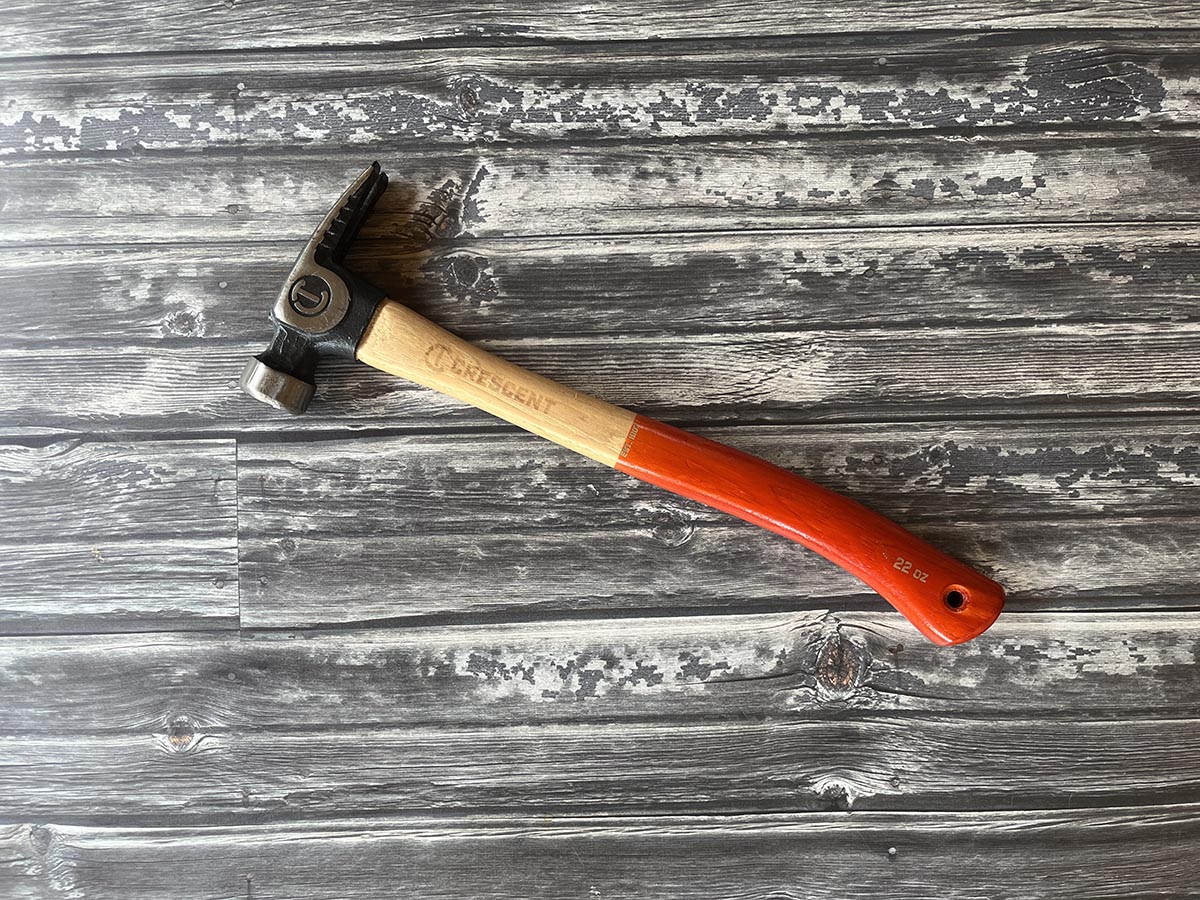
The Crescent framing hammer is built for rough carpentry and structural fastening. The model most DIYers and remodelers are likely to compare with a nail gun is the 22 oz. wood milled-face framing hammer, which features a steel head, a checkered striking face, a magnetic nail starter, a ripping claw, and an 18-inch hickory handle with a textured fawn’s foot grip.
That combination matters. The 22-ounce head provides enough mass to drive large common nails without feeling like you are swinging a boat anchor. The longer hickory handle adds leverage, while the milled face helps grip nail heads during heavy strikes. It is not a delicate finish hammer for installing cabinet trim. This is the hammer you grab when lumber needs persuasion and the project has stopped listening to reason.
First Impressions: Solid, Simple, and Ready to Work
The first thing you notice is balance. Some framing hammers feel powerful but clumsy, as if the head and handle met for the first time in the shipping box. The Crescent feels more intentional. The weight distribution gives it a smooth swing path, and the handle length helps build momentum without forcing you to muscle every nail like you are auditioning for a lumberjack calendar.
The hickory handle gives the hammer a traditional feel. Wood handles are not indestructible, but they absorb shock better than many bargain steel-handled hammers and feel warmer in the hand during long sessions. The fawn’s foot grip shape also gives your lower hand a natural stopping point, which helps when you choke down for control or slide back for a full-power swing.
Key Features of the Crescent 22 oz. Framing Hammer
22-Ounce Steel Head
A 22-ounce head hits the sweet spot for many users. It is heavy enough for framing nails, deck screws that need “encouragement,” and minor demolition, but it is not so heavy that a casual user will regret every life decision after ten minutes. For most homeowners, a 28-ounce framing hammer is overkill. The Crescent’s 22-ounce head feels like a practical middle ground.
Milled Face for Better Nail Contact
The checkered or milled face is designed to reduce slipping when striking nail heads. This is useful when driving 16d nails, toenailing studs, or working at awkward angles. The trade-off is that a milled face can leave waffle marks on wood. In framing, that usually does not matter because the lumber will be covered. On finished surfaces, however, this hammer has the manners of a shopping cart in a marble lobby.
Magnetic Nail Starter
The magnetic nail starter is one of the most useful features on the Crescent framing hammer. It holds a nail at the top of the head so you can set it with one hand. This is especially handy when reaching overhead, starting nails in tight framing bays, or holding a board with your other hand. It is not magic, but when you need it, it feels close.
Ripping Claw
Unlike a curved claw hammer made mainly for pulling nails, a framing hammer usually has a straighter ripping claw. The Crescent’s ripping claw is useful for prying boards apart, pulling embedded nails, adjusting framing, and light demolition. It can separate stubborn lumber, remove temporary bracing, and act as a mini pry bar when you do not want to climb down the ladder to grab another tool.
Hickory Handle With Fawn’s Foot Grip
The hickory handle is not just there for vintage charm. Hickory has long been used in striking tools because it can absorb impact while remaining strong and flexible. The grip shape gives the hammer better control at the end of the swing, and the 18-inch length adds reach and striking force. If your current hammer feels like a toy, the Crescent feels like the adult version that pays taxes and owns work boots.
Crescent Framing Hammer vs. Nail Gun: Which One Wins?
A nail gun wins on speed. That is not really up for debate. If you are building walls all day, sheathing a roof, or framing an addition, a framing nailer can drive fasteners much faster than any hand hammer. It also reduces fatigue when hundreds or thousands of nails are involved. Professional framers use nailers for a reason, and that reason is not because they dislike the romance of hand tools.
But the Crescent hammer wins in several real-world situations. It costs less to own, needs no setup, fits in a tool belt, works in silence, and can handle tasks a nail gun cannot. A nail gun drives nails; a framing hammer drives nails, starts nails, taps boards into alignment, pulls mistakes, pries lumber, knocks loose framing into place, and performs mild demolition when a project gets spicy.
For small jobs, setup time matters. If you only need to drive twenty nails, dragging out a compressor, hose, nailer, and extension cord can feel ridiculous. A cordless framing nailer solves some of that, but it still brings battery charging, tool weight, depth adjustment, and a much higher purchase price. The Crescent hammer is wonderfully low-tech: pick it up, swing it, put it down. No firmware updates. No “battery not included.” No drama.
Where the Crescent Hammer Performs Best
The Crescent framing hammer is at its best on small and medium construction tasks. It is a strong choice for building a raised garden bed, repairing deck boards, installing blocking, framing a shed wall, building temporary supports, setting fence rails, or assembling rough carpentry projects where speed is helpful but not everything.
It also shines in tight spaces. Nail guns are powerful, but they are bulky. In corners, between studs, under stairs, or inside small repair openings, a hammer can sometimes reach where a nailer cannot. You can use short controlled taps to start a nail, then full swings once the angle improves. When fitting framing around existing work, that flexibility is valuable.
Where a Nail Gun Still Makes More Sense
A hammer is not the best tool for every job. If you are framing an entire house, building a large deck, installing sheathing, or fastening hundreds of boards in a row, a nail gun is the better choice. It is faster, easier on the body, and more consistent when used correctly. Production framing is about rhythm and efficiency, and a nailer turns repetitive nailing into a much quicker process.
Safety also deserves attention. Nail guns are powerful and can cause serious injuries when misused, especially with contact or bump-fire triggers. That does not make them bad tools, but it does mean users need training, eye protection, careful trigger discipline, and respect for the direction of fire. A hammer can also injure you, of course. Anyone who has smashed a thumb knows the educational value of pain. But the risk profile is different, and for occasional users, a hammer is often easier to control.
Comfort and Fatigue: How It Feels After Real Work
A framing hammer should not be judged by one ceremonial nail. The real question is how it feels after repeated swings. The Crescent’s balance helps here. The hammer builds force naturally, and the hickory handle dampens some impact. That said, it is still a 22-ounce framing hammer. If you are not used to swinging one, your forearm will notice. Your shoulder may file a complaint. Your thumb may begin bargaining for hazard pay.
The key is technique. Let the hammer do the work. Grip firmly but not like you are trying to crush a walnut. Start with controlled strikes, focus on the nail head, and use the handle length to generate speed. With practice, the Crescent can sink large nails cleanly without requiring wild swings. Good hammering is less about rage and more about rhythm.
Accuracy: The Milled Face Helps, But Skill Still Matters
The milled face gives the Crescent a little extra forgiveness. If you hit slightly off-center, the checkered pattern helps grab the nail head instead of skating off. This is especially helpful for toenailing, where the nail angle makes clean contact harder. The larger strike zone also helps newer users build confidence.
However, the hammer will not fix poor alignment. If the nail starts crooked, the hammer will faithfully continue your mistake with enthusiasm. The magnetic nail starter helps start nails straight, but the user still needs to aim, reset, and adjust. In that sense, the Crescent is a good teacher. It rewards steady technique and immediately tattles on sloppy swings.
Durability and Build Quality
The Crescent feels built for actual jobsite use rather than occasional picture-hanging duty. The steel head, hickory handle, and head attachment design give it a sturdy feel. The lacquered head finish helps resist corrosion, while the handle offers enough flex to feel comfortable without seeming fragile.
Like any wood-handled hammer, it should not be abused as a pry bar beyond reason. The ripping claw can handle normal framing adjustments and nail removal, but if you are levering apart a stubborn wall assembly, a dedicated pry bar is still the smarter choice. Tools forgive many things, but they remember stupidity.
Who Should Buy the Crescent Framing Hammer?
This hammer is a strong fit for DIYers, remodelers, farmers, property managers, deck builders, fence repairers, and homeowners who want one serious hammer for rough work. It is also a good backup tool for professionals who rely on nail guns but still need a hand hammer nearby for adjustments, missed nails, and demolition tasks.
It is probably not the best choice for finish carpentry, delicate trim, furniture assembly, or light household work. For those jobs, use a lighter smooth-face hammer or a finish nailer. The Crescent framing hammer is not trying to be elegant. It is trying to be effective.
Pros and Cons
Pros
- Strong 22-ounce head for driving framing nails
- Milled face improves grip on nail heads
- Magnetic nail starter is genuinely useful
- Ripping claw works for prying and demolition
- Hickory handle helps reduce impact feel
- No batteries, compressor, hose, fuel, or setup required
- Excellent value for small framing and repair jobs
Cons
- Slower than a nail gun for high-volume framing
- Milled face can mark visible wood
- Wood handle requires reasonable care
- Repeated use can still cause arm and wrist fatigue
- Not ideal for finish carpentry or precision trim work
Practical Buying Advice
Buy the Crescent framing hammer if you need a serious, affordable, multi-use hammer for rough carpentry. It is especially sensible if you do not own a framing nailer and cannot justify buying one for occasional projects. It also makes sense if you already own a nail gun but want a dependable hammer for layout, adjustment, nail pulling, and the inevitable “why is this board not moving?” moment.
Skip it if your main work is trim, cabinetry, or finish surfaces. Also skip it as your only fastening tool if you regularly drive hundreds of framing nails in a day. In that case, a framing nailer is not a luxury; it is a productivity tool.
Verdict: Is the Crescent Framing Hammer Better Than a Nail Gun?
For production framing, no. A nail gun is faster and less tiring over long sessions. But for small builds, repairs, deck work, framing adjustments, and general rough carpentry, the Crescent framing hammer can be the better tool to own. It is simpler, more versatile, easier to transport, and ready instantly.
The best way to look at it is this: a nail gun is a specialist, while the Crescent framing hammer is a hardworking generalist. The nail gun wins the race. The hammer stays after the race, fixes the fence, pulls the bent nail, taps the post into alignment, and then opens a stubborn paint can because nobody can find the opener.
Extra Field Experience: Living With the Crescent Framing Hammer on Real Projects
After using a framing hammer on real DIY and repair-style projects, the biggest lesson is that convenience matters more than tool hype. A nail gun looks impressive, and yes, it makes that satisfying “thunk” that causes nearby dads to nod approvingly. But on many small jobs, the hammer is simply faster to start using. There is no setup. There is no hunting for the right nails in the correct collation angle. There is no checking battery charge, adjusting depth, or wondering why the tool suddenly refuses to fire like it has joined a union.
On a small deck repair, for example, a hammer like the Crescent makes sense when replacing a few boards, adding blocking, or fastening a loose rim area. You can carry it in one hand, a pouch of nails in the other, and get to work. The magnetic nail starter becomes useful when your other hand is holding a board in position. Once the nail is set, a few controlled swings seat it. When a nail bends, the ripping claw pulls it out. When two boards are slightly misaligned, the hammer can tap them flush. A nail gun cannot do that last part unless your plan is to glare at the lumber and hope.
Fence work is another place where the Crescent feels practical. Rails, braces, gate framing, and temporary supports often require a mix of fastening, nudging, prying, and correcting. A nailer may be faster when everything is perfectly positioned, but fences rarely behave perfectly. Posts twist, rails cup, and old fasteners hide in the wood like tiny metal goblins. A framing hammer gives you control, especially when working around existing materials.
The hammer also encourages better awareness. With a nail gun, it is easy to fire quickly and discover later that a board shifted or a nail missed the target. With a hammer, each strike gives feedback. You feel whether the nail is biting, bending, or pulling the boards together. That tactile information is useful for beginners because it teaches how wood responds. It also helps experienced users make small adjustments before a mistake becomes structural modern art.
That does not mean swinging a hammer all day is romantic. It is work. After enough nails, your forearm will feel it. Good gloves help, and so does taking breaks. The Crescent’s hickory handle softens the shock compared with harsher cheap hammers, but no hammer eliminates impact completely. Users with wrist, elbow, or shoulder issues should be realistic. For a whole shed or major framing job, renting or buying a nailer may be worth it.
Still, the Crescent framing hammer earns its place because it handles the messy, mixed reality of home projects. Most DIY jobs are not clean production lines. They are awkward corners, slightly warped boards, missing tools, and one screw that somebody painted over in 1998. In that environment, a dependable framing hammer is not old-fashioned. It is efficient. It is the tool you keep within reach because it solves more than one problem, and it does not complain when dropped in the dirt.
Conclusion
The Crescent Framing Hammer is not a nail gun replacement for professional high-volume framing, but it is a smarter choice for many smaller jobs. Its 22-ounce head, milled face, magnetic nail starter, ripping claw, and hickory handle make it a versatile tool for rough carpentry, repairs, decks, fences, sheds, and remodeling work. It is powerful without being ridiculous, simple without being outdated, and useful in situations where a nail gun is too bulky, too expensive, or too much trouble to set up.
So, is it better than a nail gun? For speed, no. For all-around usefulness, affordability, control, and grab-and-go convenience, absolutely. Sometimes the best tool is not the loudest one. Sometimes it is the one hanging from your tool belt, waiting patiently to fix the problem your fancy power tool just created.