Stride length and step length sound like fitness terms invented by someone who owns too many stopwatches, but they are actually simple, useful measurements. Whether you walk for health, run for performance, use a smartwatch, track steps for weight management, or simply want to know why your fitness app thinks your living room is half a mile long, learning how to measure stride length and step length can make your data much more accurate.
In everyday conversation, people often use “step length” and “stride length” interchangeably. Technically, they are different. Step length measures the distance from one foot’s contact point to the opposite foot’s contact point. Stride length measures the distance from one foot’s contact point to the next contact point of that same foot. In plain English: one step is left-to-right or right-to-left; one stride is right-to-right or left-to-left. Your stride usually includes two steps.
This guide explains the difference, shows several easy ways to measure both, gives formulas you can use immediately, and helps you avoid common mistakes. No lab coat required. A tape measure, a sidewalk, and a tiny bit of patience will do nicely.
What Is Step Length?
Step length is the distance between the point where one foot hits the ground and the point where the opposite foot hits the ground. If your right heel lands, then your left heel lands 28 inches ahead, your step length is 28 inches.
Step length matters because it helps describe how you walk or run. In a smooth walking pattern, the right and left step lengths are usually similar. If one side is noticeably shorter, longer, or inconsistent, it may reflect fatigue, soreness, poor balance, old injuries, footwear problems, or a change in walking mechanics.
What Is Stride Length?
Stride length is the distance between two consecutive ground contacts of the same foot. For example, if your right heel lands, then your left foot lands, and then your right heel lands again 56 inches ahead of the first right-foot mark, your stride length is 56 inches.
For many people, stride length is roughly twice their step length. If your average step length is 28 inches, your stride length may be about 56 inches. However, real humans are not geometry robots. Your left and right steps may differ slightly, and your stride changes with speed, slope, fatigue, shoes, terrain, and whether you are walking calmly or power-walking like you just saw your bus pull away.
Step Length vs. Stride Length: The Quick Difference
| Measurement | What It Measures | Simple Example | Best Used For |
|---|---|---|---|
| Step length | One foot to the opposite foot | Right heel to left heel | Gait symmetry, walking analysis, basic tracking |
| Stride length | Same foot to same foot | Right heel to next right heel | Fitness trackers, running metrics, distance estimates |
Why Measuring Stride Length and Step Length Matters
Knowing your stride length and step length can improve the accuracy of step counters, pedometers, smartwatches, and fitness apps. Many devices estimate distance by multiplying your number of steps by your stride length. If the stride length entered in your device is too long, your tracker may overestimate distance. If it is too short, your “three-mile walk” may magically shrink into a sad little neighborhood stroll.
These measurements are also useful for walkers, runners, physical therapy patients, older adults, and anyone monitoring movement quality. In gait analysis, step length, stride length, cadence, speed, and step width can help describe walking patterns. For everyday fitness, the goal is not to chase a perfect number. The goal is to understand your natural movement and use that information wisely.
How to Measure Step Length at Home
The easiest way to measure step length is to walk over a surface where you can mark your footfalls. You can use chalk on a driveway, painter’s tape on a smooth floor, or wet footprints on concrete. Yes, wet footprints are slightly dramatic, but they work.
Method 1: The Footprint Method
- Find a flat, safe walking surface at least 20 feet long.
- Mark a starting line.
- Walk naturally across the area at your normal pace.
- Mark where each heel lands, or use visible footprints.
- Measure from the heel mark of one foot to the heel mark of the opposite foot.
- Repeat several times and average the results.
Example: Your right heel lands at 0 inches. Your left heel lands at 29 inches. Your next right heel lands at 58 inches. Your first step length is 29 inches, and your second step length is also 29 inches. That is a nice, even walking pattern.
Method 2: The Measured-Distance Method
This method is simple and often more practical because you do not need to mark every footfall.
- Measure a known distance, such as 30 feet, 50 feet, or 10 meters.
- Walk the distance at your normal pace.
- Count every step from start to finish.
- Divide the total distance by the number of steps.
Formula:
Step length = Distance walked ÷ Number of steps
Example: You walk 50 feet and count 20 steps.
50 feet ÷ 20 steps = 2.5 feet per step
Your average step length is 2.5 feet, or 30 inches.
How to Measure Stride Length
Because stride length usually covers two steps, you can measure it directly or calculate it from step length.
Method 1: Measure Same Foot to Same Foot
- Stand at a starting line with one heel on the line.
- Walk forward naturally for several steps.
- Mark where the same heel lands again.
- Measure the distance between the first and second marks from the same foot.
- Repeat several times and average the measurements.
Example: Your right heel starts at 0 inches. After one left step and one right step, your right heel lands at 60 inches. Your stride length is 60 inches.
Method 2: Calculate Stride Length From Step Length
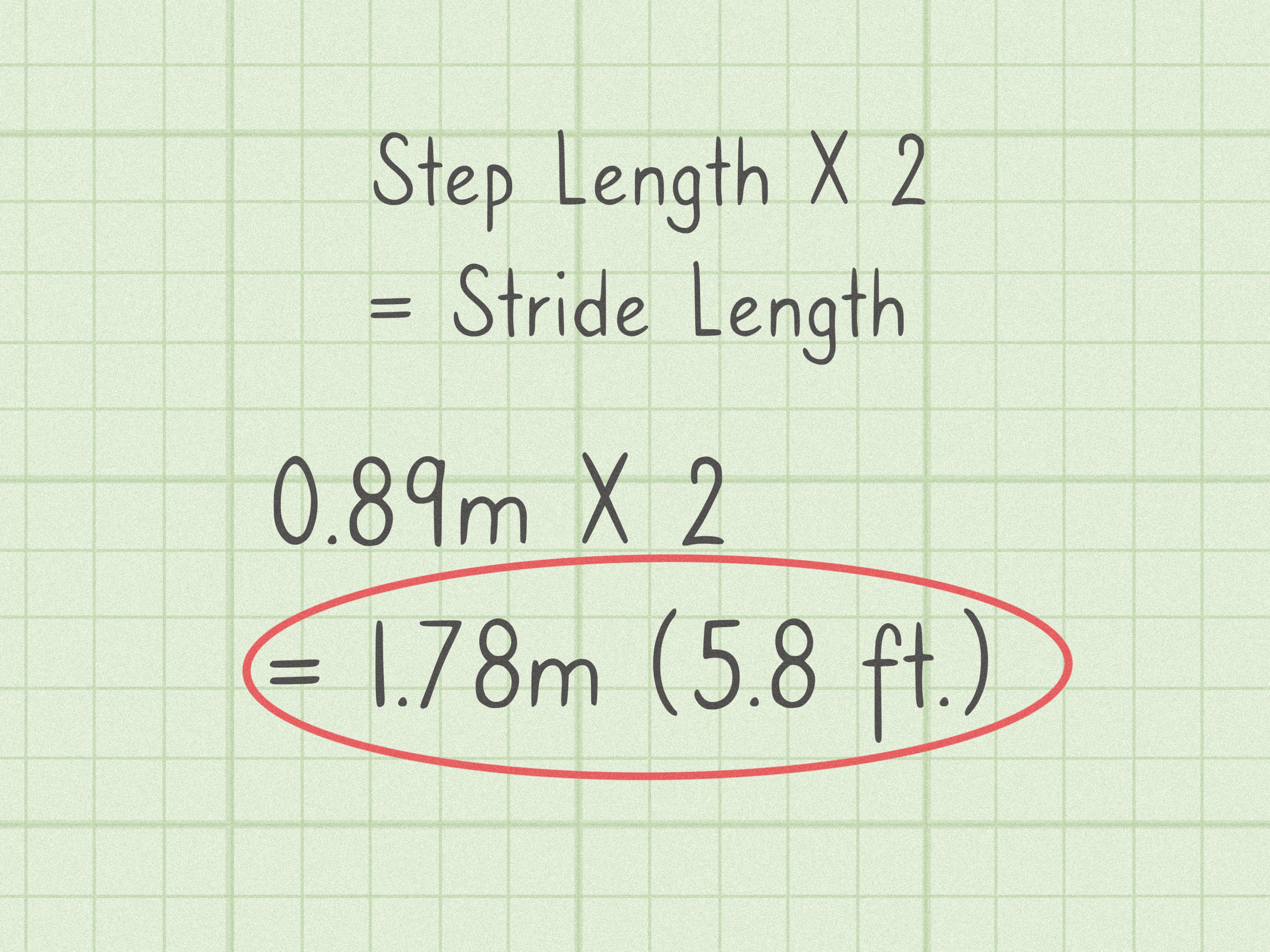
If your left and right steps are fairly even, you can estimate stride length by doubling your step length.
Stride length = Step length × 2
Example: If your average step length is 30 inches:
30 inches × 2 = 60 inches
Your estimated stride length is 60 inches, or 5 feet.
Method 3: Use a Track or Known Route
A running track, measured walking path, or marked gym floor can make this process easier. Walk or run a known distance, count your steps, and divide distance by steps. If your device asks for “stride length” but defines it as the distance covered per step, enter the average distance per step. Some fitness apps use the word “stride” casually, so check the instructions. Fitness vocabulary occasionally behaves like it had too much coffee.
How to Measure Running Stride Length
Your running stride length is usually longer than your walking stride length because running includes a brief flight phase when both feet are off the ground. That means you should measure walking and running separately if you want accurate distance tracking.
- Choose a known distance, such as 100 meters on a track.
- Run at a comfortable, normal pace.
- Count your steps from start to finish.
- Divide the distance by the number of steps.
- Repeat two or three times and average the results.
Example: You run 100 meters and count 125 steps.
100 meters ÷ 125 steps = 0.8 meters per step
Your running step length is 0.8 meters. If you want same-foot stride length, multiply by two:
0.8 meters × 2 = 1.6 meters per stride
Common Formulas for Step Length and Stride Length
Step Length Formula
Step length = Total distance ÷ Total steps
Stride Length Formula
Stride length = Distance between two contacts of the same foot
or, when left and right steps are similar:
Stride length = Average step length × 2
Distance Formula for Fitness Trackers
Distance = Steps × Step length
This is why entering a more accurate step or stride value can make your smartwatch, pedometer, or phone app more reliable, especially indoors where GPS may not help.
Average Step Length and Stride Length
Average numbers can be helpful, but they should not be treated like a law passed by the Walking Congress. Step length varies by height, leg length, mobility, age, speed, terrain, and personal walking style.
Many adults fall somewhere around 2.2 to 2.6 feet per walking step, but your true number may be shorter or longer. Taller people often have longer steps. Faster walking may increase step length, cadence, or both. Going uphill usually shortens steps. Going downhill may lengthen them. Fatigue can also shorten your step length, especially near the end of a long walk or run.
How Many Steps Are in a Mile?
The classic rough estimate is about 2,000 steps per mile, but this depends on step length. A person with a 2.5-foot step length takes about 2,112 steps to cover one mile because a mile has 5,280 feet.
5,280 feet ÷ 2.5 feet = 2,112 steps
If your step length is 2.2 feet, one mile takes about 2,400 steps. If your step length is 2.8 feet, one mile takes about 1,886 steps. This is why two people can walk the same route and finish with different step counts. No one is cheating. Their legs are just doing different math.
How to Add Stride Length to a Fitness Tracker
Most fitness trackers estimate stride length from profile information such as height, sex, and activity type. Some devices also improve distance estimates using GPS data from outdoor walks or runs. For better accuracy, measure your own walking and running step length, then enter the value manually if your app allows it.
Use at least 20 steps when measuring, although 50 or more is better. Short tests can exaggerate small mistakes. For example, if you miscount by one step during a 10-step test, your result changes a lot. If you miscount by one step during a 60-step test, the error is smaller.
Tips for Measuring More Accurately
- Walk naturally. Do not take giant “measurement steps.” You are measuring your real stride, not auditioning for a moon landing.
- Use a flat surface. Hills, soft grass, sand, and uneven sidewalks can change your step length.
- Measure more than once. Take three trials and average them.
- Separate walking and running. Your running stride is usually different from your walking stride.
- Use your normal shoes. Footwear can affect stride, especially if you switch from sandals to running shoes.
- Start before the measured zone. Walk a few steps before the starting line so you are already moving naturally.
- Do not obsess over perfection. A close average is usually good enough for fitness tracking.
Stride Length, Cadence, and Speed
Stride length does not work alone. It teams up with cadence, which is the number of steps you take per minute. Walking or running speed comes from a combination of how far each step takes you and how quickly you take those steps.
Speed = Step length × Cadence
If you want to walk faster, you can lengthen your step, increase cadence, or do a little of both. However, forcing a longer stride can backfire. Overstriding happens when your foot lands too far in front of your body. This can create a braking effect and may increase stress on joints. A smoother approach is to keep posture tall, let your arms swing naturally, and increase cadence slightly while keeping your foot landing comfortably under your body.
What Is a Good Stride Length?
A good stride length is not the longest stride possible. It is the stride that feels efficient, balanced, and repeatable for your body. For walking, that usually means smooth heel-to-toe movement, relaxed shoulders, steady arm swing, and steps that do not feel forced. For running, efficient stride length often works together with comfortable cadence and a foot strike that does not reach too far ahead of your center of mass.
If you are recovering from an injury, have balance concerns, or notice a sudden change in step length, it may be worth speaking with a healthcare professional, physical therapist, or qualified running coach. Your stride is personal. Treat it like a fingerprint with sneakers.
Common Mistakes When Measuring Step Length and Stride Length
Mistake 1: Confusing Step Length With Stride Length
Remember: step length is one foot to the opposite foot. Stride length is same foot to same foot. If a device asks for stride length but uses it to calculate distance per step, check the app’s instructions carefully.
Mistake 2: Measuring Too Short a Distance
Measuring only two or three steps can produce inaccurate results. Use at least 20 steps, and preferably more, for a better average.
Mistake 3: Changing Your Natural Walk
People often walk differently when they know they are being measured. Relax. Look ahead. Walk like you are going to the mailbox, not like you are crossing a fashion runway made of lasers.
Mistake 4: Using One Number for Everything
Your walking stride, running stride, hiking stride, treadmill stride, and tired-after-work stride may all be different. For trackers, measure the activity you actually want to track.
Example: Measuring Step Length for a Smartwatch
Let’s say you want better distance tracking for indoor walking. You measure a 60-foot hallway. You walk it at your normal pace and count 24 steps.
60 feet ÷ 24 steps = 2.5 feet per step
Convert to inches:
2.5 feet × 12 = 30 inches
You can enter 30 inches as your walking step length if your app uses distance per step. If the app truly asks for same-foot stride length, enter 60 inches. This is why reading the app label matters.
Experience Section: What Measuring Stride Length Teaches You in Real Life
Measuring stride length sounds like a small project, but it often teaches people more than expected. The first surprise is usually how inconsistent steps can be when you are paying too much attention. The moment you start counting, your brain may decide to become a walking engineer. Suddenly, every step feels suspicious. Was that a normal step? Was that too long? Did your left foot just show off? This is why it helps to do a few practice passes before recording numbers.
One practical experience many walkers notice is that pace changes everything. A relaxed stroll to the kitchen is not the same as a brisk walk around the block. When you walk faster, you may naturally take quicker steps, longer steps, or both. Some people speed up by stretching their legs forward, while others speed up by increasing cadence. The second option often feels smoother and more sustainable. If your foot lands too far ahead of your body, walking can feel choppy, like your legs are tapping the brakes with every step.
Another useful lesson comes from comparing outdoor and indoor measurements. Outdoors, your stride may lengthen because you have more space and a visual destination. Indoors, especially in hallways or on treadmills, you may shorten your steps without realizing it. That does not mean one measurement is “wrong.” It means your body adapts to the environment. If you mostly use your tracker for indoor walking, measure indoors. If you mostly walk outside, measure outside.
Shoes also make a bigger difference than people expect. A supportive walking shoe may encourage a smooth heel-to-toe roll. A stiff boot may shorten your stride. Flip-flops may turn your walk into a careful shuffle because your toes are busy trying to keep the shoe from escaping. If you track fitness seriously, measure stride length in the shoes you wear most often for that activity.
Many runners discover that their stride length changes throughout a workout. Early in a run, steps may feel springy and even. Later, fatigue can reduce stride length and cadence. That is the famous “marathon shuffle,” even if your marathon is just the last five minutes on the treadmill. Tracking stride length over time can reveal when endurance, strength, or running form starts to fade.
For everyday walkers, the biggest benefit is better awareness. You do not need to chase a perfect number. Instead, you learn what normal feels like for you. If your usual step length is about 29 inches and suddenly one side feels shorter because your hip, knee, ankle, or foot is bothering you, that change is useful information. It can remind you to rest, check your shoes, adjust your training, or ask a professional for help if the change persists.
Finally, measuring stride length can make fitness tracking less mysterious. When your app reports steps, miles, pace, and calories, it is easy to treat those numbers as magic. But much of the distance estimate comes from a simple relationship: steps multiplied by step length. Once you know your number, the data feels less like a fortune cookie and more like a tool. And that is the real win. Your stride length is not just a measurement; it is a small window into how your body moves through the world, one step at a time.
Conclusion
Learning how to measure stride length and step length is simple, useful, and surprisingly empowering. Step length measures one footfall to the opposite footfall, while stride length measures one footfall to the next footfall of the same foot. With a known distance, a step count, and a basic formula, you can calculate your walking or running measurements in minutes.
For better accuracy, measure on a flat surface, use your normal pace, count at least 20 steps, repeat the process, and average your results. Use separate measurements for walking and running, and remember that terrain, speed, fatigue, and shoes can all change your stride. Whether you are improving smartwatch accuracy, converting steps to miles, monitoring gait, or fine-tuning your walking routine, these measurements give you clearer, more personal fitness data.