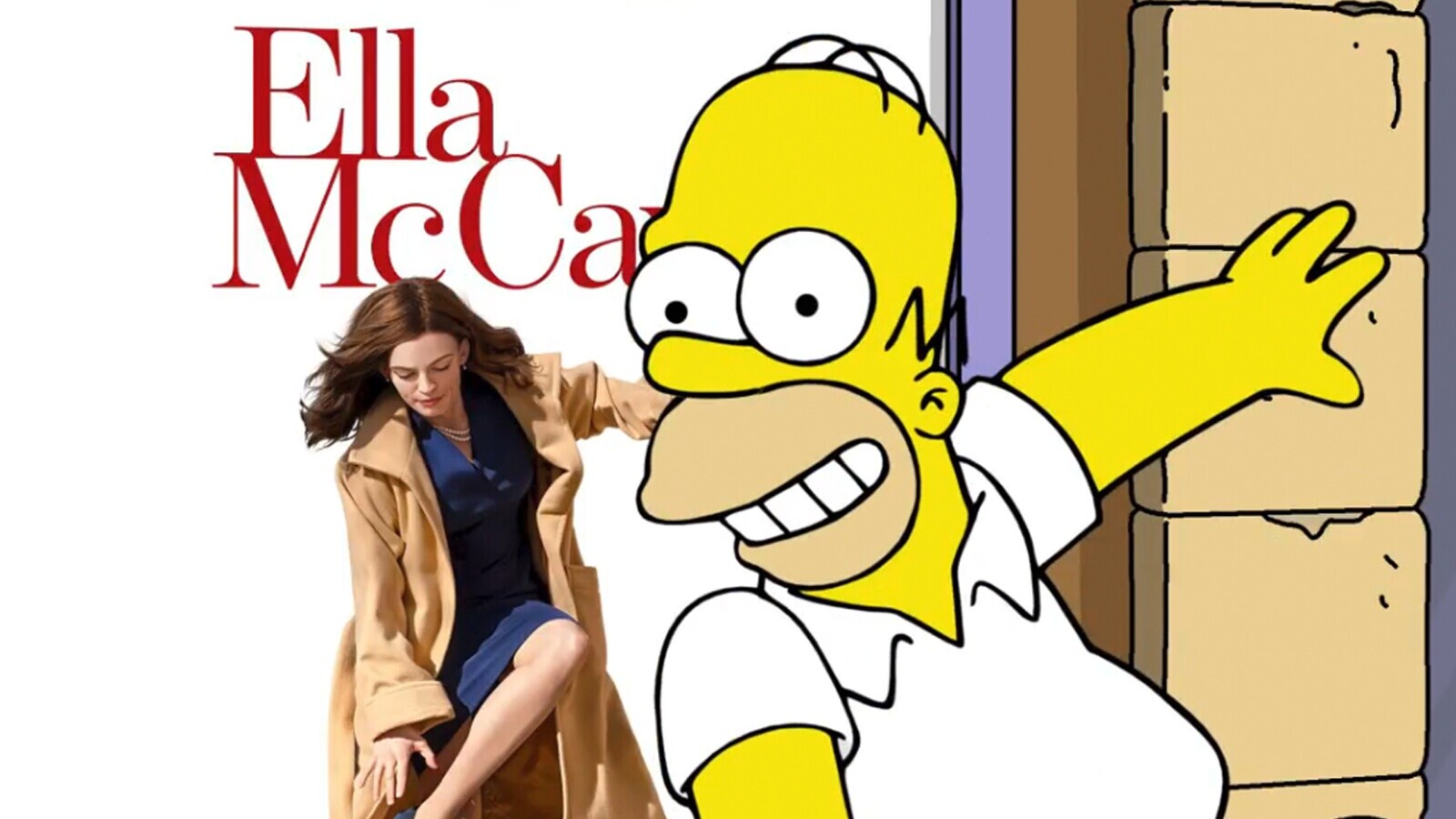
Every so often, the internet finds a movie poster, squints at it, and says, “Yes, this is now a sport.” That is roughly what happened with Ella McCay, the James L. Brooks comedy-drama that arrived with a prestige-friendly cast, a political-romantic setup, and one very memeable image of Emma Mackey balancing on one foot while fixing her shoe. From that single pose came the #EllaMcCayChallenge, an ironic social media trend that turned a theatrical poster into a full-body punchline, a cinephile ritual, and possibly the funniest free marketing campaign a studio could ask for.
Adding another layer of pop-culture weirdness, The Simpsons joined the party. The connection was not random. Brooks, one of the major creative forces behind the legendary animated series, wrote and directed Ella McCay. The film also features Julie Kavner, the unmistakable voice of Marge Simpson, in a rare live-action role. So when Springfield characters began mimicking the poster pose, the internet did what it does best: it laughed, shared, overanalyzed, and asked whether Lisa Simpson doing a shoe-adjustment meme could save a mid-budget adult comedy in the year 2025.
What Is the #EllaMcCayChallenge?
The #EllaMcCayChallenge is simple in theory and awkward in practice, which is exactly why it works. Participants stand in front of an Ella McCay poster and recreate Emma Mackey’s pose: one leg lifted, one hand reaching for the shoe, eyes pointed away from the camera, and the body positioned with the fragile grace of someone trying to look casual while gravity files a formal complaint.
The challenge reportedly began with film fans noticing how unusual the poster was. Instead of selling explosions, forbidden romance, luxury vacation vibes, or two attractive people almost kissing in the rain, the poster centered on a woman adjusting her footwear. That tiny act became strangely fascinating. It was mundane, theatrical, earnest, and funny all at once. In other words, it was perfect meme material.
What made the trend catch fire was not just the pose, but the tone surrounding it. People did not appear to be mocking the film with cruelty. The joke had a softer edge: affectionate confusion. The internet seemed to be saying, “We do not fully understand why this poster exists, but we respect the commitment.” That kind of ironic admiration is powerful. It can turn a quiet movie into a loud conversation, even when the conversation involves a lot of people nearly losing their balance in multiplex lobbies.
Why ‘The Simpsons’ Connection Matters
Calling Ella McCay a Simpsons-endorsed rom-com is not just a catchy headline trick. The film’s promotional orbit genuinely leaned into Brooks’ Simpsons legacy. For decades, The Simpsons has been more than a TV show; it is a cultural reference machine. If a Springfield character reacts to something, that thing immediately gains a little extra comic authority, like being knighted with a donut.
Brooks’ association with The Simpsons, Broadcast News, Terms of Endearment, and As Good as It Gets gives Ella McCay an unusual pedigree. This is not a random studio comedy assembled from leftover algorithm parts. It is a personal film from an 85-year-old writer-director known for complicated women, verbal chaos, bruised idealism, and characters who treat emotional processing like an Olympic event.
The Simpsons tie-in also created a delicious contrast. Ella McCay appears to be an earnest movie about politics, family, duty, and romantic turbulence. The Simpsons, meanwhile, is built to puncture earnestness with a well-timed “D’oh!” When animated Springfield residents copied Emma Mackey’s shoe pose, the campaign became self-aware. It told audiences, “Yes, we know this is odd. Come be odd with us.”
Inside the Movie: Politics, Romance, and Family Chaos
Ella McCay follows an idealistic young woman whose public career collides with private disorder. Emma Mackey plays Ella, a rising political figure who becomes governor while juggling personal scandal, family wounds, marital tension, and the expectations placed on ambitious women. The official studio description frames the story as a comedy about family, work, love, and survival, which is a polite way of saying: everyone in Ella’s life needs either a therapist, a press secretary, or a very sturdy coffee.
The cast is stacked. Alongside Mackey, the film includes Jamie Lee Curtis, Jack Lowden, Kumail Nanjiani, Ayo Edebiri, Spike Fearn, Rebecca Hall, Julie Kavner, Albert Brooks, and Woody Harrelson. On paper, that lineup sounds like the guest list at a very expensive dinner party where half the guests are charming and the other half are quietly causing narrative complications.
The movie’s setup also puts it in conversation with an older tradition of adult studio comedies and dramedies. These were once common in theaters: character-driven films about work, marriage, ambition, ethics, and people having long, beautifully written arguments in rooms with good lighting. Today, those stories often migrate to streaming platforms. That shift is part of why Ella McCay became such an interesting case study. It arrived in theaters as a throwback object in a franchise-heavy marketplace, then became more famous online for a poster pose than for its plot.
How an Awkward Poster Became Better Marketing Than a Trailer
Movie marketing usually wants control. Posters, trailers, cast interviews, late-night appearances, featurettes, premiere photos, and social media clips are all designed to guide the audience toward a preferred reaction. But the internet is not a guided tour. It is a raccoon with Wi-Fi. It finds whatever detail is funniest, shiniest, or strangest, then runs away with it.
For Ella McCay, that detail was the shoe pose. The poster image had the magic ingredients of meme culture: it was recognizable, easy to imitate, physically specific, and just awkward enough to invite parody. Anyone could participate. You did not need editing skills, a big following, or a deep knowledge of James L. Brooks’ filmography. You needed a poster, a raised leg, and enough balance to avoid becoming a cautionary tale near the popcorn counter.
Once people began posting their versions, the challenge developed its own informal rules. The left leg should be lifted. The gaze should not meet the camera. The shoe adjustment should look intentional, not like a medical emergency. These details made the meme feel like a tiny performance art assignment, which is why it appealed so strongly to movie fans. It let them participate in the theatrical experience before or even instead of watching the film.
The Irony Is the Point
The ironic social media challenge around Ella McCay works because it balances affection and disbelief. This is not the same as hate-watching. Hate-watching often feels sour, as if the audience is gathering around a thing simply to sneer at it. The Ella McCay meme feels lighter. The humor comes from the gap between the film’s serious creative pedigree and the internet’s decision to focus on footwear choreography.
That irony also reflects the modern relationship between audiences and marketing. Viewers are extremely aware when they are being sold something. They can smell corporate enthusiasm from three apps away. When a studio joins a meme, the internet often responds with suspicion. But when the meme already has enough organic weirdness, studio participation can become part of the joke. 20th Century Studios rating people’s poses, for example, turned promotion into interaction. It made the campaign feel less like a sales pitch and more like a game.
The smartest part of the trend is that it kept the film’s title circulating. Even people who had no intention of seeing Ella McCay learned the name. That matters. In a crowded entertainment economy, awareness is half the battle. The other half is convincing people to buy tickets, stream the movie, or at least stop calling it “that shoe governor film.”
Critical Reception: When the Meme Outshines the Movie
The online enthusiasm for the challenge contrasted sharply with the film’s difficult critical reception. Reviews were mixed to negative, with several critics calling the movie overstuffed, tonally uneven, or confusing. Rotten Tomatoes showed a low critic score, while audience responses were somewhat warmer but still divided. Box-office data also suggested that the film struggled commercially, opening modestly and earning far less than its reported production budget.
Still, not every response was dismissive. Some critics found value in the film’s optimism, performances, and old-fashioned sincerity. That split is important. Ella McCay may not have become a consensus crowd-pleaser, but it inspired a conversation about what kinds of movies theaters still make room for. Adult-oriented comedies about work, politics, marriage, and moral compromise are increasingly rare on the big screen. When one arrives, even a messy one, it can feel like a visitor from another era wearing sensible shoes.
The meme’s success may have softened the pile-on. Instead of becoming only a “bad reviews” story, Ella McCay became a cultural curiosity. People were not just asking whether the movie was good. They were asking why the poster looked like that, why The Simpsons were involved, why everyone was doing the pose, and whether an awkward challenge could generate more goodwill than a polished trailer. That is a far more interesting conversation than a simple flop narrative.
Why This Trend Says Something About Modern Moviegoing
The Ella McCay Challenge is not just a silly internet footnote. It points to a larger truth about moviegoing in the social media age: audiences want to feel involved. A film is no longer only something people watch. It is something they react to, remix, quote, rank, parody, and physically reenact in a theater lobby while strangers pretend not to stare.
This has changed how movies build cultural presence. A strong trailer can still help. Good reviews can still matter. Star power still counts. But a meme can travel faster than all of them because it belongs to the audience. Once fans define the joke, the studio can either ignore it, fight it, or join it. In this case, joining it was the obvious move.
The challenge also highlights the continued importance of physical movie spaces. The trend depended on posters, lobby displays, and the shared ritual of going to theaters. In a streaming-only environment, the meme would have been weaker. The fun came from people encountering the same poster in different multiplexes and treating it like a landmark. Suddenly, the lobby became part of the movie’s extended universe.
The Role of Emma Mackey’s Image
Emma Mackey’s performance may be the center of the film, but her poster image became the center of the meme. That is an odd but revealing distinction. In traditional marketing, the star’s image is meant to communicate character, tone, and appeal. Here, the image communicated something more mysterious. Ella looked busy, graceful, determined, slightly uncomfortable, and possibly late for a meeting about state infrastructure.
That ambiguity gave the internet room to play. A more conventional poster might have disappeared into the background. Two faces staring into the distance? Fine. A dramatic city skyline? Sure. A group cast arrangement? Expected. But a woman adjusting her shoe in a clean promotional composition? That invites questions. Questions invite jokes. Jokes invite posts. Posts invite challenges. Challenges invite The Simpsons. And once Homer Simpson is involved, the marketing department can probably take the afternoon off.
Lessons for Movie Marketers
The first lesson is that weirdness can be useful. Not every campaign needs to be sleek, predictable, or focus-grouped into beige oatmeal. A memorable image can create more engagement than a dozen safe assets. The second lesson is that audience participation must feel easy. The #EllaMcCayChallenge worked because it was accessible. Anyone could do it, and the imperfections made it funnier.
The third lesson is that irony is not the enemy. Studios often fear that audiences laughing at promotional material means failure. Sometimes it does. But sometimes laughter is a doorway. If people are laughing with curiosity rather than contempt, there is an opportunity to build a community around the joke. The trick is to avoid acting desperate. The internet can forgive awkwardness. It rarely forgives thirst.
Finally, the campaign proves that legacy still has value. The Simpsons connection gave Ella McCay a cultural shortcut. Viewers who might not closely follow James L. Brooks’ movie career still understand Springfield. That familiarity helped the film enter conversations it might otherwise have missed.
Experience Section: What the Ella McCay Moment Feels Like From the Audience Side
There is something wonderfully human about a social media trend built around trying to copy an awkward movie poster. Unlike polished dance challenges or influencer-ready beauty trends, the Ella McCay Challenge feels refreshingly low-stakes. Nobody needs to look cool. In fact, looking too cool would ruin it. The charm is in the wobble, the half-committed pose, the friend laughing behind the camera, and the split second when the participant realizes that standing on one foot in public is a bold lifestyle choice.
For moviegoers, this kind of trend can make a theater visit feel communal again. You walk into a lobby and see the poster not just as advertising, but as a dare. Maybe you have seen other people attempt the pose online. Maybe you have opinions about proper arm placement. Maybe you are determined to do a better version than your friend, who keeps insisting that “shoe energy” matters. Suddenly, the poster is no longer background decoration. It is an activity station.
The experience also captures why cinephile humor is so specific. Film fans love details that seem accidental: a strange tagline, an overdramatic trailer line, a poster that appears to summarize an entire emotional journey through orthopedic inconvenience. The Ella McCay pose became funny because it looked both completely ordinary and strangely mythic. She is fixing a shoe, yes, but she is also carrying the burden of family, politics, romance, public service, and probably a very tight production schedule.
There is also a nostalgic pleasure in seeing a movie poster become a real-world object of attention. In the streaming era, posters are often thumbnails, reduced to tiny rectangles competing with hundreds of other tiny rectangles. The #EllaMcCayChallenge restored some of the old lobby magic. It reminded people that theatrical marketing has texture. Posters have scale. Displays have presence. A lobby can become a playground if the audience decides to treat it that way.
The ironic part is that some participants may have engaged more deeply with the meme than with the movie itself. But that does not make the trend meaningless. In fact, it may be the most honest expression of modern pop culture. People encounter entertainment through fragments: a clip, a still image, a quote, a review headline, a viral pose. Those fragments can become their own cultural artifacts. The movie is the source, but the audience builds the ritual.
For brands and studios, there is a humbling lesson here. You can spend millions designing a campaign, but the public may choose one odd detail and make that the entire story. The best response is not to panic. The best response is to understand the joke, join carefully, and let people have fun. Once fans begin balancing on one foot beside your poster, the conversation has escaped the boardroom. That is not always bad. Sometimes it means the movie has entered the wild, where pop culture actually lives.
In the end, the Simpsons-endorsed rom-com trend is funny because it is so unlikely. A James L. Brooks political comedy became an internet challenge. A poster pose became a shared language. The Simpsons turned up like mischievous marketing cousins. And audiences, exhausted by overly polished campaigns, embraced something goofy, sincere, and slightly unstable. That feels appropriate. After all, in movies and online, balance is temporary. The meme is forever.
Conclusion
Ella McCay may not have become a conventional box-office triumph, but the #EllaMcCayChallenge gave it something many films never receive: a distinct cultural footprint. The ironic social media trend transformed an unusual poster into a participatory joke, while The Simpsons connection added a layer of affectionate absurdity. Whether audiences saw the movie, skipped it, defended it, or simply posed beside its poster, they helped turn a small marketing oddity into a memorable pop-culture moment.
The lesson is simple: in the modern entertainment world, a film does not always go viral because of its plot. Sometimes it goes viral because a character is fixing her shoe with enough mysterious confidence to make the internet stop scrolling. And honestly, that may be the most 2025 thing imaginable.
Note: This article is written as original, web-ready content in standard American English and is based on publicly available information about Ella McCay, its marketing campaign, critical reception, and the viral #EllaMcCayChallenge.