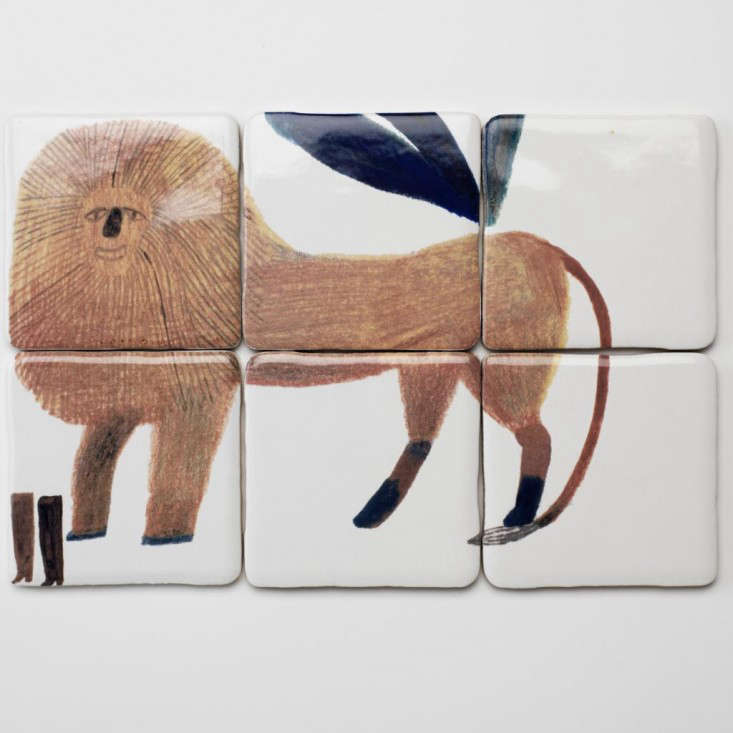
Some decorative objects tiptoe into a room. Laura Carlin’s Lion Tiles do not exactly tiptoe. They pad in quietly, swish a painted tail, and somehow make the wall feel more intelligent. This six-tile ceramic composition turns a lion into a gentle, slightly mysterious character: part animal illustration, part handmade design object, part tiny mural with excellent manners.
At first glance, the work seems simple: six square tiles arranged in a two-by-three grid, each carrying a fragment of a lion illustration. But the charm sits in the details. The lion is not trying to be a fierce safari cliché. It is softer, stranger, funnier, and more poetic than that. The mane has a radiating texture. The body stretches across the tiles with a storybook calm. A dark leafy shape or wing-like accent gives the composition a graphic spark. The result is a decorative tile set that feels equally at home in a design-conscious kitchen, a hallway gallery wall, a child’s reading nook, or a room that desperately needs one object with personality.
Laura Carlin is known for moving fluently between illustration and ceramics. Her work often carries the storytelling rhythm of children’s books, the looseness of hand drawing, and the permanence of clay. With the Lion Tiles, that mix becomes especially appealing: the piece has the friendly presence of an illustration but the tactile authority of ceramic art. In other words, it can look whimsical without looking disposable. That is harder than it sounds. Many objects try to be charming; some of them end up looking as if they were designed by a committee after too much decaf. Carlin’s tiles avoid that fate entirely.
What Are Laura Carlin’s Lion Tiles?
Laura Carlin’s Lion Tiles are a set of six decorative earthenware tiles, each measuring about 10 cm by 10 cm. When placed together, the tiles form a single lion image taken from Carlin’s larger animal mural. The illustrations are applied with decal drawings, giving the piece a clean ceramic surface while preserving the expressive character of the original artwork.
The format is important. This is not one printed picture pretending to be tile art. It is an image broken across individual ceramic squares, and those divisions become part of the design. The grout lines, spacing, and slight separations invite the eye to reassemble the animal. The viewer becomes a small participant in the artwork, connecting mane to body, body to tail, and tail to the final flick of movement.
The set has been described as suitable for framing or for use within a larger tile installation. That flexibility is one reason the Lion Tiles attract attention. They are small enough to function like a framed artwork, yet architectural enough to belong on a wall, splashback, or custom tile feature. They sit in the sweet spot between collectible ceramic and interior design detail.
Who Is Laura Carlin?
Laura Carlin is a London-based illustrator and ceramicist whose work has earned major recognition in illustration and children’s book art. Her career includes awards and honors such as the Bologna Ragazzi Award, the V&A Illustrated Book Award, the Quentin Blake Prize, and recognition from the Art Directors Club. She has also been associated with acclaimed publishing, editorial, and cultural projects, illustrating books and working with notable clients and institutions.
What makes Carlin especially interesting is not simply that she illustrates well or makes ceramics well. It is that she understands how images behave differently when they move from paper to clay. A drawing on a page is intimate. A tile on a wall is public, durable, and physical. A ceramic mural can ask to be read slowly, tile by tile, almost like a comic strip that decided to become part of the building.
Carlin’s larger ceramic projects show this fascination clearly. Her work includes large tile murals, animal compositions, plates, figures, and narrative ceramic installations. Her famous History of London mural, made from hundreds of individual tiles, demonstrates her interest in using ceramics as a storytelling surface. The Lion Tiles belong to this same family of thinking: animals, narrative, humor, and hand-drawn imperfection made permanent in clay.
Why the Lion Tiles Feel So Distinctive
A Lion Without the Usual Roar
Lions in decor often arrive with a lot of visual baggage. They can look royal, aggressive, heraldic, or a bit like they are guarding a bank from 1897. Carlin’s lion takes another route. It is calm, observant, and faintly odd in the best way. The animal has character rather than bravado. Its mane is expressive, its body is elongated, and its presence is more curious than commanding.
This gives the piece a rare emotional tone. It can appeal to adults who appreciate contemporary craft, but it also has the warmth and readability of children’s illustration. That does not mean it is childish. Rather, it keeps the imaginative openness that many adults secretly want in their homes but are afraid to admit while buying yet another beige throw pillow.
The Power of the Six-Tile Grid
The six-tile structure gives the lion a gentle rhythm. The animal is stretched horizontally, but the grid interrupts the image in a way that makes it more engaging. Each tile becomes a small scene, and together they create the full character. This is a classic strength of tile murals: the surface is both one image and many objects.
That modular quality makes the Lion Tiles more dynamic than a flat print. The edges, joints, and ceramic thickness give the artwork a physical presence. Light catches the surface. Shadows form around the tile edges. The wall gains texture. Even a small set can make a space feel more carefully considered.
Illustration That Still Looks Handmade
Carlin’s visual language often celebrates the irregularities of drawing. The lion does not need airbrushed fur or hyperrealistic anatomy. Its appeal comes from line, gesture, texture, proportion, and personality. The image feels as if it came from a sketchbook, wandered into a ceramics studio, and decided to stay.
That handmade quality matters in modern interiors. Many homes are filled with mass-produced surfaces that look clean but emotionally blank. A tile set like this introduces evidence of a human hand. It says: someone drew this, someone imagined this creature, and someone cared about how it would live on a wall.
How Laura Carlin’s Lion Tiles Fit Into Ceramic Storytelling
Ceramics have carried stories for thousands of years. Ancient vessels, decorative plates, wall tiles, and architectural ceramics often preserved myths, daily life, symbols, and cultural memory. Carlin’s work updates that tradition with a modern illustrator’s eye. Instead of grand mythological drama, she gives us animals, city scenes, people, playful details, and small narrative fragments.
The Lion Tiles are especially effective because they do not over-explain themselves. There is no caption telling the viewer what to think. The lion simply exists. Is it walking? Resting? Escaping a larger animal mural for a solo career? The ambiguity is part of the pleasure. Good decorative art leaves room for the viewer to enter the scene.
In a larger tile installation, the lion can become one character among many. As a framed six-tile work, it becomes a focused portrait. That dual identity is useful for collectors and decorators alike. The piece can be treated as art, surface, pattern, or narrative object, depending on the space.
Design Ideas for Displaying Laura Carlin’s Lion Tiles
Frame Them Like Artwork
One of the easiest ways to display the Lion Tiles is to frame the set as a single piece. A simple shadow-box frame can emphasize the ceramic depth while protecting the edges. This approach works well for renters, collectors, or anyone who likes tile art but does not want to commit to grout, adhesive, and the kind of home project that begins on Saturday and somehow ends in emotional negotiations with a hardware store employee.
Framing also makes the lion portable. It can move from a hallway to a bedroom, from a child’s room to a studio wall, or from one home to another. Because the artwork is small but visually memorable, it can hold its own in a gallery-style arrangement alongside prints, small paintings, or other ceramics.
Use Them as a Feature in a Kitchen or Pantry
A compact decorative tile set can add personality to a kitchen without overwhelming the entire backsplash. The Lion Tiles could work as a small feature above a counter, near open shelving, or within a field of plain white, cream, or handmade-look tiles. The surrounding neutral tiles would let the lion remain the star.
For a kitchen, placement matters. Decorative art tiles should be considered carefully in splash zones, high-heat areas, or places that need aggressive cleaning. A protected area or framed installation may be better than a heavy-duty cooking zone. The goal is to enjoy the lion, not subject it to tomato sauce warfare.
Add Character to a Bathroom or Powder Room
Small rooms are excellent places for expressive design. A powder room, guest bathroom, or cloakroom can handle a surprising amount of personality because people spend short bursts of time there. A six-tile lion panel can become a delightful focal point above a sink, beside a mirror, or on a narrow wall.
The softness of Carlin’s illustration works especially well against handmade textures, warm whites, muted greens, dark blues, natural wood, and brass fittings. The lion brings warmth without turning the room into a theme park. Nobody needs a bathroom that screams “jungle adventure” unless there is also a ticket booth.
Pair Them With Books, Plants, and Objects
Because Laura Carlin’s work has strong ties to illustration and storytelling, the Lion Tiles pair beautifully with bookshelves, reading corners, and creative studios. Place the framed set near illustrated books, ceramic vessels, or leafy plants, and the lion suddenly feels like part of a quiet domestic narrative.
The design also works well with natural materials: oak, linen, handmade paper, matte paint, and clay objects. The key is not to over-style. Let the tiles breathe. A lion may be king of the jungle, but even a king needs negative space.
Why Collectors and Design Lovers Notice These Tiles
Several qualities make Laura Carlin’s Lion Tiles appealing to collectors. First, they connect directly to a known artist with a distinctive cross-disciplinary practice. Second, they represent a specific strand of contemporary craft where illustration, ceramics, and interior design overlap. Third, they are compact enough to collect without requiring a mansion, a forklift, or a suspiciously generous inheritance.
They also fit the growing appreciation for objects that feel personal and story-rich. In an age of smooth digital sameness, hand-drawn ceramics offer a different kind of value. They show texture, thought, and irregularity. They remind us that rooms do not have to be perfect to be beautiful. In fact, a little oddness often makes a room more alive.
The Lion Tiles also benefit from being part of Carlin’s broader animal-tile language. Her animal murals include a range of creatures rendered with humor and tenderness. The lion set can stand alone, but it also hints at a larger world. That sense of a bigger imagined environment makes the work feel richer than a one-off decorative motif.
What Makes the Lion Motif Work So Well?
The lion is one of the most recognizable animals in visual culture. It can symbolize courage, power, protection, royalty, wilderness, and storytelling. Carlin’s version gently softens those associations. The lion is still important, but it is not pompous. It looks like it might have opinions, but it probably expresses them politely.
This balance is what makes the piece so usable in interiors. A hyperdramatic lion can dominate a room. A cartoonish lion can feel too young. Carlin’s lion sits between those extremes. It is poetic, artistic, and approachable. It has enough sophistication for adult spaces and enough warmth for family rooms.
The color palette also helps. The warm browns, cream background, and dark accent shapes are easy to integrate into many interiors. The tiles can work with modern, rustic, eclectic, Scandinavian, cottage, or arts-and-crafts-inspired spaces. They bring character without demanding that every other object in the room audition for a wildlife documentary.
Buying and Authenticity Considerations
Because availability can change over time, anyone interested in Laura Carlin’s Lion Tiles should treat old product pages as historical references rather than guaranteed current listings. Earlier descriptions identify the set as six decorative earthenware tiles connected to Carlin’s larger animal mural. If purchasing, buyers should verify condition, dimensions, provenance, and whether the tiles are original, commissioned, vintage stock, or part of a later release.
For secondary-market purchases, ask for clear photographs of the front, back, edges, and any marks or documentation. Small chips, crazing, or surface wear may matter differently depending on whether the tiles will be framed, displayed, or installed. If the set is intended for an architectural installation, consult a professional installer before committing. Art tiles are not always the same as standard field tiles, and decorative value should not be confused with technical suitability for every wet or high-traffic location.
Care Tips for Decorative Ceramic Tiles
Decorative ceramic tiles are generally durable, but art tiles deserve thoughtful handling. Dust framed tiles gently with a soft cloth. Avoid harsh chemicals, abrasive pads, and acidic cleaners unless the maker or installer specifically recommends them. If installed, pay attention to grout maintenance and moisture exposure, especially in kitchens or bathrooms.
When in doubt, choose the least dramatic cleaning method first. A lion tile does not need a chemical thunderstorm. Gentle care preserves the surface, the image, and the quiet handmade quality that makes the piece special.
Experiences With Laura Carlin’s Lion Tiles
Living with a small ceramic artwork like Laura Carlin’s Lion Tiles is different from owning a print. A print tends to stay politely behind glass. A tile set has more presence. It catches light during the day, throws tiny shadows at the edges, and reminds you that it is made from earth, heat, drawing, and intention. That combination gives it a grounded feeling, even when the image itself is playful.
One of the most enjoyable experiences is watching how people react to the piece. From a distance, they may see only a simple lion. Up close, they notice the texture of the mane, the spacing between the tiles, the gentle awkwardness of the body, and the way the image crosses from square to square. It invites closer looking. In a home, that is a valuable quality. The best decorative objects do not reveal everything in half a second. They keep a little conversation in reserve.
The Lion Tiles also change depending on placement. In a hallway, they become a small surprise passed several times a day. In a kitchen, they bring warmth to a practical space and soften the seriousness of cabinets, counters, and appliances. In a child’s room, they feel storybook-like without being overly cute. In a studio, they can serve as a reminder that drawing does not have to stay on paper. It can become object, surface, furniture, mural, and memory.
Another pleasing experience comes from the six-part format. The grid gives the viewer a sense of assembly, almost like a puzzle that has already been solved but still shows its thinking. The seams are not flaws. They are part of the rhythm. They slow the eye down. Instead of consuming the image instantly, the viewer reads it in pieces: mane, back, legs, tail, negative space, dark accent. That slow reading is one reason tile art can feel so satisfying.
For homeowners who prefer minimal interiors, the Lion Tiles can introduce personality without visual chaos. For maximalists, they can join a room full of books, textiles, ceramics, and odd treasures without getting lost. The piece is flexible because it has both clarity and eccentricity. It knows what it is: a lion, yes, but also a drawing, a ceramic object, and a small narrative.
Perhaps the best experience is emotional rather than decorative. The tiles carry a feeling of gentle intelligence. They are funny without being silly, artistic without being cold, and charming without begging for attention. In a world full of decor that tries too hard, Laura Carlin’s Lion Tiles succeed by doing something quieter. They simply stand there, lion-shaped and thoughtful, making the room feel a little more human.
Conclusion
Laura Carlin’s Lion Tiles are more than a decorative animal image on ceramic squares. They are a compact example of how illustration can become architecture, how clay can carry personality, and how a small artwork can transform the mood of a room. The six-tile lion has humor, warmth, and craft intelligence. It belongs to Carlin’s broader world of narrative ceramics, where animals, people, cities, and stories move from paper into permanent form.
For collectors, the Lion Tiles offer a memorable connection to a celebrated illustrator and ceramicist. For interior design lovers, they provide a versatile focal point that can be framed, installed, or styled with other handmade objects. For anyone tired of blank walls and overly serious decor, they offer something better: a lion with presence, wit, and just enough mystery to keep the room awake.