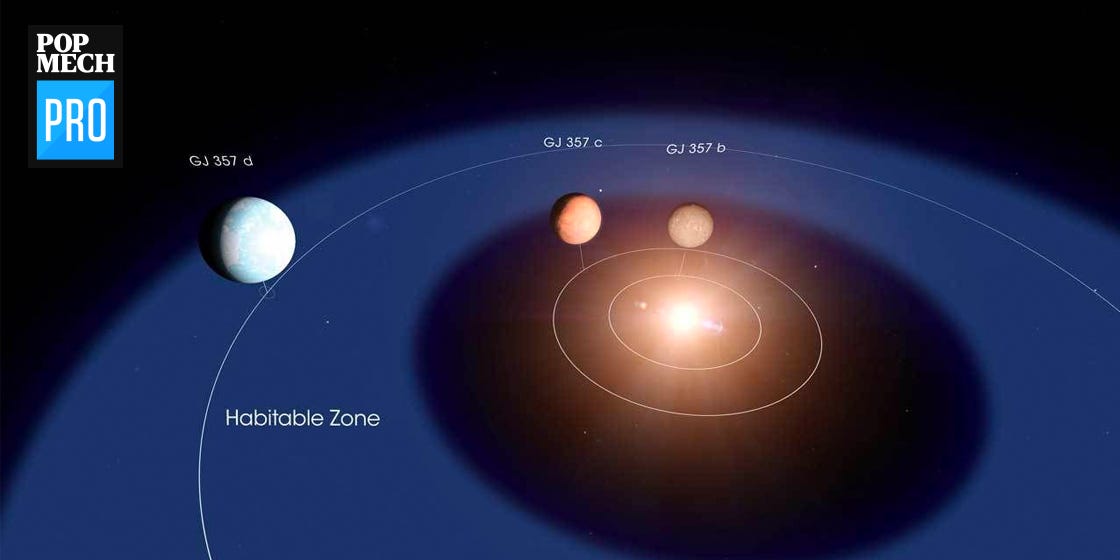
Note: This body-only HTML is ready for copy/paste into a CMS. The headline refers to the GJ 357 system, where NASA’s TESS first found the “hot Earth” GJ 357 b and follow-up observations revealed the more widely discussed outer world GJ 357 d.
Space headlines love a dramatic phrase, and honestly, “Hot Earth” earns its movie-trailer voice-over. It sounds like the name of a summer blockbuster where our planet gets misplaced and replaced with a lava-marinated stunt double. But in real astronomy, the phrase points to something even cooler: a nearby exoplanet system called GJ 357, where NASA’s planet-hunting spacecraft TESS spotted an intensely baked rocky world and helped scientists uncover a second, more tantalizing planet farther out.
That combination is what makes this discovery so sticky. The first catch was not a dreamy blue marble with oceans and weather. It was GJ 357 b, a rocky world so close to its star that nobody is booking beach vacations there unless they enjoy beaches made of regret. Yet by confirming that inner planet, astronomers were able to dig into older ground-based measurements and expose a larger family of worlds around the same star, including GJ 357 d, a planet sitting near the outer edge of the star’s habitable zone.
In other words, the “Hot Earth” was the bait, the clue, and the opening act. The real story is not just that NASA found a planet that sizzles. It is that modern planet hunting now works like detective fiction with very expensive telescopes: one suspicious dip in starlight leads to an entire system, a pile of old evidence suddenly matters, and the case gets stranger the longer you stare at it.
Discovery background and system framing:
What NASA Actually Found in the GJ 357 System
The star at the center of this story, GJ 357, is an M-type dwarf located about 31 light-years away in the constellation Hydra. Compared with the Sun, it is smaller, cooler, and dimmer. That matters because small stars make it easier for telescopes to notice planets. When a planet crosses in front of a petite star, the resulting dip in brightness is easier to detect than it would be around a giant, blazing sun-like star.
In February 2019, TESS saw exactly that kind of dip. Every 3.9 days, the star dimmed just enough to suggest that a planet was passing across its face. That planet became GJ 357 b. NASA described it as a “hot Earth” because it is about 22% larger than Earth, likely rocky, and blasted by so much stellar radiation that its equilibrium temperature is around 490 degrees Fahrenheit (254 degrees Celsius). Translation: fascinating, yes; comfy, no.
But the science got better once astronomers checked older ground-based observations. Using the radial velocity methodwhich tracks tiny stellar wobbles caused by orbiting planetsthey uncovered two more worlds: GJ 357 c and GJ 357 d. The middle planet, GJ 357 c, is at least 3.4 times Earth’s mass and still far too warm to be sold as Earth 2.0. The outer planet, GJ 357 d, orbits every 55.7 days and receives roughly the amount of stellar energy that Mars gets from the Sun. That is why the system quickly graduated from “interesting” to “drop everything and model this.”
Core measurements for GJ 357 b/c/d:
Why the 'Hot Earth' Matters Even If It Is Not Habitable
At first glance, a scorched rocky planet may seem like a scientific consolation prize. It is not. Worlds like GJ 357 b are valuable because they are close, bright, and measurable. In exoplanet research, that is the golden trifecta. The best planets are not always the most hospitable-looking ones. Often, they are the ones astronomers can actually study in detail.
GJ 357 b is especially useful because it transits a nearby red dwarf, making it one of the better rocky targets for future atmospheric work. Even when a planet is too hot for life as we know it, its atmosphereor lack of onecan teach scientists how rocky planets behave under extreme conditions. Does it hold onto gases? Does radiation strip its atmosphere away? Does the chemistry resemble a supercharged version of Venus, or something stranger?
This is where the story becomes bigger than one planet. Hot rocky worlds help astronomers build context. Every time they study one, they get better at telling the difference between a truly Earth-like planet and a world that only looks promising from a distance. Planet hunting is not just about finding “home.” It is about learning which houses are on fire before you start admiring the curtains.
Why hot rocky planets still matter:
How TESS Turned a Tiny Flicker into a Planetary Story
TESS, short for the Transiting Exoplanet Survey Satellite, was built for discoveries exactly like this. Launched in 2018, the MIT-led NASA mission surveys huge portions of the sky, looking for the slight drops in brightness that happen when planets transit in front of nearby stars. Its strength is not just finding exoplanets. It is finding them around bright, relatively nearby stars that can later be studied by other telescopes.
That design explains why GJ 357 became such a compelling target. TESS did not need a giant, obvious signal. It only needed enough evidence to point the astronomical community toward a promising star. Once that happened, archival measurements from observatories in Chile, Hawaii, and elsewhere suddenly became part of the same puzzle. TESS started the conversation; radial velocity data finished the sentence.
This is also why the mission has aged so well. TESS began as the heir to Kepler’s exoplanet legacy, but with a more neighborhood-focused strategy. Instead of staring deeply at a narrower patch of sky, TESS performs an all-sky survey designed to locate worlds that future instruments can probe more closely. As of March 26, 2026, NASA’s Exoplanet Archive lists 6,153 confirmed exoplanets, including 765 confirmed TESS planets and 7,913 TESS project candidates. That is a long way from the early days when one “hot Earth” headline felt like a major event all by itself.
TESS mission design and current archive context:
The Planet Everyone Talked About After the Headline: GJ 357 d
The funny thing about the “Hot Earth” headline is that the hottest planet in the story was not the one that captured most people’s imagination. That honor went to GJ 357 d, the outer world that sits near the star’s habitable zone. Scientists were careful with their wording from the start. They did not declare alien beaches, alien fish, or alien real estate opportunities. They said the planet was especially intriguing.
That caution matters. GJ 357 d’s size is not directly measured from a transit, because TESS did not see it cross the star. Its minimum mass is about 6.1 Earth masses, and if it is rocky, it could be roughly one to two Earth radii. Without an atmosphere, the planet would be brutally cold, with an estimated equilibrium temperature near -64 degrees Fahrenheit (-53 degrees Celsius). With a sufficiently thick atmosphere, however, it might trap enough heat for liquid water to exist at the surface.
This possibility was exciting enough that researchers at Cornell’s Carl Sagan Institute began modeling what the planet might be like, from rocky scenarios to water-world possibilities. That is the sweet spot in exoplanet science: not certainty, but enough evidence to justify serious climate modeling. A promising world does not need to be proven habitable on day one. It only needs to be interesting enough that smart people keep losing sleep over it.
Habitable-zone nuance and early modeling:
Why Scientists Stay Careful About the Word “Habitable”
If there is one rule in exoplanet journalism that deserves to be tattooed on every keyboard, it is this: habitable zone does not mean habitable planet. The habitable zone is a temperature-based estimate, not a guarantee of oceans, weather, biology, or little extraterrestrials inventing jazz. A planet can sit in the “right” zone and still be a frozen rock, a dense mini-Neptune, or a climate disaster with vibes that are less Earth and more cosmic policy failure.
That is exactly why later work on GJ 357 d is so important. In 2023, researchers at the University of California, Riverside, argued that the planet may be more massive than earlier estimates suggestedpossibly as much as 10 Earth masses. If that is true, then GJ 357 d may be less like a scaled-up Earth and more like a world whose gravity and dynamics complicate the very idea of habitability. The same study also warned that its orbital influence could destabilize other Earth-like planets that might otherwise sit in the habitable zone.
That does not erase the original discovery. It improves it. Good science is not a straight line from headline to certainty. It is a long, slightly messy process of narrowing possibilities. GJ 357 d is still important because it shows how astronomers move from hopeful first impressions to more rigorous physical constraints. The dream survives, but it has to survive the math first.
Later caution on GJ 357 d mass and dynamics:
What This Discovery Says About the Future of Exoplanet Hunting
The GJ 357 story demonstrates a bigger truth about astronomy in the TESS era: discoveries increasingly come from layered teamwork. One instrument notices the transit. Another observatory checks the wobble. A research group models the climate. A later team rethinks the orbital stability. The final portrait is built piece by piece, and sometimes the most important result is not a single planet but a whole system of possibilities.
It also shows why nearby stars matter so much. Distant exoplanets can be statistically thrilling, but nearby planets are where the real character studies begin. A star just 31 light-years away is practically local by galactic standards. Nobody is walking there, obviously, unless someone invents a deeply irresponsible travel package. But nearby systems are the ones that future observatories can test for atmospheric composition, temperature structure, and maybe eventually biosignatures.
So while the “Hot Earth” label sounds flashy, the deeper lesson is patient and technical. TESS is not merely finding planets. It is building the shortlist for the next generation of exoplanet science. Every rocky world around a bright nearby star becomes part of a larger scouting report for telescopes that will ask harder questions.
Broader mission significance:
Experiences Related to “NASA Exoplanet Hunter Finds 'Hot Earth'”
One of the most fascinating human experiences tied to stories like this is how quickly they reshape our sense of distance. On paper, 31 light-years is unimaginably far. In conversation, though, GJ 357 starts to feel weirdly close. Astronomers call it nearby. Journalists call it our cosmic neighborhood. Readers start treating the system like it is a few exits down the highway, albeit with dramatically worse parking. That emotional shrinking of distance is part of what makes exoplanet discoveries so powerful. They take a cold number and turn it into a place that feels almost reachable.
There is also the experience of scientific suspense. Most people encounter planets in school as complete facts: Earth exists, Mars is red, Jupiter is big, Pluto has been through a branding crisis. Exoplanet science is different. You get to watch the uncertainty in real time. First there is a dimming signal. Then a candidate. Then a confirmation. Then extra planets emerge from older data. Then modelers step in. Then years later someone says, “Actually, this world may be heavier and less friendly than we hoped.” That process can feel less like memorizing science and more like following a slow-burn mystery series with better lighting and fewer car chases.
For researchers, the experience is even more intense. A discovery like GJ 357 is not one dramatic telescope moment followed by applause and sandwiches. It is long stretches of data work, collaboration, rechecking, instrument comparison, and careful wording. Scientists have to balance excitement with restraint. They know the public wants the phrase “Earth-like,” but they also know that one sloppy adjective can start a decade of misunderstanding. In that sense, the experience of exoplanet research is equal parts wonder and self-discipline.
There is also something deeply relatable in the way one small clue can change the value of old information. TESS saw a transit, and suddenly years of archived radial-velocity observations became newly useful. That mirrors a very human experience: sometimes a single fresh insight makes old notes, old memories, or old evidence snap into focus. The data were there. The story was notuntil the right question arrived.
For everyday readers and skywatchers, discoveries like this often create a quiet emotional effect that is harder to describe. They remind us that Earth is not the template by default. Rocky planets can be scorched, frozen, oversized, stripped, cloaked, tilted, or dynamically chaotic. Our solar system starts to feel less like the normal setup and more like one arrangement among many. That realization can be humbling in the best way. It lowers the ego and raises the curiosity.
And then there is the strange joy of naming. “GJ 357 b” sounds like a password you would forget in twelve seconds, not a world. Yet over time these labels gather personality. GJ 357 b becomes the “hot Earth.” GJ 357 d becomes the maybe-habitable outer sibling. Scientists, writers, and readers all perform a small act of imagination by turning catalog entries into places. The names stay technical, but the worlds start to feel real.
Finally, the story offers a modern experience of hope that is grounded rather than gushy. Nobody credible says GJ 357 d definitely has life. Nobody serious pretends GJ 357 b is an alien vacation destination. The hope comes from something subtler: our tools keep improving, our questions keep sharpening, and a small dimming event in a nearby star can now reveal an entire planetary family. That is the real thrill behind “NASA Exoplanet Hunter Finds ‘Hot Earth.’” Not that we found a second Earth overnight, but that we are getting bettermeasurably, steadily, thrillingly betterat finding out what is really out there.
Extended reflective section grounded in measured facts and mission context:
Conclusion
“NASA Exoplanet Hunter Finds ‘Hot Earth’” works as a headline because it is punchy, but the real science is richer than the slogan. TESS first found GJ 357 b, a blistering rocky planet hugging its small star. That discovery then opened the door to GJ 357 c and GJ 357 d, the last of which sparked genuine interest because it sits near the habitable zone and may, under the right conditions, support surface liquid water.
The bigger takeaway is that exoplanet science has matured into a layered search for context, not just trophies. Hot worlds matter. Borderline worlds matter. Doubt matters. Reanalysis matters. And as TESS continues its extended mission, the discovery of one scorched little planet still serves as a perfect reminder that sometimes the hottest object in the room is merely the clue that leads you to the truly interesting one.
Wrap-up and current mission relevance: